INTEGRATED SHIELD PLANS
What Is MediShield Life Singapore?
2026 Beginner’s Guide — How It Works, Who’s Covered & What’s Changed
MediShield Life is Singapore’s mandatory national health insurance scheme, covering every Citizen and Permanent Resident from birth — including those with pre-existing conditions. It is administered by the CPF Board, funded by annual premiums paid from your MediSave account, and designed to protect you against large hospital bills at subsidised wards in public hospitals. It is not optional: you cannot opt out.
Not financial advice. All figures are for educational reference only. Data as at September 2026 unless noted.
- MediShield Life is compulsory for all Singapore Citizens and PRs — premiums are paid automatically from MediSave.
- It covers large bills primarily at subsidised Class B2/C wards. For higher wards or private hospitals, you need an Integrated Shield Plan (ISP).
- From 1 June 2026, the annual claim limit is $200,000 with no lifetime cap. New outpatient deductibles also apply.
Table of Contents
- What Is MediShield Life?
- How Does MediShield Life Work?
- Who Is Covered?
- How Are Premiums Calculated?
- What Does MediShield Life Cover?
- Key 2026 Changes
- MediShield Life vs Integrated Shield Plans
- How to Pay Your Premiums
- How to Make a Claim
- Frequently Asked Questions
What Is MediShield Life?
MediShield Life is Singapore’s national health insurance scheme, launched on 1 November 2015. It replaced the old MediShield scheme and introduced two major improvements: coverage is lifelong (you cannot age out of it), and pre-existing conditions are included (with a higher premium loading in the first few years).
The scheme is administered by the CPF Board — not by a private insurer. Every Singapore Citizen and Permanent Resident is automatically enrolled from birth. You pay annual premiums from your MediSave account, and in return, the scheme covers a portion of your hospital bills and selected outpatient treatments when you need them.
It’s important to understand what MediShield Life is designed for: it calibrates its claim limits to cover nine in ten subsidised bills at Class B2/C wards in public hospitals. If you want coverage for higher-class wards (B1, A) or private hospitals, you need an Integrated Shield Plan (ISP) on top.
How Does MediShield Life Work?
When you’re hospitalised at a public hospital, your bill goes through three layers before you know what you owe out of pocket:
Layer 1 — Claim Limits
MediShield Life has published claim limits for each type of treatment — daily ward charges, surgical procedures, outpatient treatments, and so on. Only the portion of your bill within these limits is “claimable”. Any amount above the limits must be paid out of pocket or through your ISP.
Layer 2 — The Deductible
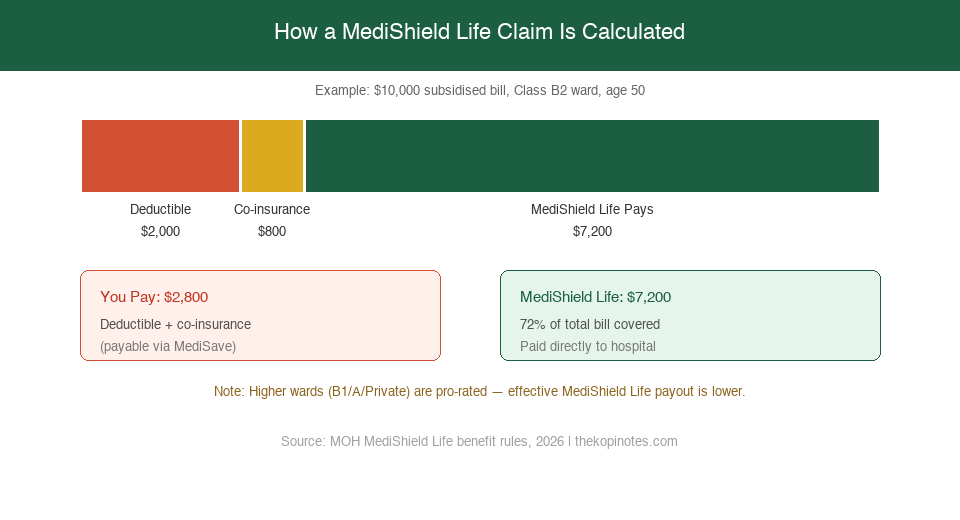
Before MediShield Life pays anything, you must first cover a fixed deductible. This applies once per policy year — so if you’re hospitalised twice in the same year, you only pay the deductible on your first admission.
In 2026, the inpatient deductible is:
| Ward Class | Deductible (Age ≤80) |
|---|---|
| Class C ward | $1,500 |
| Class B2 and above | $2,000 |
Source: MOH MediShield Life Benefits, Phase 1 enhancement from 1 April 2025. Phase 2 increase takes effect 1 April 2027.
Policyholders above age 80 pay higher deductibles. You can pay the deductible using your MediSave account.
Layer 3 — Co-Insurance
After the deductible, MediShield Life pays most of the remaining claimable bill — but not all of it. You still pay a percentage called co-insurance:
| Claimable Amount Tier | Your Co-Insurance |
|---|---|
| First portion of claimable amount | 10% |
| Middle portion | 5% |
| Higher portion | 3% |
Source: CPF Board MediShield Life co-insurance structure, 2026.
The tiered structure means that for a very large bill, your share gets proportionally smaller. MediShield Life picks up a bigger and bigger fraction as costs rise — protecting you from truly catastrophic expenses.
Who Is Covered by MediShield Life?
Coverage is automatic and mandatory. You’re enrolled from:
- Birth — all Singapore Citizen babies are enrolled at birth
- Grant of PR status — PRs are enrolled when status is granted
- Grant of citizenship — new Citizens are enrolled upon citizenship
For Singaporeans with pre-existing conditions (such as diabetes, hypertension, or heart disease), MediShield Life still covers you — but an Additional Premium applies for the first 10 years of coverage. After that, you pay the same standard premium as everyone else in your age band.
There is no age limit. Unlike private insurance, you cannot lose your MediShield Life coverage because you’re too old or too sick. It truly is coverage for life. You can check more about whether it’s compulsory and how to manage your coverage here.
How Are MediShield Life Premiums Calculated?
Your annual MediShield Life premium depends on your age. The older you are, the higher the premium — this is called age-banded pricing. Premiums are reviewed periodically by the MediShield Life Council.
To keep premiums affordable, the government provides subsidies for lower-income households and special schemes for Pioneer and Merdeka Generation seniors:
- Pioneer Generation (born on or before 31 Dec 1949): receive a subsidy of 40–60% off their annual premium, plus an annual Medisave top-up
- Merdeka Generation (born 1 Jan 1950 to 31 Dec 1959): receive a 25% premium discount plus $200/year Medisave top-up
- Singaporeans on means-tested subsidies: additional premium support from MediFund or other assistance schemes
All premiums are paid automatically from your MediSave account each January. You don’t need to do anything — the CPF Board deducts it directly. See TKN’s full MediShield Life premium table by age band for the exact amounts.
What Does MediShield Life Cover?
MediShield Life covers two broad categories: inpatient/day surgery and selected outpatient treatments.
For inpatient stays, key limits from 1 June 2026 include:
- Normal ward: up to $830/day (plus $800 extra for the first 2 days)
- Intensive Care Unit: up to $5,140/day
- Implants: up to $7,000 per treatment
For outpatient treatments, only specific high-cost therapies are covered — not routine GP or specialist visits:
- Cancer drug treatment: $200–$12,800/month (depending on the drug)
- Kidney dialysis: $1,750/month
- Radiotherapy: $400–$15,700 per treatment (varies by type)
- Immunosuppressants (post-organ transplant): $710/month
For the complete list of claim limits across all treatment categories, see the full MediShield Life benefits guide for 2026.
What MediShield Life does NOT cover: dental treatment, cosmetic surgery, fertility treatments (except iatrogenic infertility cases from June 2026), routine maternity, overseas treatment, ambulance fees, and medical equipment purchases.
Key 2026 Changes to MediShield Life
The most significant enhancements to MediShield Life in recent memory took effect on 1 June 2026, following the MediShield Life Council’s review:
- Higher annual claim limit: Raised to $200,000 per policy year (up from previous limits)
- Higher ward limits: Normal ward up to $830/day; ICU up to $5,140/day
- New outpatient deductible: A $500/year deductible now applies to covered outpatient treatments (e.g. dialysis, cancer drug therapy). This can be paid from MediSave. Inpatient deductible paid counts towards the outpatient cap too.
- Expanded coverage: Fertility preservation for patients facing iatrogenic infertility (e.g. from cancer treatment) is now covered
- Higher outpatient claim limits: Kidney dialysis up from $1,100 to $1,750/month; cancer drug services up from previous limits
Separately, ISP rider rules changed on 1 April 2026: new riders can no longer cover the MOH minimum deductible, and the co-payment cap on new riders is at least $6,000/year. However, new rider premiums are around 30% lower than before. Riders bought before 27 November 2025 are grandfathered — do not switch unnecessarily.
MediShield Life vs Integrated Shield Plans (ISPs)
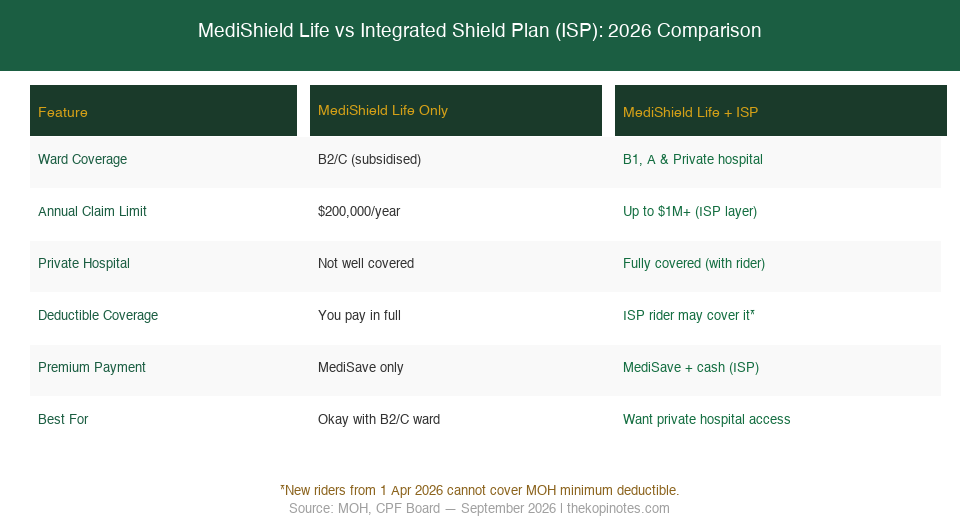
MediShield Life is the foundation layer. An Integrated Shield Plan (ISP) sits on top of it and covers the gap between MediShield Life payouts and your actual bill — especially for higher-class wards or private hospitals.
There are seven ISP insurers approved by MOH: AIA, Great Eastern, HSBC Life, NTUC Income, Prudential, Raffles Health Insurance, and Singlife. Each ISP includes the MediShield Life component (paid to CPF Board) plus a private insurance component (paid to the insurer).
After the April 2026 reforms, ISP riders no longer cover the minimum deductible set by MOH. This means even with a rider, you’ll pay at least $1,500–$2,000 as a deductible per admission. The trade-off: rider premiums dropped by around 30%. See our review of PRUShield as an example of how an ISP works in practice.
How to Pay MediShield Life Premiums
You don’t need to actively pay. The CPF Board automatically deducts your annual MediShield Life premium from your MediSave account each January. You’ll receive an annual premium notice by post or through cpf.gov.sg.
If your MediSave balance is insufficient (e.g. you’re self-employed and haven’t contributed enough), you’ll need to top it up or arrange a cash payment. Under the Flexi-MediSave scheme, those aged 65 and above can withdraw up to $200/month from their MediSave for approved outpatient treatments at participating clinics.
How to Make a MediShield Life Claim
In most cases, the process is automatic. You don’t submit a claim yourself.
- Inform the hospital at registration that you’re claiming MediShield Life (and ISP, if you have one).
- Receive your treatment — the hospital submits the claim to CPF Board on your behalf.
- CPF Board assesses and pays the hospital directly for the MediShield Life portion.
- You pay the balance — your deductible, co-insurance, and any amounts above claim limits — using MediSave or cash at discharge.
If you paid your bill in full (e.g. at a clinic that doesn’t auto-submit), log in to cpf.gov.sg or the CPF Mobile app and submit a claim under the Healthcare section within 12 months of your treatment date.
Frequently Asked Questions
What is MediShield Life in simple terms?
MediShield Life is Singapore’s government-run health insurance scheme. Every Citizen and PR is automatically enrolled — you can’t opt out. Each year, premiums are deducted from your MediSave account. When you’re hospitalised or need certain expensive outpatient treatments, MediShield Life pays a portion of your bill directly to the hospital. You’re responsible for the deductible and co-insurance.
Is MediShield Life the same as Medisave?
No — they’re different parts of Singapore’s healthcare financing system. MediSave is your personal healthcare savings account (part of CPF). MediShield Life is an insurance scheme that uses money from your MediSave to pay premiums. When you have a hospital bill, you can use MediSave to pay your share (deductible + co-insurance), while MediShield Life pays the insured portion to the hospital.
What ward class does MediShield Life cover?
MediShield Life is calibrated for Class B2 and C wards at public hospitals, where government subsidies already lower your bill. If you choose a B1, A, or private hospital ward, your bill is pro-rated to the B2/C equivalent before MediShield Life applies its limits. This means MediShield Life covers a smaller fraction of your actual private-ward bill. An Integrated Shield Plan (ISP) bridges this gap.
What is the 2026 MediShield Life deductible?
For inpatient claims in 2026, the deductible is $1,500 (Class C ward) or $2,000 (Class B2 and above) for policyholders aged 80 and below. Older policyholders pay higher deductibles. From 1 June 2026, a new $500/year outpatient deductible also applies to covered outpatient treatments like dialysis and cancer drug therapy. Both deductibles can be paid from MediSave.
Does MediShield Life cover pre-existing conditions?
Yes — this is one of the key improvements MediShield Life made over the old MediShield scheme. All Citizens and PRs are covered regardless of pre-existing conditions. However, if you have a pre-existing condition, you’ll pay an Additional Premium for the first 10 years of coverage, after which your premium reverts to the standard rate. Claims related to pre-existing conditions are still covered throughout this period.
How is MediShield Life different from an Integrated Shield Plan?
MediShield Life is the mandatory base layer — run by the government, covering B2/C wards, with a $200,000 annual claim limit. An Integrated Shield Plan (ISP) is a private insurance add-on that sits on top. It covers the same B2/C ward claims (so you don’t double-pay), plus the additional coverage for higher wards or private hospitals. ISP premiums include a MediShield Life component (to CPF Board) and a private component (to the insurer). You need an ISP only if you want more than basic B2/C coverage.
What changed with the April 2026 ISP rider reforms?
From 1 April 2026, new ISP riders can no longer cover the minimum deductible set by MOH (i.e. $1,500 or $2,000 depending on ward). Even with a rider, you will pay the deductible yourself at each new policy year. Additionally, the minimum co-payment cap for new riders is $6,000 per year. In exchange, premiums on new riders are approximately 30% lower. Riders purchased before 27 November 2025 are grandfathered and keep their old benefits — it’s generally not worth switching unless your premium is significantly different.
Get Free Insurance Advice
Speak with a licensed insurance advisor. No obligation, no cost.
By submitting this form, you agree to our Privacy Policy.
This article was researched with the help of AI. While we strive to keep all information accurate and up to date, there may be errors. If you notice any discrepancies, please contact us.