Integrated Shield Plans 2026: How Much Premiums Rise by Age (And What to Do About It)
An Integrated Shield Plan (ISP) tops up your MediShield Life to cover Class A, B1, or private hospital wards. All seven MOH-approved insurers — AIA, Great Eastern, HSBC Life, Income, Prudential, Raffles, and Singlife — tie premiums to your age. By the time you reach 60, your base plan premium can be three times what you paid at 30. From April 2026, rider rules changed too. Here is exactly what to expect at each life stage — and how to plan ahead.
Not financial advice. All figures are for educational reference only. Data verified as at 1 September 2026.
- ISP base premiums roughly triple between age 30 and 60 — private hospital plans go from ~S$600–750/year to S$2,000–2,500/year
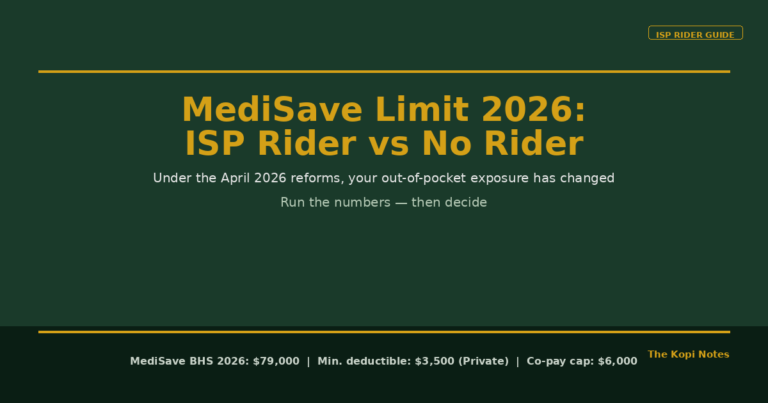
- From 1 April 2026, new riders no longer cover the deductible; you bear up to S$3,500 deductible + 5% co-pay (capped at S$6,000/year)
- MediSave covers base ISP premiums but NOT rider premiums — riders must be paid in cash
- Review your plan every 5–10 years; downgrading your ward tier in your 50s can save thousands annually
What Is an Integrated Shield Plan?
MediShield Life covers Class B2 and C ward stays in public hospitals. Every Singapore Citizen and Permanent Resident is automatically covered. An ISP layers additional private insurance on top — extending your protection to Class B1, Class A, or private hospital wards.
You pay for the base ISP plan using MediSave. Rider premiums — which reduce your deductible and co-payment — must be paid in cash. There are seven MOH-approved ISP insurers: AIA, Great Eastern, HSBC Life, Income Insurance, Prudential, Raffles Health Insurance, and Singlife.
Each offers multiple tiers. The higher your ward-class target, the higher the premium. And the steeper the age-related increase. Understanding this curve early is the single most important thing you can do for your healthcare budget.
For how MediSave and ISP claims interact after the 2026 rule changes, see: MediSave hospitalisation 2026: claim limits and rider changes explained.
Why ISP Premiums Rise With Age
ISPs use “age next birthday” (ANB) pricing. Your premium steps up every year because statistical hospitalisation risk increases with age. The curve is particularly steep in Singapore — and it catches policyholders off guard.
In your 30s, the annual premium feels manageable. You might pay S$600–750 for a private hospital plan. That is easy to fund from MediSave, with a small cash top-up for the rider.
By your 50s, the same plan costs S$1,500–2,000 per year just for the base plan. Your rider premium (cash-only since April 2026) adds another S$400–1,000. By 70, total ISP costs for a comprehensive private plan can exceed S$8,000–10,000 per year.
This is why reviewing your ISP in your 40s — before the big jump — is critical. Many policyholders wait until premiums become painful. By then, switching options are more limited due to underwriting requirements.
See also: ISP rider changes 2026: what changed, what you now pay and what to do.
ISP Premium by Age: What the Major Plans Cost (2026)
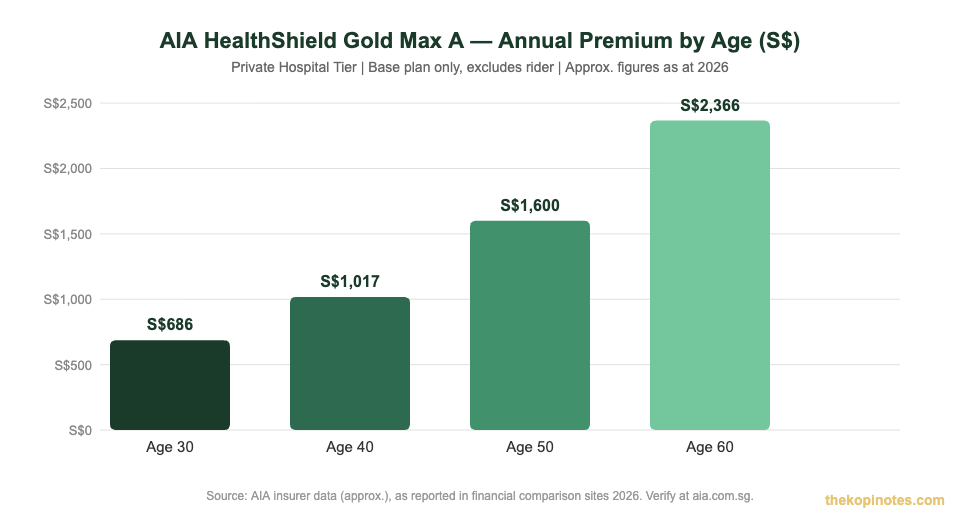
The table below shows approximate annual base plan premiums for private hospital-tier ISPs by age. These exclude the MediShield Life component and any rider premiums. Figures are for Singapore Citizens and are approximate — verify directly with each insurer.
| Plan (Private Hospital Tier) | Age 30 | Age 40 | Age 50 | Age 60 |
|---|---|---|---|---|
| AIA HealthShield Gold Max A | ~S$686 | ~S$1,017 | ~S$1,600 | ~S$2,366 |
| Income Enhanced IncomeShield Preferred | ~S$595 | ~S$850 | ~S$1,350 | ~S$1,900 |
| Prudential PRUShield Premier | ~S$750 | ~S$1,080 | ~S$1,650 | ~S$2,400 |
| Great Eastern SupremeHealth P Plus | ~S$700 | ~S$1,000 | ~S$1,550 | ~S$2,200 |
Source: AIA figures (~S$686 age 30, ~S$2,366 age 60) cited in ShopBack and financial comparison sites, 2026. Income ~S$595 at age 30 cited in multiple comparison publications 2026. Other figures are approximate ranges based on published insurer data. Verify current premiums at each insurer’s website. MOH ISP plan list as at 1 June 2026.
The April 2026 Rider Changes Explained
From 1 April 2026, MOH introduced new requirements for ISP riders. If you bought a new rider on or after this date, the rules are fundamentally different. If you bought your old rider before 27 November 2025, you are grandfathered — but only until your first renewal after 1 April 2028.
Here is what changed, directly from MOH’s official announcement:
| Feature | Old Rider (before Apr 2026) | New Rider (from Apr 2026) |
|---|---|---|
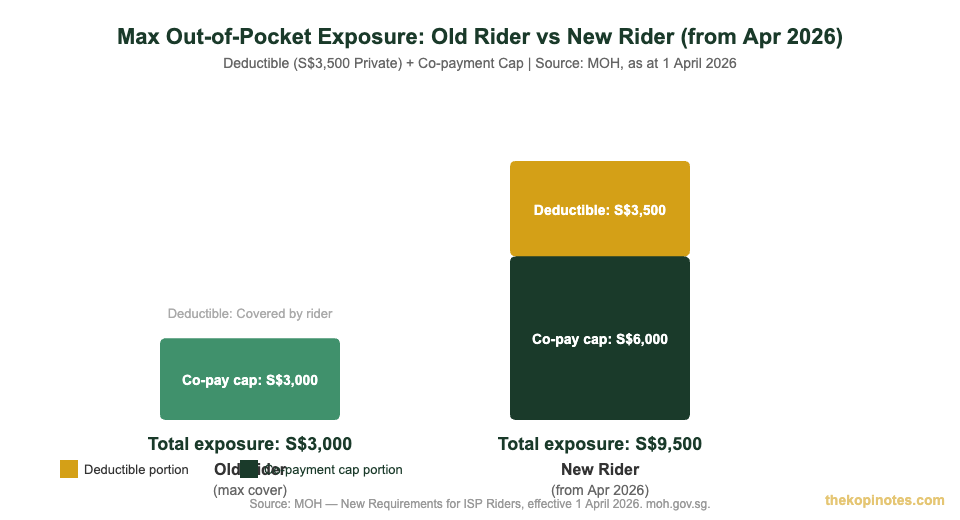
| Deductible coverage | Covered by rider | NOT covered — you pay |
| Deductible amount (Private ward) | S$3,500 | S$3,500 (unchanged) |
| Deductible (B1 ward) | S$2,500 | S$2,500 (unchanged) |
| Co-payment | Min 5% of bill | Min 5% of bill (unchanged) |
| Co-payment annual cap | S$3,000/year | S$6,000/year (doubled) |
| Estimated rider premium | Higher (full coverage) | ~30% lower on average |
| MediSave for deductible? | Yes (within limits) | Yes (within limits) |
Source: MOH — New Requirements for Integrated Shield Plan Riders, effective 1 April 2026. moh.gov.sg. Deductible amounts from MOH ISP framework.
The practical effect: for a private hospital admission, your maximum out-of-pocket exposure under a new rider is S$3,500 (deductible) + up to S$6,000 (co-pay cap) = up to S$9,500 per year. Under the old rider, that was covered by your rider (you paid only your rider premium).
The upside: new rider premiums are on average 30% lower than the old full-coverage riders. The trade-off is you absorb more risk per admission.
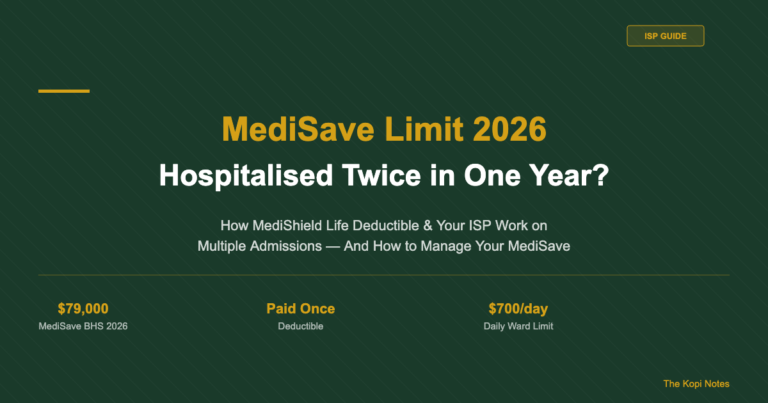
Both the deductible and co-payment can be paid from MediSave, subject to prevailing withdrawal limits. This is crucial — your MediSave acts as a buffer even under the new rules.
Can MediSave Pay Your ISP Premiums?
Yes — for the base plan. MediSave can cover your ISP base plan premium up to CPF Board’s annual Medisave Additional Withdrawal Limit (AWL) for IPs. The AWL varies by age: older policyholders get a higher MediSave allowance because their premiums are higher.
Rider premiums are different. These must be paid in cash. There is no MediSave top-up for riders. This is a common misunderstanding — many people assume MediSave covers their entire ISP bill. It covers only the base plan.
For the exact 2026 AWL amounts by age, check with CPF Board’s official MediSave withdrawal guide. The limits are updated periodically and vary depending on your plan tier and age.
One thing that does not change: both your deductible and co-payment can be paid from MediSave (on top of the premium withdrawal). So even though the new rider rules mean you now absorb the deductible yourself, you can still use MediSave to settle it at the hospital — as long as you have enough balance.
If you are building your long-term retirement plan and want to understand how MediSave fits alongside CPF LIFE and other savings, use our Singapore retirement planning calculator to model your projected healthcare budget.
How to Manage Rising ISP Costs Over Time
Rising ISP premiums are real — but they are manageable with the right approach. Here are the key strategies to consider:
1. Review your plan in your early 40s. This is the window before premiums jump sharply. At 40–45, you can still switch plans or ward tiers without paying dramatically higher premiums. After 50, re-underwriting requirements may limit your options if you have new health conditions.
2. Consider downgrading your ward tier. If you bought a private hospital plan in your 30s but find the premiums unsustainable at 55, switching to a Class A plan can cut your base premium by 30–50%. You still get better-than-B2/C coverage, but at a lower cost. For the best Class A ward options, see: best Class A ward Integrated Shield Plans 2026.
3. Reassess your rider. Under the new 2026 rules, new riders are about 30% cheaper than the old full-coverage ones. If you are still on an old rider that transitions in 2028, compare the cost of the new rider vs the out-of-pocket risk you would absorb. For many healthier individuals in their 40s, the lower premium is worth the trade-off.
4. Keep your MediSave topped up. MediSave is your buffer for the deductible and co-payment under the new rider rules. If you are self-employed, voluntary top-ups to MediSave make sense. If you are salaried, ensure your CPF contributions are being maximised.
5. Do not cancel your ISP entirely. This is a common mistake when premiums feel high. Dropping your ISP means reverting to MediShield Life only — and re-applying later with new health conditions will be harder and potentially more expensive.
Which ISP Is Right for Your Life Stage?
There is no single “best” plan for everyone. But here is a general framework by life stage:
In your 20s–30s: Prioritise private hospital coverage if your budget allows. Premiums are low, and you lock in coverage before any health conditions arise. NTUC Enhanced IncomeShield Preferred is the most affordable private tier option. AIA HealthShield Gold Max A offers one of the largest specialist panels.
In your 40s: This is your review window. Check if your total ISP cost (base + rider) still makes sense relative to your budget. Compare what a Class A plan would cost if you downgraded. Consider the NTUC Income Enhanced IncomeShield review for a detailed look at the Preferred and Advantage plan tiers.
In your 50s–60s: The premium jump is significant. Keep your plan if you can — re-entry with health conditions is difficult. If cash flow is tight, downgrade the ward tier rather than cancelling the rider or the plan entirely. A Class B1 plan with a new rider still gives you meaningful coverage at far lower cost.
In your 70s+: Premiums become very high. Most retirees use MediSave heavily at this stage. Make sure your MediSave balance is sufficient. If your ISP premium now exceeds your MediSave AWL, the excess must be paid in cash. Build a dedicated healthcare reserve as part of your retirement plan — see our CPF investment strategy guide for how to structure your CPF accounts for retirement healthcare.
Frequently Asked Questions
How much does an Integrated Shield Plan cost per year in Singapore?
Why do ISP premiums increase so much as I get older?
What changed about ISP riders from April 2026?
Can I use MediSave to pay my ISP rider premium?
Should I downgrade my ISP ward tier as I get older?
Which ISP insurer has the lowest premiums in Singapore in 2026?
How do I pay the deductible under the new 2026 rider rules?
Disclaimer: This article is for educational purposes only and does not constitute financial or insurance advice. ISP premiums and policy terms are subject to change. Always verify current premium rates and policy details directly with your insurer. Data as at 1 September 2026. Consult a MAS-licensed financial adviser before making any insurance decisions.
Get Free Insurance Advice
Speak with a licensed insurance advisor. No obligation, no cost.
By submitting this form, you agree to our Privacy Policy.
This article was researched with the help of AI. While we strive to keep all information accurate and up to date, there may be errors. If you notice any discrepancies, please contact us.