Medisave Limit 2026: ISP Rider vs No Rider — What Actually Costs Less?
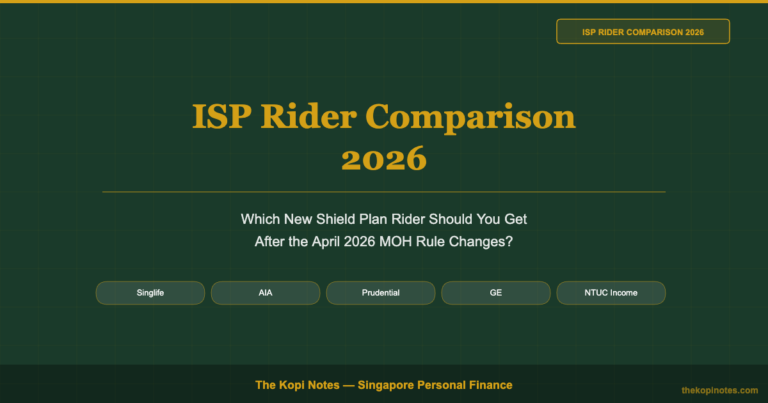
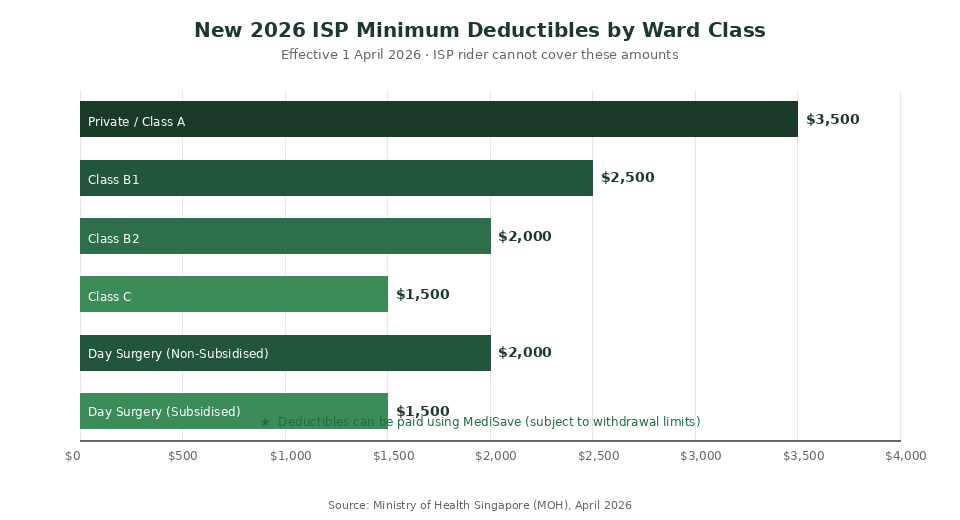
From 1 April 2026, Singapore’s Integrated Shield Plan (ISP) rider rules changed significantly. ISP riders can no longer pay your minimum deductible — which ranges from $1,500 to $3,500 depending on your ward class. In return, new rider premiums cost around 30% less. This guide runs the numbers at real hospital bill sizes so you can decide whether keeping — or dropping — your rider actually saves money over time.
Not financial advice. All figures are for educational reference only. Data verified as at 12 October 2026.
What Changed in April 2026
The Ministry of Health (MOH) introduced sweeping changes to ISP riders effective 1 April 2026. These reforms were driven by concerns that “full riders” — policies that eliminated copayments entirely — were contributing to over-consumption of healthcare services and rising premiums for everyone.
| Feature | Old Rider Rules | New Rules (Apr 2026) |
|---|---|---|
| Deductible coverage | Rider could cover 100% | Rider cannot cover minimum deductible |
| Minimum copayment | Could be 0% with full rider | 5% minimum (rider covers the rest) |
| Annual copayment cap | $3,000 per year | $6,000 per year |
| Rider premium impact | Higher premiums | ~30% cheaper |
Source: Ministry of Health Singapore (MOH), April 2026
The key takeaway: you now carry more of the first-dollar risk (the deductible plus up to $6,000 in copayment per year), but your rider premium is cheaper. And the rider still provides substantial protection for large bills. For a full breakdown of how the new copayment structure works in practice, see the new ISP rider co-payment breakdown 2026.
Your Out-of-Pocket Breakdown: With and Without a Rider
Without a Rider (ISP Base Plan Only)
Your ISP base plan — from insurers like AIA, NTUC Income, Prudential, Great Eastern, or Raffles Health — covers hospitalisation costs above your deductible. But you still owe your full minimum deductible (the first $1,500 to $3,500 of your bill, depending on ward class), paid every policy year. And you owe 10% co-insurance on the remaining bill above the deductible — with no annual cap.
That absence of a cap matters enormously. For a $200,000 bill, 10% of the portion above the $3,500 deductible is $19,650 — bringing total out-of-pocket above $23,000.
With a New ISP Rider (from April 2026)
A new ISP rider supplements your base plan. You still pay the full minimum deductible yourself — the rider cannot cover this. Above the deductible, you pay a minimum 5% copayment; your rider covers the rest of the co-insurance. And your annual copayment is capped at $6,000 — once you reach that, the rider and base plan cover 100% of the remaining bill.
This $6,000 cap is the most powerful feature of the new rider framework. For any bill above roughly $123,500, your out-of-pocket with the rider never exceeds $3,500 + $6,000 = $9,500 maximum per year.
Source: Ministry of Health Singapore (MOH), April 2026
Worked Examples: Rider vs No Rider at Real Bill Sizes
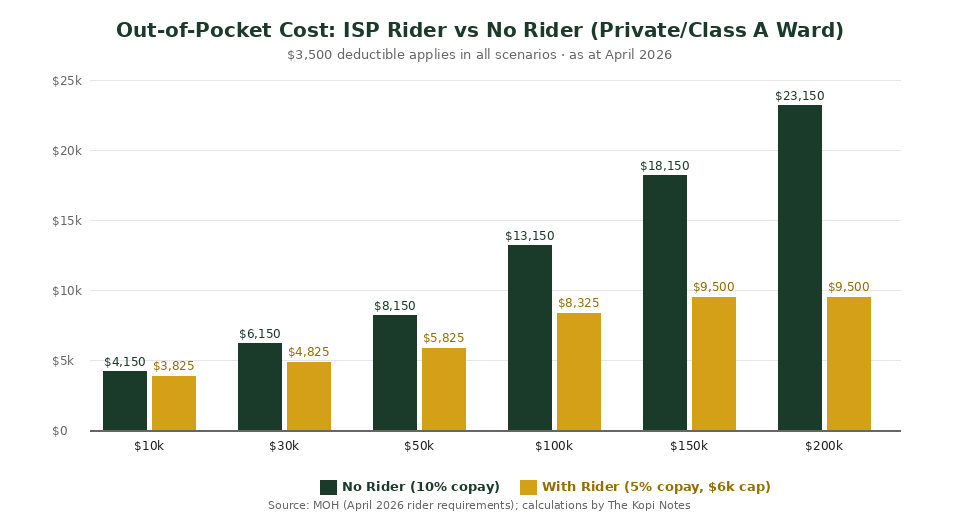
The chart and table below show your total out-of-pocket exposure for a private hospital or Class A ward admission under the April 2026 rules. All scenarios assume the Class A/Private deductible of $3,500.
Source: MOH (April 2026 rider requirements); calculations by The Kopi Notes
| Hospital Bill | Without Rider (OOP) | With New Rider (OOP) | Rider Saves You |
|---|---|---|---|
| $10,000 | $4,150 | $3,825 | $325 |
| $30,000 | $6,150 | $4,825 | $1,325 |
| $50,000 | $8,150 | $5,825 | $2,325 |
| $100,000 | $13,150 | $8,325 | $4,825 |
| $150,000 | $18,150 | $9,500 (cap hit) | $8,650 |
| $200,000 | $23,150 | $9,500 (cap hit) | $13,650 |
Class A/Private ward · $3,500 deductible · No rider: 10% co-insurance, no cap · New rider: 5% copay, $6,000/year cap · Source: MOH, April 2026
The savings are modest for smaller bills but substantial once claims exceed $50,000. For any bill above $123,500, your maximum out-of-pocket with the rider is always $9,500 — regardless of how large the bill grows. For context on what drives large hospital bills in Singapore, see our guide on MediSave limit and private hospital bills 2026.
The Break-Even Calculation: When Does the Rider Pay for Itself?
A new ISP rider costs you an annual premium. The rider pays you back through reduced copayments whenever you make a claim. The question: does the premium justify the potential savings?
Single-Year Break-Even
In any year where you are hospitalised, the rider saves you 5% of your bill above the deductible (up to the $6,000 annual cap). For the rider to pay for itself in that year, your savings need to exceed your annual premium:
- $700/year premium → break-even at a bill of approximately $17,500
- $1,200/year premium → break-even at approximately $27,500
- $500/year premium → break-even at approximately $13,500
Most private hospital inpatient episodes — even a routine appendectomy or a short stay for infection — will exceed these thresholds. A standard Class A inpatient day in Singapore can run $2,000–$5,000 in specialist fees and ward charges alone.
Lifetime Value: The Real Picture
The probability of a major hospitalisation in any single year is low, but the cumulative probability over 20–30 years is significant. One major event — cardiac surgery, cancer treatment, complex orthopaedic procedure — with a $100,000–$300,000 bill generates $4,825–$13,650 in rider savings in a single admission. Against a $700/year premium, that is 7–20 years of premiums recovered in one claim.
The rider is, at its core, catastrophic protection. Its value is not in saving a few hundred dollars on small bills — it is in capping your maximum out-of-pocket at $9,500 in the worst case. Read our real cost of an ISP rider in 2026 analysis, or use the Singapore retirement calculator to see how uncapped healthcare costs could affect your long-term financial plan.
When to Keep Your Rider (4 Scenarios)
Keep Your Rider If…
1. You always use private or Class A wards. Private ward bills are the largest in the system — regularly above $50,000–$100,000 for serious conditions. At these bill sizes, the rider saves you thousands and caps your exposure at $9,500. If you are committed to private care, the rider is almost always worth the premium.
2. You have a family history of costly conditions. Cancer treatment, cardiac procedures, major orthopaedic surgery, and neurosurgery routinely generate six-figure bills at private hospitals. The rider’s $6,000 annual copayment cap is designed exactly for these situations.
3. You are in your 40s or older with ISP premiums already rising. Rider premiums increase with age, but the new framework’s ~30% reduction makes them more sustainable. As you age, your statistical risk of hospitalisation rises — making the rider’s protection more valuable precisely when you need it most.
4. You are the sole breadwinner or have dependants. An unexpected $20,000+ out-of-pocket healthcare bill is a serious financial shock. The rider limits downside risk and protects family cash flow.
Consider Dropping Your Rider If…
You consistently use B1 wards or below (where bills and rider savings tend to be smaller), and you have strong savings that can absorb a $9,000–$15,000 out-of-pocket expense in a bad year — provided you are disciplined about directing the saved premium into a healthcare reserve fund.
For more on the copayment framework across all ward classes, see our ISP co-payment guide 2026.
Using MediSave to Pay Your Deductible and Copayment
One often-overlooked advantage: you can use your MediSave to pay the deductible and copayment that the rider no longer covers. The 2026 MediSave Basic Healthcare Sum (BHS) — the amount you are allowed to retain in your MediSave account above the Full Retirement Sum — is $79,000. Anything above the BHS is transferred to your Special Account or Retirement Account.
MediSave can be used for the minimum deductible (up to withdrawal limits), the 5% copayment that the rider cannot waive, and ISP premiums themselves (up to the ISP MediSave withdrawal limit for your age band). For a $3,500 deductible and $5,000 copayment on a $100,000 bill — totalling $8,500 — MediSave can cover the deductible portion and part of the copayment, reducing cash out-of-pocket further.
For optimisation strategies, see our year-end MediSave tax relief strategies 2026.
The Legacy Rider Question
If you hold a pre-April 2019 ISP rider (grandfathered under the old rules), you have until 1 April 2028 to decide whether to transition to the new framework or let your legacy rider lapse. Covered in detail in our ISP legacy rider transition to 2028 guide.
Frequently Asked Questions
What is the MediSave Basic Healthcare Sum (BHS) for 2026?
Can my ISP rider still cover my deductible after April 2026?
How does the $6,000 annual copayment cap work?
Are new ISP rider premiums really 30% cheaper?
Is it still worth having an ISP rider if I only use Class B1 wards?
What happens to my legacy ISP rider before 2028?
Can I use MediSave to pay the deductible my rider no longer covers?
The Bottom Line
The April 2026 ISP rider reforms changed the economics of rider ownership — but did not make riders obsolete. The new framework shifts more first-dollar risk to you (the deductible, and up to $6,000 in annual copayment), while capping your maximum out-of-pocket at $9,500 per year for catastrophic bills.
If you ever face a $100,000–$300,000 hospitalisation bill, the rider’s value is undeniable. The real question is whether you can comfortably absorb a $9,500 out-of-pocket in a bad year — and whether the (now ~30% cheaper) premium is a sensible price for that protection. For most Singapore households using private or Class A wards, the answer is yes.
Not financial advice. All figures for educational reference only. Data verified as at 12 October 2026. Source: CPF Board (MediSave BHS 2026), Ministry of Health Singapore (ISP rider framework April 2026).
Get Free Insurance Advice
Speak with a licensed insurance advisor. No obligation, no cost.
By submitting this form, you agree to our Privacy Policy.
This article was researched with the help of AI. While we strive to keep all information accurate and up to date, there may be errors. If you notice any discrepancies, please contact us.