Dividend Growth ETFs for Singapore Investors: VIG, SCHD, DGRW & USDV Guide (2026)
A complete Singapore investor’s guide to dividend growth ETFs — tax advantages, step-by-step broker instructions, and 2026 data.
Dividend growth ETFs like VIG, SCHD and DGRW hold US companies with long streaks of rising payouts, giving Singapore investors a quality-screened alternative to chasing raw yield. The catch: all three are US-domiciled, so dividends face 30% withholding tax (WHT) and holdings above USD 60,000 carry US estate tax exposure. The Ireland-domiciled equivalent, USDV (SPDR S&P US Dividend Aristocrats UCITS ETF) on the London Stock Exchange, cuts WHT to 15% and removes the estate tax risk entirely.
Not financial advice. All figures are for educational reference only. Data as at September 2026 unless noted.
Table of Contents
Contents — Click to expand
- What Are Dividend Growth ETFs?
- Key Facts at a Glance: VIG, SCHD, DGRW & USDV
- Why Singapore Investors Should Consider the LSE Alternative
- Expense Ratio and Total Costs
- How to Buy Dividend Growth ETFs in Singapore (Step-by-Step)
- Dividend Growth vs Dividend Yield ETFs
- Who Should Buy Dividend Growth ETFs?
- Frequently Asked Questions
What Are Dividend Growth ETFs?
Dividend growth ETFs screen for companies with a long, unbroken track record of raising dividends every year — not simply the highest current yield. This matters because a high headline yield can signal distress (a falling share price inflates the yield ratio), while a multi-year streak of dividend increases usually signals a durable, cash-generative business.
The three benchmark US dividend growth ETFs are VIG (Vanguard Dividend Appreciation ETF, tracking the S&P U.S. Dividend Growers Index, which requires at least 10 consecutive years of dividend increases), SCHD (Schwab U.S. Dividend Equity ETF, tracking the Dow Jones U.S. Dividend 100 Index, which blends a 10-year dividend growth screen with quality and yield factors), and DGRW (WisdomTree U.S. Quality Dividend Growth Fund, which weights holdings by return-on-equity and return-on-assets alongside growth expectations). All three are listed on US exchanges (NYSE Arca or Nasdaq) and domiciled in the United States.
For Singapore investors specifically, the Ireland-domiciled, London Stock Exchange-listed equivalent is USDV (SPDR S&P US Dividend Aristocrats UCITS ETF), which tracks the S&P High Yield Dividend Aristocrats Index — US companies that have raised dividends for at least 20 consecutive years. USDV holds the same underlying US dividend-aristocrat companies but wraps them in a UCITS structure that is more tax-efficient for a Singapore resident.
Key Facts at a Glance: VIG, SCHD, DGRW & USDV
| ETF | Index | Domicile | Exchange | TER | AUM |
|---|---|---|---|---|---|
| VIG | S&P U.S. Dividend Growers | USA | NYSE Arca | 0.04% p.a. | ~USD 111B |
| SCHD | Dow Jones U.S. Dividend 100 | USA | NYSE Arca | 0.06% p.a. | ~USD 110B |
| DGRW | WisdomTree U.S. Quality Dividend Growth | USA | Nasdaq | 0.28% p.a. | ~USD 16.5B |
| USDV | S&P High Yield Dividend Aristocrats | Ireland | London Stock Exchange | 0.35% p.a. | ~USD 3.9B |
Source: Vanguard VIG factsheet, Schwab, WisdomTree and State Street SPDR USDV factsheet, September 2026.
Why Singapore Investors Should Consider the LSE Alternative
For a Singapore resident, the headline TER is only part of the cost picture. US-domiciled ETFs like VIG, SCHD and DGRW withhold 30% US dividend withholding tax at source, because Singapore has no tax treaty with the US that reduces this rate for individual investors. USDV, domiciled in Ireland, benefits from the US-Ireland tax treaty, which caps dividend WHT passed through to the fund at 15% — effectively halving the tax drag on income from the same underlying US dividend-aristocrat companies.
The second, often-overlooked risk is US estate tax. Non-resident aliens (which includes most Singapore investors) holding US-situs assets — including US-domiciled ETFs like VIG, SCHD and DGRW — above USD 60,000 can be subject to US estate tax rates of up to 40% on the excess, payable by the estate before assets pass to heirs. Ireland-domiciled UCITS ETFs like USDV are not US-situs assets, so this exposure does not apply.
| ETF Type | Domicile | US Dividend WHT | US Estate Tax Risk |
|---|---|---|---|
| USDV (LSE) | Ireland | 15% | None |
| VIG / SCHD / DGRW (US) | USA | 30% | Yes (above USD 60k) |
Expense Ratio and Total Costs
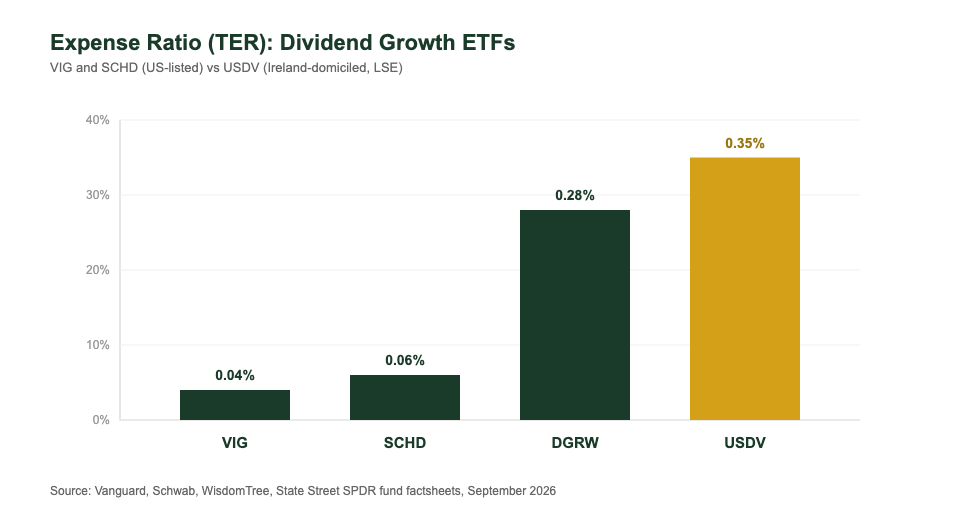
VIG’s 0.04% TER and SCHD’s 0.06% TER are among the cheapest equity ETFs available anywhere — on a SGD 50,000 position, that is roughly SGD 20–30 a year in fund fees. DGRW’s quality-growth screening pushes its TER to 0.28% (around SGD 140 a year on the same SGD 50,000), while USDV’s 0.35% TER (around SGD 175 a year) is the highest of the four, reflecting both the UCITS wrapper’s higher running costs and the Dividend Aristocrats’ more concentrated, actively-rebalanced index.
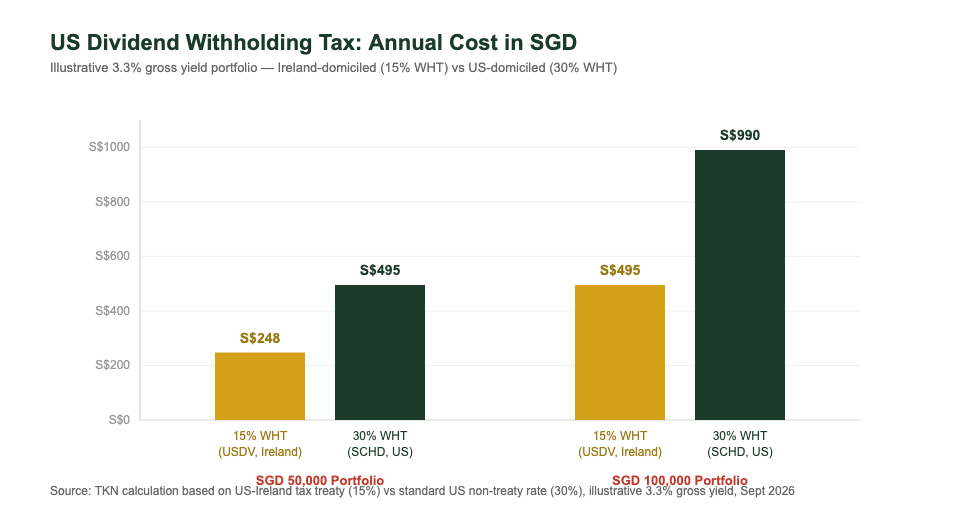
However, TER alone understates the real cost for a Singapore holder of the US-domiciled funds. A worked example: on a SGD 100,000 position yielding an illustrative 3.3% gross, the annual dividend is roughly SGD 3,300. At USDV’s 15% WHT, the investor keeps SGD 2,805 after tax drag (SGD 495 withheld). At SCHD’s 30% WHT, the investor keeps only SGD 2,310 (SGD 990 withheld) — a difference of SGD 495 every year, which more than offsets USDV’s higher TER once the position exceeds roughly SGD 60,000.
How to Buy Dividend Growth ETFs in Singapore (Step-by-Step)
For USDV on the LSE: fund your brokerage account in GBP or USD, search for ticker “USDV” and confirm the London Stock Exchange listing (ISIN IE00B6YX5D40), then place a limit order during LSE trading hours (around 4:30pm–1am SGT, with daylight-saving adjustments). Syfe’s brokerage platform supports LSE-listed UCITS ETFs with a straightforward sign-up flow for beginners, while Interactive Brokers (IBKR) offers the lowest per-trade commission for larger, recurring purchases. Saxo Markets and FSMOne are also viable for LSE access.
For VIG, SCHD or DGRW on US exchanges: the process is similar but settles in USD on NYSE Arca or Nasdaq during US market hours (9:30pm–4am SGT). Most Singapore brokers that offer US equities — IBKR, Syfe, Saxo, Tiger Brokers, moomoo — support these tickers directly. Endowus offers these as part of its fund and ETF portfolios for investors who prefer a managed approach.
Dividend Growth vs Dividend Yield ETFs
Dividend growth ETFs (VIG, SCHD, DGRW, USDV) are not the same strategy as high dividend yield ETFs — the two sit at different points on the quality-versus-income spectrum, and conflating them is a common beginner mistake. A pure yield ETF maximises current income and can include financially stretched companies propping up an inflated yield; a dividend growth ETF screens out those names in favour of multi-year payout consistency, usually at the cost of a lower starting yield.
| ETF | Strategy | TER | Structure | Best For |
|---|---|---|---|---|
| VIG | Dividend growth (10yr+ streak) | 0.04% | Distributing | Lowest-cost US exposure |
| SCHD | Growth + quality + yield blend | 0.06% | Distributing | Balanced income + growth |
| DGRW | Quality-weighted growth | 0.28% | Distributing | Quality tilt, ROE/ROA screen |
| USDV | 20yr+ dividend aristocrats | 0.35% | Distributing | SG investors wanting lower WHT |
For pure yield instead of growth, Singapore investors typically look at a high dividend yield ETF such as Vanguard’s FTSE All-World High Dividend Yield UCITS ETF — a different strategy entirely from the four growth-focused funds in this guide.
Who Should Buy Dividend Growth ETFs?
Dividend growth ETFs suit investors who want US equity exposure with a quality tilt and a track record of rising income, rather than the highest possible yield today. They fit well as a passive income Singapore building block alongside S-REITs, since the two income sources respond differently to interest rate cycles. Consider USDV over the US-listed trio if your position size will exceed roughly SGD 60,000–80,000 (where the WHT saving outweighs the higher TER) or if you want to eliminate US estate tax exposure outright. Consider VIG or SCHD instead if your total US-situs exposure (across all holdings) will stay well under the USD 60,000 estate tax threshold and the lower TER matters more than the WHT difference at your portfolio size.
These ETFs are not CPF-investable, but LSE and US-listed ETFs bought through SRS-eligible brokers can be funded from an SRS account — see our CPF investment strategy guide and retirement calculator to check how dividend growth ETFs fit your broader retirement funding plan.
Frequently Asked Questions
What is a dividend growth ETF and why do Singapore investors buy it?
A dividend growth ETF screens for companies with a long history of raising dividends every year, rather than the highest current yield. Singapore investors buy them for diversified, quality-tilted US equity income exposure that has historically been more resilient through downturns than pure high-yield strategies.
Is USDV the same as VIG, SCHD or DGRW?
USDV tracks a different index (S&P High Yield Dividend Aristocrats, 20-year dividend increase streak) from VIG, SCHD and DGRW, but it holds largely overlapping blue-chip US dividend payers. Its main advantage for Singapore investors is domicile: as an Ireland-domiciled UCITS ETF, it carries 15% US dividend withholding tax instead of 30%, and avoids US estate tax exposure.
Can I buy these ETFs using my CPF or SRS funds?
VIG, SCHD, DGRW and USDV are not on the CPF Investment Scheme (CPFIS) approved list, so you cannot buy them with CPF Ordinary Account funds. SRS funds can be used if your brokerage supports SRS-funded purchases of US or LSE-listed securities — check with your broker directly, as support varies.
Which broker is best for buying dividend growth ETFs in Singapore?
For USDV on the LSE, Syfe and FSMOne offer straightforward access for beginners, while Interactive Brokers (IBKR) has the lowest per-trade commission for larger or recurring purchases. For US-listed VIG, SCHD or DGRW, IBKR, Syfe, Saxo, Tiger Brokers and moomoo all support direct US market access.
What is the minimum investment for a dividend growth ETF?
There is no fund-level minimum — you can buy as little as one share or unit. In practice, your minimum is one share’s price plus your broker’s minimum trade size (some brokers support fractional shares, lowering this further). As at September 2026, one share of each ETF costs roughly USD 220 (VIG), USD 28 (SCHD), USD 32 (DGRW) or GBP 7 (USDV).
Is it better to hold dividend growth ETFs or S-REITs for passive income in Singapore?
They are complementary rather than substitutes. S-REITs offer Singapore-dollar income with no foreign withholding tax and typically higher starting yields, while dividend growth ETFs offer US equity diversification and a long history of rising per-share payouts. Many Singapore investors hold both — see our guide to the best S-REITs in Singapore 2026 for the REIT side of that allocation.
Ready to Start Investing in Dividend Growth ETFs?
Open a brokerage account and buy your first dividend growth ETF today. Use our referral links for exclusive sign-up bonuses.
This article was researched with the help of AI. While we strive to keep all information accurate and up to date, there may be errors. If you notice any discrepancies, please contact us.