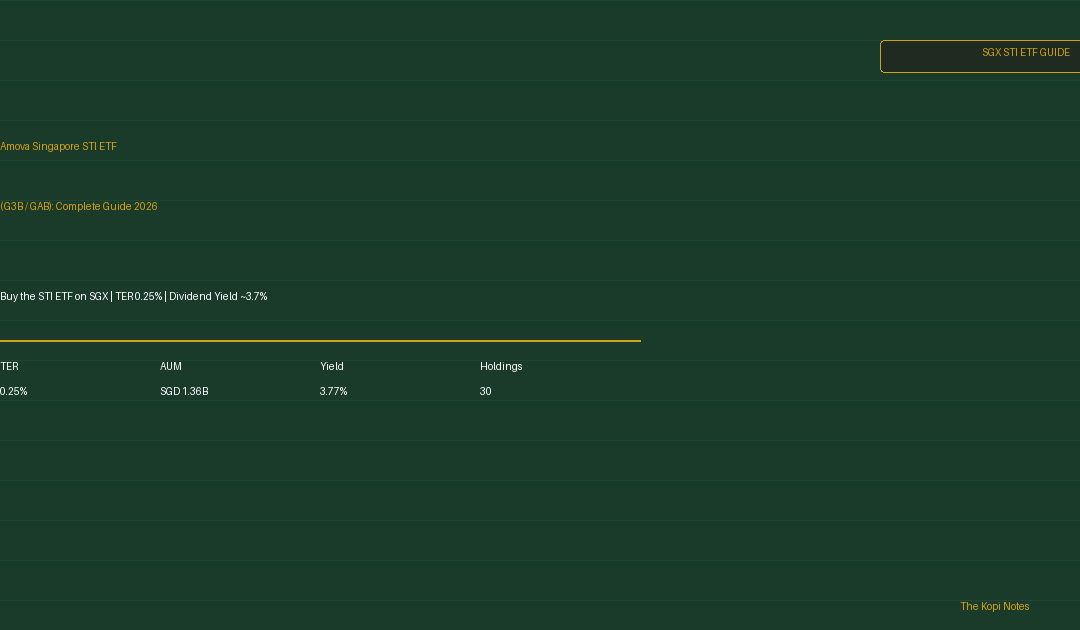
Amova Singapore STI ETF (G3B / GAB): Complete Guide for Singapore Investors 2026
A complete Singapore investor’s guide — fund facts, dividend yield, buying instructions, and 2026 data for G3B and GAB.
The Amova Singapore STI ETF is a passively managed exchange-traded fund listed on the Singapore Exchange (SGX) that tracks the Straits Times Index (STI) — the benchmark index of Singapore’s top 30 companies. It trades under two share classes: G3B (distributing, pays semi-annual dividends) and GAB (accumulating, reinvests dividends automatically). With a Total Expense Ratio (TER) of just 0.25% per annum and an AUM of SGD 1.36 billion, it is one of the most cost-efficient ways for Singapore investors to gain diversified exposure to large-cap Singapore equities, including DBS, OCBC, UOB, Singtel, and CapitaLand Integrated Commercial Trust.
Not financial advice. All figures are for educational reference only. Data as at April 2026 unless noted.
Table of Contents
Contents — Click to expand
- What Is the Amova Singapore STI ETF?
- Key Facts at a Glance (G3B & GAB)
- Why Invest in the STI? Singapore’s Blue-Chip Benchmark
- G3B vs GAB: Distributing vs Accumulating
- Expense Ratio and Total Costs
- Dividend Yield and Payout History
- How to Buy the Amova STI ETF in Singapore (Step-by-Step)
- Amova STI ETF vs SPDR STI ETF vs Nikko AM STI ETF
- Who Should Buy the Amova STI ETF?
- Frequently Asked Questions
What Is the Amova Singapore STI ETF?
The Amova Singapore STI ETF is managed by Amova Asset Management (formerly Aberdeen Standard Investments’ local arm after rebrand) and listed on the SGX Mainboard. Its investment objective is to replicate, as closely as possible and before expenses, the performance of the FTSE Straits Times Index (STI) — the headline blue-chip benchmark for Singapore equities.
The STI comprises the 30 largest companies listed on SGX by full market capitalisation, reviewed quarterly. As at April 2026, it is heavily weighted towards Singapore’s three major banks — DBS Group Holdings, Oversea-Chinese Banking Corporation (OCBC), and United Overseas Bank (UOB) — which together account for over 50% of the index. Other significant constituents include Singtel, CapitaLand Integrated Commercial Trust (CICT), Jardine Matheson, and Keppel Corporation.
The fund was originally launched in February 2009 under Aberdeen Standard Investments’ branding and has since become one of the largest ETFs by AUM on the SGX, with assets under management of approximately SGD 1.36 billion as at April 2026. In September 2025, Amova launched the GAB accumulating share class, giving Singapore investors the choice between regular income (G3B) and automatic compounding (GAB) — both tracking the same underlying index at the same TER of 0.25%.
The fund is domiciled in Singapore and classified as an Excluded Investment Product (EIP) under MAS regulations, making it eligible for purchase through most Singapore brokerage platforms and compatible with the CPF investment strategy under the CPF Investment Scheme (CPFIS).
Key Facts at a Glance (G3B & GAB)
| Metric | G3B (Distributing) | GAB (Accumulating) |
|---|---|---|
| Full Name | Amova Singapore STI ETF SGD (Dist) | Amova Singapore STI ETF SGD (Acc) |
| SGX Ticker | G3B | GAB |
| Index Tracked | FTSE Straits Times Index (STI) | |
| Domicile | Singapore | |
| Structure | Distributing (semi-annual dividends) | Accumulating (reinvests dividends) |
| TER (Expense Ratio) | 0.25% p.a. | |
| AUM (combined) | SGD ~1.36 billion (as at April 2026) | |
| Number of Holdings | 30 | |
| Trading Currency | SGD | |
| Launch Date | February 2009 | September 2025 |
| CPFIS Eligible | Yes (both share classes) | |
Source: Amova Asset Management factsheet & SGX (April 2026)
Why Invest in the STI? Singapore’s Blue-Chip Benchmark
The Straits Times Index is Singapore’s most-watched equity benchmark, representing the 30 largest and most liquid companies listed on the SGX Mainboard by full market capitalisation. It is reviewed quarterly by the FTSE Group to ensure index constituents remain relevant. For Singapore investors building long-term wealth, the STI offers several structural advantages:
Concentration in Singapore’s banking sector: Singapore’s three major banks — DBS, OCBC, and UOB — are widely regarded as among Asia’s best-capitalised and most profitable banks. Their combined weighting in the STI (over 50% as at April 2026) means the index provides strong dividend-oriented exposure to financials. DBS alone makes up approximately 26.4% of the index, making it the largest single constituent.
No capital gains tax in Singapore: Singapore has no capital gains tax, meaning any price appreciation in STI ETF holdings is entirely tax-free for Singapore residents. This compares favourably with markets like the US, where capital gains may be taxed at federal and state level.
SGD-denominated exposure: Unlike LSE-listed ETFs such as CSPX or VWRA, which trade in USD or GBP, the Amova STI ETF trades in SGD. This eliminates currency conversion costs and foreign exchange risk for Singapore-based investors whose income, expenses, and liabilities are in SGD.
CPFIS eligibility: Both G3B and GAB are approved under the CPF Investment Scheme (CPFIS). This is a significant advantage over many internationally-focused ETFs, allowing investors to deploy their Ordinary Account (OA) CPF savings into Singapore blue-chip equities through a regulated, low-cost vehicle.
High liquidity and tight spreads: G3B is one of the most heavily traded ETFs on SGX. Institutional and retail trading activity ensures tight bid-ask spreads, typically under SGD 0.01, reducing implicit transaction costs for investors trading in and out of the position.
G3B vs GAB: Distributing vs Accumulating
The Amova STI ETF’s two share classes track exactly the same underlying index at the same TER. The key difference is how dividends from the 30 STI constituents are handled:
| Feature | G3B (Distributing) | GAB (Accumulating) |
|---|---|---|
| Dividend treatment | Paid out as cash, semi-annually | Reinvested into the fund automatically |
| Ex-dividend dates (2026) | January 2, July 1 | N/A — no distribution |
| Best for | Investors wanting regular passive income | Investors reinvesting for long-term growth |
| Tax drag | None (Singapore has no dividend tax) | None |
| Compounding effect | Investor must manually reinvest distributions | Automatic — more efficient for long-term compounders |
Source: Amova Asset Management (April 2026)
Which should you choose? For investors building a retirement portfolio or wanting to supplement their monthly income — for example, those already receiving CPF LIFE payouts — G3B’s semi-annual distributions are a natural choice. For younger investors with a 10–20 year horizon who do not need current income, GAB is the more efficient option because dividends compound automatically without transaction costs.
A practical worked example: on a SGD 100,000 portfolio in G3B at a 3.77% yield, you would receive approximately SGD 3,770 in dividends per year, paid in two tranches of around SGD 1,885 each. In GAB, that same SGD 3,770 would instead be reinvested into more units automatically, compounding your position for higher long-term returns — assuming you would have reinvested the G3B dividends anyway. For long-term wealth building, use our Singapore retirement calculator to model the impact of compounding dividends over 10, 20, or 30 years.
Expense Ratio and Total Costs
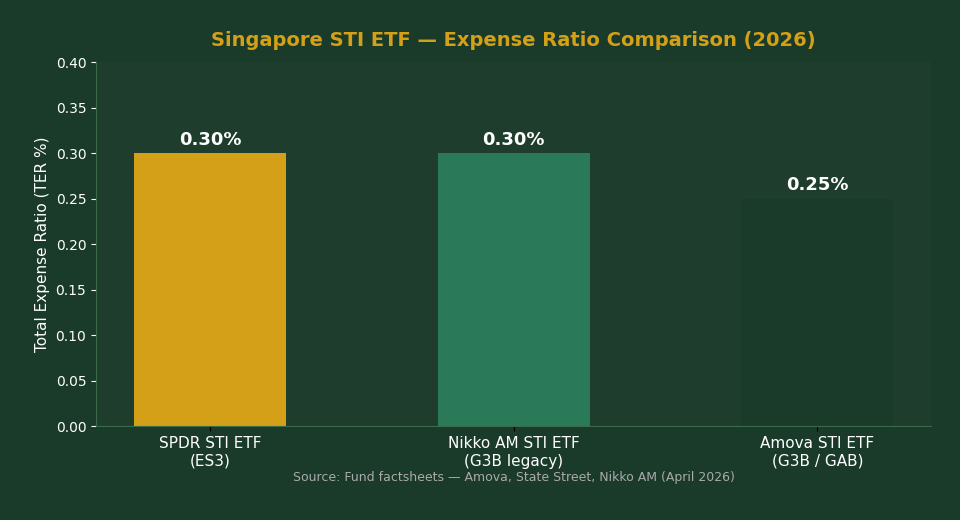
The Amova Singapore STI ETF has a Total Expense Ratio (TER) of 0.25% per annum, capped at this level since 1 December 2023 following a fee reduction by Amova. This is the lowest TER among the three Singapore-listed STI ETFs, offering a small but meaningful cost advantage over the SPDR STI ETF (ES3) and the Nikko AM STI ETF (both at 0.30% TER).
For a Singapore investor holding a SGD 50,000 position in the Amova STI ETF, the annual management cost is approximately SGD 125 per year — compared to SGD 150 for the SPDR or Nikko equivalents. While SGD 25 per year seems small, over a 20-year holding period and accounting for compounding, the fee difference can grow into a meaningful sum.
Beyond the TER, investors should factor in brokerage commissions and the bid-ask spread when buying and selling. G3B is highly liquid with a typical spread of under SGD 0.01, making transaction costs relatively low compared with less-traded SGX securities.
Dividend Yield and Payout History
G3B distributes dividends semi-annually — typically in January and July. For the 12 months ended December 2025, G3B paid a total dividend of SGD 0.18 per share (two tranches of SGD 0.09 each), translating to a trailing dividend yield of approximately 3.77% as at April 2026 based on a share price of approximately SGD 4.77.
This yield compares favourably with the Singapore Savings Bonds 10-year average return (around 2.5–3.0% as at April 2026) and T-bills, while offering the additional upside of capital appreciation linked to Singapore’s equity market. It is also competitive against passive income alternatives in Singapore such as S-REITs (which typically yield 5–7% but with higher individual security risk).
| Year | Dividend Per Share (SGD) | Ex-Date (H1) | Ex-Date (H2) | Approx. Yield |
|---|---|---|---|---|
| 2026 (H1) | SGD 0.09 (H1 declared) | Jan 2, 2026 | Jul 1, 2026 (expected) | ~3.77%* |
| 2025 | SGD 0.18 | Jan 2025 | Jul 2025 | ~3.6–3.8% |
| 2024 | SGD 0.17 | Jan 2024 | Jul 2024 | ~3.5% |
| * Based on SGD 4.77 share price, April 2026. Yield is indicative and fluctuates with price. | ||||
Source: Amova Asset Management, SGX, StockAnalysis.com (April 2026)
How to Buy the Amova STI ETF in Singapore (Step-by-Step)
The Amova STI ETF (G3B or GAB) is listed on SGX and can be purchased through any Singapore-authorised broker that has SGX equity access. Both the distributing (G3B) and accumulating (GAB) share classes are available. Below is a step-by-step guide for the most commonly used platforms.
Option 1: Interactive Brokers (IBKR) — Best for Cost-Conscious Investors
IBKR offers some of the lowest brokerage commissions for SGX-listed ETFs, typically SGD 1.50–2.50 per trade minimum or 0.05% of trade value, whichever is higher. For larger positions (SGD 10,000+), IBKR is generally the most cost-efficient choice.
- Log into your IBKR account and go to Trade → Order Entry
- Search for G3B (distributing) or GAB (accumulating) in the search bar
- Select the SGX listing (exchange: SGX-ST)
- Set order type: Limit or Market; enter quantity in lots (1 lot = 100 shares for G3B)
- Confirm and submit. Settlement is T+2 in SGD
Option 2: Syfe Brokerage — Best for Beginners and Regular Savers
Syfe’s brokerage platform offers a clean, mobile-first experience ideal for investors making regular monthly purchases. For investors who also want robo-advisory exposure, combining a Syfe Core Equity100 account with a manual STI ETF position via Syfe Brokerage is a popular strategy among Singapore retail investors. Use our Syfe referral code for a sign-up bonus when opening your account.
- Download the Syfe app and complete identity verification (SingPass MyInfo available)
- Fund your account via PayNow or bank transfer in SGD
- Tap Brokerage → Search and enter “G3B” or “GAB”
- Enter the number of lots you wish to buy and confirm the order
Option 3: FSMOne — Best for CPF and SRS Investments
FSMOne is the platform of choice for investors buying the Amova STI ETF using CPF OA or SRS funds. Both G3B and GAB are CPFIS-OA approved. Through FSMOne, you can transfer CPF OA funds and purchase G3B directly, making it one of the few ways to deploy CPF savings into a diversified Singapore equity ETF. Use our FSMOne referral code when signing up to access their latest promotions.
- Open a FSMOne account and link your CPF OA via the CPF Board portal
- Navigate to ETFs → SGX Listed ETFs and search for G3B
- Select number of lots and confirm your CPF OA or SRS account as funding source
- Order will be executed on SGX; settlement in T+2 business days
Option 4: MooMoo Singapore — Best for Active Traders
MooMoo (FUTU Singapore) offers competitive commissions and a feature-rich platform including real-time data, order flow analytics, and advanced charting. For more details on the platform, see our moomoo Singapore review.
- Open and fund a MooMoo Singapore account (minimum SGD 100 to start)
- Search for G3B in the Singapore market section
- Select order type and quantity; submit
Amova STI ETF vs SPDR STI ETF vs Nikko AM STI ETF
There are currently three ETFs tracking the Straits Times Index listed on SGX, each managed by a different fund house. While all three track the same FTSE STI index with very similar portfolio construction, they differ on TER, AUM, liquidity, and availability of an accumulating share class.
| Feature | Amova STI ETF (G3B / GAB) | SPDR STI ETF (ES3) | Nikko AM STI ETF |
|---|---|---|---|
| Manager | Amova AM | State Street Global Advisors | Nikko Asset Management |
| SGX Ticker | G3B (Dist) / GAB (Acc) | ES3 | G3B (legacy) / O87 (Acc) |
| TER | 0.25% ✅ Lowest | 0.30% | 0.30% |
| Approx AUM | SGD 1.36 billion | SGD ~1.5 billion | SGD ~500 million |
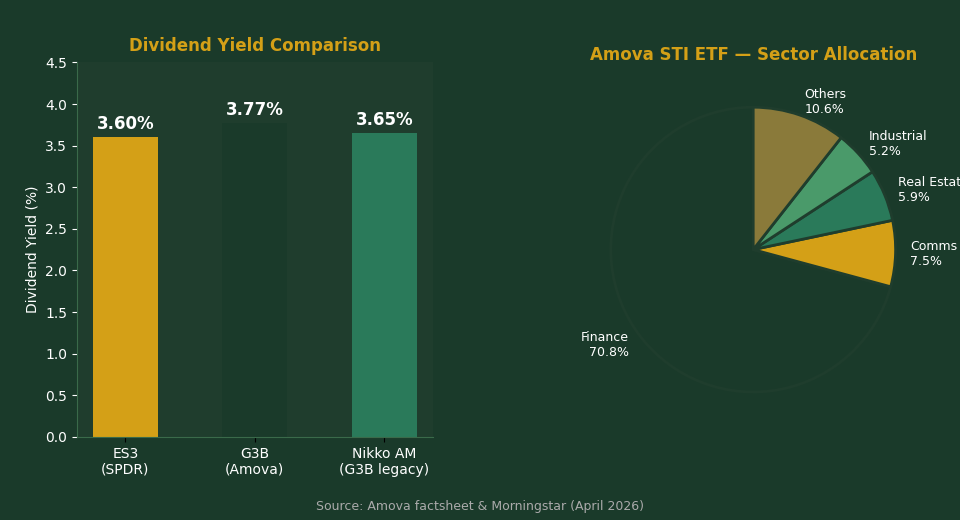
| Dividend Yield | ~3.77% | ~3.60% | ~3.65% |
| Accumulating class? | Yes (GAB, launched Sep 2025) | No | No |
| CPFIS-OA eligible | Yes | Yes | Yes |
| Best for | Lowest-cost STI exposure; compounders prefer GAB | Highest liquidity, longest track record | Smaller ticket size investors |
Source: Fund factsheets, SGX, Morningstar (April 2026). AUM figures are approximate.
Our take: For most Singapore investors buying and holding for the long term, the Amova STI ETF’s lower 0.25% TER is a clear advantage. Over a 20-year holding period on a SGD 100,000 portfolio, the 0.05 percentage point TER saving versus ES3 or Nikko AM compounds to a meaningful difference. Investors who prefer the automatic reinvestment of dividends should consider GAB — the only accumulating STI ETF available on SGX as at May 2026.
Who Should Buy the Amova STI ETF?
The Amova Singapore STI ETF is a strong core holding for certain types of Singapore investors but may not suit everyone’s portfolio objectives.
The Amova STI ETF is ideal if you:
- Want concentrated exposure to Singapore’s top 30 blue-chip companies, particularly the banking sector
- Prefer SGD-denominated investments that avoid foreign currency risk
- Are using CPF OA or SRS funds and want a regulated, index-tracking equity vehicle (CPFIS-approved)
- Are a dividend investor seeking reliable semi-annual income from G3B (historically ~3.6–3.8% yield)
- Are building a long-term retirement portfolio and want the lowest-cost STI ETF with GAB’s automatic reinvestment
- Want a simple, low-maintenance Singapore equity allocation alongside global ETFs like VWRA or CSPX
Consider alternatives if you:
- Want broader global diversification beyond Singapore — the STI’s 30-stock concentration and heavy bank weighting means you are taking on significant sector and geographic concentration risk
- Are seeking higher dividend yields — Singapore REITs typically offer 5–7% yields, though with higher volatility
- Want exposure to global equities including US tech stocks — consider CSPX (S&P 500) or VWRA (global all-cap) instead
- Prefer the SPDR STI ETF (ES3) due to its longer track record and slightly higher daily trading volume
For Singapore investors building a diversified retirement portfolio, a common approach is to hold the Amova STI ETF (for local blue-chip exposure and CPF OA compatibility) alongside a global equity ETF such as CSPX or VWRA (for international diversification), and supplement with S-REITs for income. Use the Singapore retirement calculator to model how an STI ETF allocation fits into your long-term financial plan.
Disclaimer: This article is for informational and educational purposes only. It does not constitute financial advice. All investment decisions should be made based on your own financial circumstances and risk tolerance, preferably with guidance from a licensed financial adviser. Past performance is not indicative of future results. All figures cited are as at April 2026 and are subject to change.
Frequently Asked Questions
What is the Amova Singapore STI ETF and why do Singapore investors buy it?
The Amova Singapore STI ETF is a passively managed fund listed on SGX (tickers: G3B for distributing, GAB for accumulating) that tracks the FTSE Straits Times Index — Singapore’s top 30 companies by market capitalisation. Singapore investors buy it for cost-efficient, diversified exposure to Singapore blue-chip equities including DBS, OCBC, UOB, and Singtel, at a low TER of 0.25% per annum. It is also CPFIS-approved, allowing investors to use their CPF OA savings to invest.
What is the difference between G3B and GAB?
G3B and GAB are two share classes of the same Amova Singapore STI ETF, tracking the identical FTSE Straits Times Index at the same 0.25% TER. G3B is the distributing share class — it pays out dividends semi-annually (around January and July). GAB is the accumulating share class, launched in September 2025, which automatically reinvests dividends back into the fund for compounding growth. If you need regular income, choose G3B. If you are investing for long-term growth and prefer automatic reinvestment, choose GAB.
Can I buy the Amova STI ETF using my CPF or SRS funds?
Yes. Both G3B and GAB are approved under the CPF Investment Scheme (CPFIS-OA), meaning you can use your CPF Ordinary Account savings to purchase the Amova STI ETF. You can also purchase it using Supplementary Retirement Scheme (SRS) funds. FSMOne is one of the most commonly used platforms for CPFIS purchases of SGX-listed ETFs, as it offers a direct CPF transfer facility. Note that CPF SA (Special Account) funds may not be used for CPFIS; only OA funds qualify.
Is the Amova STI ETF better than the SPDR STI ETF (ES3) or Nikko AM STI ETF?
All three STI ETFs track the same FTSE Straits Times Index and hold the same 30 companies. The key differentiator is cost: the Amova STI ETF has a TER of 0.25%, slightly lower than both ES3 and Nikko AM STI ETF at 0.30%. Over a long holding period, this 0.05% annual difference compounds into meaningful savings. Additionally, the Amova ETF offers GAB — an accumulating share class — which ES3 and Nikko AM do not. For most long-term investors, the Amova STI ETF is the most cost-efficient choice among the three.
What dividend does the Amova STI ETF (G3B) pay?
G3B pays dividends semi-annually, typically in January and July. For the 12 months ended December 2025, the total dividend was SGD 0.18 per share (SGD 0.09 per semi-annual tranche). Based on a share price of approximately SGD 4.77 as at April 2026, this equates to a trailing dividend yield of approximately 3.77%. Dividend amounts vary from year to year depending on the aggregate dividends paid by the 30 STI constituent companies. The next expected ex-dividend date for G3B is 1 July 2026, with payment expected on 15 July 2026.
What are the risks of investing in the Amova STI ETF?
The Amova STI ETF carries the same risks as any equity investment: the value of your units can fall as well as rise. Key risks include: (1) Concentration risk — over 50% of the STI is allocated to Singapore’s three major banks (DBS, OCBC, UOB), meaning the ETF’s performance is heavily tied to the Singapore banking sector. (2) Singapore-specific risk — as a single-country ETF, it lacks the global diversification offered by ETFs like VWRA or CSPX. (3) Market risk — like all equity ETFs, G3B and GAB are affected by broad market downturns. (4) Currency risk — the ETF trades in SGD, which shields local investors from foreign exchange risk, but Singapore’s export-oriented economy means SGD strength can affect constituent company earnings. Past performance is not a reliable indicator of future results.
Ready to Buy the Amova STI ETF?
Open a brokerage account today and start building your Singapore blue-chip portfolio. Use our referral links for exclusive sign-up bonuses.
This article was researched with the help of AI. While we strive to keep all information accurate and up to date, there may be errors. If you notice any discrepancies, please contact us.