CPF & MEDISAVE · OCTOBER 2026
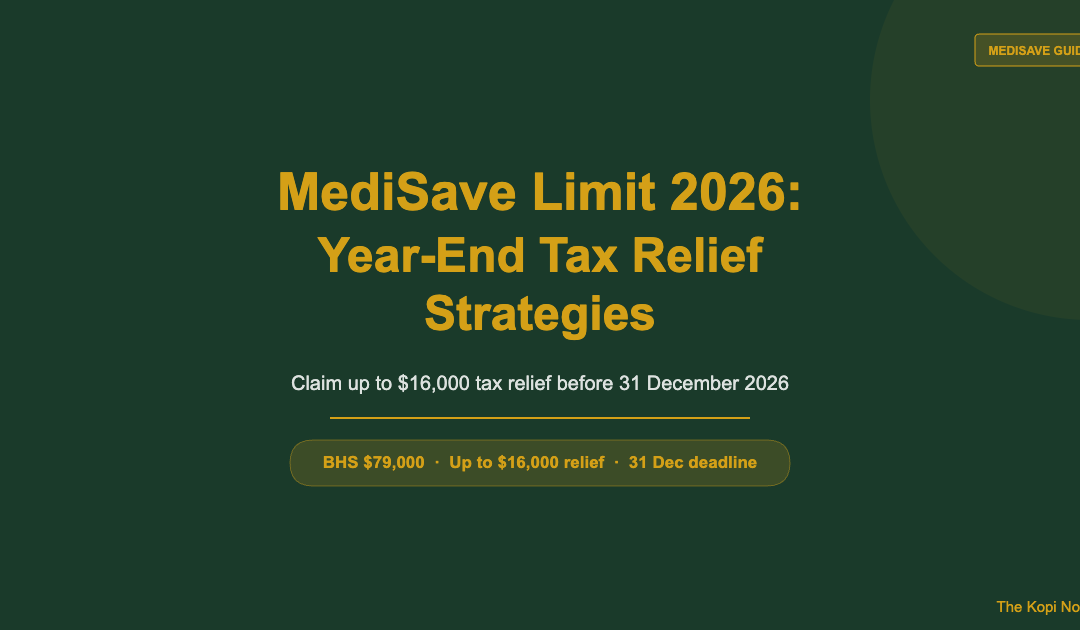
MediSave Limit 2026: Year-End Tax Relief Strategies Before 31 December
The BHS is $79,000 this year. Here’s how to claim up to $16,000 in income tax relief with a strategic cash top-up before the deadline.
In This Guide
The MediSave Basic Healthcare Sum (BHS) for 2026 is $79,000 — and if your MediSave Account (MA) balance sits below that ceiling, a strategic cash top-up before 31 December can unlock up to $16,000 in Singapore income tax relief. The relief is split into two separate buckets: $8,000 for topping up your own MA, and a further $8,000 for topping up family members’ MAs. Done right, this is one of the most tax-efficient moves a Singapore resident can make before the year ends.
Not financial advice. All figures are for educational reference only. Data as at October 2026 unless noted. Always verify with CPF Board and IRAS before acting.
What Is the MediSave Limit (BHS) in 2026?
The Basic Healthcare Sum (BHS) is the cap on how much money can sit in your MediSave Account. Once your MA balance reaches or exceeds the BHS, additional CPF contributions automatically overflow into your Special Account (SA) or Retirement Account (RA). For members who have not yet turned 65, the BHS is adjusted annually — it was set at $79,000 for 2026, up from $71,500 in 2024.
Why does this matter for tax relief? Because IRAS only grants the MediSave relief on cash top-ups — money you voluntarily transfer from your bank account into your MA via CPF’s online portal. This is distinct from the mandatory CPF contributions your employer makes each month. And critically, you can only top up to the BHS ceiling: if your MA already holds $79,000 or more, no further cash top-up is eligible for relief.
| Year | BHS Ceiling | Year-on-Year Increase |
|---|---|---|
| 2023 | $68,500 | +$3,500 |
| 2024 | $71,500 | +$3,000 |
| 2025 | $75,500 | +$4,000 |
| 2026 | $79,000 | +$3,500 |
Source: CPF Board — cpf.gov.sg, 2026. BHS applies to members below age 65.
Once you turn 65, your MA is merged into your Retirement Account (RA) and the BHS is locked in at the amount that applied when you turned 55. If you topped up before 55, you benefited from every year of BHS growth along the way — a strong argument for starting early.
How the $16,000 MediSave Tax Relief Cap Works
Singapore’s MediSave tax relief is governed by the CPF Cash Top-Up Relief scheme under the Income Tax Act. There are two separate sub-limits, both falling under the broader $80,000 annual relief cap that applies across all CPF-related reliefs:
| Top-Up Category | Max Annual Relief | Eligible Recipients |
|---|---|---|
| Own MA top-up | $8,000 | Self (Singapore Citizen or PR) |
| Family MA top-up | $8,000 | Parents, grandparents, spouse, siblings, children — SC/PR only |
| Total MediSave relief | $16,000 | Combined, subject to $80,000 overall cap |
Source: IRAS — iras.gov.sg/income-tax/individuals/tax-reliefs-rebates-and-deductions/tax-reliefs/cpf-cash-top-up-relief, October 2026.
An important nuance: the $8,000 own-MA relief is shared with your SA and RA top-up relief. In other words, if you made a $5,000 cash top-up to your SA earlier in the year, you only have $3,000 remaining in the shared bucket for an MA top-up before the year ends. Check your CPF transaction history on cpf.gov.sg before deciding how much to top up.
The $8,000 family relief bucket, by contrast, is separate and only relates to cash top-ups you make into other people’s MediSave Accounts. Both the taxpayer and the family member must be Singapore Citizens or Permanent Residents. As the taxpayer, you claim the relief — the family member who receives the funds does not claim it again.
Our in-depth CPF investment strategy guide walks through how MediSave top-ups fit into the broader retirement picture alongside SA top-ups and CPF investing.
Year-End Strategy: 3 Steps Before 31 December
The relief year follows the calendar year — every dollar of cash top-up must be received in your (or your family member’s) MediSave Account on or before 31 December 2026 to be counted for YA 2027 tax relief. Bank transfers typically clear in one to two business days, so aim to initiate your top-up by 29 December at the latest to be safe. Here is the most efficient three-step approach:
Step 1 — Know your remaining room. Log into the CPF website and check your current MA balance. Subtract it from $79,000. That figure — let’s call it your “headroom” — is the maximum you can top up in cash. If your MA already sits at $79,000 or above, you have no room left and no relief to claim this year for the own-MA bucket.
Step 2 — Check your remaining shared relief quota. If you made any cash top-ups to your SA or RA earlier in 2026, those reduce the $8,000 own-MA bucket. Log into myTax Portal (IRAS) after 1 March 2027 when the year is closed to see the relief granted — but for planning purposes, check your CPF transaction history now. Only top up the amount that will actually generate relief: topping up $10,000 when you only have $5,000 of headroom in the own-MA relief bucket wastes the opportunity to redirect that extra $5,000 to a family member’s MA instead.
Step 3 — Execute the top-up via CPF e-Cashier. Visit CPF e-Cashier and select “MediSave Top-Up” under the CPF Cash Top-Up (for Self) or CPF Cash Top-Up (for Family) option. Payment can be made by PayNow, eNETS, or internet banking. No forms need to be submitted to IRAS — CPF Board reports the top-up directly, and it auto-populates your tax assessment the following year.
Running the numbers on your overall retirement plan? The Singapore retirement calculator on TKN lets you model how different CPF contribution strategies affect your projected retirement income.
Tax Savings by Income Level
The actual tax savings from a MediSave top-up depend entirely on your marginal income tax rate — the rate that applies to your last dollar of chargeable income. Singapore’s personal income tax is progressive, so higher earners save more in absolute terms from the same $8,000 top-up.
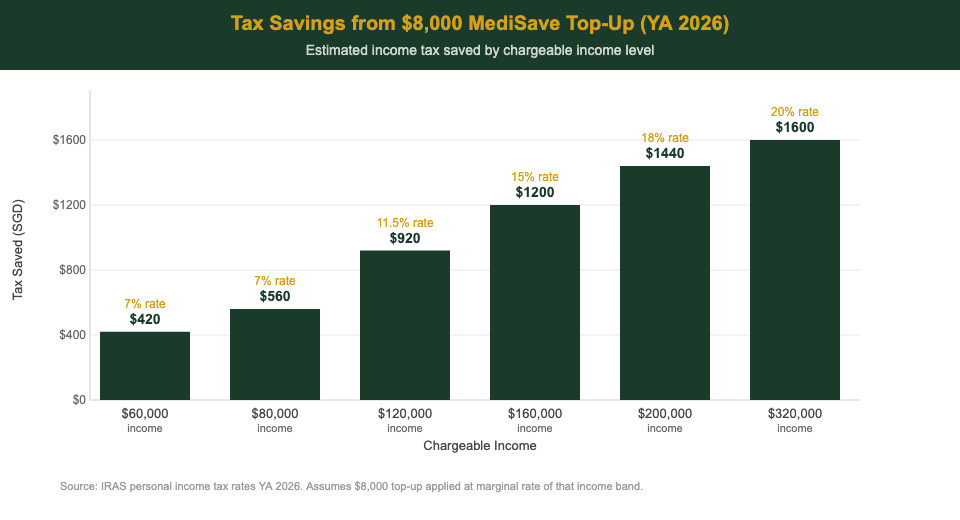
For a Singapore resident earning $160,000 in chargeable income, the marginal rate is 15%. An $8,000 MediSave top-up saves $1,200 in tax — equivalent to a 15% instant return on $8,000, with the money going into a government-backed account earning 4% per annum. At $200,000 chargeable income, the saving rises to $1,440 (18% rate). Capturing the family relief bucket on top — another $8,000 top-up into a parent or spouse’s MA — doubles these savings.
| Chargeable Income | Marginal Rate | Own MA Saving ($8k) | Max Saving ($16k total) |
|---|---|---|---|
| $60,000 | 7% | $420 | $840 |
| $80,000 | 7% | $560 | $1,120 |
| $120,000 | 11.5% | $920 | $1,840 |
| $160,000 | 15% | $1,200 | $2,400 |
| $200,000 | 18% | $1,440 | $2,880 |
| $320,000 | 20% | $1,600 | $3,200 |
Source: IRAS personal income tax rates YA 2026. Assumes full $8,000 per bucket is used and no other relief limitations apply.
Even at the 7% bracket, a $16,000 total outlay yields $1,120 in guaranteed tax savings — and the money sits in your CPF earning 4% p.a., tax-free. Over a decade, the compounding on $16,000 at 4% adds another ~$7,700 before touching any of the tax benefit.
Compare this with other low-risk year-end tax moves: a top-up to Singapore T-bills in 2026 earns you market-rate interest but no tax relief, while the MediSave top-up gives you both a guaranteed after-tax return and a 4% interest floor.
Own MA vs Family MA: Which to Top Up First?
Most Singaporeans instinctively top up their own MA first. That is usually correct — but not always. The right sequencing depends on who has headroom under the BHS and what your household’s total tax situation looks like.
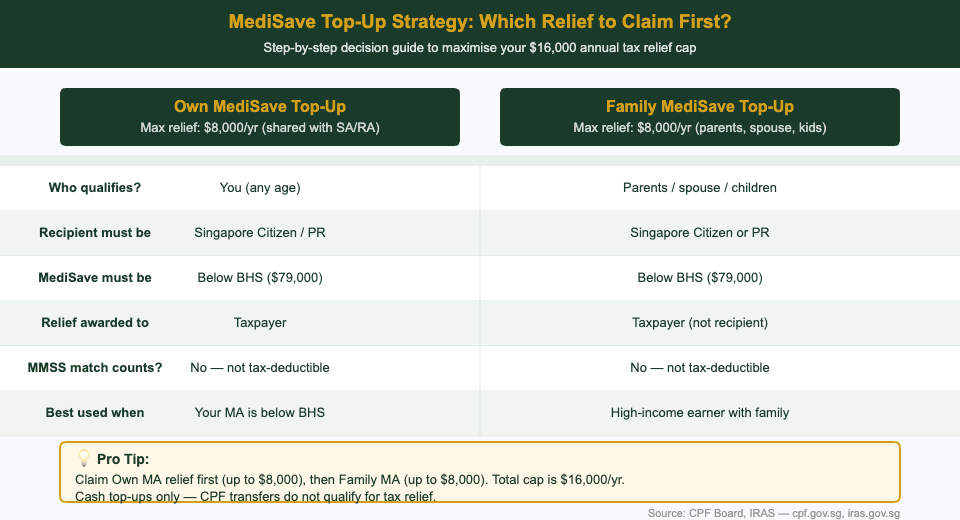
The core rule: you claim the tax relief regardless of whose MA you top up. So if your own MA is already near the BHS — say, $76,000 — you only have $3,000 of room for the own-MA bucket. Rather than letting the other $5,000 of relief go unused, you can direct it to a parent or spouse who has more MediSave headroom. The family MA bucket is separate and allows another $8,000 in relief on top.
One scenario where the family bucket wins priority: a high-income earner in their 40s whose own MA has been fully funded by years of employer contributions and is already at $79,000. Their MA has no room for a cash top-up. But if they have elderly parents with lower CPF balances — a common situation for those whose parents worked in lower-income jobs — the parents’ MAs likely have significant headroom. Topping those up saves the high-income child up to $8,000 in relief while also giving the parents a larger MediSave cushion for healthcare expenses in retirement.
For a full breakdown of how MediSave fits into your broader CPF investment strategy, including the SA top-up vs MA top-up trade-off, see our dedicated guide.
If you use a robo-advisor to manage your broader portfolio, platforms like Endowus (referral code: 2V343) allow you to invest your MediSave in approved unit trusts for returns potentially above the 4% floor — though this involves market risk and is not suitable for everyone.
Does the MMSS Match Count for Tax Relief?
In January 2026, CPF introduced the Matched MediSave Scheme (MMSS) — a government co-contribution that matches your voluntary MediSave cash top-up dollar-for-dollar, up to $1,000 per year, for Singaporeans aged 55 to 70. The scheme is designed to encourage older Singaporeans who may have depleted their MediSave to rebuild the balance.
However, a frequently misunderstood point: the government’s matched portion does NOT qualify for income tax relief. Only the cash you put in yourself counts. So if you top up $1,000 and the government matches with another $1,000, you get tax relief only on your $1,000 contribution — not on the matched $2,000 total.
This does not make the MMSS unattractive — a 100% match on your contribution is an excellent guaranteed return. It simply means you should not conflate the MMSS benefit with the tax relief benefit. Both are valuable independently: you get a $1,000 tax deduction on your $1,000 cash top-up, and you get a free $1,000 from the government on top of that. The MMSS match itself earns 4% p.a. interest once credited to your MA.
For MMSS-eligible members aged 55 to 70: maximise the matched contribution first (up to $1,000 of your own cash), then consider whether additional top-ups up to the $8,000 own-MA relief ceiling make sense for your tax situation.
Common Pitfalls to Avoid
After covering MediSave strategies across multiple articles in this series, these are the mistakes we see most often:
Topping up after 31 December. The deadline is strict. A transfer initiated on 31 December but not credited until 2 January 2027 counts for YA 2028, not YA 2027. Initiate by 28-29 December to allow for settlement.
Forgetting that the $8,000 own-MA bucket is shared with SA/RA. If you have already topped up your SA or RA in 2026, those contributions reduce the room you have left for your MA. Many people double-claim in their heads and are surprised when their tax assessment reflects a smaller relief than expected.
Topping up a family member who is not eligible. The family member must be a Singapore Citizen or Permanent Resident. Foreign spouses and foreign-born parents who have not obtained PR are not eligible recipients. Check the CPF eligibility checker on cpf.gov.sg before transferring.
Over-contributing to an MA that is already at the BHS. If a family member’s MA has already hit $79,000, the CPF system will reject the top-up — but if the transfer still processes, it will be returned. This wastes time and delays tax planning. Always check the recipient’s MA balance beforehand via the CPF nomination portal (you can check a family member’s balance if you are their CPF nominee or use their Singpass to check on their behalf).
Counting on the MediSave top-up to offset a shortfall in other reliefs. Remember the overall $80,000 annual relief cap. If your total CPF, SRS, and other reliefs already exceed $80,000, additional MediSave top-ups generate no further tax benefit for the year.
For a broader look at maximising your CPF before the year end, including SA top-ups and Supplementary Retirement Scheme contributions, our Syfe (referral code: SRPRFFFCD) review covers how robo-advisors complement your CPF strategy in the broader retirement income picture.
Frequently Asked Questions
What is the MediSave BHS limit for 2026?
How much tax relief can I get from topping up MediSave in 2026?
Does the MMSS government match count toward tax relief?
What is the deadline for the MediSave top-up to count for this tax year?
Can I top up a foreign spouse's or foreign parent's MediSave to claim tax relief?
Can I invest my MediSave balance for higher returns?
The Kopi Notes is an independent personal finance publication. Nothing on this site constitutes financial, investment, or legal advice. Always seek professional advice tailored to your circumstances. MediSave interest rates, BHS figures, and tax rates are current as at October 2026 and are subject to change by CPF Board and IRAS.
Get Free Insurance Advice
Speak with a licensed insurance advisor. No obligation, no cost.
By submitting this form, you agree to our Privacy Policy.
This article was researched with the help of AI. While we strive to keep all information accurate and up to date, there may be errors. If you notice any discrepancies, please contact us.