iREIT Global Share Price 2026: EUR/SGD Tailwind, WALE Analysis & Valuation Guide (SGX: UD1U)
A complete guide to iREIT Global’s share price drivers, DPU sensitivity, and 2026 recovery outlook for Singapore investors.
iREIT Global (SGX: UD1U) is Singapore’s only pure-play European office REIT, investing in commercial properties across Germany, the Netherlands, Spain, France, Denmark, and the UK. Its share price is primarily driven by three forces: the EUR/SGD exchange rate (which determines SGD distributions), the WALE (Weighted Average Lease Expiry) of its blue-chip tenant base, and its elevated gearing ratio of ~45.5% as at H1 2026. For Singapore income investors, iREIT Global offers a genuinely differentiated European income stream — but one that requires careful monitoring of the EUR/SGD rate and debt refinancing risk.
Not financial advice. All figures are for educational reference only and based on publicly available SGX disclosures and analyst estimates as at October 2026 unless noted.
Table of Contents
Contents — Click to expand
- What Is iREIT Global?
- Key Facts at a Glance
- Share Price Drivers: EUR/SGD, Gearing & DPU
- EUR/SGD Currency Impact on DPU
- WALE & Tenant Quality Analysis
- Valuation: P/NAV Discount & Yield
- Gearing & Debt Refinancing Risk
- iREIT Global vs Peer S-REITs
- Should You Buy iREIT Global?
- Frequently Asked Questions
What Is iREIT Global?
iREIT Global (SGX: UD1U) is a Singapore-listed REIT that invests in income-producing commercial real estate in Europe. Listed on the Singapore Exchange in 2014, it was one of the earliest S-REITs to offer direct exposure to the European property market — specifically grade-A office buildings and mixed-use commercial assets in major European cities.
The REIT is managed by iREIT Global Management Pte. Ltd. and was co-founded with a focus on master-leased European assets — meaning many of its properties are leased to a single institutional or government-linked tenant under long-term agreements. This structure provides predictable, contracted rental income, which is then converted from EUR to SGD before distribution to unitholders.
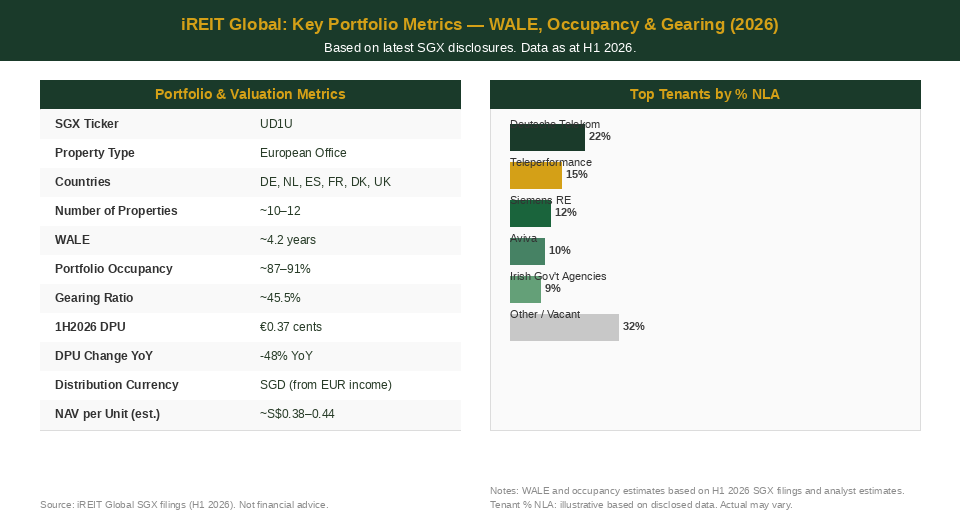
As at H1 2026, iREIT Global’s portfolio spans approximately 10–12 properties across six European countries: Germany, the Netherlands, Spain, France, Denmark, and the UK. Key tenants include Deutsche Telekom (its largest tenant by NLA), Teleperformance, and various government-linked agencies — providing the kind of counterparty quality rarely seen in Singapore-listed office REITs.
The REIT distributes income semi-annually in SGD. Because rental income is denominated in EUR, the EUR/SGD exchange rate is the single biggest variable outside of operational performance — a 5% appreciation in the EUR versus SGD translates directly to approximately 5% more DPU in SGD terms, all else equal.
Key Facts at a Glance
| Metric | Detail |
|---|---|
| SGX Ticker | UD1U |
| REIT Type | European Commercial / Office REIT |
| Countries | Germany, Netherlands, Spain, France, Denmark, UK |
| Property Type | Grade-A Office & Commercial (master leases) |
| Portfolio WALE | ~4.2 years (as at H1 2026) |
| Gearing Ratio | ~45.5% (H1 2026; MAS limit 50%) |
| 1H2026 DPU | €0.37 cents per unit (-48% YoY) |
| Distribution Currency | SGD (converted from EUR income) |
| Distribution Frequency | Semi-annual |
| Approx. NAV/Unit (est.) | ~S$0.38–0.44 (subject to property valuations) |
| Investor Profile | Income investors seeking European property diversification |
Source: iREIT Global SGX filings and semi-annual results (H1 2026). Data as at October 2026. Not financial advice.
Share Price Drivers: EUR/SGD, Gearing & DPU
iREIT Global’s share price tends to move in response to four primary catalysts:
1. EUR/SGD Exchange Rate. Because all rental income is earned in EUR and distributed in SGD, every swing in the EUR/SGD rate has a direct, roughly linear impact on the DPU that unitholders receive. When the EUR strengthens against the SGD — as it has been doing in 2026 as the European Central Bank (ECB) holds rates while the Fed cuts — iREIT Global’s distributions in SGD rise without any improvement in the underlying European properties. This currency tailwind is one reason analysts track the EUR/SGD pair closely for this REIT.
2. DPU Trajectory. The 48% year-on-year decline in DPU to €0.37 cents per unit in H1 2026 was driven primarily by higher interest costs on variable-rate debt as European rates rose sharply from 2022–2024. With the ECB’s rate-cut cycle now underway, the direction of DPU recovery depends heavily on how quickly iREIT Global can refinance expiring debt at lower floating rates or hedge into fixed instruments.
3. Portfolio Valuation and NAV. European office property values have been under pressure globally as remote work reduces demand for traditional office space. iREIT Global’s NAV has declined from its peak due to downward property revaluations, causing the REIT to trade at a discount to NAV — a discount that may narrow as European office markets stabilise in 2026–2027.
4. Gearing and Refinancing Risk. At ~45.5% gearing (close to MAS’s 50% regulatory cap for REITs), any further decline in property valuations could push iREIT Global closer to the limit, potentially triggering equity fund-raising or asset disposal. Investors monitor this carefully alongside the debt maturity profile.
EUR/SGD Currency Impact on DPU
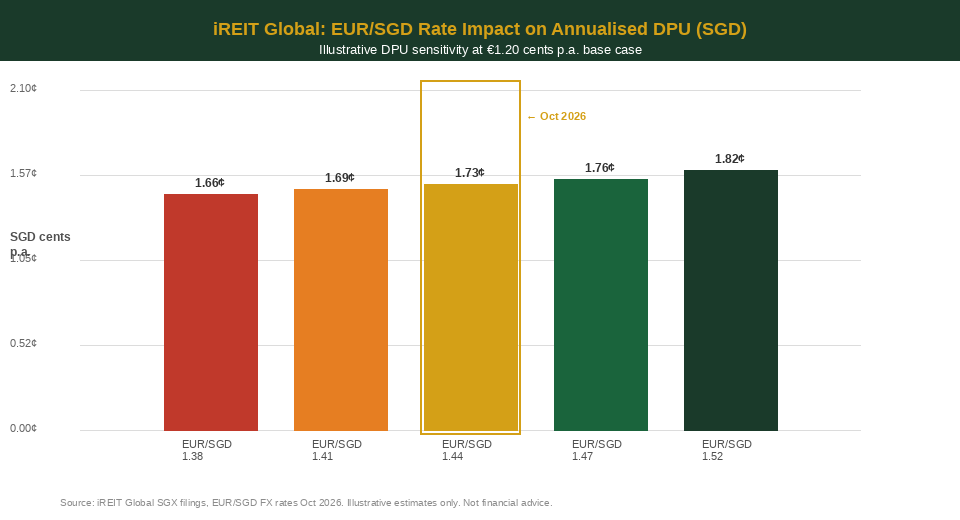
The EUR/SGD exchange rate is arguably the most important external variable for iREIT Global investors. As at October 2026, EUR/SGD is trading around 1.43–1.46 — a meaningful recovery from the lows of ~1.36–1.38 seen in 2023–2024 when the ECB was still in rate-hiking mode while the MAS was also tightening SGD. As the ECB shifts to rate cuts and the Fed continues easing, the EUR has regained ground.
To illustrate the sensitivity: if iREIT Global earns approximately €2.40 cents per unit in annual distributions (illustrative at current European portfolio levels), the SGD equivalent at various EUR/SGD rates would be:
| EUR/SGD Rate | Annual DPU (SGD cents) | DPU Change vs Base | Implied Yield at S$0.22 |
|---|---|---|---|
| 1.38 (Bear) | 3.31¢ | -4.3% | 1.51% |
| 1.41 (Below Base) | 3.38¢ | -2.3% | 1.54% |
| 1.44 (Base — Oct 2026) | 3.46¢ | Base | 1.57% |
| 1.47 (Mild Bull) | 3.53¢ | +2.0% | 1.60% |
| 1.52 (Bull) | 3.65¢ | +5.5% | 1.66% |
Illustrative only. Assumes ~€2.40 cents annual DPU at iREIT Global property level and S$0.22 unit price. Actual DPU depends on operational performance, hedging, and debt costs. Not financial advice.
As the table shows, the yield impact of EUR/SGD movement is real but not dramatic at the current DPU level — which remains suppressed relative to historical distributions. The more significant EUR/SGD catalyst would be if DPU recovers from the current depressed levels as debt costs normalise, in which case a higher EUR/SGD would amplify that recovery further.
Investors looking for European real estate exposure alongside more established Singapore property income streams may want to review the best S-REITs in Singapore 2026 guide, which covers a broader range of yield and sector options.
WALE & Tenant Quality Analysis
One of iREIT Global’s most compelling structural attributes is the quality and duration of its tenant base. Unlike many office REITs that let short-term multi-tenanted leases, a significant portion of iREIT Global’s portfolio is held on master leases — long-term, whole-building agreements with single institutional tenants.
Its WALE of approximately 4.2 years provides reasonable income visibility out to 2028–2030 for much of the portfolio. More importantly, the tenant credit quality reduces the risk of sudden vacancy spikes. Deutsche Telekom (Germany’s largest telecommunications company, majority state-owned) has been one of its anchor tenants for years, providing a AAA-grade counterparty in the most stable office market in Europe.
| Country | Key Asset/Tenant | Approx. % NLA | Lease Structure | Tenant Credit |
|---|---|---|---|---|
| Germany | Deutsche Telekom Campus | ~22% | Master Lease | State-Backed / AA |
| France | Teleperformance HQ | ~15% | Long-Term Direct | Investment Grade |
| Netherlands | Siemens Real Estate | ~12% | Master Lease | Investment Grade |
| UK | Aviva Insurance | ~10% | Long-Term Direct | Investment Grade |
| Denmark | Government Agencies | ~9% | Master Lease | Sovereign-Linked |
| Spain | Various Commercial Tenants | ~10% | Multi-Tenant | Mixed / Watch |
Source: iREIT Global SGX disclosures and company presentations. Approximate figures — actual NLA allocation may vary. Illustrative tenant estimates based on publicly disclosed data.
The Spain portfolio has historically been the most challenging, given softer office demand in Madrid and Barcelona compared to core German and Dutch markets. Investors should monitor occupancy rates in the Spanish assets as these are more susceptible to lease non-renewal. The Germany and Netherlands core assets, by contrast, benefit from master leases that provide contractual income regardless of sub-tenancy levels.
For context on how this WALE profile compares with Singapore-focused REITs, see our broader guide on passive income through Singapore S-REITs.
Valuation: P/NAV Discount & Yield
A key attraction for value-oriented investors in iREIT Global is its persistent trading discount to Net Asset Value (NAV). NAV-based valuation is meaningful for REITs because the underlying properties can be independently valued — a significant discount to NAV implies either a margin of safety (if the NAV holds) or a warning signal (if the NAV continues to be revised down).
Based on analyst estimates and management disclosures as at October 2026, iREIT Global’s adjusted NAV per unit is estimated at approximately S$0.38–0.44 per unit, depending on the methodology used for European property valuations. With the share price typically trading in the S$0.18–0.25 range (figures are indicative and subject to market movement), this implies a P/NAV ratio of approximately 0.45–0.60x — a discount of 40–55% to NAV.
Such a steep discount to NAV can persist for extended periods when:
- The income return (yield) is insufficient to justify the risk premium (current yield is depressed due to the DPU decline)
- There are concerns about balance sheet sustainability (elevated gearing at 45.5%)
- The asset class (European office) is out of favour globally
However, the discount can also compress quickly if: (a) DPU recovers as European interest rates fall and debt is refinanced, (b) European office demand stabilises, or (c) there is a strategic corporate action such as privatisation, portfolio disposal, or recapitalisation. Given the current discount level, any of these catalysts could drive meaningful share price appreciation.
If you are building a balanced passive income portfolio and want to model how iREIT Global might fit, use our Singapore retirement calculator to estimate the monthly income required from your investment portfolio.
Gearing & Debt Refinancing Risk
Gearing is the most important near-term risk factor for iREIT Global. At ~45.5% as at H1 2026, the REIT is operating with relatively thin headroom before reaching MAS’s 50% regulatory cap (with proportionate property valuation risk). The key questions for investors are:
Debt maturity profile: When do iREIT Global’s loans expire, and at what rate? If significant debt is refinancing in 2026–2027, the REIT should benefit from the ECB’s rate-cutting cycle — existing floating-rate facilities will reprice lower, directly improving distributable income. However, if debt expires and credit conditions in European commercial real estate remain tight, refinancing risk is non-trivial.
Hedging strategy: iREIT Global has historically used a mix of fixed-rate debt and interest rate swaps to partially hedge its EUR interest costs. The degree of hedging in place determines how much of the ECB rate cuts flow through to DPU.
Asset disposals: If gearing remains elevated, management may consider selective asset disposals to deleverage — potentially unlocking value if assets can be sold near NAV. Any disposal at a discount to book value would however be dilutive to NAV.
Investors should check iREIT Global’s latest SGX announcements (available on SGX’s investor portal) for the most current debt maturity schedule and refinancing updates before making investment decisions.
iREIT Global vs Peer S-REITs
How does iREIT Global compare with other SGX-listed REITs that Singapore investors might consider for income diversification? The table below compares iREIT Global with other sub-scale or niche S-REITs to contextualise its risk/reward profile:
| REIT | Market | Yield (est.) | Gearing | Unique Risk |
|---|---|---|---|---|
| iREIT Global (UD1U) | Europe Office | ~1.5–2.5%* | ~45.5% | EUR/SGD FX, European office demand |
| Elite Commercial REIT (MXNU) | UK Office | ~6–7% | ~41% | UK DWP lease renewal risk |
| Sasseur REIT (CRPU) | China Outlets | ~9–10% | ~26% | China consumer sentiment, CNY/SGD |
| IREIT Global (UD1U) | vs S-REIT Index avg | ~5–7% avg | ~36% avg | Singapore-centric; lower FX risk |
*iREIT Global’s depressed yield reflects the DPU decline in H1 2026. Yield may recover as interest costs normalise. Not financial advice — compare current data before investing.
As the table shows, iREIT Global currently offers a lower yield than most S-REIT peers due to the DPU decline, while carrying above-average gearing. The investment case is therefore not primarily income-yield-based in 2026 — it is more of a recovery and NAV-discount compression play for investors willing to wait for European interest rate normalisation and property market stabilisation.
By contrast, investors seeking higher, more immediate income yields from Singapore property might prefer established S-REITs such as Keppel DC REIT, Frasers Centrepoint Trust, or the diversified exposure offered through a Singapore REIT ETF. For commission-efficient access to either iREIT Global or Singapore-listed ETFs, platforms like FSMOne offer low-fee RSP options — see our FSMOne referral code page for sign-up bonuses.
Should You Buy iREIT Global?
iREIT Global is appropriate for a specific type of investor. Here is a straightforward framework:
iREIT Global may suit you if:
- You want genuine geographic diversification beyond Singapore’s property market
- You believe European office demand will stabilise and interest rates will continue falling, improving DPU recovery
- You are comfortable with FX risk and understand that a weaker EUR/SGD directly reduces your SGD income
- You are a contrarian investor comfortable with high-gearing, distressed-discount situations where P/NAV is depressed
- iREIT Global forms a small, diversifying position (e.g. 3–5% of portfolio) alongside higher-yielding core S-REITs
Consider alternatives if:
- You need reliable, stable income now — the current DPU is depressed and recovery timing is uncertain
- You are uncomfortable with the gearing level and the theoretical risk of a rights issue or equity fundraising
- You prefer Singapore-centric property exposure without FX risk
- You have limited risk capital and need a more predictable yield from REITs like Mapletree Logistics Trust or Frasers Centrepoint Trust
If you are considering iREIT Global as part of a broader retirement income strategy, check our retirement planning calculator to understand how much passive income you need and how iREIT Global’s current yield fits into that picture. For investors interested in CPF-eligible alternatives, the CPF investment strategy guide covers CPFIS-eligible unit trusts and the Endowus referral code for CPF and SRS-accessible funds.
For investors who prefer the diversification of an S-REIT portfolio without single-REIT concentration risk, the Syfe REIT+ portfolio (use code SRPRFFFCD) provides managed S-REIT exposure with automatic rebalancing — a simpler alternative to building individual S-REIT positions.
Frequently Asked Questions
What is iREIT Global's SGX ticker?
iREIT Global trades on the Singapore Exchange (SGX) under the ticker UD1U. It is denominated and traded in Singapore dollars (SGD), though its underlying rental income is earned in EUR from European commercial properties. Investors can purchase UD1U units through any SGX-connected brokerage including Interactive Brokers, Syfe Brokerage, FSMOne, and DBS Vickers.
Why did iREIT Global's DPU fall 48% in H1 2026?
iREIT Global’s 1H2026 DPU fell approximately 48% year-on-year to €0.37 cents per unit primarily due to a sharp increase in debt servicing costs as European interest rates rose from near-zero to 3–4% between 2022 and 2024. Variable-rate loans repriced higher, directly reducing the distributable income available to unitholders. Secondary factors included softer property valuations and some vacancies in Spain. The ECB’s rate-cutting cycle beginning in 2024–2025 should gradually reduce this burden as loans are refinanced.
How does the EUR/SGD exchange rate affect iREIT Global distributions?
All of iREIT Global’s rental income is earned in EUR. The REIT converts EUR income to SGD before distributing to unitholders. When EUR strengthens against SGD (i.e., EUR/SGD rises), the same EUR income buys more SGD, resulting in higher SGD distributions. Conversely, a weaker EUR reduces SGD payouts. In October 2026, EUR/SGD is approximately 1.43–1.46, which is recovering from the lows of ~1.36–1.38 seen in 2023–2024 — a mild tailwind for current distributions.
Is iREIT Global's gearing ratio a concern?
Yes — at approximately 45.5% as at H1 2026, iREIT Global’s gearing is elevated relative to the S-REIT sector average of ~35–37%. The MAS regulatory limit is 50% (with approval to go higher under certain conditions). This leaves limited headroom if European property values decline further. Investors should monitor whether iREIT Global undertakes asset disposals, equity fundraising, or debt refinancing to reduce gearing. High gearing amplifies both upside and downside — a recovery in property values and DPU would be magnified, but further asset devaluation increases risk of a dilutive equity raise.
Who are iREIT Global's key tenants?
iREIT Global’s portfolio is anchored by institutional-grade and government-linked tenants. Deutsche Telekom (Germany’s state-backed telecommunications giant) is one of the largest tenants by NLA. Other major tenants include Teleperformance (France), Siemens Real Estate (Netherlands), Aviva (UK), and various government agencies in Denmark. This blue-chip tenant base is a key structural positive — it reduces vacancy risk significantly compared to speculative multi-tenant office buildings, and underpins the WALE of approximately 4.2 years.
Can I buy iREIT Global using CPF or SRS?
iREIT Global (UD1U) is listed on SGX and may be eligible for purchase under the CPF Investment Scheme (CPFIS) or Supplementary Retirement Scheme (SRS), subject to your broker’s eligibility list and MAS rules. Check directly with your broker (e.g. OCBC Securities, DBS Vickers, FSMOne) whether UD1U is CPFIS-approved for OA or SA funds. SRS purchases are generally more flexible — most SGX-listed securities can be purchased via SRS brokerage accounts. Always confirm current eligibility before investing CPF or SRS funds.
What is the outlook for iREIT Global's share price in 2026?
The share price outlook for iREIT Global in 2026 depends on three key variables: (1) the trajectory of ECB interest rate cuts and their impact on iREIT Global’s debt refinancing costs, (2) the EUR/SGD exchange rate — continued EUR recovery would boost SGD distributions, and (3) European office occupancy stability, particularly in Spain. If DPU begins recovering from the H1 2026 trough as debt costs normalise, and if the REIT can reduce gearing via asset recycling, there is potential for P/NAV discount compression. This is not a near-term income play — it is a medium-term recovery thesis. Not financial advice.
Build Your S-REIT Passive Income Portfolio
Compare Singapore REITs, calculate your income targets, and access broker sign-up bonuses — all in one place.
This article was researched with the help of AI. While we strive to keep all information accurate and up to date, there may be errors. If you notice any discrepancies, please contact us.