New ISP Rider 2026: Co-Payment Breakdown & How to Decide
Old rider vs new rider · Real MOH bill examples · Premium savings calculator
From 1 April 2026, new Integrated Shield Plan (ISP) riders in Singapore no longer cover your deductible — and the co-payment cap doubled from ,000 to ,000 a year. In exchange, premiums dropped by around 30%. Whether you should switch depends on one thing: will your premium savings outweigh the higher out-of-pocket cost if you’re hospitalised? This guide does the math for you.
Not financial advice. All figures are for educational reference only. Data verified as at 20 September 2026 — sourced from MOH Singapore official press release (26 November 2025).
- New riders (from April 2026) don’t cover your deductible (,500–,500 depending on ward class). You pay this first, every year you’re hospitalised.
- Your co-payment cap doubles from ,000 to ,000 — but premiums drop ~30% (saving ~00/year on average for private hospital policyholders).
- The switch makes financial sense for most policyholders who aren’t hospitalised every year — but run the numbers for your specific age and ward class.
What Changed on 1 April 2026?
MOH announced the changes in November 2025. The goal: break the cycle of rising premiums driven by over-servicing and over-consumption at private hospitals.
Before April 2026, your rider could cover almost everything — your deductible, your co-payment, up to a cap of ,000 a year. That “peace of mind” came at a cost. MOH found that private hospital IP policyholders with riders were 1.4 times more likely to make a claim, with average claim sizes 1.4 times higher than those without riders.
From 1 April 2026, three things changed:
- No deductible coverage. New riders can no longer cover the minimum deductible set by MOH. You pay that amount before insurance kicks in.
- Higher co-payment cap. The minimum annual co-payment cap rose from ,000 to ,000 (excluding the deductible).
- Lower premiums. New private hospital riders cost about 30% less on average.
Who’s affected? If you bought your rider before 27 November 2025, you’re not immediately affected. Your existing rider continues until you decide to switch. Riders bought between 27 November 2025 and 31 March 2026 must transition to a compliant rider by the next policy renewal after 1 April 2028.
Old Rider vs New Rider: Side-by-Side Comparison
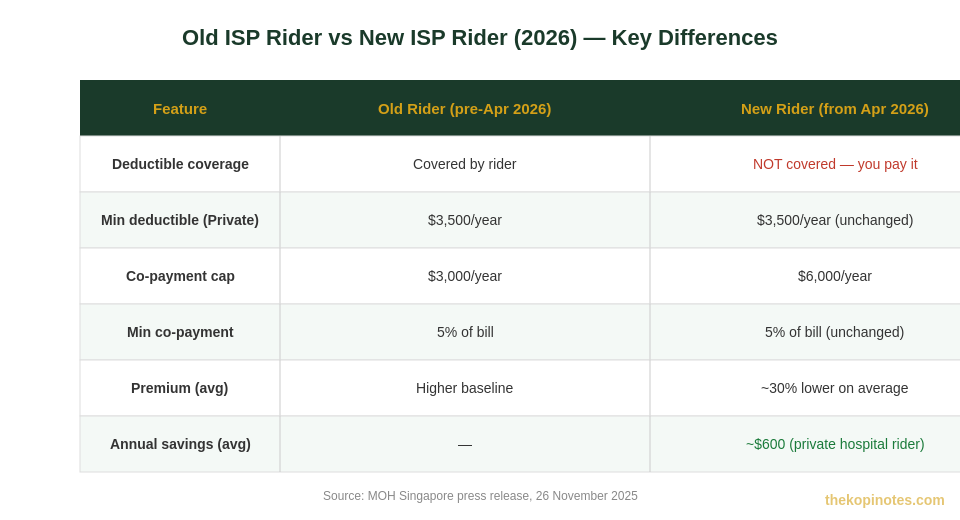
Here’s everything that changed — and what stayed the same.
Source: MOH Singapore press release, 26 November 2025
| Feature | Old Rider (pre-Apr 2026) | New Rider (from Apr 2026) |
|---|---|---|
| Deductible coverage | ✅ Covered by rider | ❌ NOT covered — you pay |
| Min deductible (Class A/Private) | ,500/year | ,500/year (unchanged) |
| Annual co-payment cap | ,000 | ,000 |
| Min co-payment | 5% of bill | 5% of bill (unchanged) |
| Average premium | Higher | ~30% lower on average |
| Annual premium saving | — | ~00 (private hospital rider) |
| MediSave usable for deductible + co-pay | Yes | Yes |
Source: MOH Singapore, November 2025. Actual premiums vary by insurer, plan, and age.
The key point: with the new rider, you absorb the deductible yourself — every year you’re hospitalised. Your MediSave hospitalisation limits and ward class both affect how much you ultimately pay.
Minimum Deductibles by Ward Class (2026)
MOH sets the minimum deductible for each IP based on the ward class your plan covers. This is the amount you pay first — before your IP or rider pays anything. Under the new rules, your rider can no longer absorb this cost.
| IP Coverage / Ward Utilised | Minimum Deductible (per year) |
|---|---|
| Class A / Private hospital | ,500 |
| Class B1 | ,500 |
| Class B2 | ,000 |
| Class C | ,500 |
| Day surgery / Short stay (non-subsidised) | ,000 |
| Day surgery / Short stay (subsidised) | ,500 |
Source: MOH Singapore, Annex A. Deductibles apply per policy year and may be updated from time to time.
One useful detail: the deductible is based on the lower of your IP’s target ward class and the ward class you actually use. So if your plan targets B1 but you choose a C ward, your deductible is ,500 — not ,500. You pay the deductible once per policy year, even with multiple hospitalisations.
Not sure which ward class is right for you? Our guide to Integrated Shield Plans breaks down the differences and what each level of coverage means in practice.
Real Bill Examples from MOH (Worked Math)
MOH published two worked examples in their press release. These show exactly how the numbers play out under the new vs old rider.
Example 1: 60-Year-Old, Knee Replacement, Private Hospital (6,900 bill)
| Item | Old Rider | New Rider |
|---|---|---|
| Total hospital bill | 6,900 | 6,900 |
| Deductible paid by you | bash (rider covers it) | ,500 |
| Co-payment (5% of remaining) | ,840 | ,670 |
| Total out-of-pocket (MediSave) | ,840 | ,170 |
| Extra paid vs old rider | — | +,330 more in MediSave |
| Annual rider premium saving | — | ~,600/year in cash |
| 3-year cumulative premium saving | — | ,800 saved in cash |
Source: MOH Singapore Annex B, November 2025. Bill size based on median private hospital knee replacement bills in 2024. Actual bills vary.
The verdict for this 60-year-old: switching saved ,800 in premiums over 3 years. The higher hospitalisation cost ,330 more in MediSave. He came out ,470 better off after one hospitalisation over 3 years. And his savings grow larger each year as premiums rise with age.
Example 2: 40-Year-Old, ACL Surgery, Private Hospital (8,700 bill)
Mrs B previously had no rider — premiums were too expensive. With the new, cheaper rider available in April 2026, she signed up. In December 2026 she tore her knee and needed surgery.
- Deductible (,500) + 5% co-pay on remainder = ,260 total co-pay
- Of this, ,900 was covered by MediSave withdrawals
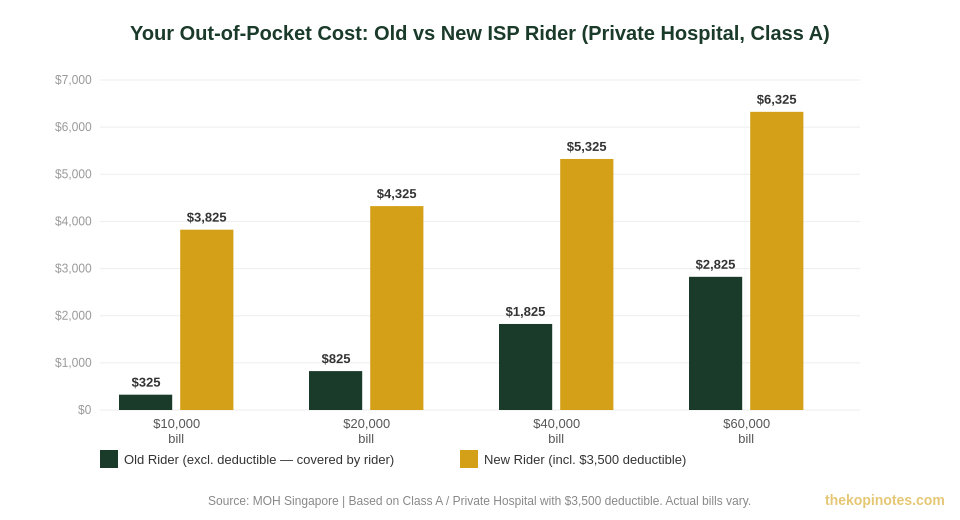
- Out-of-pocket cash: ,360 (vs ,120 without any rider)
The rider still gave her meaningful protection even under the new rules — limiting her cash outlay significantly. And she’s paying 00 less per year than peers who bought the old pricier rider.
Source: MOH Singapore | Class A / Private Hospital, ,500 deductible. Actual bills vary.
Premium Savings: Who Benefits Most?
The 30% reduction applies on average across all ages — but MOH notes that older policyholders enjoy greater savings in absolute dollar terms, because their premiums are higher to begin with.
| Rider Type | Avg Annual Premium Saving | 5-Year Cumulative Saving |
|---|---|---|
| Private hospital rider | ~00/year | ~,000 |
| Public hospital rider | ~00/year | ~,000 |
| 60-year-old (MOH example) | ~,600/year | ~,000 |
Source: MOH Singapore, November 2025. Averages — actual saving depends on your insurer, age, and plan.
MOH’s data shows an average 40-year-old undergoes day surgery or hospitalisation only once or twice in 20 years. A 60-year-old will see about two episodes in the next 10 years. That frequency is the key variable when weighing premium savings against higher co-payment.
Wondering whether to drop your rider entirely? See what happened when 181,800 Singaporeans cancelled their ISP rider in 2025 — and whether that makes sense for you.
Should You Switch to the New Rider?
There’s no single right answer. Here’s a framework to help you decide.
Switch to the new rider if:
- You’re not hospitalised frequently. If you go years between hospital stays, the premium savings pile up while your co-payment stays at bash. One healthy year = 00+ saved.
- You have sufficient MediSave. If your MediSave balance is healthy, you can absorb the deductible and higher co-payment without touching cash savings.
- You’re older. Your premium savings are larger in absolute terms — the break-even comes faster.
- You want lower cash outlay now. The premium reduction is immediate. The higher co-payment only matters when you’re hospitalised.
Keep your old rider if:
- You have a chronic condition leading to frequent hospitalisations. If you’re admitted every year, you pay the deductible every year — eroding the premium saving quickly.
- You’re on a public hospital plan (Class B1/C). Deductibles are lower (,500–,500), but so are your premium savings (~00/year for public hospital riders).
- You have a planned major procedure soon. If surgery is coming in the next 12 months, staying on the old rider for that year may cost less overall.
Thinking about your shield plan more broadly? Our complete Singapore Shield Plan guide covers ISP basics, ward classes, and how MediShield Life works alongside your IP rider.
If you’ve already decided to downgrade instead, see our detailed look at whether to downgrade your ISP rider in 2026, including the latest MOH data on how many Singaporeans have already made that call.
Frequently Asked Questions
Can I still use MediSave to pay the new deductible?
If I bought my rider before 27 November 2025, must I switch?
What if I bought my rider between 27 November 2025 and 31 March 2026?
Does the ,000 co-payment cap include the deductible?
Can insurers offer terms more generous than the new minimums?
How do I switch to the new rider?
All data verified as at 20 September 2026. Sources: MOH Singapore press release, 26 November 2025. This article is for general educational purposes and does not constitute financial or medical advice. Please consult a licensed financial adviser for advice tailored to your circumstances.
Get Free Insurance Advice
Speak with a licensed insurance advisor. No obligation, no cost.
By submitting this form, you agree to our Privacy Policy.
This article was researched with the help of AI. While we strive to keep all information accurate and up to date, there may be errors. If you notice any discrepancies, please contact us.