EM Local Currency Bond ETFs for Singapore Investors: EM1C vs SEML vs EMLC vs LEMB (2026 Guide)
A Singapore investor’s guide to emerging market local-currency government bond ETFs — currency risk, yield, tax treatment, and how they differ from the USD-denominated EM bonds most guides cover.
Emerging market (EM) local-currency bond ETFs like EM1C, SEML, EMLC, and LEMB hold government bonds issued by countries such as Brazil, India, Mexico, and South Africa — denominated in each country’s own currency, not USD. Singapore investors buy them through LSE-listed UCITS versions (EM1C, SEML) or US-listed versions (EMLC, LEMB), but the real risk isn’t withholding tax — it’s currency swings across a basket of emerging market currencies.
Not financial advice. All figures are for educational reference only. Data as at September 2026 unless noted.
- EM local bond ETFs pay a higher headline yield (~5-6%) than USD-denominated EM bonds, but a chunk of that return depends on EM currencies staying stable against USD — not just on the countries paying their coupons.
- The UCITS versions (EM1C, SEML) avoid US estate tax exposure entirely. The US-listed versions (EMLC, LEMB) don’t — above USD 60,000 in US-situs assets, your estate could owe US estate tax.
- Local withholding tax on the bond interest is baked into every version’s returns regardless of where the ETF itself is domiciled — that part you can’t avoid by picking LSE over NYSE.
Table of Contents
Quick Answer: Which EM Local-Currency Bond ETF Should You Pick?
If you’re a Singapore investor and want exposure to this asset class, EM1C (VanEck J.P. Morgan EM Local Currency Bond UCITS ETF, LSE ticker EMLC) is the cleanest choice for most people. It’s Ireland-domiciled, accumulating (no dividend admin), and carries zero US estate tax exposure.
SEML (iShares J.P. Morgan EM Local Government Bond UCITS ETF) is the better pick only if you specifically want quarterly cash distributions instead of automatic reinvestment — it charges a higher 0.50% TER for that convenience. The US-listed versions, EMLC and LEMB, offer nothing extra over their UCITS equivalents for a Singapore investor and add estate tax risk you don’t need to take.
Key Differences at a Glance
Four ETFs give Singapore investors exposure to the same broad asset class — local-currency emerging market government bonds — but they differ meaningfully in structure, cost, and tax exposure. Here’s how they stack up.
| Feature | EM1C / EMLC.L | SEML / IEML | EMLC (US) | LEMB (US) |
|---|---|---|---|---|
| Full Name | VanEck J.P. Morgan EM Local Currency Bond UCITS ETF | iShares J.P. Morgan EM Local Government Bond UCITS ETF | VanEck J.P. Morgan EM Local Currency Bond ETF | iShares J.P. Morgan EM Local Currency Bond ETF |
| Exchange | London Stock Exchange | London Stock Exchange | NYSE Arca | NYSE Arca |
| ISIN | IE00BDS67326 | IE00B5M4WH52 | US92189F7015 | US4642865178 |
| Domicile | Ireland | Ireland | USA | USA |
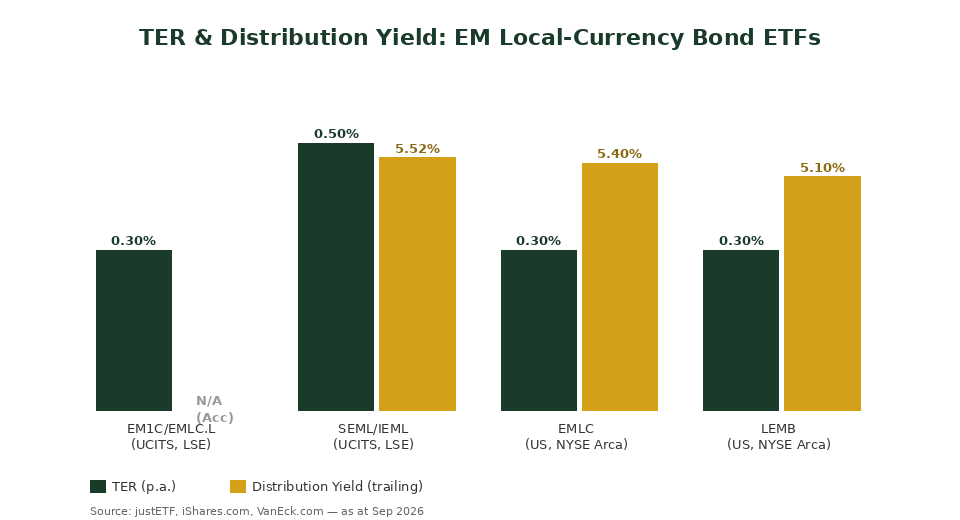
| TER | 0.30% p.a. | 0.50% p.a. | 0.30% p.a. | 0.30% p.a. |
| Structure | Accumulating | Distributing (quarterly) | Distributing (monthly) | Distributing (monthly) |
| AUM | ~EUR 206m (Sep 2026) | ~EUR 4.2bn (Sep 2026) | ~USD 4.2bn (Sep 2026) | ~USD 720m (Sep 2026) |
| Index Tracked | JPM GBI-EM Global Core | JPM GBI-EM Global Diversified (10% Cap/1% Floor) | JPM GBI-EM Global Core | JPM GBI-EM Global Diversified |
| Holdings | ~445 bonds | ~346 bonds | ~400+ bonds | ~200+ bonds |
| US Estate Tax Risk | None | None | Yes (above USD 60k) | Yes (above USD 60k) |
Source: justETF, iShares.com, VanEck.com fund factsheets, as at September 2026.
Why Currency Risk — Not Withholding Tax — Is the Real Story Here
Most TKN guides on US vs UCITS ETFs lead with withholding tax (WHT) as the main differentiator. For EM local-currency bonds, that’s not the biggest risk. Here’s why.
When you buy CSPX or VWRA, the underlying assets are priced in USD. When you buy EM1C or SEML, the underlying bonds are priced in Brazilian real, Indian rupee, South African rand, Mexican peso, and a dozen other currencies. The fund converts everything back to USD (or GBP, if you buy the GBP share class) for its published NAV. That conversion is where most of your return volatility actually comes from.
For example, EM1C returned +4.93% year-to-date and +8.29% over the past 12 months as at September 2026 — a healthy result. But in 2022, the same underlying strategy (via SEML) fell -5.35% for the year, even though EM government bonds were still paying their coupons on schedule. The loss came almost entirely from EM currencies weakening against a strong US dollar that year. If you’re not comfortable with that kind of swing, this isn’t the right asset class regardless of which ticker you pick.
Here’s the part that surprises most investors: local withholding tax on the bond interest itself is baked into every version’s return, regardless of whether the ETF is domiciled in Ireland or the US. Many emerging market governments withhold tax on interest paid to foreign bondholders before it ever reaches the fund. That’s a country-level cost, not a US-tax-treaty issue — you can’t dodge it by choosing LSE over NYSE the way you can with US dividend withholding tax on equity ETFs like CSPX vs VOO.
Tax & Estate Exposure Comparison
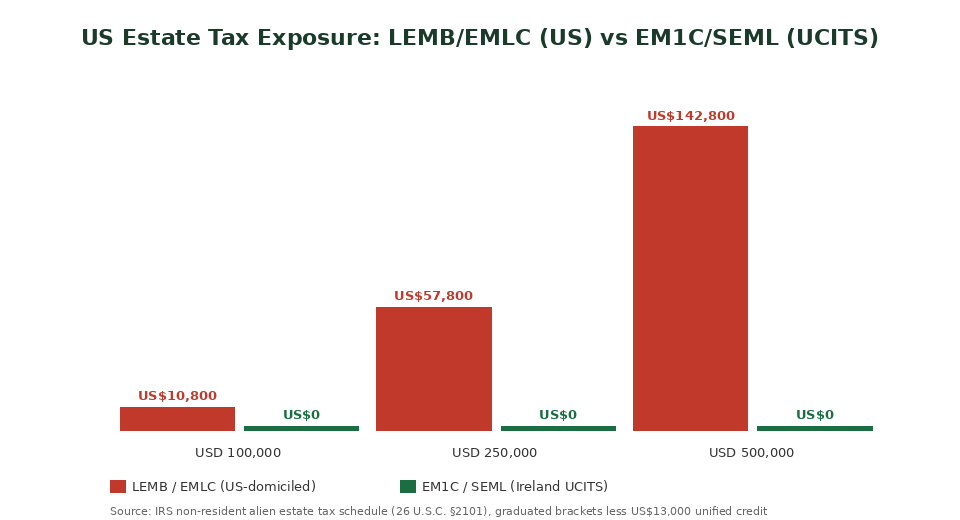
The genuine, avoidable tax risk with these ETFs is US estate tax — and it only applies to the US-listed versions, EMLC and LEMB. Non-US-resident individuals holding US-situs assets (which includes US-listed ETFs) above USD 60,000 can be subject to US federal estate tax on the excess, at graduated rates up to 40%, if they pass away while still holding the position.
This risk simply doesn’t exist for EM1C or SEML, because Ireland-domiciled UCITS funds are not US-situs assets. Here’s the actual dollar exposure using the real graduated non-resident-alien estate tax brackets (18%–40% above the USD 60,000 exemption, less the USD 13,000 unified credit) — not a rough estimate.
| Portfolio Value | US Estate Tax (EMLC/LEMB, US-listed) | US Estate Tax (EM1C/SEML, UCITS) |
|---|---|---|
| USD 100,000 | USD 10,800 | USD 0 |
| USD 250,000 | USD 57,800 | USD 0 |
| USD 500,000 | USD 142,800 | USD 0 |
Source: IRS non-resident alien estate tax schedule (26 U.S.C. §2101), graduated brackets less USD 13,000 unified credit.
On the withholding tax side, bond interest income (as opposed to equity dividends) can often qualify as an “interest-related dividend” under US Regulated Investment Company (RIC) rules, which can be exempt from the standard 30% non-resident withholding tax that hits equity dividends. This applies to EMLC and LEMB’s US-source interest allocations, not to the country-level withholding embedded in the underlying EM bonds themselves — the two are separate tax layers and shouldn’t be conflated.
Total Cost of Ownership
For a SGD 50,000 position, here’s what the annual management fee actually costs you across the four options, using USD/SGD ≈ 1.28.
| ETF | TER | Annual Fee on SGD 50,000 |
|---|---|---|
| EM1C (VanEck UCITS, Acc) | 0.30% | SGD 150 |
| SEML (iShares UCITS, Dist) | 0.50% | SGD 250 |
| EMLC (VanEck US) | 0.30% | SGD 150 |
| LEMB (iShares US) | 0.30% | SGD 150 |
Note that the US-listed versions don’t offer any fee advantage over their UCITS equivalents here — EMLC’s US and UCITS share classes both charge 0.30%. The only reason SEML costs more is that iShares’ local-government-bond UCITS structure carries a higher TER than VanEck’s, not because of domicile. There’s no cost-driven reason to accept US estate tax exposure for this asset class.
Who Should Pick Which?
EM1C is ideal if you want simple, low-cost, accumulating exposure to EM local-currency government bonds without thinking about dividend reinvestment, and you want zero US estate tax exposure. This covers most Singapore investors adding EM bonds as a diversifier.
SEML is worth the extra 0.20% TER if you specifically want quarterly cash distributions — for example, if you’re using this as an income sleeve in a retirement drawdown strategy and prefer visible cash flow over automatic reinvestment.
Consider skipping this asset class entirely if you’re not comfortable with double-digit currency-driven drawdowns in a single year (as happened in 2022), since that’s the dominant risk factor here — not credit risk or withholding tax.
This isn’t CPF-investable, but LSE-listed UCITS ETFs bought through an SRS-eligible broker can typically be held within an SRS account. If you’re weighing this against other fixed-income options for a Singapore retirement portfolio, our Singapore T-bills 2026 guide and our retirement calculator are useful starting points for comparing risk-adjusted yield across your options.
If you’ve already read our guide to USD corporate bond ETFs or our emerging market corporate bond ETF comparison, this article covers the other half of the EM fixed-income picture — government debt in local currency, rather than USD-denominated corporate or sovereign debt.
Frequently Asked Questions
What is an EM local-currency bond ETF, and how is it different from a USD-denominated EM bond ETF?
An EM local-currency bond ETF, like EM1C or SEML, holds government bonds issued by emerging market countries in each country’s own currency — Brazilian real, Indian rupee, South African rand, and so on. A USD-denominated EM bond ETF (like the corporate bond funds covered in our other guides) holds bonds priced in US dollars instead. Local-currency funds carry direct currency risk against your reference currency; USD funds don’t have that extra layer, but usually pay a lower yield to compensate.
Is EMLC the same fund whether I buy it on the LSE or on NYSE Arca?
No. EMLC.L (LSE, ticker EM1C on some venues) is VanEck’s Ireland-domiciled UCITS ETF, while EMLC (NYSE Arca) is a separate US-domiciled fund from the same manager tracking a similar JPM GBI-EM Global Core index. They hold similar underlying bonds and charge the same 0.30% TER, but they are legally distinct funds with different domiciles, and only the US-listed EMLC carries US estate tax exposure for non-resident investors.
Can I buy EM local-currency bond ETFs using my CPF or SRS funds?
These LSE-listed UCITS ETFs are not on the CPF Investment Scheme’s approved list, so you cannot use CPF Ordinary Account or Special Account funds to buy them. Some SRS-eligible brokers do support LSE-listed ETF purchases within an SRS account — check with your specific broker (IBKR, Saxo, or FSMOne) before assuming SRS eligibility, as this varies by platform.
Which broker is best for buying EM1C or SEML in Singapore?
Interactive Brokers (IBKR) and Saxo Markets both support LSE-listed UCITS ETF purchases and are generally the most cost-effective for this asset class, since EM local-currency bond ETFs are a niche product with lower average trade volumes. FSMOne also supports LSE access for Singapore clients. moomoo Singapore does not currently support LSE trading, so it’s not an option for EM1C or SEML specifically.
Is EM local-currency bond investing safe? What are the main risks?
The main risk is currency volatility — EM currencies can weaken sharply against USD during risk-off periods, as happened across 2022, and that can outweigh the coupon income you earn. Credit risk (a country defaulting or restructuring debt) and liquidity risk in smaller local bond markets are secondary but real considerations. This asset class is best treated as a diversifier within a broader fixed-income allocation, not a core holding.
Why does SEML have a higher expense ratio than EM1C if they track similar indices?
SEML (iShares) tracks the JPM GBI-EM Global Diversified index with a 10% country cap and 1% floor, and pays quarterly cash distributions, while EM1C (VanEck) tracks the related JPM GBI-EM Global Core index and automatically reinvests income. The 0.20 percentage-point TER difference reflects each provider’s own pricing and the operational cost of running a distributing share class rather than a fundamental difference in what’s inside the fund.
Ready to Diversify Your Fixed-Income Allocation?
Open a brokerage account that supports LSE-listed ETFs and explore EM local-currency bonds as part of a diversified portfolio.
This article was researched with the help of AI. While we strive to keep all information accurate and up to date, there may be errors. If you notice any discrepancies, please contact us.