Expense Ratio Meaning: A Complete Guide for Singapore ETF Investors (2026)
Understand TER, hidden costs, and how to compare ETF fees — with real SGD calculations for Singapore investors.
An expense ratio (also called the Total Expense Ratio or TER) is the annual fee an ETF charges to cover its operating costs, expressed as a percentage of your invested amount. For Singapore investors, the expense ratio is automatically deducted from the fund’s assets — you never receive a bill. A TER of 0.07% on a SGD 100,000 portfolio costs just SGD 70 per year, while a 0.50% TER on the same amount costs SGD 500 — a difference that compounds significantly over decades.
Not financial advice. All figures are for educational reference only. Data as at June 2026 unless noted.
Table of Contents
Contents — Click to expand
- What Is an Expense Ratio?
- TER vs MER: What’s the Difference?
- How Expense Ratios Are Deducted
- Expense Ratio Comparison: Popular ETFs in Singapore
- Real Cost Impact in SGD at Different Portfolio Sizes
- Hidden Costs Beyond the Expense Ratio
- Expense Ratio in the Singapore Context
- How to Minimise Costs as a Singapore ETF Investor
- Frequently Asked Questions
What Is an Expense Ratio?
The expense ratio is the annual cost of owning an ETF or mutual fund, expressed as a percentage of your total investment. It covers the fund manager’s fee, custody fees, auditing costs, legal expenses, and administration — everything it takes to keep the fund running and tracking its index.
For exchange-traded funds (ETFs), the expense ratio is formally called the Total Expense Ratio (TER). Unlike a broker commission that you pay upfront when buying or selling, the TER is silently deducted from the fund’s net asset value (NAV) on a daily basis. You never receive a separate invoice — the cost is already baked into the ETF’s price.
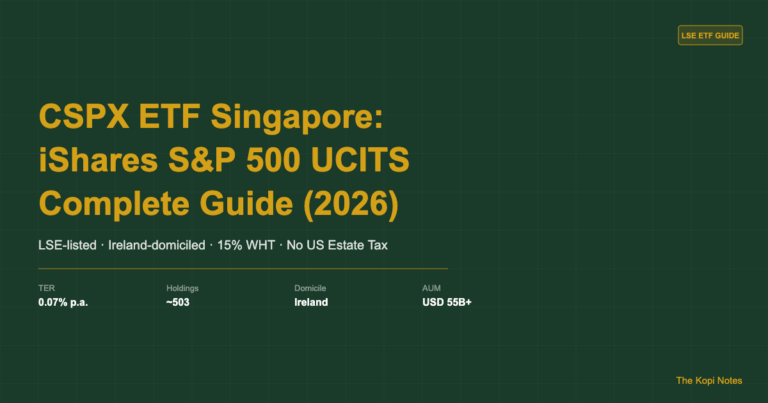
Here’s a simple illustration: if CSPX (iShares Core S&P 500 UCITS ETF) has a TER of 0.07% p.a. and you invest SGD 50,000, the annual cost is just SGD 35. This works out to less than SGD 3 per month — an extremely low drag on your returns compared to actively managed funds, which typically charge 1–2% annually.
The key insight for Singapore investors: every percentage point of TER you avoid translates directly into higher returns over the long run. On a SGD 200,000 portfolio held for 20 years, the difference between a 0.07% TER and a 1.50% TER (typical for unit trusts) amounts to over SGD 80,000 in lost compounding — money that stayed with the fund manager instead of you.
TER vs MER: What’s the Difference?
You may encounter two terms when researching ETF costs: TER (Total Expense Ratio) and MER (Management Expense Ratio). In Singapore and the UK/European markets where most LSE-listed UCITS ETFs originate, TER is the standard. In North America, MER is used more commonly. They are conceptually similar but have subtle differences:
| Term | Used In | What It Covers | Includes Transaction Costs? |
|---|---|---|---|
| TER | UK/EU/SG (LSE-listed ETFs) | Management fee + admin + custody + audit + legal | No |
| MER | North America (US/Canada) | Management fee + admin + operating expenses | No |
| OCF | EU (post-2013 regulation) | Ongoing Charges Figure — equivalent to TER | No |
Source: iShares/BlackRock fund documentation, ESMA guidelines, June 2026
For practical purposes as a Singapore investor buying LSE-listed ETFs, focus on the TER listed on the fund factsheet. The management fee is a subset of TER — always compare TER-to-TER, never management fee to TER.
How Expense Ratios Are Deducted
ETF expense ratios are not charged as a lump sum once a year. Instead, the fund accrues the daily equivalent of the annual TER and deducts it from the fund’s net asset value. This means:
- You never see a fee deducted from your brokerage account
- The ETF’s market price already reflects the cost drag
- There is no “fee payment date” — it happens continuously, invisibly
- The performance you see quoted already accounts for the TER
Worked example: CSPX has a TER of 0.07% p.a. On a trading day, the daily accrual is approximately 0.07% ÷ 365 = 0.000192% of NAV. On a SGD 100,000 portfolio, this is roughly SGD 0.19 per day, or SGD 70 per year. You will never see this deducted from your account — it’s already reflected in the price you get when you sell or check your portfolio value.
This is why expense ratios are so easy to overlook. Unlike a brokerage commission where you explicitly pay S$5 when you click “buy”, the TER is invisible — which is exactly why it deserves careful attention when selecting ETFs for your long-term portfolio. You can find more about optimising your overall passive income approach in our guide on passive income Singapore strategies.
Expense Ratio Comparison: Popular ETFs in Singapore
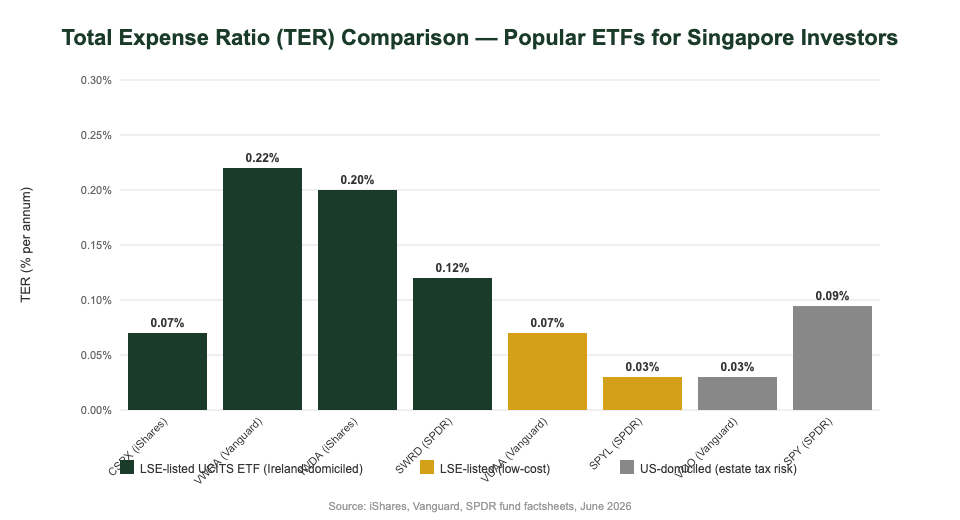
Most Singapore investors buying ETFs on the London Stock Exchange (LSE) focus on a small set of UCITS ETFs. Here’s how their TERs compare as at Q1 2026, alongside their US-domiciled equivalents:
| ETF | Ticker | Exchange | TER | Index | Structure |
|---|---|---|---|---|---|
| iShares Core S&P 500 UCITS ETF | CSPX | LSE | 0.07% | S&P 500 | Accumulating |
| SPDR S&P 500 UCITS ETF | SPYL | LSE | 0.03% | S&P 500 | Accumulating |
| Vanguard S&P 500 UCITS ETF | VUAA | LSE | 0.07% | S&P 500 | Accumulating |
| Vanguard FTSE All-World UCITS ETF | VWRA | LSE | 0.22% | FTSE All-World | Accumulating |
| iShares MSCI World UCITS ETF | IWDA | LSE | 0.20% | MSCI World | Accumulating |
| SPDR MSCI World UCITS ETF | SWRD | LSE | 0.12% | MSCI World | Accumulating |
| Vanguard S&P 500 ETF (US) | VOO | NYSE | 0.03% | S&P 500 | Distributing |
| SPDR S&P 500 ETF Trust (US) | SPY | NYSE | 0.09% | S&P 500 | Distributing |
Source: iShares, Vanguard, SPDR fund factsheets, Q1 2026. Note: US-domiciled ETFs (VOO, SPY) carry 30% withholding tax on dividends and US estate tax risk for Singapore investors.
At first glance, VOO’s 0.03% TER looks identical to SPYL. However, for Singapore investors the comparison is misleading: VOO distributes dividends subject to 30% US withholding tax, while SPYL (Ireland-domiciled) pays only 15% WHT under the Ireland-US tax treaty — and reinvests automatically as an accumulating ETF. For a dividend yield of ~1.3%, this WHT difference costs roughly 0.20% per year in additional drag — more than wiping out VOO’s lower TER. This is one reason most Singapore investors who want CPF investment strategy advice are directed toward LSE-listed UCITS ETFs.
Real Cost Impact in SGD at Different Portfolio Sizes
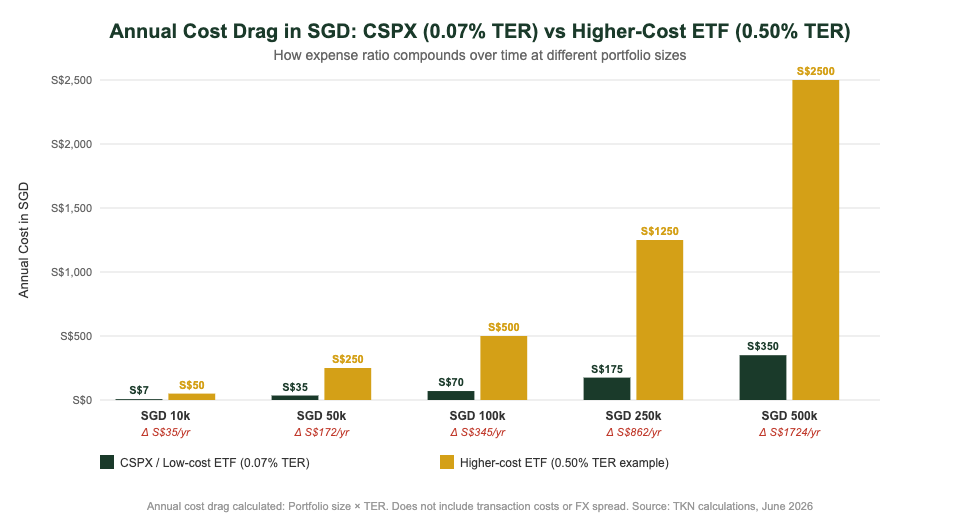
The expense ratio matters more as your portfolio grows. Here’s the annual cost impact in SGD for a low-cost ETF (0.07% TER, like CSPX) versus a higher-cost option (0.50% TER, typical of some actively managed ETFs or robo-advisory funds):
| Portfolio Size | Annual Cost at 0.07% TER | Annual Cost at 0.50% TER | Annual Saving | 10-Year Saving (compounded) |
|---|---|---|---|---|
| SGD 10,000 | SGD 7 | SGD 50 | SGD 43 | ~SGD 493 |
| SGD 50,000 | SGD 35 | SGD 250 | SGD 215 | ~SGD 2,468 |
| SGD 100,000 | SGD 70 | SGD 500 | SGD 430 | ~SGD 4,937 |
| SGD 250,000 | SGD 175 | SGD 1,250 | SGD 1,075 | ~SGD 12,342 |
| SGD 500,000 | SGD 350 | SGD 2,500 | SGD 2,150 | ~SGD 24,684 |
Calculations: Annual cost = portfolio × TER. 10-year compounded saving assumes 7% annual portfolio growth and reinvestment. Source: TKN calculations, June 2026.
Use our Singapore retirement calculator to model how different TER levels affect your projected retirement portfolio over 20–30 years. The compounding effect of even a 0.43% annual cost saving is substantial — for many Singapore investors, it represents one or two additional years of retirement income.
Hidden Costs Beyond the Expense Ratio
The TER is just one component of your total cost of ETF ownership. Singapore investors should account for three additional cost layers:
1. Bid-Ask Spread
Every time you buy or sell an ETF on an exchange, you pay the spread between the buy price (ask) and the sell price (bid). For large, liquid ETFs like CSPX and VWRA, this spread is typically 0.01–0.05% per trade — negligible for long-term investors who trade infrequently. For smaller, less liquid ETFs, spreads can widen to 0.2–0.5% or more, especially during volatile market sessions.
2. Brokerage Commission
Your broker charges a commission each time you buy or sell. Interactive Brokers (IBKR) is the most cost-effective for larger trades: USD 1–3 per LSE trade. Saxo and moomoo charge slightly more. Syfe Brokerage often has commission-free trades for qualifying accounts. Check out the moomoo Singapore review and the Syfe referral code for current offers.
3. Foreign Exchange (FX) Spread
Most LSE-listed ETFs trade in GBP or USD. When you convert SGD to GBP/USD to fund your purchase, your broker charges an FX conversion fee — typically 0.3–1.0% depending on the broker. IBKR charges as little as 0.2 basis points (0.002%) for FX conversion, making it extremely competitive for Singapore investors funding positions in GBP. This FX drag is a one-time cost per trade, not an ongoing annual fee like TER.
4. Tracking Difference
Tracking difference is the gap between the ETF’s actual return and the index return it aims to replicate. It incorporates the TER but also reflects securities lending income, dividend reinvestment timing, and sampling methods. A well-run ETF can have a tracking difference that is actually lower than its stated TER — meaning the fund’s securities lending income more than offsets its cost. CSPX, for instance, has historically delivered a tracking difference close to or slightly below its 0.07% TER. This is distinct from tracking error, which measures the consistency of tracking, not the level.
Expense Ratio in the Singapore Context
Singapore has a few unique factors that make expense ratio selection more nuanced than in other countries:
No capital gains tax, no dividend tax: Singapore investors do not pay capital gains tax or dividend income tax on ETF returns. This makes the TER the primary drag on investment returns — unlike in countries where investors also model tax drag on distributions.
Withholding tax on dividends matters more than TER for US-holding ETFs: Ireland-domiciled UCITS ETFs (CSPX, VWRA, IWDA) pay 15% withholding tax on US dividends at the fund level, while US-domiciled ETFs (VOO, VTI, SPY) pay 30%. On a 1.3% S&P 500 dividend yield, this 15% WHT difference translates to ~0.20% annual drag — making the headline TER comparison misleading when comparing SPYL (0.03%) to VOO (0.03%). They are not equivalent for Singapore investors. You can read more about this structural advantage in our article on the Singapore REIT ETF guide.
CPF and SRS compatibility: ETFs listed on the LSE are not eligible for CPF investment. However, some ETFs listed on the SGX — including STI ETFs and selected S-REIT ETFs — are CPFIS-approved. These tend to have higher TERs than global LSE-listed ETFs (SPDR STI ETF: 0.30%, Nikko AM STI ETF: 0.30%) but offer CPF liquidity. For SRS (Supplementary Retirement Scheme) accounts, LSE-listed ETFs can be purchased through eligible brokers. Explore strategies further in our guide to CPF investment strategy.
Robo-advisors charge a wrap fee on top of underlying ETF TERs: Services like Syfe, Endowus, and FSMOne charge platform or management fees (typically 0.25–0.65% p.a.) on top of the underlying ETF TERs. For example, a Syfe portfolio holding CSPX at 0.07% TER might have a total annual cost of 0.32–0.72% once the platform fee is included. Use the Endowus referral code or FSMOne referral code if signing up via a platform — some offer fee rebates or sign-up bonuses that offset the first year’s platform costs.
How to Minimise Costs as a Singapore ETF Investor
Here is a practical hierarchy for keeping your total cost of ETF ownership low:
1. Choose UCITS ETFs with TER below 0.25%: For S&P 500 exposure, SPYL (0.03%) or CSPX (0.07%) or VUAA (0.07%) are best-in-class. For global equity, SWRD (0.12%) is lower cost than IWDA (0.20%) or VWRA (0.22%). The difference between VWRA and SWRD sounds small (0.10%), but on a SGD 200,000 portfolio it is SGD 200 per year — more than a weekend dinner out, every year, forever.
2. Avoid US-domiciled ETFs unless you fully understand the tax implications: VOO and VTI may have lower TERs, but the 30% WHT and US estate tax exposure (for holdings above USD 60,000) make them structurally inferior for most Singapore investors. The best S-REITs and global ETFs for Singapore are almost always Ireland-domiciled UCITS funds. See our rundown of the best S-REITs in Singapore 2026 for a parallel discussion of cost drag in the REIT space.
3. Use a low-cost broker for LSE trades: IBKR charges USD 1–3 per LSE trade. On a SGD 10,000 monthly DCA, this is effectively a 0.02–0.05% transaction cost — far lower than the 0.18–0.30% charged by many bank-linked brokers. Lower transaction costs mean more capital stays invested and compounds.
4. Invest in accumulating ETFs to avoid dividend drag: Accumulating ETFs (CSPX, VUAA, VWRA, SWRD) automatically reinvest dividends within the fund. You avoid the timing drag of dividend reinvestment and — more importantly for Singapore — you avoid triggering the 15% WHT that distributing versions pay out. Every dollar of dividend that stays inside the fund compounds without any withholding event.
5. Compare total cost, not just TER: Use this framework: Total Annual Cost ≈ TER + (WHT on dividends) + (broker commission ÷ holding period) + (FX spread ÷ holding period). For a 10-year hold with annual top-ups, broker commission becomes negligible. WHT and TER dominate.
Disclaimer: Past cost structures may change. Always verify current TERs and broker fees directly with the fund manager and your broker before investing. This article is for educational purposes only and does not constitute financial advice.
Frequently Asked Questions
What does expense ratio mean for an ETF?
The expense ratio (also called TER or Total Expense Ratio) is the annual fee charged by an ETF to cover its operating costs — management fees, custody, auditing, and administration. It is expressed as a percentage of your invested amount and is automatically deducted from the fund’s net asset value each day. A 0.07% expense ratio means you pay SGD 70 per year on a SGD 100,000 investment. You never receive a separate bill — it is silently priced into the ETF’s performance.
Is a lower expense ratio always better?
Generally yes — all else being equal, a lower TER means more of the index’s returns flow to you. However, for Singapore investors, a lower TER does not always mean lower total cost. A US-domiciled ETF with 0.03% TER (e.g. VOO) can cost more in net terms than an Ireland-domiciled ETF with 0.07% TER (e.g. CSPX), because VOO subjects dividends to 30% US withholding tax while CSPX pays only 15%. Always compare total cost — TER plus withholding tax impact — not just the headline TER number.
How do I find an ETF's expense ratio?
The most reliable source is the official fund factsheet, available directly from the fund manager’s website — for CSPX, visit the iShares/BlackRock website; for VWRA, visit Vanguard UK. The TER is listed as “Total Expense Ratio” or “Ongoing Charges” near the top of the factsheet. SGX’s ETF screener and Bloomberg also list TERs, but always cross-check against the official factsheet since data aggregators sometimes display outdated figures.
What is the difference between expense ratio and management fee?
The management fee is the portion of the expense ratio paid to the fund manager for running the fund. The Total Expense Ratio (TER) is broader — it includes the management fee plus additional operating costs such as custody fees, auditing, legal expenses, and index licensing fees. TER is always equal to or higher than the management fee. When comparing two ETFs, always compare TER-to-TER, not management fee to TER, to get an accurate cost picture.
Does Singapore charge tax on ETF expense ratios or returns?
Singapore does not levy capital gains tax or personal dividend income tax on ETF investments. This makes the expense ratio and withholding tax (levied by the country where the ETF is domiciled, not Singapore) the primary cost considerations. Ireland-domiciled UCITS ETFs like CSPX and VWRA benefit from Ireland’s 15% withholding tax rate on US dividends — lower than the 30% that US-domiciled ETFs face — giving Singapore investors an efficient tax structure overall.
What expense ratio is considered good for an ETF in Singapore?
For broad-market index ETFs listed on the LSE, a TER below 0.20% is considered competitive and below 0.10% is excellent. SPYL (0.03%), CSPX (0.07%), VUAA (0.07%), and SWRD (0.12%) represent best-in-class options available to Singapore investors. SGX-listed ETFs generally have higher TERs — the STI ETFs (Nikko AM and SPDR) both charge 0.30% — but offer CPF investment eligibility that LSE-listed ETFs do not. The “right” TER depends on your goals: CPF compatibility may justify a higher TER for some investors.
Can expense ratios change over time?
Yes. Fund managers occasionally reduce TERs as assets under management (AUM) grow — larger funds can spread fixed costs over a larger base, enabling fee cuts. SPYL, for example, cut its TER to 0.03% partly as a competitive response to attract Singapore and Asian investors away from CSPX. Conversely, some smaller or niche ETFs may raise TERs if AUM falls. Check the fund factsheet at least annually to confirm the current TER, especially before making large lump-sum investments.
Ready to Start Investing in Low-Cost ETFs?
Open a brokerage account and minimise your expense ratio drag from day one. Use our referral links for exclusive sign-up bonuses.
This article was researched with the help of AI. While we strive to keep all information accurate and up to date, there may be errors. If you notice any discrepancies, please contact us.