Should You Downgrade Your Integrated Shield Plan Rider in 2026?
Updated: 17 September 2026 | Category: Integrated Shield Plans
Whether to downgrade your Integrated Shield Plan (ISP) rider in 2026 depends on your age, health status, and financial cushion. From 1 April 2026, new IP riders sold in Singapore no longer cover the minimum deductible (S$1,500–S$3,500 per year), but their premiums are roughly 30% lower. About 182,000 Singaporeans downgraded or cancelled their riders in 2025. Here is how to decide if you should follow suit.
Not financial advice. All figures are for educational reference only. Data verified as at 17 September 2026 from official MOH sources unless noted.
- New IP riders (from April 2026) are cheaper — about 30% lower premiums — but you pay deductibles and co-payments out of pocket.
- If you rarely need hospitalisation or can afford S$6,000 per year in costs, the new rider saves you money overall.
- If you have chronic conditions or high hospitalisation risk, keeping your legacy rider may still make financial sense.
Why 182,000 Singaporeans Downgraded Their IP Rider in 2025
Rising premiums pushed a record number of Singaporeans to rethink their Integrated Shield Plan coverage in 2025. According to a parliamentary response by the Ministry of Health (MOH), about 182,000 policyholders downgraded or cancelled their riders in 2025 — before the new April 2026 rules even kicked in.
Private hospital rider premiums had been growing at 17% per year in recent years. For many families, the annual rider cost was simply no longer justifiable against the actual risk of a costly hospitalisation.
The trend of downgrades had increased each year over the past three years. MOH noted that policyholders may downgrade for various reasons — affordability is one, but so is right-sizing coverage based on actual needs.
The good news: the April 2026 changes were partly designed to respond to this affordability pressure. New riders are significantly cheaper. Whether the trade-off makes sense for you is the key question.
What Changed on 1 April 2026 — The New IP Rider Rules
From 1 April 2026, new Integrated Shield Plan riders sold in Singapore must follow stricter MOH rules. These changes affect anyone buying a new rider — or switching from a legacy rider.
Here are the three key changes:
1. No more deductible coverage. Your rider can no longer pay the minimum IP deductible set by MOH. You must pay this amount yourself before coverage begins. The minimum deductible ranges from S$1,500 to S$3,500 per year, depending on your ward class and age band.
2. Higher co-payment cap. After you pay the deductible, you also pay 5% of the remaining eligible bill. This co-payment is now capped at S$6,000 per year (raised from the previous S$3,000 cap).
3. Lower premiums in return. To compensate, new rider premiums are expected to be about 30% lower on average compared to legacy riders. Individual savings vary by age, ward class, and insurer — industry data shows a range of 16% to 84% lower for specific age groups.
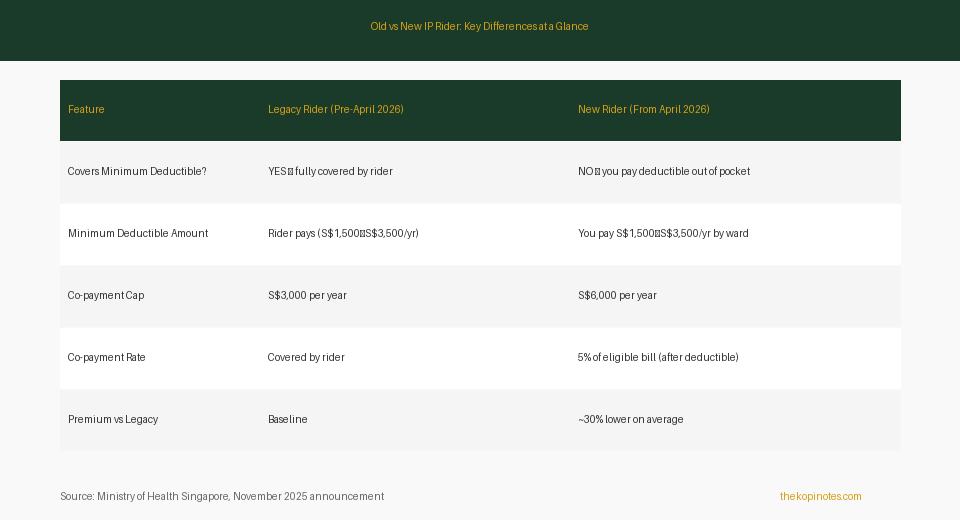
Source: Ministry of Health Singapore, November 2025 announcement. Table: The Kopi Notes.
Who is affected? If you bought your rider before 27 November 2025, you are on a legacy rider and not immediately required to change. Your insurer will decide how to handle your plan going forward.
If you bought your rider between 27 November 2025 and 31 March 2026, MOH requires you to transition to a compliant rider no later than your next policy renewal from April 2028.
If you bought your rider from 1 April 2026 onwards, you are already on the new framework.
Legacy Rider vs New Rider: The Real Cost Comparison
Let’s put real numbers on this. Assume you are a 40-year-old in a private hospital plan. Your current legacy rider premium might be around S$2,200 per year. A new compliant rider of the same plan could cost roughly S$1,540 per year — saving you about S$660 annually.
But here is what you trade for that saving: you now pay out of pocket for deductibles and co-payments whenever you are hospitalised.
| Scenario | Legacy Rider OOP* | New Rider OOP* | Difference |
|---|---|---|---|
| Healthy year (no claim) | S$2,200 | S$1,540 | Save S$660 |
| Day surgery (S$5,000 bill) | S$2,200 | S$1,540 + S$1,675 (S$1,500 deductible + 5% × S$3,500) |
Pay S$1,015 more |
| Hospitalisation (S$20,000 bill) | S$2,200 | S$1,540 + S$4,325 (S$1,500 deductible + 5% × S$16,500) |
Pay S$3,665 more |
| Serious illness (S$60,000 bill) | S$2,200 | S$1,540 + S$7,500 (S$1,500 deductible + cap at S$6,000) |
Pay S$6,840 more |
*OOP = out-of-pocket total costs including premiums. Illustrative figures for a 40-year-old, private hospital plan, deductible S$1,500 (youngest age band). Actual figures vary by insurer, age, and ward class. Source: MOH deductible structure, insurer premium estimates.
The math becomes clear: the new rider saves you money in healthy years, but costs significantly more if you are actually hospitalised. The break-even point depends on how often you expect to use your plan.
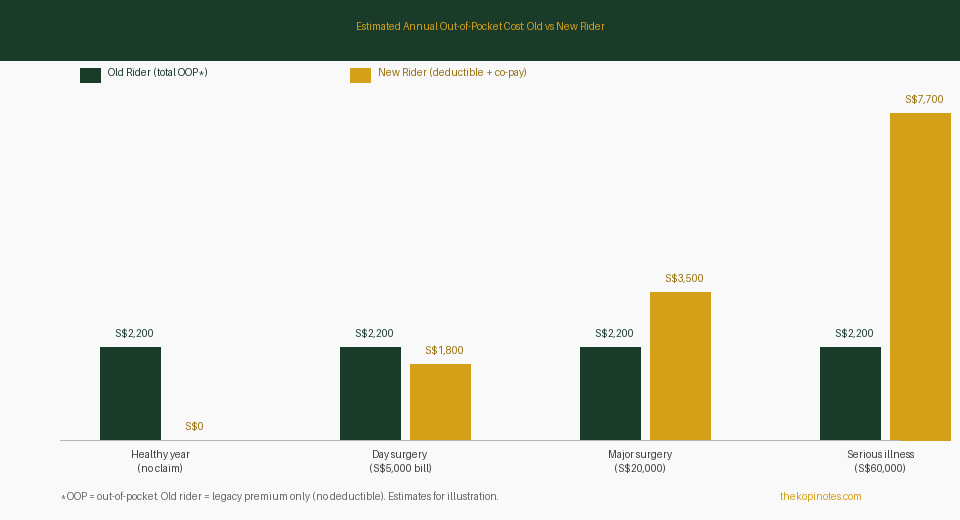
Source: MOH Singapore deductible framework, insurer premium estimates. Figures are illustrative for a 40-year-old private hospital plan. Actual costs vary.
When You Should Switch to the New IP Rider
The new rider is most attractive if you match several of these conditions:
You are young and healthy. Younger policyholders hospitalise less often. If you have not been admitted in years and have no chronic conditions, the premium savings compound quickly. A 30-year-old saving S$500 per year over 10 years is S$5,000 in savings — even if you have one hospitalisation in that period, you may still come out ahead.
You have emergency savings to cover the S$6,000 cap. The maximum you pay per year under a new rider (deductible + co-payment cap) is S$6,000–S$9,500 depending on your ward class. If you have a rainy-day fund of S$10,000 or more, this is manageable. Without that cushion, a surprise hospitalisation could strain your finances.
Your ISP rider premium has been rising steeply. If you have been paying significantly more each year due to premium hikes, switching resets you to a lower base. Premium growth of 17% per year means your legacy rider cost doubles roughly every 4–5 years. A lower-base new rider may grow to the same amount later, but you enjoy savings now.
You are willing to be more cost-conscious as a patient. The new structure incentivises you to consider ward class and treatment choices more carefully. If you are comfortable choosing B1 or lower wards when the situation allows, you can reduce your deductible exposure.
For many healthy working adults aged 25–45, switching to a new compliant rider is likely the more cost-efficient choice over a 5–10 year horizon. You can also read our co-payment guide for a full breakdown of how the new co-payment structure works.
When You Should Keep Your Legacy Rider
Keeping your legacy rider makes more sense in these situations:
You have chronic conditions or upcoming planned procedures. If you have diabetes, cancer, or heart disease and expect regular hospitalisation, your out-of-pocket costs under the new rider could add up to S$6,000–S$9,500 every year. Your legacy rider shields you from those costs even as your premiums rise.
You are over 60. Older age bands have higher minimum deductibles and more frequent hospitalisation. The premium savings from switching may be smaller in absolute terms for older policyholders, while the cost exposure is higher. Run the numbers carefully with your financial adviser before switching.
Your legacy rider premium is still affordable. Not every legacy rider is overpriced. If your premiums have been stable and the coverage is comprehensive, there is no urgency to switch. Your insurer may also eventually offer new compliant options you can migrate to on favourable terms.
You have dependants relying on your coverage. A family with young children under your policy benefits from the certainty of lower out-of-pocket costs. A paediatric admission can easily reach S$20,000. With a legacy rider, your out-of-pocket is effectively just the premium.
The bottom line: if you have reason to expect hospitalisation, the legacy rider’s premium cost is effectively an insurance premium against a large unexpected bill. Read our full ISP guide to understand the full coverage structure before deciding.
How to Downgrade or Switch Your Integrated Shield Plan Rider
If you decide to switch to a new compliant rider or downgrade your coverage, the process is straightforward. Here is what to do:
Step 1: Check your current insurer’s new rider options. All seven MOH-approved ISP providers (AIA, Aviva/NTUC Income, Great Eastern, Prudential, Raffles Health Insurance, Singlife, and Tokio Marine) have launched new compliant riders. Log into your insurer’s portal or call their hotline to see what is available for your plan tier.
Step 2: Compare the premium reduction vs new OOP exposure. Ask your insurer for the exact new rider premium for your age and plan. Then calculate your break-even: if the premium saving is S$700/year and your deductible is S$1,500, you need to stay claim-free for about 2 years to cover one typical day-surgery event.
Step 3: Confirm your switching window. You can typically switch riders at your policy anniversary date. Some insurers allow mid-year switches. Contact your insurer or financial adviser to confirm the earliest switch date for your policy.
Step 4: Check for coverage gaps. Switching riders should not create a new waiting period for pre-existing conditions if you are staying with the same insurer and plan level. But confirm this in writing before switching.
Step 5: Update your Medisave usage accordingly. Your new lower rider premium will be deductible from Medisave (up to the prevailing withdrawal limits). Check your Medisave hospitalisation coverage limits to ensure you are using Medisave optimally for the new premium amount.
Not sure how to compare plans across insurers? Our ISP premium by age guide breaks down current premiums across all providers by age band. You may also use our Singapore retirement calculator to model how lower ISP premiums affect your long-term healthcare budget.
Frequently Asked Questions
Should I downgrade my Integrated Shield Plan rider in 2026?
It depends on your health profile and finances. If you are young, healthy, and have savings to cover up to S$6,000 in annual out-of-pocket costs, switching to a new rider can save you roughly 30% on premiums. If you have chronic conditions or expect frequent hospitalisation, keeping your legacy rider may cost less overall despite the higher premiums.
A good starting point: calculate how often you have been hospitalised in the last five years and what those bills came to. If it was rare and minor, switching likely saves you money. If it was frequent, your legacy rider is probably still the better deal.
What is the minimum deductible for the new IP rider in 2026?
The minimum deductible for new IP riders ranges from S$1,500 to S$3,500 per year, depending on your ward class and age band. This amount is not covered by the new rider — you must pay it out of pocket before your insurance coverage begins. The deductible is higher for private hospital wards and older age bands.
How much lower are the new IP rider premiums in 2026?
New compliant IP riders are expected to be about 30% lower on average compared to legacy riders with maximum coverage. Industry data shows the range is 16% to 84% lower depending on your age, ward class, and specific insurer. Younger policyholders and those on lower ward classes tend to see larger percentage savings. Always compare your specific insurer’s quote against your current premium.
Can I keep my legacy IP rider without switching?
Yes, if you bought your rider before 27 November 2025, you are on a legacy rider and are not immediately required to switch. Your insurer will determine its own approach for legacy riders. However, if you bought your rider between 27 November 2025 and 31 March 2026, MOH requires you to transition to a compliant rider by your next policy renewal from April 2028.
What is the co-payment cap for the new IP rider?
The co-payment cap for new IP riders is S$6,000 per year, raised from the previous S$3,000. After paying your minimum deductible, you pay 5% of the remaining eligible bill — this 5% portion is capped at S$6,000. So in a worst-case scenario, your maximum annual out-of-pocket (excluding deductible) is S$6,000. Add your deductible and you get the total maximum OOP per year.
Where can I compare integrated shield plan providers in Singapore?
The MOH Integrated Shield Plan comparison page lists all seven approved providers with their plan tiers. You can also read TKN’s ISP premium by age breakdown and our individual insurer reviews for a more detailed side-by-side. Our Singlife ISP review is a good starting point if you are comparing newer providers.
Disclaimer: The Kopi Notes is not a licensed financial adviser. This article is for educational purposes only and does not constitute financial or insurance advice. Figures are for illustrative purposes. Always consult a qualified financial adviser before making changes to your health insurance coverage. Data verified as at 17 September 2026.
Get Free Insurance Advice
Speak with a licensed insurance advisor. No obligation, no cost.
By submitting this form, you agree to our Privacy Policy.
This article was researched with the help of AI. While we strive to keep all information accurate and up to date, there may be errors. If you notice any discrepancies, please contact us.