This is an editorial analysis. Not financial advice.
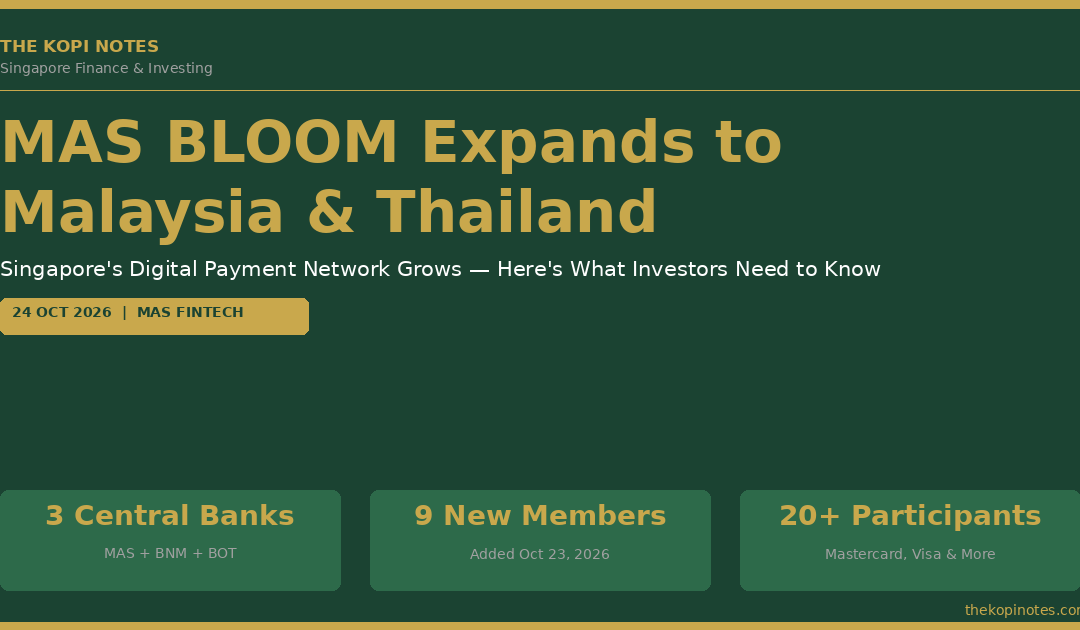
Singapore’s cross-border payments are about to get faster, cheaper and smarter. On 23 October 2026, the Monetary Authority of Singapore announced that Bank Negara Malaysia (BNM) and the Bank of Thailand (BOT) have joined the BLOOM initiative as policymaker members — alongside nine new commercial participants including Mastercard, Visa, Ripple and ShopeePay. For Singapore retail investors, this is a signal worth paying close attention to.
Data verified as at 24 October 2026.
What Is BLOOM?
BLOOM stands for Borderless, Liquid, Open, Online, Multi-currency. Launched by MAS in October 2025, it is Singapore’s flagship initiative to develop an open, multi-currency digital money ecosystem for cross-border payments across the Asia-Pacific region.
In plain English: BLOOM is MAS’s effort to make it as easy to send money from Singapore to Kuala Lumpur or Bangkok as it is to send money within Singapore — with near-instant settlement, lower fees, and full regulatory oversight. It does this by creating shared infrastructure that connects different types of digital money: stablecoins (like XSGD), tokenised commercial bank deposits, and eventually Central Bank Digital Currencies (CBDCs).
Think of it as a financial internet protocol for money — one that financial institutions, fintechs and businesses across borders can all plug into.
The initiative is grounded in Singapore’s Payment Services Act framework, which governs stablecoin issuers and digital payment providers operating in the city-state.
Why Malaysia and Thailand? Why Now?
The expansion is not random. Singapore’s two largest ASEAN trade partners are Malaysia and Thailand. Combined, ASEAN’s cross-border payment flows exceed US$1 trillion annually, yet they remain expensive, slow and fragmented compared to domestic transfers.
With BNM and BOT now formal policymaker members alongside MAS, the three central banks will co-develop shared standards and governance frameworks — the regulatory scaffolding needed before commercial participants can scale real payment volumes.
The announcement came at the Singapore FinTech Festival 2026, where MAS Governor Chia Der Jiun noted that BLOOM’s expansion to Malaysia and Thailand marks a significant milestone in ASEAN’s journey toward a more interconnected payment ecosystem.
For context, MAS had already been advancing its cross-border digital money agenda throughout 2026, including the UK-Singapore Financial Dialogue in October, where digital finance featured prominently alongside Singapore’s equity market reform agenda.
Who Are the New Members?
Nine new commercial participants joined BLOOM on 23 October 2026:
- Airwallex — Australian-founded global payment platform popular with Singapore SMEs
- Mastercard — Global payment network, now formally committed to BLOOM’s interoperability stack
- Maybank — Malaysia’s largest bank by assets, a natural bridge for SGD-MYR corridors
- Monee — Cross-border digital wallet provider focused on Southeast Asia corridors
- Nium — Singapore-headquartered global payments infrastructure company
- Ripple — Blockchain-based payment network known for XRP-based cross-border settlement
- ShopeePay — Sea Group’s digital payments arm, dominant in Malaysia and Indonesia
- Visa — Global payment network (joining alongside Mastercard)
- World Bank Group — Multilateral development bank adding institutional credibility
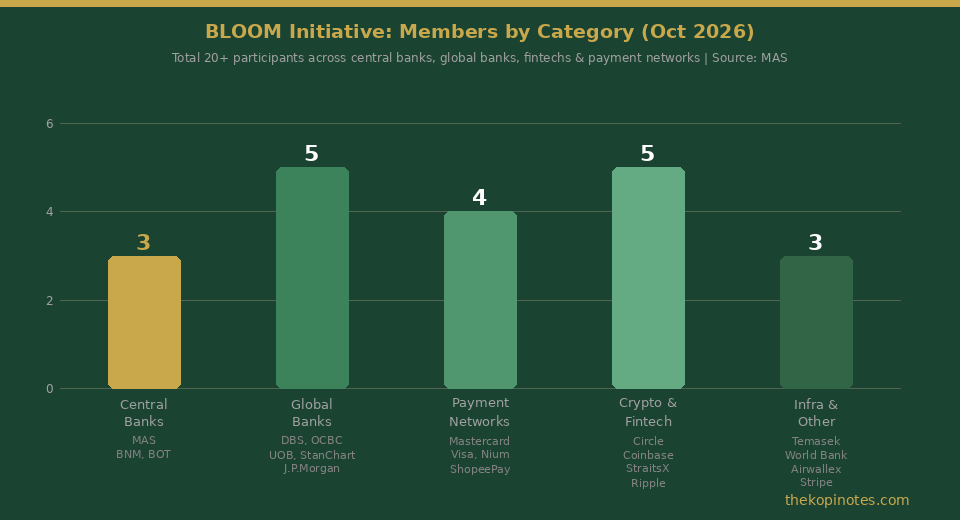
These nine join existing BLOOM participants, which include DBS, OCBC, UOB, Standard Chartered, J.P. Morgan, Circle, Coinbase, Temasek, Stripe, StraitsX and others — a roster that now spans global banks, payment networks, regulated stablecoin issuers and infrastructure providers.
The Three Focus Areas
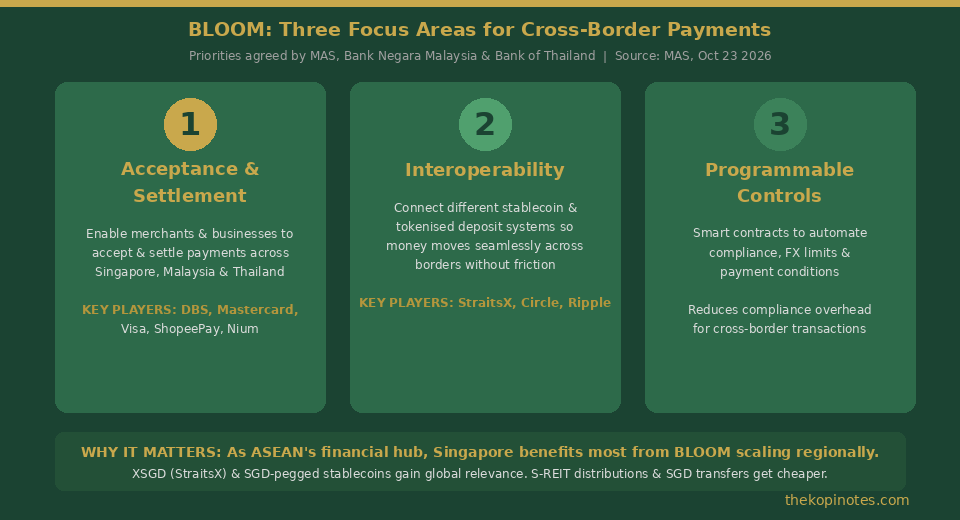
The expanded BLOOM network — now spanning three central banks and over 20 commercial participants — has aligned on three strategic workstreams for the 2026–2027 period:
1. Acceptance and Settlement Across Jurisdictions
The first workstream focuses on enabling merchants and businesses in Singapore, Malaysia and Thailand to accept and settle payments using digital money without friction. Today, if a Singapore retailer wants to accept payment from a Malaysian customer, the process involves multiple correspondent banks, conversion fees and settlement delays of one to three days. BLOOM aims to collapse this to near-instant settlement with transparent pricing.
2. Interoperability
Different institutions issue different forms of digital money: StraitsX issues XSGD (an SGD-pegged stablecoin), J.P. Morgan issues JPM Coin (a tokenised deposit), Circle issues USDC. The second workstream focuses on making these distinct systems technically interoperable — so XSGD held by a Singapore exporter can be accepted by a Thai importer using a baht-denominated tokenised deposit, with seamless conversion underneath.
This is technically complex. It requires shared protocols for message formatting, FX pricing, clearing and settlement — essentially creating an open standard that all participants build to.
3. Programmable Controls
The third and most novel workstream explores programmable controls — using smart contracts to automate conditions on how money moves. Examples include: automatically applying a government subsidy payment only when goods are delivered; restricting corporate disbursements to approved vendor categories; or triggering trade finance payments on verified shipping milestones.
For retail investors, the most visible implication is lower compliance overhead for cross-border transactions, which should translate to reduced fees and faster processing times over the medium term.
BLOOM Participant Overview
| Category | Participants |
|---|---|
| Central Banks (Policymakers) | MAS (Singapore), BNM (Malaysia) ★, BOT (Thailand) ★ |
| Global Banks | DBS, OCBC, UOB, Standard Chartered, J.P. Morgan, Maybank ★ |
| Payment Networks | Mastercard ★, Visa ★, ShopeePay ★, Nium ★ |
| Crypto & Fintech | Circle, Coinbase, StraitsX, Ripple ★, Monee ★ |
| Infrastructure & Other | Temasek, Stripe, Airwallex ★, World Bank Group ★ |
★ New members joining Oct 23, 2026. Full participant list subject to MAS confirmation.
What Does This Mean for Singapore Retail Investors?
The BLOOM expansion has implications across several areas that TKN’s core audience cares about:
S-REITs and Regional Property Exposure
S-REITs with significant Malaysian and Thai assets could benefit from more efficient cross-border distributions. When REIT managers collect rental income in MYR or THB and repatriate it to Singapore for distribution, they incur FX conversion costs and settlement delays. BLOOM’s infrastructure, once scaled, could reduce these frictions substantially.
TKN has previously covered how S-REIT distributions are affected by currency movements and cross-border costs — the BLOOM framework addresses some of these structural inefficiencies at the infrastructure level.
Digital Banks and Fintech Players
Singapore’s digital banks — MariBank, GXS and Trust Bank — are all exploring cross-border payment propositions. With BLOOM providing common rails infrastructure, it becomes easier for them to offer competitive cross-border transfer rates to customers sending money to Malaysia or Thailand.
ShopeePay’s participation is particularly notable: Sea Group, which owns Shopee and MariBank, now has a seat at the BLOOM table. This could accelerate integration between MariBank’s savings products and ShopeePay’s cross-border merchant payment flows.
Singapore Dollar Internationalisation
MAS has been steadily advancing the internationalisation of the Singapore dollar as part of its broader financial hub strategy. BLOOM is a key pillar: by making SGD-denominated digital money (particularly XSGD, issued by StraitsX) usable for cross-border settlement in Malaysia and Thailand, MAS increases the global footprint of the SGD.
This matters for investors holding SGD-denominated assets: a more widely used SGD supports the currency’s stability and demand. It is part of the same strategic thread as MAS’s Fintech FSTI scheme and its October 2026 monetary policy decisions.
CPF and Cross-Border Workers
For the large number of Malaysian workers in Singapore contributing to CPF, BLOOM’s SGD-MYR payment corridor improvements could eventually feed into more efficient CPF withdrawal and transfer experiences. This is longer-term and will depend on regulatory alignment between MAS and BNM — but the policymaker partnership now established provides the institutional foundation.
Singapore GDP and Financial Sector
Singapore’s financial services sector contributes approximately 14% of GDP. Maintaining and expanding Singapore’s role as ASEAN’s payment hub is a strategic national priority. BLOOM’s expansion cements Singapore’s position at the centre of the region’s digital money infrastructure — a positive structural tailwind for the broader economy and, indirectly, for locally-listed financial stocks including the three Singapore banks.
The Road Ahead
The BLOOM initiative is still in its infrastructure-building phase. The practical benefit for retail consumers — cheaper, faster cross-border transfers — is likely 18 to 36 months away from widespread availability. The near-term milestones to watch:
- Q1 2027: Publication of common technical standards for BLOOM interoperability by MAS and participating central banks
- H1 2027: Pilot live transactions in the SGD-MYR corridor between participating banks and payment networks
- 2027–2028: Potential expansion to Indonesia, Philippines and Vietnam as BLOOM scales across ASEAN
- Ongoing: Regulatory progress on MAS’s stablecoin framework under the Payment Services Act, which underpins BLOOM’s legal architecture
Bottom Line
The MAS BLOOM expansion to Malaysia and Thailand is the most significant development in Singapore’s cross-border payments infrastructure in years. For retail investors, the direct investment implications are indirect and medium-term: watch how this plays out for digital banks, S-REITs with regional exposure, and the SGD’s continued internationalisation.
The more immediate takeaway is strategic: Singapore is positioning itself as the infrastructure layer for ASEAN’s digital money ecosystem. With MAS, BNM and BOT now aligned — alongside giants like Mastercard, Visa and J.P. Morgan — the commercial momentum behind BLOOM is substantial. This is not a pilot; it is a framework with real institutional buy-in.
For investors building long-term positions in Singapore, the strength of the country’s financial infrastructure — of which BLOOM is a key pillar — is part of why Singapore consistently attracts global capital. That structural advantage is being reinforced, not eroded.
Frequently Asked Questions
What is MAS BLOOM?
BLOOM (Borderless, Liquid, Open, Online, Multi-currency) is MAS’s initiative to create open digital money infrastructure for cross-border payments across the Asia-Pacific region. It connects stablecoins, tokenised deposits and other forms of digital money across multiple currencies and jurisdictions.
Who joined BLOOM on October 23, 2026?
Bank Negara Malaysia (BNM) and the Bank of Thailand (BOT) joined as policymaker members. Nine new commercial participants also joined: Airwallex, Mastercard, Maybank, Monee, Nium, Ripple, ShopeePay, Visa and the World Bank Group.
When will I be able to use BLOOM for everyday transfers?
BLOOM is in infrastructure-building phase. Retail consumer access to BLOOM-powered cross-border transfers is likely 18–36 months away, subject to technical pilot results and regulatory alignment between Singapore, Malaysia and Thailand.
How does BLOOM affect XSGD and Singapore stablecoins?
XSGD (issued by StraitsX, which is a BLOOM participant) is positioned to be a key settlement currency in the BLOOM ecosystem. BLOOM’s growth directly increases the use case and demand for SGD-pegged stablecoins in cross-border transactions across ASEAN.
Is BLOOM relevant to S-REIT investors?
Yes, indirectly. S-REITs with assets in Malaysia and Thailand could benefit from lower FX conversion costs on distributions over the medium term. More broadly, BLOOM strengthens Singapore’s financial hub status, which supports the operating environment for all Singapore-listed financial assets.
What is Singapore’s broader digital money strategy?
BLOOM is one component of MAS’s broader agenda, which also includes the Project Orchid programmable SGD initiative, the Payment Services Act regulatory framework for stablecoins, and MAS’s fintech support schemes. Together, these position Singapore as the ASEAN hub for regulated digital finance.
This article was researched with the help of AI. While we strive to keep all information accurate and up to date, there may be errors. If you notice any discrepancies, please contact us.