Endowment Plan Policy Loan Singapore 2026: Should You Borrow Against Your Policy?
A complete guide to policy loans on endowment plans — interest rates, lapse risks, and when it beats surrendering your policy.
A policy loan on an endowment plan lets Singapore policyholders borrow up to 80–92% of the plan’s current cash value — without surrendering the policy. Interest rates typically range from 5.5% to 7.0% p.a. depending on your insurer. This option is ideal for short-term cash needs when you want to preserve your policy’s long-term maturity payout rather than triggering early surrender penalties.
Not financial advice. All figures are for educational reference only. Data verified as at October 2026 unless noted. Policy loan rates are indicative — check with your insurer for current rates applicable to your specific policy.
Table of Contents
Contents — Click to expand
- What Is an Endowment Plan Policy Loan?
- How a Policy Loan Works in Singapore
- Policy Loan Interest Rates in Singapore (2026)
- Policy Loan vs Surrendering Your Endowment Plan
- Policy Loan vs Personal Loan: Which Is Cheaper?
- Key Risks to Know Before You Borrow
- How to Apply for a Policy Loan in Singapore
- Who Should (and Shouldn’t) Take a Policy Loan?
- Frequently Asked Questions
What Is an Endowment Plan Policy Loan?
An endowment plan policy loan is a cash advance secured against your endowment policy’s accumulated cash value (also called surrender value). Unlike a bank loan, you are essentially borrowing from yourself — using your own policy as collateral — which means no credit check, no income verification, and no tedious application process.
The loan is available on most participating and non-participating endowment plans in Singapore, as long as the policy has built up sufficient cash value — typically after the first two to three policy years. Popular insurers offering this feature include AIA, Prudential, Great Eastern, NTUC Income, and Manulife.
The key distinction: a policy loan does not end your policy. Your endowment plan remains in force, continuing to accumulate guaranteed returns and bonuses (for participating plans). You repay the loan at your own pace — though unpaid interest compounds and is added to the outstanding loan balance.
This makes a policy loan a fundamentally different decision from surrendering your endowment plan early, which permanently ends the policy and forfeits future bonuses. Understanding this difference is critical before you decide which route to take.
How a Policy Loan Works in Singapore
The mechanics of a Singapore endowment plan policy loan are straightforward:
- Check your available cash value. Log into your insurer’s app or customer portal to see the current surrender value of your policy. This is the figure your loan limit is based on.
- Apply for the loan. Most major insurers allow applications via their digital portal, mobile app, or by submitting a policy loan application form. No credit check or income document is required.
- Receive funds. Approved loan amounts are typically credited to your bank account within 3–7 business days, though some insurers process same-day or next-day for digital applications.
- Interest accrues daily or monthly. Interest is charged on the outstanding loan balance. If you do not make regular repayments, interest compounds — meaning interest is charged on the unpaid interest balance over time.
- Repay at your own pace. There is typically no fixed repayment schedule. You can repay in full, make partial payments, or let the interest accumulate — but allowing interest to grow unchecked carries significant lapse risk (see the Risks section).
Upon maturity of your endowment plan, any outstanding loan balance plus accrued interest is deducted from your maturity payout before you receive the remainder. Similarly, upon death, the death benefit is reduced by the outstanding loan balance.
Policy Loan Interest Rates in Singapore (2026)
Policy loan interest rates vary by insurer and by the currency denomination of your policy. SGD-denominated policies generally attract lower rates than USD-denominated ones. Based on publicly disclosed information from major Singapore insurers, indicative rates as at late 2025/2026 are:
| Insurer | SGD Policy Loan Rate (Indicative) | Max Loan Limit |
|---|---|---|
| AIA Singapore | ~5.5–6.5% p.a. | Up to 90% of cash value |
| Prudential Singapore | ~5.25–6.25% p.a. | Up to 90% of gross surrender value |
| Great Eastern Life | ~6.0–6.5% p.a. | Up to 92% of cash value |
| NTUC Income | ~5.5–6.5% p.a. | Up to 90% of surrender value |
| Manulife Singapore | ~5.5–7.0% p.a. | Up to 80–90% of cash value |
Source: Publicly disclosed insurer information; rates are indicative and subject to change. Always confirm the current rate directly with your insurer before applying. Data compiled October 2026.
A practical example: if your SGD 100,000 endowment plan has accumulated a cash value of SGD 60,000 after seven years, you can typically borrow up to SGD 54,000 (90% of SGD 60,000). At 6% p.a., borrowing SGD 20,000 for one year costs you SGD 1,200 in interest — assuming no compounding if you repay within the year.
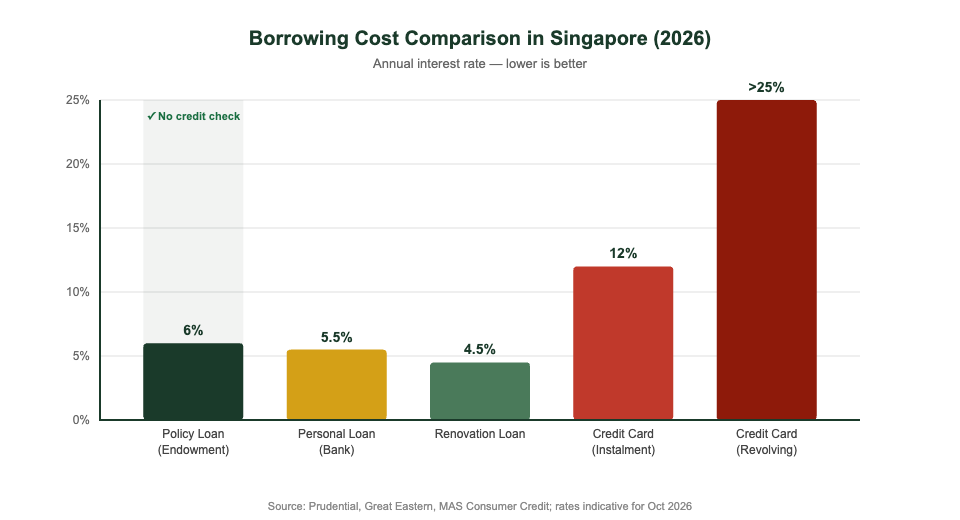
Compared with passive income strategies or Singapore Savings Bonds generating 2.5–3.5% p.a., paying 6% p.a. on a policy loan is a real cost — but it’s cheaper than most credit card debt and avoids the permanent cost of surrendering.
Policy Loan vs Surrendering Your Endowment Plan
This is the key decision most policyholders face when they need cash: borrow against the policy or surrender it outright? The answer depends heavily on how far along you are in the policy term and how urgently you need the money.
| Factor | Policy Loan | Early Surrender |
|---|---|---|
| Policy Status | Policy remains in force | Policy permanently terminated |
| Cash Received | Up to 80–92% of cash value | 100% of surrender value (may include penalty) |
| Future Maturity Payout | Preserved (less loan balance) | Forfeited |
| Non-Guaranteed Bonuses | Continue to accumulate | Lost on surrender |
| Life Coverage | Continues (death benefit reduced by loan) | Ends immediately |
| Ongoing Cost | Interest at ~5.5–7.0% p.a. | Surrender penalty (early years) |
| Best When | Temporary cash need; plan has strong remaining upside | Permanent change of plan; poor plan performance |
Source: The Kopi Notes analysis, October 2026.
The classic scenario where a policy loan wins: you are seven years into a ten-year endowment plan with SGD 50,000 in accumulated cash value, and you need SGD 15,000 for an emergency. Surrendering now forfeits three more years of guaranteed returns plus accumulated bonuses. Borrowing SGD 15,000 at 6% costs you SGD 900 per year in interest, but you collect the full SGD 60,000–70,000 maturity payout at year ten.
You can use this analysis alongside a Singapore retirement calculator to model the impact of your policy loan on your overall retirement income plan.
Policy Loan vs Personal Loan: Which Is Cheaper?
On the surface, a policy loan rate of 5.5–7.0% p.a. seems comparable to a bank personal loan’s effective interest rate (EIR) of 3.5–6.5% p.a. for promotional or existing-customer rates. However, there are several important differences to consider.
Advantages of a policy loan over a personal loan:
- No credit check. Your credit score and debt-to-income ratio are irrelevant. Even if your credit score has declined, you can still access a policy loan.
- No fixed repayment schedule. Bank personal loans require fixed monthly repayments. Policy loans are flexible — you choose when and how much to repay.
- Faster approval. Policy loans are often approved and disbursed within three to seven business days versus one to two weeks for a bank personal loan.
- Lower total cost if repaid quickly. If you need cash for one to two months only, a policy loan charged at daily simple interest can cost far less than a bank personal loan with upfront processing fees.
Disadvantages of a policy loan vs a bank personal loan:
- Interest compounds if not repaid. Unlike a bank loan’s fixed amortised schedule, unpaid policy loan interest is added to the principal — compounding your debt silently.
- Reduces your maturity payout. The full outstanding loan plus interest is deducted at maturity, reducing what you receive.
- Tied to your policy. If you later need to surrender the policy for any reason, any outstanding loan balance is deducted from your surrender value.
For comparison with Endowus or Syfe alternatives that may offer better liquidity without borrowing, see the Endowus referral code page or compare through the Syfe referral code for robo-advisory options.
Key Risks to Know Before You Borrow
A policy loan is one of the safest forms of borrowing in Singapore — but it carries specific risks that policyholders often overlook.
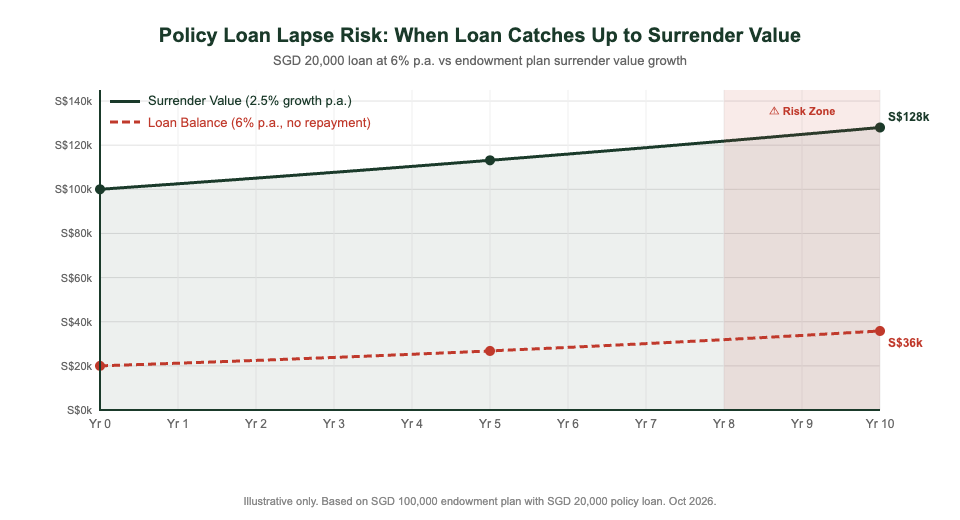
1. Compounding interest can erode your surrender value. If you borrow and make no repayments, interest compounds annually. On a SGD 20,000 loan at 6% p.a., your outstanding balance grows to SGD 35,817 after 10 years. If your policy’s cash value hasn’t grown proportionally, this increases your lapse risk significantly.
2. Policy lapse risk. If at any point the outstanding loan balance (principal plus accrued interest) exceeds the policy’s cash value, the insurer will notify you that you must repay part of the loan — or the policy will lapse. A lapsed policy means you receive nothing and forfeit all future benefits, including the life coverage. This is the worst-case scenario and must be actively avoided through regular monitoring.
3. Reduced death benefit. The death benefit payable to your nominees upon your passing is reduced by the full outstanding loan balance plus accrued interest at the time of claim. Ensure your nominees and financial dependents understand this, and consider whether your total life coverage remains adequate.
4. Interest rate changes. Policy loan rates are not fixed forever. Insurers reserve the right to revise rates, which can affect your repayment planning. Always obtain confirmation of the current applicable rate in writing from your insurer before borrowing.
5. Reduced SRS or CPF-IS eligibility. If your endowment plan was purchased using SRS or CPF funds, special rules apply. Confirm with your insurer and CPF Board before taking a policy loan on such policies. You can also explore the CPF investment strategy guide for alternatives.
How to Apply for a Policy Loan in Singapore
The application process differs slightly by insurer, but the general steps are:
- Log into your insurer’s customer portal or mobile app. AIA, Prudential, Great Eastern, NTUC Income, and Manulife all offer digital policy loan applications. For older policies, you may need to submit a paper form.
- Select your policy and check the available loan limit. The portal will show your current cash value and maximum loan amount in real time.
- Enter the loan amount and preferred bank account for disbursement. Most insurers disburse to a Singapore bank account registered with them.
- Review the interest rate and terms. Confirm the applicable annual interest rate and whether it is charged on a simple or compound basis. Ask for written confirmation if in doubt.
- Submit and wait for disbursement. Digital applications typically take three to seven business days. Some insurers offer faster processing for policies with long-standing relationships.
For policies originally purchased through a financial adviser, you may need to route the application through your adviser. Contact your insurer’s customer service hotline directly if you are unsure of the process.
Who Should (and Shouldn’t) Take a Policy Loan?
A policy loan on your endowment plan makes sense if:
- You need temporary liquidity (one to three years) and plan to repay the loan within that timeframe
- You are more than halfway through your policy term and surrender penalties or forfeited bonuses exceed the loan interest cost
- You have no access to a competitive bank loan (poor credit history, or already at your bank’s credit limit)
- Your emergency fund has been depleted and you need fast access to cash without credit checks
- The alternative is high-cost debt (credit card revolving debt at 26%+ p.a.)
A policy loan is likely not the right choice if:
- You are in the early years of your policy (Year 1–3) and the cash value is very small — the loan amount may not be meaningful
- You need funds permanently and have no realistic plan to repay — the compounding interest will quietly erode your eventual payout
- You have easy access to lower-cost alternatives such as a home equity term loan or a government-backed loan scheme
- Your policy has consistently underperformed and you are already considering surrendering it — in which case, surrendering and redeploying into the best S-REITs in Singapore 2026 may generate better long-term returns
If you are uncertain, consider speaking with a MAS-licensed financial adviser who can model the exact financial impact of borrowing versus surrendering based on your specific policy’s illustrated projections.
Disclaimer: This article is for general educational purposes only and does not constitute financial advice. Policy loan terms, interest rates, and eligibility conditions vary by insurer and specific policy. Always verify details directly with your insurer or a MAS-licensed financial adviser before making any decision.
Frequently Asked Questions
What is a policy loan on an endowment plan in Singapore?
A policy loan allows you to borrow cash against the accumulated cash value (surrender value) of your endowment plan without cancelling the policy. The policy continues to earn returns and provide life coverage while the loan remains outstanding. Interest is charged on the loan balance, and the outstanding amount is deducted from your maturity payout or death benefit when due.
What is the typical policy loan interest rate in Singapore?
Policy loan interest rates in Singapore typically range from 5.5% to 7.0% p.a. for SGD-denominated endowment plans, depending on the insurer. Rates are periodically revised by insurers in line with prevailing interest rate conditions. Always confirm the current rate directly with your insurer before applying, as rates are not fixed in advance.
How much can I borrow against my endowment plan?
Most Singapore insurers allow you to borrow up to 80–92% of your policy’s current cash value (surrender value). For example, if your policy has a cash value of SGD 50,000, you could borrow approximately SGD 40,000–46,000. The exact limit depends on your insurer’s policy terms and the specific plan type. Policies in their first two to three years may not yet have sufficient cash value to support a loan.
Will taking a policy loan affect my endowment plan's returns or coverage?
Your endowment plan continues to accumulate guaranteed and non-guaranteed returns while the loan is outstanding — so your maturity value continues to grow as projected. However, the outstanding loan balance plus accrued interest will be deducted from your final payout at maturity. Your life coverage also remains in force, but the death benefit payable to your nominees is reduced by the outstanding loan balance.
What happens if I don't repay my policy loan?
If you do not repay your policy loan, interest compounds on the outstanding balance. Over time, the growing loan balance can approach your policy’s cash value. If the loan balance exceeds the cash value at any point, the insurer will send you a notice demanding partial repayment — failure to respond will result in the policy lapsing, which means you receive nothing and lose all future benefits. This is the most serious risk of a policy loan.
Is a policy loan better than surrendering my endowment plan?
In most cases, a policy loan is better than surrendering early if you only need temporary liquidity and the remaining years of the policy carry significant upside (guaranteed maturity value plus potential bonuses). Surrendering is irreversible and permanently ends the policy, forfeiting future payouts. However, if your policy has consistently underperformed and you do not plan to repay the loan, surrendering and redeploying into higher-returning assets may be the better long-term financial decision.
Can I take a policy loan on an endowment plan bought with CPF or SRS funds?
Special rules apply to endowment plans purchased using CPF Investment Scheme (CPFIS) or Supplementary Retirement Scheme (SRS) funds. Policy loans on CPFIS-linked policies must comply with CPF Board rules, and any loan proceeds may need to be returned to your CPF account. For SRS-linked plans, check with your insurer and a MAS-licensed adviser before proceeding, as tax implications may arise on the loan disbursement.
Planning Your Financial Future Beyond Your Endowment Plan?
Explore higher-return alternatives like S-REITs, robo-advisors, and T-bills — or model your retirement income with our free calculator.
Get Free Insurance Advice
Speak with a licensed insurance advisor. No obligation, no cost.
By submitting this form, you agree to our Privacy Policy.
This article was researched with the help of AI. While we strive to keep all information accurate and up to date, there may be errors. If you notice any discrepancies, please contact us.