MediSave Limit 2026: What If You’re Hospitalised Twice in One Year?
Your complete guide to how MediShield Life and your ISP handle multiple admissions — and how to protect your MediSave balance.
If you’re hospitalised twice in the same policy year in Singapore, the good news is that MediShield Life’s annual deductible is paid only once — your second admission does not trigger a fresh deductible. However, each stay still draws on your MediSave balance at up to $700 per day for a normal ward, so a two-admission year can meaningfully dent your account. Your Integrated Shield Plan (ISP) covers the same way on the second admission, minus the deductible already met.
Not financial advice. All figures are for educational reference only. Data verified as at 16 October 2026.
Table of Contents
Contents — Click to expand
- The Good News: Deductible Applies Only Once Per Year
- How MediShield Life Works Across Multiple Admissions
- What Changes in Your Second Hospitalisation
- How Your ISP Handles Repeat Admissions
- How MediSave Gets Drawn Down Across Two Stays
- Worked Example: Two Hospitalisations in 2026
- How to Protect Your MediSave Balance
- Frequently Asked Questions
The Good News: Deductible Applies Only Once Per Year
Facing a second hospitalisation in the same year feels daunting — but there is one piece of genuinely good news in Singapore’s healthcare system. Under MediShield Life (and your Integrated Shield Plan, if you have one), the annual deductible is applied once per policy year, not once per admission.
This means if you were hospitalised in February and had already paid the deductible for your ward class, a second admission in August does not restart the clock. MediShield Life will begin covering claimable costs from the first dollar of that second stay (subject to co-insurance, which we’ll cover below).
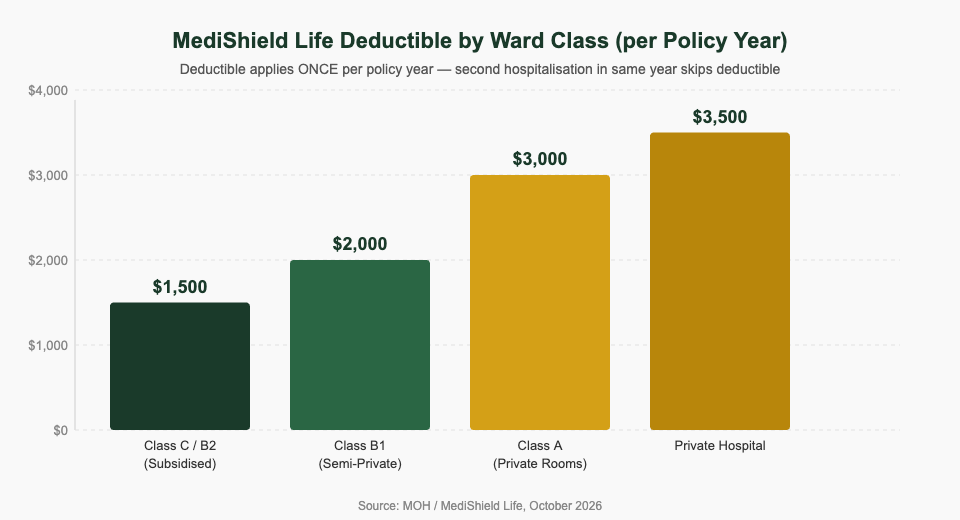
The deductible amounts for 2026 by ward class are:
| Ward Class | Annual Deductible (Per Policy Year) |
|---|---|
| Class C / B2 (Subsidised) | $1,500 |
| Class B1 (Semi-Private) | $2,000 |
| Class A (Private Rooms in Public Hospital) | $3,000 |
| Private Hospital | $3,500 |
Source: MOH / MediShield Life, October 2026. For more details on how deductibles work, see our guide to the MediShield Life deductible 2026.
How MediShield Life Works Across Multiple Admissions
MediShield Life reimburses a portion of your inpatient bill based on claim limits set by MOH. These limits cap how much can be claimed per day, per surgery, or per episode — and your MediSave is used to pay your share of the bill (the deductible and the remaining co-insurance).
For each admission, the MediSave withdrawal limits apply independently:
- Normal ward: Up to $700 per day in MediSave withdrawals
- ICU: Up to $900 per day
- Surgery: Separate surgical table limits ranging from $1,500 to $7,550, depending on the procedure
These per-day limits do not reset or compound across admissions — they simply apply to each day of each stay. So a 5-day Class B1 stay in February followed by a 5-day stay in August means you can use MediSave for up to $700 × 10 = $7,000 across both stays in the year (for the ward charges component alone, before surgery tables).
What does reset — or rather, does not re-apply — is the deductible. Once your first admission satisfies the deductible for your ward class, subsequent admissions in the same policy year skip it. This is a meaningful saving, especially for higher ward classes.
What Changes in Your Second Hospitalisation
Your second hospitalisation in the same policy year proceeds as follows:
Deductible: Already met — MediShield Life coverage kicks in from dollar one of claimable costs for this admission.
Co-insurance: Still applies. MediShield Life covers approximately 80% to 90% of the claimable bill (above the deductible), and you pay 10% co-insurance up to certain caps. This co-insurance is payable from MediSave.
MediSave withdrawal limits: Continue to apply per day, per stay. Your $700/day ward limit and the surgical table limits apply to this admission just as they did to your first.
Cash portion: Any bill amounts above the MediShield Life claim limits — and any amounts above your MediSave withdrawal limits — must be paid in cash, or claimed through your ISP (if you have one).
Understanding these MediSave hospitalisation claim limits 2026 helps you estimate what you’ll owe out of pocket before the hospital bill arrives.
How Your ISP Handles Repeat Admissions
If you hold an Integrated Shield Plan, the ISP’s own deductible structure mirrors MediShield Life — it is also typically an annual deductible, not a per-admission deductible. This means your ISP’s deductible (if any applies to your plan tier) is similarly paid only once per policy year.
Under the new ISP rider rules introduced in 2025 and 2026, policyholders with the new-format riders pay a co-payment on their bills. This co-payment applies on each claim regardless of whether it is the first or second admission in the year — but because the deductible is already settled after the first stay, the total out-of-pocket for your second hospitalisation should be lower than for the first.
A key point: ISP rider premiums cannot be paid from MediSave — they must be paid in cash. Only the base ISP premium (up to the age-based Additional Withdrawal Limit) can use MediSave funds. The Additional Withdrawal Limit (AWL) for base ISP premiums is:
| Age Next Birthday | MediSave AWL for ISP Base Premium |
|---|---|
| 1–40 | $300 / year |
| 41–70 | $600 / year |
| 71 and above | $900 / year |
Source: CPF Board / MOH, October 2026. Any ISP premium above this AWL must be paid in cash.
For a detailed walkthrough of how to navigate an ISP claim at a private hospital, see our step-by-step guide to filing an ISP claim at a private hospital.
How MediSave Gets Drawn Down Across Two Stays
Here’s the part most people underestimate: your MediSave balance does not care how many times you’ve been hospitalised. Every eligible claim against your account draws down your balance. Over two admissions, that drawdown can be substantial.
With the MediSave Basic Healthcare Sum (BHS) set at $79,000 for 2026 (for members under 65), the cap on what you can hold in MediSave is generous — but it is not a blank cheque. Many Singaporeans in their 40s and 50s hold far less than the BHS, meaning a pair of hospital stays in one year can bring their balance uncomfortably low.
The components drawing from your MediSave account in a hospital year include:
- MediShield Life premiums: Deducted annually from MediSave
- ISP base premium (up to AWL): Deducted annually from MediSave
- Hospitalisation ward charges: Up to $700/day per admission
- Surgery charges: Separately capped per procedure
- Deductible (first admission): Paid from MediSave (if not covered by ISP rider)
- Co-insurance: Paid from MediSave (10% of claimable amount above deductible)
With two hospital stays, items 3 through 6 above apply twice (except the deductible, which applies only once). For someone with a mid-range MediSave balance, this can mean thousands of dollars in drawdowns in a single year — and that’s before considering rising ISP premiums that further compress the available balance.
Worked Example: Two Hospitalisations in 2026
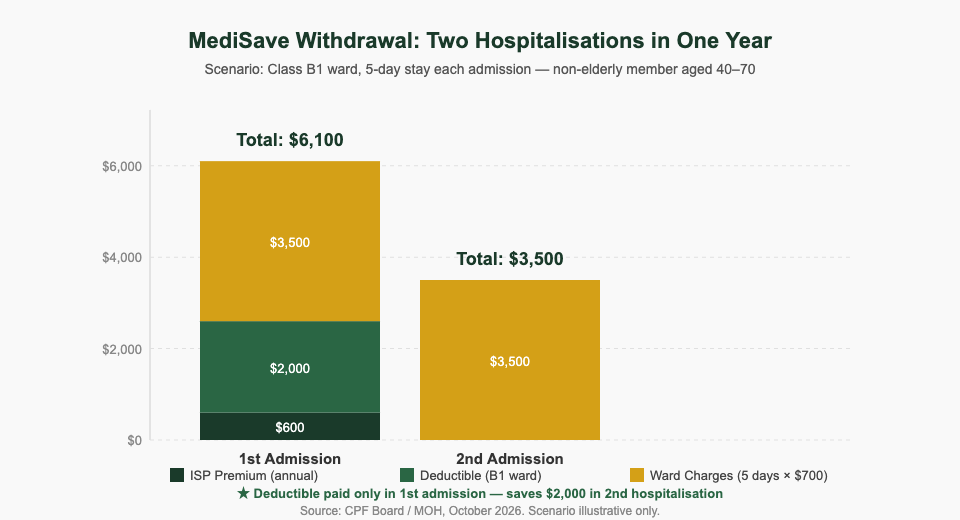
Let’s take a concrete Singapore scenario. Mei Ling, 47, holds an ISP with a new-format rider and is admitted to a Class B1 ward in a restructured hospital twice in 2026 — once in April (5 days, minor surgery) and once in September (5 days, no surgery).
| Cost Component | 1st Admission (April) | 2nd Admission (September) |
|---|---|---|
| Ward charges (5 days × $700) | $3,500 (MediSave) | $3,500 (MediSave) |
| MediShield Life deductible (B1) | $2,000 (MediSave) | $0 (already met) |
| ISP base premium — AWL (age 41–70) | $600/yr (MediSave) | — |
| ISP rider co-payment (~5% of bill above deductible, cash) | ~$400 (cash) | ~$250 (cash) |
| Estimated MediSave drawn per admission | ~$6,100 | ~$3,500 |
Source: Illustrative example based on CPF Board / MOH figures, October 2026. Actual amounts depend on ward type, diagnosis and surgery table. Rider co-payment rate based on new ISP rider structure.
Across both admissions, Mei Ling draws approximately $9,600 from her MediSave for ward and deductible charges — plus pays roughly $650 in cash for rider co-payments and premiums above her AWL. The second admission is notably cheaper because the deductible is already satisfied.
How to Protect Your MediSave Balance
If you face — or anticipate facing — multiple hospitalisations in a year, here are the practical steps to protect your MediSave balance:
1. Voluntary MediSave top-ups. You can top up your own MediSave (or a family member’s) up to the prevailing BHS of $79,000. Top-ups are eligible for dollar-for-dollar tax relief under the CPF Cash Top-Up Relief (capped at $8,000 per year for self, and $8,000 for family members). Topping up before a planned admission puts more buffer in place.
2. Review your ISP ward class. Staying in a ward class that matches your ISP coverage — or downgrading to a lower class temporarily if you do not have a rider — can reduce your deductible and MediSave drawdown. A Class B1 admission draws a $2,000 deductible versus $3,500 for a private hospital. For tips on how the new 2026 rider rules affect your real-cost calculation, see our overview of the Integrated Shield Plan Singapore landscape.
3. Check the annual Matched MediSave Scheme. For eligible lower-income Singaporeans, the government matches voluntary MediSave top-ups up to $600 per year. Check your eligibility and use this before your MediSave runs low.
4. Keep rider premium payments current. ISP rider premiums cannot be paid from MediSave — they require cash. Missing rider premium payments due to cash-flow stress is one of the main reasons Singaporeans end up downgrading their coverage in a crisis. Budget for rider cash payments separately from your MediSave balance, especially if you expect a hospitalisation year.
5. Time elective procedures thoughtfully. If a second admission within the same policy year is elective, consider whether timing it before or after the policy renewal date makes a difference. If your policy year renews in July and you need an elective procedure, a September admission uses the “deductible already met” advantage from your earlier admission. A January admission would trigger a fresh deductible for the new policy year.
6. Use Singapore’s retirement planning tools. Estimating how much healthcare buffer you need in MediSave over the long run is part of retirement planning. The Singapore retirement calculator can help you map projected healthcare spend alongside your other retirement expenses.
Frequently Asked Questions
If I'm hospitalised twice in the same year, do I pay the MediShield Life deductible twice?
No. MediShield Life’s deductible applies once per policy year, not once per admission. If your first hospitalisation in the policy year satisfies the deductible for your ward class (for example, $2,000 for Class B1), your second admission in the same policy year skips the deductible entirely. MediShield Life will cover claimable amounts from the first dollar of that second stay, subject to the 10% co-insurance.
What is the MediSave daily withdrawal limit for a hospital stay in 2026?
The MediSave withdrawal limit for inpatient ward charges is $700 per day for a normal ward and $900 per day for ICU. Surgery procedures are claimed separately under the surgical table, with limits ranging from approximately $1,500 to $7,550 depending on the procedure. These limits apply independently to each admission — there is no annual cap on total hospitalisation withdrawals, but your MediSave balance is finite and draws down with each claim.
Does my ISP deductible also apply only once per year?
Yes, for most ISP policies in Singapore the deductible structure mirrors MediShield Life — it is an annual deductible that applies once per policy year, not per admission. This means once the first hospitalisation satisfies your ISP’s deductible (which for private hospital plans is typically $3,500 or higher), your second admission in the same policy year does not trigger a new deductible. Always confirm this with your specific insurer, as individual policy terms can vary.
What is the MediSave Basic Healthcare Sum (BHS) for 2026?
The MediSave Basic Healthcare Sum (BHS) for 2026 is $79,000 for members below age 65. This is the cap on how much you can hold in your MediSave Account — contributions above the BHS are automatically redirected to your other CPF accounts. Members who turn 65 in 2026 have their BHS fixed at $79,000 for life. Members already 66 and above retain the BHS that was set for their cohort when they turned 65.
Can I pay my ISP rider premium from MediSave after multiple hospitalisations?
No. ISP rider premiums cannot be paid from MediSave regardless of how many times you have been hospitalised — they must be settled in cash. Only the base ISP premium (the component that tops up MediShield Life to your chosen ward class) can be paid from MediSave, up to the age-based Additional Withdrawal Limit: $300 per year for under 40, $600 per year for ages 41 to 70, and $900 per year for 71 and above. Budget for rider premiums as a separate cash expense throughout your hospitalisation year.
What if my MediSave balance runs out during a hospitalisation year?
If your MediSave Account balance is insufficient to cover the full MediSave-eligible amount for your hospital bills, you will need to pay the shortfall in cash. You may also tap a family member’s MediSave Account, subject to their consent and the same withdrawal limits. To avoid this situation, consider voluntary MediSave top-ups before the end of each year — these are eligible for CPF Cash Top-Up Relief (up to $8,000 per year for self) and help rebuild your buffer before the next policy year begins.
Review Your ISP Coverage Before Your Next Admission
Make sure your Integrated Shield Plan matches your ward class and hospitalisation needs. Understand your deductible and co-payment structure before a claim arises.
Get Free Insurance Advice
Speak with a licensed insurance advisor. No obligation, no cost.
By submitting this form, you agree to our Privacy Policy.
This article was researched with the help of AI. While we strive to keep all information accurate and up to date, there may be errors. If you notice any discrepancies, please contact us.