Integrated Shield Plan Deductible in Singapore (2026): How Much You Pay Before Your Rider Kicks In
A plain-English breakdown of MOH’s new deductible rules for Integrated Shield Plan riders, with worked SGD examples by ward class.
Your Integrated Shield Plan (IP) deductible is the fixed amount you must pay out of pocket each policy year before your rider starts paying. From 1 April 2026, MOH no longer allows new riders to cover this deductible. It ranges from $1,500 to $3,500 depending on your ward class. After the deductible, you also pay a share of the remaining bill, capped at a minimum of $6,000 a year, which can usually be paid from MediSave.
Not financial advice. All figures are for educational reference only. Data verified as at 15 August 2026.
- From 1 April 2026, new IP riders can no longer cover your deductible — the fixed amount (S$1,500 to S$3,500, depending on ward class) you pay before your rider kicks in.
- After the deductible, you also pay 5% co-payment, but this is now capped at a minimum of S$6,000 a year — up from S$3,000 previously.
- Both the deductible and co-payment can usually be paid from MediSave, subject to withdrawal limits, so you may not need much cash.
Table of Contents
What Is an Integrated Shield Plan Deductible?
An Integrated Shield Plan (IP) is your MediShield Life policy plus private insurance coverage on top, sold by insurers like Great Eastern, AIA, Prudential, Income, Singlife, and HSBC Life. Many policyholders also buy a rider — an add-on that reduces how much you pay when you claim.
The deductible is different from your co-payment. Think of it as an annual excess. It is a fixed dollar amount you must pay first, before your IP or rider starts paying anything at all. You only pay it once per policy year — multiple bills in the same year count toward the same deductible.
For example, if your deductible is $2,000 and you are warded for a $10,000 bill, you pay the first $2,000. Only the remaining $8,000 is subject to co-payment and insurer payout rules. That said, once you have already paid your deductible for the year, a second hospital bill later that year does not require you to pay the deductible again.
Here’s why this matters. From 1 April 2026, you can no longer buy a rider that pays this deductible for you. That single change is reshaping how much cash — or MediSave — you need to set aside for a hospital stay.
How the April 2026 Rider Reform Changed Deductibles
On 26 November 2025, the Ministry of Health (MOH) announced new design requirements for IP riders. The changes took effect on 1 April 2026, and they hit two levers at once.
First, new IP riders sold from 1 April 2026 can no longer cover the minimum IP deductible that MOH sets for your ward class. Previously, a “full rider” would often absorb the deductible entirely, leaving you with close to zero out-of-pocket cost. That is no longer allowed for new riders.
Second, the co-payment cap — the most you pay in co-insurance each year, on top of the deductible — was raised from a minimum of $3,000 (set in 2018) to a minimum of $6,000 per year. Importantly, this cap applies to co-payments excluding the deductible. So your true worst-case annual out-of-pocket, before MediSave, is the deductible plus up to $6,000 in co-payment.
Why the change? MOH’s data showed private hospital IP policyholders with riders were 1.4 times as likely to claim, with claims 1.4 times larger on average, than those without riders. Generous riders removed the “brake” on healthcare spending, which pushed up bill sizes, claims, and ultimately premiums for everyone. The reform is meant to restore IP riders to their original purpose — protecting you against large, unexpected bills, not covering every dollar of routine treatment.
The upside for you: MOH expects new riders to cost about 30% less on average than existing riders with maximum coverage — an official MOH estimate, not an industry projection. That works out to roughly $600 a year in premium savings for private hospital rider holders, and about $200 a year for public hospital rider holders, on average, with older policyholders saving more. If you are researching how the 2026 ISP rider rules changed more broadly, or want the fuller policy breakdown, see our explainer on the new ISP rider rules.
Note that these changes only apply to new riders bought on or after 27 November 2025. If you bought your rider before that date, your insurer will decide its own approach and timeline for transitioning you — check with your insurer or financial adviser directly.
Deductible Amounts by Ward Class
MOH does not set one deductible for everyone. It varies by the ward class you are targeting coverage for, and by the ward class you actually use when hospitalised. The table below shows the prevailing minimum IP deductibles as published by MOH.
| Ward Class | Minimum IP Deductible |
|---|---|
| Class A / Private | $3,500 |
| Class B1 | $2,500 |
| Class B2 | $2,000 |
| Class C | $1,500 |
| Day Surgery / Short Stay Ward (Non-Subsidised) | $2,000 |
| Day Surgery / Short Stay Ward (Subsidised) | $1,500 |
| Outpatient | Not applicable |
Source: Ministry of Health, “New Requirements for Integrated Shield Plan Riders” (26 November 2025), Annex A, Table 1. Figures are the prevailing minimum IP deductibles as at November 2025; MOH notes these may be updated from time to time.
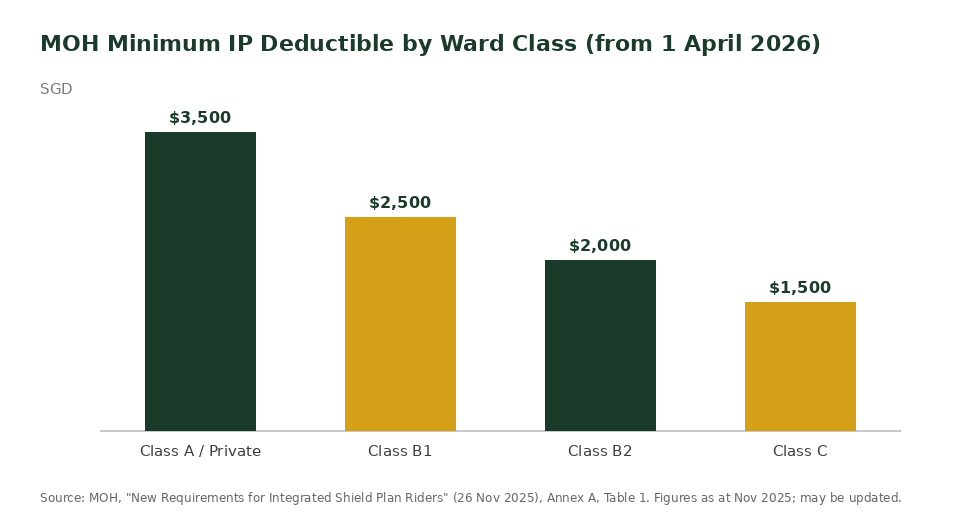
Notice the logic: your deductible is the lower of (i) the ward class your IP targets, and (ii) the ward class you actually use. So if your plan is designed for Class B1 coverage but you are warded in Class B2, your deductible is $2,000, not $2,500. If you use a private or Class A ward, your deductible rises to whatever your plan targets, up to $3,500.
Worked SGD Example
Numbers are easier to picture with a real bill. Let’s say you are on a private hospital IP with a new rider bought after 1 April 2026, and you are warded in a private hospital for a procedure costing $50,000.
| Item | Amount |
|---|---|
| Total hospital bill | $50,000 |
| You pay: deductible (Private/Class A) | $3,500 |
| Remaining bill after deductible | $46,500 |
| You pay: 5% co-payment on remaining bill | $2,325 |
| Total you pay (deductible + co-payment) | $5,825 |
| Insurer and IP payout | $44,175 |
Illustrative calculation by The Kopi Notes, based on MOH’s published deductible and 5% minimum co-payment rules effective 1 April 2026. Actual claims depend on your specific plan, panel status, and pre-authorisation.
In this example, your $5,825 out-of-pocket cost stays under the $6,000 minimum co-payment cap, so the cap does not even need to kick in. But what happens with a much larger bill?
Say the same policyholder instead faces a $150,000 bill for a complex surgery. The deductible is still $3,500. Five percent of the remaining $146,500 would be $7,325 — but this exceeds the $6,000 co-payment cap, so your co-payment is capped at $6,000. Your total out-of-pocket becomes $3,500 + $6,000 = $9,500, and the insurer pays the remaining $140,500. This is exactly the “peace of mind” the cap is designed to give you: no matter how large the bill, your co-payment portion cannot exceed $6,000 a year.
Can You Use MediSave to Pay the Deductible?
Yes. According to MOH, the deductible and co-payments under the new rider design can be paid using MediSave, subject to prevailing withdrawal limits. This is separate from the MediSave Additional Withdrawal Limit (AWL) that applies to paying your rider premiums — that AWL ranges from $300 to $900 a year depending on your age, and is a different mechanism from the withdrawal limits that apply when you actually make a claim for hospitalisation.
In its own modelling, MOH projected that roughly six in ten rider claimants would not need to pay any cash out-of-pocket at all after MediSave covers their share. For the remaining four in ten, most would pay $1,000 or less in cash, and practically all would pay $3,000 or less. That is a meaningful cushion — but it also means you should not assume MediSave alone will always cover 100% of your deductible and co-payment, especially for very large bills or if your MediSave balance is limited.
For the fuller picture on withdrawal limits and how much MediSave you can use for hospital bills and IP-related costs, see our guide on how much MediSave you can use in Singapore. You can also check the Central Provident Fund (CPF) Board’s own guidance on withdrawal limits directly at cpf.gov.sg.
What Singapore Policyholders Should Do Now
However you feel about the reform, a few practical steps will help you plan around it.
Know your ward class and deductible. Check your policy documents or ask your insurer which ward class your IP targets, and confirm your deductible from the table above. This tells you your worst-case cash exposure before insurance pays anything.
Check your MediSave balance. Since deductibles and co-payments can typically be paid from MediSave, review your account balance and withdrawal limits so you are not caught short during a hospital stay. For a full walkthrough, see what an Integrated Shield Plan covers and how it interacts with MediShield Life.
Decide if you still need a rider. With the deductible no longer covered, some policyholders may find the new riders less compelling for smaller, more predictable medical needs — while still valuable for catastrophic bills. If you are shopping around, start by comparing Integrated Shield Plans in Singapore across insurers before committing.
Build a dedicated buffer. Even with MediSave, having a cash buffer of $3,000 to $6,000 set aside for medical emergencies gives you breathing room, since not every dollar of co-payment may be MediSave-eligible depending on your balance and age-based limits. If you are also thinking about how healthcare costs fit into your broader retirement plan, our Singapore retirement calculator can help you model this alongside your other goals.
Talk to a financial adviser before switching. If you bought your rider before 27 November 2025, do not assume you are automatically affected. Speak to your insurer or an independent adviser about your specific transition timeline and whether staying on your existing rider or moving to a new one makes more sense for you. If you’re also building up savings or investments alongside your healthcare planning, platforms like the ones behind our Endowus referral code are worth a look for the investment side of your financial plan.
Frequently Asked Questions
What is the Integrated Shield Plan deductible in Singapore?
It is a fixed amount you must pay out of pocket each policy year before your Integrated Shield Plan or rider starts paying your hospital bill. As at 2026, MOH sets this at $1,500 to $3,500 depending on your ward class, and you only pay it once per policy year even if you are hospitalised more than once.
Why can't my new rider cover the deductible anymore?
From 1 April 2026, MOH no longer allows new IP riders to cover the minimum deductible it sets. This is meant to restore some cost discipline, since fully-covered deductibles were linked to higher claim frequency and larger bill sizes, which in turn pushed premiums up for everyone.
How much is the co-payment cap for Integrated Shield Plan riders in 2026?
The minimum co-payment cap was raised from $3,000 to $6,000 per year from 1 April 2026. This cap applies to co-payments excluding your deductible, so your maximum yearly out-of-pocket is your deductible plus up to $6,000, before MediSave.
Can I use MediSave to pay my Integrated Shield Plan deductible?
Yes. MOH has confirmed that the deductible and co-payments under the new rider design can be paid using MediSave, subject to prevailing withdrawal limits. MOH projects that about six in ten rider claimants will not need to pay cash out-of-pocket at all after MediSave.
Does the deductible change apply to my existing rider?
Not automatically. The new rules only apply to new riders bought on or after 27 November 2025. If you purchased your rider before that date, your insurer will separately decide its own approach and timeline for transitioning existing policyholders, so check directly with your insurer.
Will my premiums be lower under the new rider rules?
MOH expects new riders to cost about 30% less on average than existing riders with maximum coverage — roughly $600 a year in savings for private hospital rider holders and about $200 a year for public hospital rider holders, on average. Actual savings depend on your insurer, plan, and age.
Plan Ahead for Your Healthcare and Retirement Costs
Model your medical buffer alongside your long-term retirement plan, or explore how to invest your savings more efficiently.
Get Free Insurance Advice
Speak with a licensed insurance advisor. No obligation, no cost.
By submitting this form, you agree to our Privacy Policy.
This article was researched with the help of AI. While we strive to keep all information accurate and up to date, there may be errors. If you notice any discrepancies, please contact us.