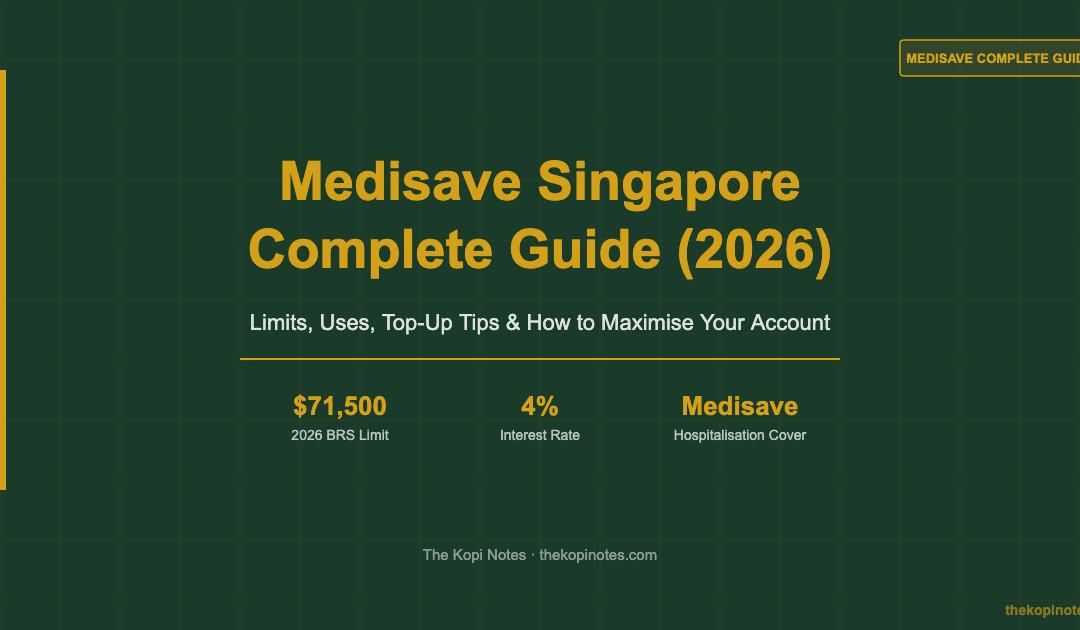
Medisave Singapore: Complete Guide (2026) — Limits, Uses & Top-Up Tips
Your CPF Medisave account explained — how much you have, what you can spend it on, and how to grow it faster.
Medisave is a mandatory CPF savings account that covers your hospitalisation bills, approved outpatient treatments, and health insurance premiums. Every working Singaporean and PR contributes a percentage of their salary into Medisave each month. Your balance earns a guaranteed 4% interest per year, and the Basic Healthcare Sum (BHS) cap for 2026 is $71,500. Money above the BHS flows into your Special or Retirement Account instead.
Not financial advice. All figures are for educational reference only. Data as at July 2026 unless noted.
- Medisave is your CPF health savings account — it earns 4% p.a. and you cannot withdraw cash from it
- You can use it to pay hospital bills, MediShield Life and Integrated Shield Plan premiums, and some outpatient treatments
- Topping up Medisave voluntarily gets you a dollar-for-dollar tax relief (up to your personal income tax relief cap)
Table of Contents
Contents — Click to expand
- What Is Medisave?
- How Medisave Contributions Work
- Medisave Limit 2026: The Basic Healthcare Sum (BHS)
- What Can You Use Medisave For?
- How to Top Up Medisave (And Why You Should)
- Medisave Interest Rate: How Your Balance Grows
- Medisave for Maternity and Delivery
- Flexi-Medisave for Seniors
- Medisave and Your Integrated Shield Plan
- Frequently Asked Questions
What Is Medisave?
Medisave is one of the three CPF accounts every Singaporean and Singapore PR has. The other two are the Ordinary Account (OA) and the Special Account (SA). Your Medisave Account (MA) exists purely for healthcare — you cannot make a cash withdrawal from it under normal circumstances.
Think of it like a forced healthcare savings pot. Every month, a slice of your CPF contribution goes directly into your Medisave. You cannot touch it for day-to-day spending — but when a hospital bill arrives, your Medisave balance is there to cushion the blow.
The CPF Board manages the account, and the money earns a guaranteed 4% interest per year. That’s higher than most savings accounts in Singapore. So even if you don’t draw on it often, your balance quietly compounds every year.
Medisave works alongside MediShield Life — the national health insurance scheme — to cover the bulk of your hospitalisation costs. If you upgrade to an Integrated Shield Plan (ISP), your Medisave also pays the ISP premiums, reducing your out-of-pocket cash outflow. You can learn more about how this fits together in our Singapore REIT ETF guide and our broader guides on building a financial safety net.
How Medisave Contributions Work
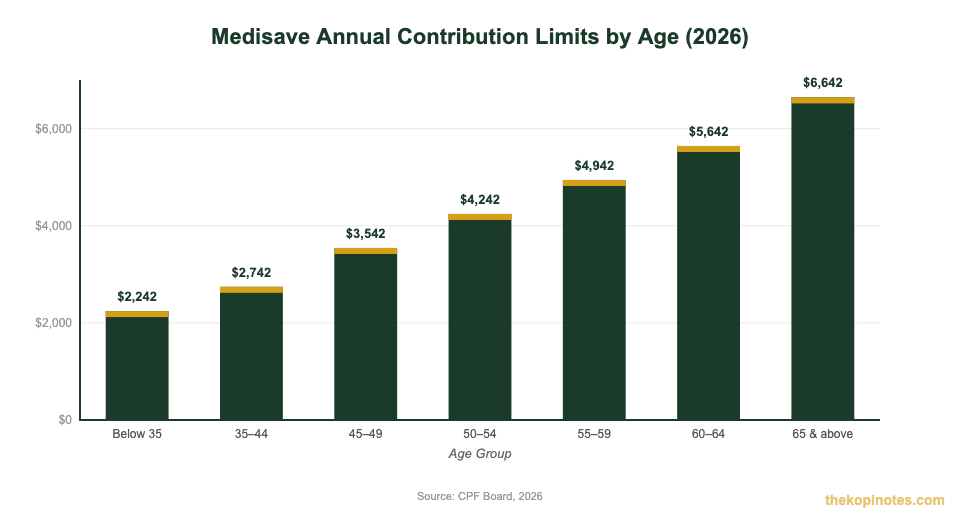
Your Medisave contribution rate depends on your age and your monthly wages. It is expressed as a percentage of your gross salary, up to the CPF Wage Ceiling (currently $7,400/month ordinary wage for 2026).
Here is the breakdown for employees as at 2026:
| Age Group | Employee CPF Rate | Employer CPF Rate | Medisave Allocation Rate |
|---|---|---|---|
| Below 35 | 20% | 17% | 8–10.5% of wages |
| 35–45 | 20% | 17% | 9–10.5% of wages |
| 45–50 | 20% | 17% | 10–10.5% of wages |
| 50–55 | 20% | 17% | 10.5% of wages |
| 55–60 | 15% | 15% | 10.5% of wages |
| 60–65 | 9.5% | 12.5% | 10.5% of wages |
| 65 & above | 7% | 9% | 10.5% of wages |
Source: CPF Board, 2026. Rates apply to wages up to the Ordinary Wage Ceiling ($7,400/month).
Let’s make that real. If you are 32 years old and earn $5,000 a month, your combined CPF contribution (employee + employer) is $5,000 × 37% = $1,850. Of that, roughly 8–10.5% goes to Medisave — so approximately $400–$525 per month flows into your healthcare pot. Over a year, that’s $4,800–$6,300 just from salary contributions.
Medisave Limit 2026: The Basic Healthcare Sum (BHS)
The Basic Healthcare Sum (BHS) is the cap on how much you can hold in your Medisave Account. For 2026, the BHS is $71,500.
This is important: once your Medisave hits the BHS, any new contributions overflow into your Special Account (if you are below 55) or your Retirement Account (if you are 55 or above). So you do not lose the money — it just shifts to a different CPF account that you can eventually use for retirement income.
The BHS increases slightly each year in line with healthcare cost trends. In 2025 it was $69,000. In 2024 it was $66,000. The CPF Board announces the new figure in January each year.
For self-employed persons (SEPs), Medisave contributions are also mandatory — but the rules differ. SEPs must contribute a percentage of their net trade income annually, assessed by IRAS. The contribution rates mirror the employee allocation rates above. If you earn $50,000 in net trade income and you are 40, you would contribute approximately $5,000–$5,250 to Medisave that year.
What Can You Use Medisave For?
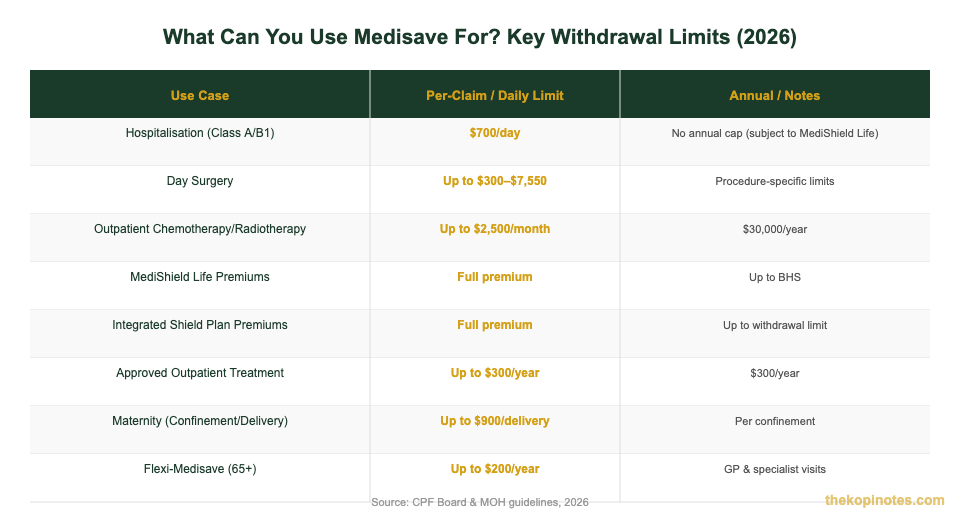
This is where most people get confused. Medisave is not a free-for-all healthcare wallet. The CPF Board has specific approved uses, and each has its own withdrawal limit.
Here are the main categories:
1. Hospitalisation and Day Surgery
You can use Medisave to pay for hospitalisation in a Singapore restructured hospital or private hospital. The daily withdrawal limit is $700 per day for normal ward stays. For day surgery, the limit depends on the procedure — it ranges from $300 to $7,550 per operation.
2. MediShield Life Premiums
MediShield Life is the national health insurance scheme. Its annual premium is automatically deducted from your Medisave — you do not need to do anything. Premiums range from a few hundred dollars for younger Singaporeans to over $1,500 per year for those above 70.
3. Integrated Shield Plan (ISP) Premiums
If you upgrade to an Integrated Shield Plan — such as AIA HealthShield Gold Max, Prudential PRUShield, or Great Eastern Supreme Health — you can pay the basic plan premium using Medisave. However, rider premiums (the part that covers co-payments) must be paid in cash following MOH’s 2021 rider reforms.
4. Approved Outpatient Treatments
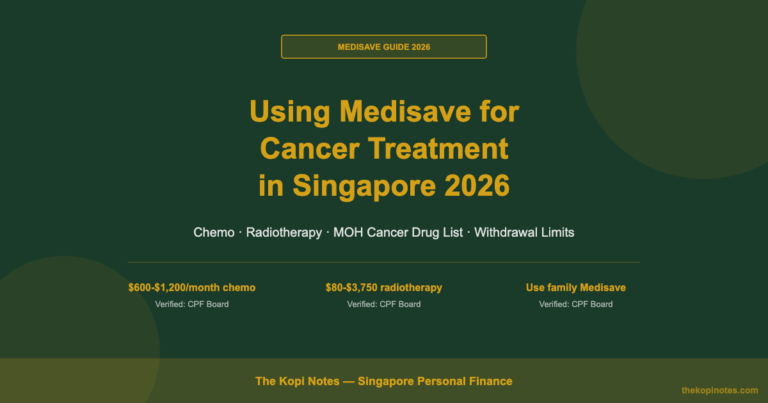
This includes chemotherapy, radiotherapy, renal dialysis, and certain chronic disease management programmes. The limits are higher — up to $2,500 per month for chemotherapy and radiotherapy, or $30,000 per year. For the chronic disease outpatient programme, you can use up to $300 per year at CHAS GP clinics.
5. Maternity and Delivery
You can draw up to $900 per delivery from Medisave to offset hospitalisation and delivery charges. More on this in the maternity section below.
6. Flexi-Medisave (Age 65 and above)
Seniors can use up to $200 per year for outpatient visits at GP clinics and specialist outpatient clinics. This is a relatively recent scheme targeted at helping seniors manage routine healthcare costs.
How to Top Up Medisave (And Why You Should)
You can voluntarily top up your Medisave Account at any time — and there is a compelling reason to do so: tax relief.
Every dollar you top up to your Medisave (or a family member’s Medisave) qualifies for dollar-for-dollar income tax relief, subject to the $80,000 overall personal income tax relief cap. For someone paying 15% marginal tax, a $5,000 Medisave top-up saves $750 in taxes. Plus, the money earns 4% interest once it is in the account.
Here is how to top up Medisave:
Via the CPF website: Log in with your SingPass at cpf.gov.sg. Navigate to “My Requests” → “Building Up My CPF Savings” → “Top Up Medisave Account”. You can use PayNow, e-NETS, or GIRO.
Via the CPF mobile app: Download the CPF app on iOS or Android. The top-up process is similar — log in with SingPass and follow the prompts.
Cash top-up limits: You can only top up to the BHS. If your Medisave is already at $71,500, further voluntary cash top-ups are not allowed — though your employer’s contributions will still flow to your OA or SA instead.
If you are self-employed and your Medisave contributions are already mandatory, any voluntary top-up above your assessed contribution also qualifies for the same tax relief. This is a useful strategy for CPF investment strategy planning — reducing your tax bill while building your healthcare buffer.
Medisave Interest Rate: How Your Balance Grows
Your Medisave Account earns 4% per annum, guaranteed by the Singapore government. Interest is calculated monthly on the lowest balance in the account during the month and credited annually in January.
This 4% applies to the first $60,000 of your combined CPF balances (with a $20,000 cap from OA). Beyond that, the standard rates apply. In practice, most Medisave balances are fully within the 4% rate band.
Here is how a $30,000 Medisave balance grows over 10 years at 4% with no withdrawals and no additional contributions:
| Year | Balance (no additional contributions) | Interest Earned |
|---|---|---|
| Year 1 | $31,200 | $1,200 |
| Year 3 | $33,745 | $1,298 |
| Year 5 | $36,499 | $1,404 |
| Year 10 | $44,407 | $1,708 |
Illustration only. Assumes 4% p.a. compounded, no withdrawals, no additional contributions. Source: CPF Board interest rate framework.
The 4% interest rate on Medisave is significantly better than most bank savings accounts. For context, a Singapore Savings Bond currently yields around 2.5–3% for a 10-year hold. Medisave beats SSBs on interest — though SSBs give you more flexibility since you can withdraw them anytime.
Medisave for Maternity and Delivery
If you are planning to start a family, Medisave provides some relief for delivery costs. You can withdraw up to $900 per delivery for hospitalisation and delivery charges.
For pre-delivery costs, there is also the Medisave Maternity Package (MMP). This covers prenatal checks and delivery at approved healthcare institutions. The MMP withdrawal limit is up to $2,550 per pregnancy — covering pre-delivery outpatient visits ($450) and the actual delivery ($2,100 in total including the $900 hospitalisation).
In practice, this does not cover the full cost of a private hospital delivery. For reference, a normal vaginal delivery at Mount Elizabeth could cost $8,000–$15,000. MediShield Life covers a portion, your ISP covers more if you have one, and Medisave covers what it can up to the limit. The gap is paid in cash.
Want to know more about how your passive income from investments can help offset healthcare gaps like this? It is exactly the kind of financial planning most Singaporeans overlook until they need it.
Flexi-Medisave for Seniors (Age 65 and Above)
From age 65, you get access to Flexi-Medisave — a scheme that lets you use up to $200 per year from your Medisave for outpatient visits at approved GP and specialist clinics.
This $200 can be used across multiple visits. It covers consultation fees, medicine, and simple investigations at CHAS and PolyClinics. It cannot be used at A&E or for inpatient treatment — those still go through the standard Medisave hospitalisation scheme.
Flexi-Medisave works alongside the MediAssist scheme for low-income seniors. The two together help reduce the out-of-pocket cost of routine health management for those above 65.
If you are helping an elderly parent plan for retirement healthcare costs, combining Flexi-Medisave with a good Integrated Shield Plan is the most cost-efficient approach. Use our Singapore retirement calculator to model healthcare costs as part of retirement planning.
Medisave and Your Integrated Shield Plan
One of the most important roles Medisave plays is paying for your Integrated Shield Plan (ISP) premiums. ISPs are private health insurance plans that sit on top of MediShield Life — they typically cover Class A ward or private hospital stays, which MediShield Life alone does not fully cover.
Every insurer in Singapore offers an ISP. The main ones are:
- AIA HealthShield Gold Max — popular for its comprehensive private hospital coverage
- Prudential PRUShield — known for competitive premiums and wide panel
- Great Eastern Supreme Health — strong for older policyholders
- NTUC Income Enhanced IncomeShield — known for affordable options
- Singlife Shield — newer entrant with digital-first approach
You pay the ISP’s basic plan premium from Medisave. The rider — which covers your co-insurance and deductible — must be paid in cash following MOH’s 2021 rider reform. The reform was designed to keep policyholders cost-conscious and prevent over-claiming.
For most working Singaporeans, the combination looks like this: MediShield Life (auto-deducted from Medisave) + ISP basic plan (deducted from Medisave) + ISP rider (cash payment). The rider typically costs $400–$1,500 per year in cash, depending on your age and plan tier.
If you are unsure which ISP to pick, read our guide to building your financial safety net or explore our Syfe referral code for building a longer-term investment portfolio alongside your insurance coverage.
Disclaimer: This article is for informational purposes only and does not constitute financial, insurance, or medical advice. Always consult a qualified financial adviser or insurance specialist before making decisions about your Medisave or health insurance coverage.
Frequently Asked Questions
What is Medisave and how does it work in Singapore?
Medisave is a mandatory CPF savings account that every Singaporean and Singapore PR has. A portion of your monthly CPF contribution goes into your Medisave Account automatically. The money earns 4% interest per year and can only be used for approved healthcare expenses — such as hospitalisation, surgery, MediShield Life premiums, and Integrated Shield Plan premiums. You cannot withdraw the cash directly.
What is the Medisave limit in 2026?
The Medisave limit for 2026 is $71,500, known as the Basic Healthcare Sum (BHS). This is the maximum amount you can hold in your Medisave Account. Any CPF contributions beyond this cap will overflow into your Special Account (if you are below 55) or Retirement Account (if you are 55 or above). The BHS increases slightly every year to keep up with healthcare costs.
Can I use Medisave for outpatient GP visits?
Generally, Medisave cannot be used for routine outpatient GP visits. However, there are two exceptions. First, seniors aged 65 and above can use up to $200 per year under the Flexi-Medisave scheme at approved GP clinics. Second, patients on approved chronic disease management programmes (like the Community Health Assist Scheme) can use up to $300 per year at participating CHAS clinics.
How do I top up Medisave and what is the tax benefit?
You can top up Medisave via the CPF website (cpf.gov.sg) or the CPF mobile app using PayNow, e-NETS, or GIRO. Every dollar you contribute voluntarily qualifies for dollar-for-dollar income tax relief, subject to the $80,000 overall personal income tax relief cap. For example, a $5,000 top-up at a 15% marginal tax rate saves you $750 in taxes — plus the money then earns 4% annual interest inside Medisave.
Can I use Medisave to pay for private hospital stays?
Yes, but with limits. Medisave can be used to pay for hospitalisation in both restructured and private hospitals in Singapore. The standard withdrawal limit is $700 per day for ward stays. For a private hospital bill of, say, $15,000 over a 5-day stay, Medisave covers up to $3,500 (5 × $700). MediShield Life and your Integrated Shield Plan would cover the rest, subject to deductibles and co-insurance.
What happens to Medisave when I turn 55?
When you turn 55, CPF creates a Retirement Account (RA) for you and transfers a portion of your OA and SA balances to meet the Full Retirement Sum. Your Medisave Account remains intact — you keep it for healthcare expenses throughout retirement. Any Medisave contributions above the BHS ($71,500) overflow into your RA from age 55 onwards. You also gain access to Flexi-Medisave from age 65.
Is Medisave enough to cover a hospitalisation bill?
It depends on the bill size and your coverage. Medisave alone, with its per-day and per-procedure limits, typically covers a portion of the bill — not all of it. This is why most Singaporeans pair Medisave with MediShield Life and an Integrated Shield Plan (ISP). The ISP covers the bulk of Class A or private hospital costs. The rider on your ISP (paid in cash) further reduces or eliminates co-payment. Together, the three layers provide comprehensive hospitalisation coverage.
Plan Your Healthcare & Retirement Together
Use our tools and guides to build a complete financial safety net — from Medisave to Shield Plans to long-term investments.
Get Free Insurance Advice
Speak with a licensed insurance advisor. No obligation, no cost.
By submitting this form, you agree to our Privacy Policy.
This article was researched with the help of AI. While we strive to keep all information accurate and up to date, there may be errors. If you notice any discrepancies, please contact us.