Medisave Limit 2026: The Step-by-Step Guide to Filing an ISP Claim at a Private Hospital
Updated October 2026 · Integrated Shield Plans · 10 min read
Filing an ISP claim at a private hospital in Singapore follows six steps: request a Letter of Guarantee before admission, have the hospital submit it to your insurer, receive direct-billing treatment, pay only your deductible and co-payment at discharge, let Medisave settle the deductible automatically, then verify the claim closed correctly in your CPF portal. Most direct-billing claims are settled within 30 days with no paperwork from you.
Not financial advice. All figures are for educational reference only. Data as at October 2026 unless noted.
In This Guide
- Step 1: Request the Letter of Guarantee Before Admission
- Step 2: What to Do at the Hospital Admission Counter
- Step 3: How Direct Billing Works During Your Stay
- Step 4: At Discharge — Paying Your Deductible and Co-Payment
- Step 5: After Discharge — Verifying the Claim
- Step 6: Manual Reimbursement if Direct Billing Fails
- Medisave Limits 2026 for Hospitalisation
- Rider Co-Payment Rules (April 2021 Onwards)
- Common Mistakes That Cost You Money
- Frequently Asked Questions
Step 1: Request the Letter of Guarantee Before Admission
For planned hospitalisations at a private hospital, the single most critical action is requesting a Letter of Guarantee (LOG) — sometimes called a Guarantee of Payment (GOP) — from your insurer before you check in. The LOG is a pre-authorisation that tells the hospital your insurer has verified your coverage and will pay the insured portion of your bill directly.
Without a LOG, even if your ISP fully covers your procedure, the hospital may require you to pay the full bill upfront and seek reimbursement yourself — which can mean fronting S$20,000–S$80,000 before getting reimbursed months later.
How to request a LOG: Call your insurer’s 24-hour hotline or log in to their customer portal at least 3–5 working days before your admission. You’ll need to provide the hospital name, the attending specialist’s name, your diagnosis or procedure code (if your doctor has given you one), and the expected admission and discharge dates. Most insurers process planned LOG requests within 1–3 business days.
The LOG is specific to the hospital, procedure, and dates. If any of these change during your stay (e.g. the procedure is updated or your stay is extended), ask the insurance coordinator to request an amended LOG from your insurer.
Step 2: What to Do at the Hospital Admission Counter
Bring your NRIC or passport, your ISP policy number (found on your policy document or insurer app), any referral letter from your GP or specialist, and the LOG reference number if you have one. Tell the admission staff explicitly: “I have an Integrated Shield Plan with [insurer name] and would like to use direct billing.”
Choose your ward class carefully. Your ISP covers a specific ward class — B1, A, or Private. If you request a ward class above your coverage level, you pay the difference out of pocket. For a three-night private hospital stay, this ward-class upgrade difference can easily add S$1,000–S$3,000 to your bill.
For more on choosing the right ISP ward class in the first place, the integrated shield plan Singapore guide covers the full trade-off between cost and coverage in detail.
Step 3: How Direct Billing Works During Your Stay
Under direct billing, the hospital charges your insurer directly for all covered portions. Here’s what happens behind the scenes:
- The hospital generates an itemised bill throughout your stay (procedures, medications, room charges, specialist fees)
- The insurance coordinator submits the bill to your insurer — AIA, Great Eastern, Prudential, Singlife, or Income
- The insurer reviews the claim against your policy terms and pays its share directly to the hospital
- At discharge, you only see and pay: your deductible (if not yet met this policy year), your co-payment percentage, and any amounts above your policy limits
Most panel hospitals — hospitals on your insurer’s approved list — offer seamless direct billing. At non-panel hospitals or specialist centres, direct billing may not be available, and you may need to pay upfront and claim reimbursement. Always check your insurer’s hospital panel list online before admission.
Step 4: At Discharge — Paying Your Deductible and Co-Payment
At discharge, the hospital presents a statement showing what you owe after the insurance deduction. This consists of up to three parts.
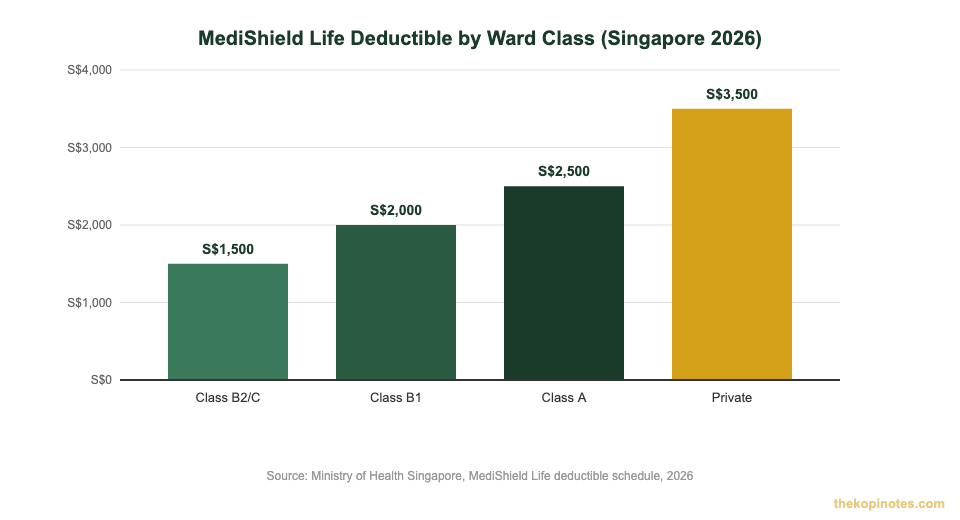
The Annual Deductible: This is the first portion of a hospitalisation claim that you must pay before your ISP kicks in. For 2026, the MediShield Life deductibles are:
| Ward Class | Annual Deductible (2026) | Notes |
|---|---|---|
| Class B2/C | S$1,500 | Subsidised wards |
| Class B1 | S$2,000 | 4-bedded, restructured hospital |
| Class A | S$2,500 | 1–2 bedded, restructured hospital |
| Private Hospital | S$3,500 | Single-bedded private room |
Source: Ministry of Health Singapore, MediShield Life deductible schedule, 2026. The deductible is per policy year, not per hospitalisation — if you have multiple admissions in the same policy year, you only pay it once.
The deductible can be paid from your Medisave. The hospital will request this Medisave deduction as part of billing — you don’t need to withdraw cash first. Any deductible amount above your available Medisave balance must be paid in cash.
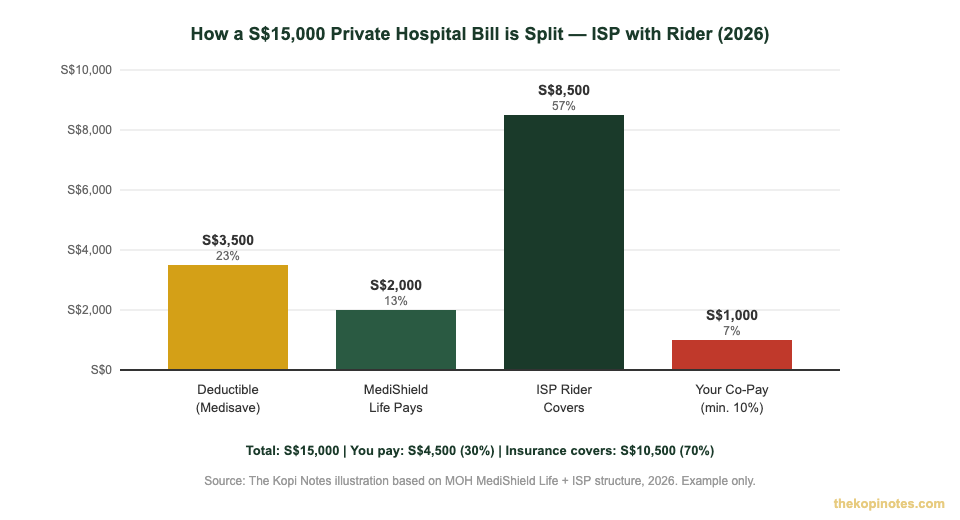
The Co-Payment: After the deductible is met, your ISP covers most of the remaining bill. If you have a rider, you pay at least 5–10% co-payment (see the rider section below). Without a rider, you pay the MediShield Life co-insurance amount (3–10% of the bill above the deductible, depending on total claim size).
Amounts above policy limits: If your bill exceeds your ISP’s annual claim limit (rare except for very complex, extended cases), you pay the excess out of pocket.
Step 5: After Discharge — Verifying the Claim
With direct billing, most claims settle automatically — no forms to submit. Within 1–2 weeks of discharge, log in to your CPF account at cpf.gov.sg and check your Medisave transaction history. You should see a deduction for your deductible and any Medisave-covered co-payment, along with a credit showing the amount paid to the hospital.
Also log in to your insurer’s customer portal to verify claim status. Look for a “Settled” or “Approved” status with the exact amount paid. If the claim shows “pending” after 30 days, or the settlement amount appears incorrect, contact your insurer’s claims department directly.
Keep all hospital discharge summaries, itemised bills, and official receipts for at least five years. If there’s ever a dispute or a follow-up claim (e.g. related complications), these documents are essential.
Step 6: Manual Reimbursement if Direct Billing Fails
If your hospital isn’t on the panel or direct billing wasn’t arranged, you’ll need to submit a manual reimbursement claim. The deadline is typically 180 days (6 months) from discharge, though some ISPs have a 90-day window — always check your policy documents.
Documents typically required: original hospital discharge summary, itemised bill (not just the summary invoice), official receipts for all payments made, completed insurer claim form (downloadable from your insurer’s website), and for surgeries, the surgical report. Submit via your insurer’s customer portal or by registered mail. Keep photocopies of everything. Processing typically takes 3–6 weeks for complete submissions.
For a deeper look at how deductibles affect your total out-of-pocket healthcare cost across a lifetime, see the ISP deductible impact guide.
Medisave Limits 2026 for Hospitalisation
During hospitalisation, Medisave can cover your deductible and co-payment, subject to per-day withdrawal limits. For 2026:
| Ward Type | Medisave Per-Day Limit (2026) |
|---|---|
| Normal ward (B2/C, B1, A, Private) | S$550 per day |
| ICU / High dependency unit | S$700 per day |
Source: CPF Board, Medisave hospitalisation withdrawal limits, 2026. Per-day limits apply to the patient’s out-of-pocket share only — the insurer’s portion does not count against these limits.
Note: The S$79,000 Basic Healthcare Sum (BHS) is the target balance for your Medisave account — it is not an annual withdrawal cap. There is no overall annual ceiling on Medisave withdrawals for hospitalisation beyond the per-day limits above, as long as your Medisave balance remains sufficient.
The ISP annual Medisave withdrawal limit (used for paying ISP premiums) is separate from the hospitalisation withdrawal limits — they do not share a combined cap. If you’ve already used your annual ISP premium withdrawal limit, you can still use Medisave for hospitalisation under the per-day rules above.
For more on how Medisave interacts with your long-term retirement healthcare planning, the Singapore retirement planning calculator includes Medisave projection scenarios for different ISP coverage levels.
Our earlier guide on what happens when your Medisave limit runs out in 2026 covers the annual premium withdrawal limit in detail if you want to understand both sides of the Medisave equation.
Rider Co-Payment Rules (April 2021 Onwards)
Since 7 April 2021, MOH requires all new and renewed ISP riders to include a minimum co-payment. Under the new ISP rider rules for 2026, the mandatory minimum co-payment structure is:
| Ward Class | Minimum Co-Payment (With Rider) | Annual Cap (Typical) |
|---|---|---|
| Class A and below | 5% | ~S$3,000/year |
| Private Hospital | 10% | ~S$3,000/year |
Source: Ministry of Health Singapore, ISP rider framework effective 7 April 2021. Annual cap amounts vary by insurer and product tier — check your policy documents for your exact cap.
If you bought your rider before April 2021 and have not made changes, you may be on a grandfathered plan with different (or no) mandatory co-payment. Check your policy or call your insurer to confirm. The co-payment is typically payable from Medisave within the per-day withdrawal limits — any co-payment above the Medisave per-day limit is paid in cash at discharge.
Common Mistakes That Cost You Money
1. Not requesting the LOG in advance. Without a LOG for a planned admission, you may need to pay the full bill upfront and wait months for reimbursement. This is the single most preventable mistake.
2. Choosing a higher ward class than your ISP covers. If your plan covers Class A and you request a private room, you pay the entire ward class differential out of pocket — often S$400–S$800 per night on top of everything else.
3. Using a non-panel hospital without confirming reimbursement terms first. Non-panel hospitals may have more restrictive reimbursement caps under your ISP. Always check the panel list before booking a specialist.
4. Missing the manual claim deadline. Most ISPs have a 180-day window; some only 90 days. Missing it typically means forfeiting the entire reimbursement.
5. Not checking if the deductible was already met this policy year. If you were hospitalised earlier in the same policy year, you may not owe the deductible again. Checking this at the billing counter before paying can save you S$1,500–S$3,500.
6. Assuming all procedures are covered. Cosmetic procedures, experimental treatments, and conditions with specific exclusion clauses in your policy are not covered. When in doubt before a procedure, call your insurer’s pre-authorisation line — not just the hospital.
For a side-by-side comparison of how all five ISPs handle claims, exclusions, and panel hospital access, the ISP comparison guide 2026 has the full breakdown. If you’re thinking about whether a rider is still worth having given the new co-payment rules, the shield plan comparison Singapore 2026 guide walks through the cost-benefit math.
Not financial advice. ISP policy terms, deductibles, and co-payment rules are subject to change. Always verify current terms directly with your insurer or a licensed financial adviser before making decisions.
Frequently Asked Questions
Do I need to submit any forms to file an ISP claim if the hospital uses direct billing?
No — with direct billing, the hospital handles the entire claim process with your insurer. You only need to provide your ISP policy number at admission and, for planned admissions, obtain a Letter of Guarantee beforehand. After discharge, verify that the claim settled correctly in your CPF Medisave transaction history and your insurer’s claims portal within 2–4 weeks.
How long does an ISP claim take to be settled?
Direct billing claims are typically settled within 14–30 days after discharge. Manual reimbursement claims (where you pay upfront and claim back) generally take 3–6 weeks after submission of complete documents. Complex claims requiring additional medical reports can take 2–3 months. If your claim is pending for more than 30 days without an update, call your insurer’s claims department directly.
Can I use Medisave to pay the deductible at a private hospital?
Yes. The full deductible amount (S$3,500 for private hospital stays in 2026) can be paid directly from your Medisave at discharge. The hospital requests the Medisave deduction as part of the billing process — you authorise it at the billing counter and the deduction happens automatically. No cash withdrawal is needed beforehand. Any portion of the deductible that exceeds your available Medisave balance must be paid in cash.
What is the Medisave withdrawal limit for hospitalisation in 2026?
For hospitalisation, Medisave can be withdrawn at up to S$550 per day for normal ward stays (including private hospital single-bedded rooms), or S$700 per day for ICU or high dependency unit stays. These limits apply to the patient’s share of the bill — the insurer’s payment does not count against them. There is no annual ceiling on total Medisave withdrawals for hospitalisation beyond these per-day limits, provided your Medisave balance is sufficient.
What happens if I can't pay the deductible or co-payment at discharge?
If you cannot pay in full at discharge, speak to the hospital’s billing department — most will arrange a payment plan. You can also contact your insurer about whether any portion can be deferred. Hospitals cannot legally detain you over a bill, but unpaid balances accrue and may be escalated to debt recovery. It is best to contact both the hospital and your insurer before discharge to agree on a payment arrangement rather than leaving the bill unresolved.
My ISP rider was bought before April 2021 — do the new co-payment rules apply to me?
If your rider was purchased before 7 April 2021 and has been continuously renewed without any changes or upgrades, you are likely on a grandfathered plan and the new minimum co-payment rules do not apply to you. However, if you have upgraded, switched, or reinstated your rider since April 2021, the new co-payment requirements apply. Check your policy schedule or call your insurer to confirm your exact co-payment terms before your next hospitalisation.
Make Your ISP Work Harder For You
Compare ISP options, understand your true costs, and plan for long-term healthcare expenses.
Get Free Insurance Advice
Speak with a licensed insurance advisor. No obligation, no cost.
By submitting this form, you agree to our Privacy Policy.
This article was researched with the help of AI. While we strive to keep all information accurate and up to date, there may be errors. If you notice any discrepancies, please contact us.