Medisave Limit 2026: What Happens When Your MediSave Runs Out During Hospitalisation?
Your MediSave account has strict daily withdrawal limits — SGD 1,130 for the first two days and SGD 400 per day from day three. For a long hospitalisation, even SGD 50,000 drains in about four months. When MediSave runs out, you can draw on an immediate family member’s account or pay cash. This guide explains exactly what happens — and how to prepare before it does.
Not financial advice. All figures are for educational reference only. Data as at October 2026 unless noted.
The Hidden Risk Nobody Talks About
Most Singaporeans know MediSave exists. Fewer know its hard limits. The CPF Board sets daily caps on how much you can withdraw for hospitalisation — and for a serious illness like a stroke, cancer, or major surgery requiring an extended stay, those limits mean your account can hit zero faster than families expect.
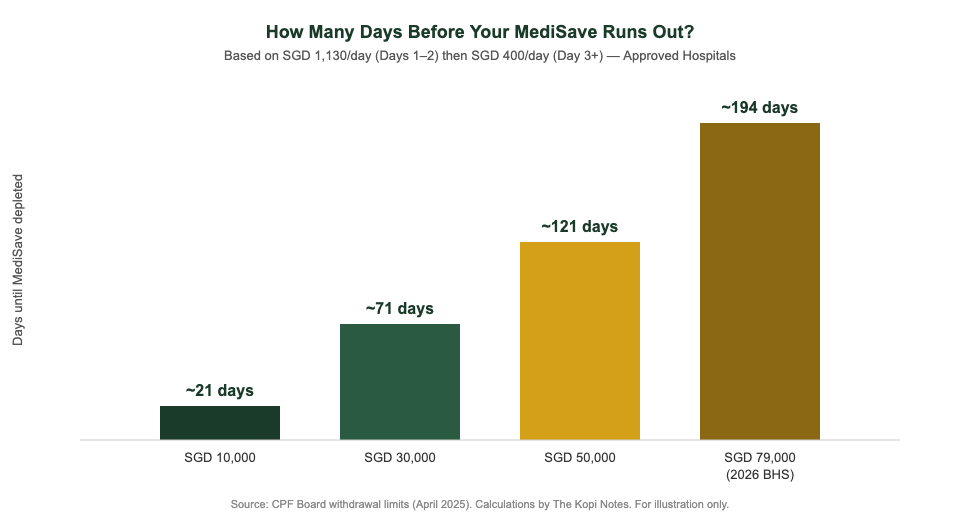
Consider a 65-year-old with a MediSave balance of SGD 30,000 — above average for many working Singaporeans. At the CPF’s approved withdrawal rates, that balance depletes in roughly 71 days. A three-month hospital stay — not uncommon for a stroke patient or someone recovering from major surgery — can wipe out a lifetime of MediSave contributions.
When that happens, you are not left without options. But those options require preparation. And the time to understand them is before you are lying in a hospital bed, not after.
This guide covers the 2026 MediSave daily limits, the Basic Healthcare Sum (BHS), and exactly what to do when your balance runs out. For a deeper look at maintaining your MediSave before hospitalisation, also read our MediSave low balance guide for hospitalisation.
How MediSave Is Drawn Down During Hospitalisation
MediSave withdrawals for hospitalisation follow a two-tier daily limit structure set by the CPF Board. Limits are higher for the first two days — reflecting the concentration of costs at admission — then taper to a lower daily cap from day three.
| Day of Hospitalisation | Daily MediSave Withdrawal Limit | Setting |
|---|---|---|
| Days 1–2 | SGD 1,130/day | Approved restructured and private hospitals |
| Day 3 onwards | SGD 400/day | Same approved hospitals |
| Community hospitals | SGD 250/day | Step-down care after acute hospitalisation |
Source: CPF Board, MediSave Hospitalisation Withdrawal Limits (April 2025). Subject to change — verify at cpf.gov.sg.
These daily limits are not the total you pay — they are the maximum MediSave can cover per day. The actual daily bill may be higher (especially in private hospitals or A-class wards), meaning you may still have cash out-of-pocket even before your MediSave runs out. MediShield Life and your Integrated Shield Plan (ISP) cover the bulk of the bill, but MediSave is your primary source for the co-insurance and deductible portions.
MediSave 2026: Your Limits and How Long They Last
In 2026, the Basic Healthcare Sum (BHS) is SGD 79,000. This is the maximum balance your MediSave account can hold — contributions above the BHS are redirected to your Special Account (if below 55) or Retirement Account (if 55 and above). The BHS is revised annually on 1 January.
Even at the maximum BHS, prolonged hospitalisation depletes the account. The chart below shows how long different MediSave balances last under the SGD 1,130/SGD 400 withdrawal rate structure:
| Starting MediSave Balance | Approximate Days Before Depletion | Real-World Context |
|---|---|---|
| SGD 10,000 | ~21 days | Recovery from a major surgery |
| SGD 30,000 | ~71 days | About 10 weeks — a post-stroke rehabilitation stay |
| SGD 50,000 | ~121 days | About 4 months — a cancer treatment course |
| SGD 79,000 (2026 BHS) | ~194 days | About 6.5 months — a serious long-term condition |
Source: CPF Board withdrawal limits (April 2025). Assumes SGD 1,130/day for days 1–2, SGD 400/day from day 3. Actual depletion depends on ward class, insurer claims and individual plan. For illustration only.
These numbers reflect the reality of Singapore’s hospitalisation financing. The SGD 400/day limit from day three reflects an average ward cost, but actual costs — especially in private hospitals or A-class wards — can be significantly higher. Any excess beyond the daily limit must come from cash or your ISP. For a detailed breakdown of how ISP premiums have changed and what plans cover, see our ISP premium cap guide.
What Happens When MediSave Runs Out?
If your MediSave balance reaches zero during a hospitalisation, the hospital does not automatically receive a notification from CPF. It is your responsibility — or your family’s — to make alternative payment arrangements. The hospital’s Business Office will typically contact your next-of-kin when MediSave withdrawals stop processing.
Option 1: Use an Immediate Family Member’s MediSave
Under CPF’s MediSave Family Account Pooling rules, you can draw from the MediSave accounts of your spouse, children, parents, grandparents, siblings, and grandchildren. This is not automatic — you must apply at the hospital’s Business Office or through the CPF website. Each family member can authorise use of their account, subject to their own balance and daily withdrawal limits.
Pre-authorising family MediSave accounts before a planned admission is strongly recommended. You can do this via the CPF digital services portal — it avoids stressful paperwork during the hospitalisation itself.
Option 2: Pay Cash
If no family MediSave is available — or it is insufficient — you pay the remaining balance in cash. For long stays, this can run into tens of thousands of dollars. This is the scenario that catches families off-guard: a prolonged hospitalisation that drains the patient’s MediSave, then reaches into family accounts, and still leaves a shortfall.
Option 3: Apply for MediFund
MediFund is Singapore’s safety net for patients who cannot afford their bills after MediShield Life, MediSave, and ISP coverage are exhausted. It is available to Singapore Citizens (and in limited cases Permanent Residents) admitted to restructured hospitals who meet means-testing. Applications are made through the hospital’s Medical Social Worker — you must ask. MediFund does not cover private hospital bills.
How MediShield Life and ISPs Reduce the Burden
MediSave is not your only line of defence. MediShield Life — Singapore’s mandatory basic hospitalisation insurance — covers a significant portion of your bill. An Integrated Shield Plan (ISP) goes further, covering the deductible and co-insurance that MediShield Life leaves with the patient. Understanding how these three layers interact is critical to calculating your true MediSave exposure.
A Real-World Example: SGD 20,000 Class B1 Bill (2026)
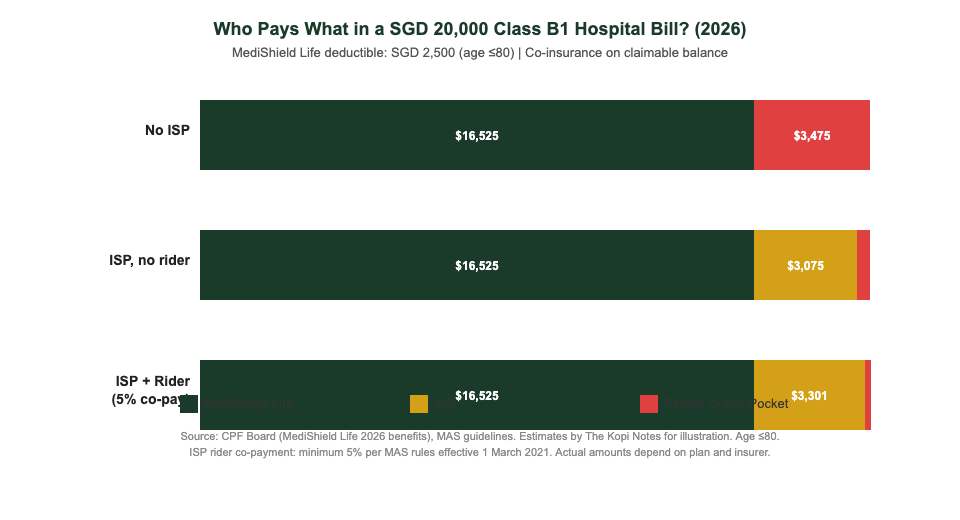
For a Class B1 ward hospital bill of SGD 20,000 (patient aged ≤80, using 2026 MediShield Life deductibles effective from 1 June 2026):
| Coverage Scenario | MediShield Life Pays | ISP Pays | Patient Out-of-Pocket |
|---|---|---|---|
| No ISP | SGD 16,525 | — | SGD 3,475 |
| ISP, no rider | SGD 16,525 | ~SGD 3,075 | ~SGD 400 |
| ISP + rider (5% min co-pay) | SGD 16,525 | ~SGD 3,301 | ~SGD 174 |
Source: CPF Board (MediShield Life 2026 benefits effective 1 June 2026), MAS guidelines. Estimates by The Kopi Notes for illustration. Class B1 restructured hospital, patient aged ≤80, deductible SGD 2,500, co-insurance 10%/5%/3%. Actual figures depend on plan, insurer, and ward type.
Without ISP, a single hospitalisation episode demands SGD 3,475 from your MediSave or cash — for just one admission. If hospitalised repeatedly, the drain accelerates. With an ISP and rider, the same bill leaves less than SGD 200 out-of-pocket. The ISP does not prevent MediSave use — it dramatically reduces how much you need to draw each time.
Factor your healthcare financing into your long-term plan. Use our Singapore retirement planning calculator to model how healthcare costs affect your retirement readiness, alongside your CPF investment strategy.
10 Steps to Protect Your MediSave Before and During Hospitalisation
The best time to manage MediSave depletion risk is before you need a hospital bed. Here is a practical action plan for Singaporeans at every life stage:
- Check your MediSave balance now. Log in to the CPF app or myCPF portal to see your current balance versus the 2026 BHS of SGD 79,000.
- Top up your MediSave voluntarily. You can top up using cash up to the BHS. Cash top-ups via the CPF voluntary contribution scheme qualify for income tax relief of up to SGD 8,000 per year (combined across all CPF cash top-ups).
- Get an Integrated Shield Plan. If you do not have one, apply before health conditions appear — pre-existing conditions may be excluded or attract higher premiums. An ISP dramatically reduces how much MediSave is drawn per hospitalisation.
- Review your ISP rider. Since 1 March 2021, all new ISP riders must carry a minimum 5% co-payment (capped at SGD 3,000/year for Class A/Private). Confirm your rider terms annually with your insurer.
- Know which family members’ MediSave you can use. Identify who in your family has available MediSave and discuss the arrangement before an emergency — not during one.
- Pre-authorise family MediSave online. Log in to the CPF website to pre-authorise family members’ accounts. This avoids delays and paperwork at the hospital’s Business Office when you are already unwell.
- Alert the hospital’s Business Office early. If your MediSave is low going into a planned admission, notify the Business Office on admission day. They will help you arrange alternative payment and check whether you qualify for subsidised wards.
- Request a ward downgrade if needed. If admitted to a Class A or private ward and your MediSave is depleting, you can request a downgrade. This reduces your bill and the portion falling outside ISP coverage.
- Ask about MediFund if facing hardship. Ask the hospital’s Medical Social Worker about MediFund eligibility early — not after discharge. The hospital will not proactively suggest this.
- Grow your CPF beyond MediSave. If you have CPF-OA savings or SRS funds not earmarked for housing or retirement, consider growing them through an investment platform. Endowus (referral code: 2V343) lets you invest CPF-OA and SRS funds in diversified portfolios, including low-cost fund options — a way to build a longer-term financial buffer for healthcare costs in retirement.
Frequently Asked Questions
What happens if my MediSave balance is zero before I go into hospital?
If your MediSave balance is already zero, MediShield Life and your ISP (if you have one) still apply to your bill — they do not depend on your MediSave balance. You will need to pay the deductible and co-insurance portions in cash. Contact the hospital’s Business Office before admission to arrange a payment plan. If you are a Singapore Citizen with financial difficulty, ask to see a Medical Social Worker about MediFund eligibility.
Can I use my children's or spouse's MediSave to pay my hospital bills?
Yes. Under CPF’s MediSave Family Account Pooling rules, you can draw from the MediSave accounts of your spouse, children, parents, grandparents, siblings, and grandchildren. Apply at the hospital’s Business Office or via the CPF website. Each family member’s contribution is drawn from their own available MediSave balance and is subject to their individual daily withdrawal limits (SGD 1,130/day for days 1–2, SGD 400/day from day three).
Is there a maximum amount I can withdraw from a family member's MediSave?
There is no fixed dollar cap on total family MediSave pooling — you can draw from as many family accounts as needed, and there is no cap on the number of accounts. However, each account is subject to the same daily withdrawal limits as the patient’s own account, and you cannot withdraw more than an individual family member’s available MediSave balance. Each family member must consent to their account being used.
What is MediFund and who qualifies?
MediFund is Singapore’s safety net for patients who cannot afford their hospital bills even after MediShield Life, MediSave, and ISP coverage. It is available to Singapore Citizens admitted to public restructured hospitals or approved community institutions who meet means-testing criteria. The hospital’s Medical Social Worker assesses your household income and circumstances. Permanent Residents may qualify for Medifund Silver if they are elderly. MediFund does not cover private hospital bills.
Does an Integrated Shield Plan cover MediSave shortfalls?
An ISP does not directly top up your MediSave account. Instead, it reduces how much MediSave you need to draw by covering the deductible and co-insurance portions that MediShield Life leaves with the patient. With a well-structured ISP and rider, your out-of-pocket draw per hospitalisation can fall from thousands of dollars to a few hundred, preserving your MediSave balance for future admissions.
Can I top up my MediSave before a planned operation?
Yes. You can top up MediSave voluntarily via the CPF app or website at any time, up to the 2026 BHS of SGD 79,000. Cash top-ups attract income tax relief of up to SGD 8,000 per year (combined with all CPF cash top-ups). Top up as early as possible — contributions take a few business days to appear in your account.
What is the Basic Healthcare Sum (BHS) for 2026?
The 2026 BHS is SGD 79,000. This is the maximum amount your MediSave account can hold. Once you reach the BHS, additional MediSave contributions are redirected to your Special Account (if below 55) or Retirement Account (if 55 and above). The BHS is reviewed annually on 1 January in line with estimated long-term healthcare costs for elderly Singaporeans.
What is the MediShield Life deductible for 2026?
From 1 June 2026, the MediShield Life deductibles are: Class C ward — SGD 2,000 (age ≤80), SGD 2,750 (age ≥81); Class B1 ward — SGD 2,500 (age ≤80), SGD 3,500 (age ≥81); Class A and Private hospitals — SGD 3,500 (age ≤80), SGD 4,500 (age ≥81). You pay this deductible from MediSave or cash before MediShield Life begins covering your bill. These deductibles apply once per policy year.
Build Your Healthcare Safety Net
MediSave is part of your healthcare financing — but it has limits. Pair it with an ISP and a long-term investment plan to make your CPF work harder for retirement and healthcare. Endowus lets you invest CPF-OA and SRS funds in low-cost diversified portfolios.
Get Endowus Referral Code (2V343)
Not financial advice. Referral benefit subject to Endowus terms.
Get Free Insurance Advice
Speak with a licensed insurance advisor. No obligation, no cost.
By submitting this form, you agree to our Privacy Policy.
This article was researched with the help of AI. While we strive to keep all information accurate and up to date, there may be errors. If you notice any discrepancies, please contact us.