Medisave Limit 2026: How the New ISP Co-Payment Rules Affect Your Premiums
The April 2026 rider changes promise savings — but also higher out-of-pocket costs. Here is how to make your Medisave limit work harder.
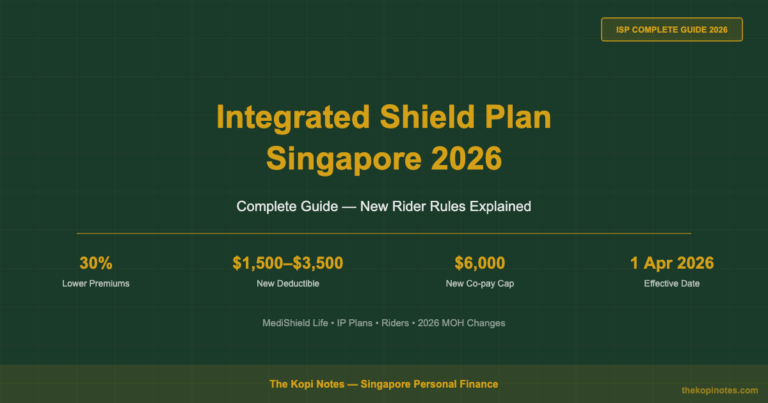
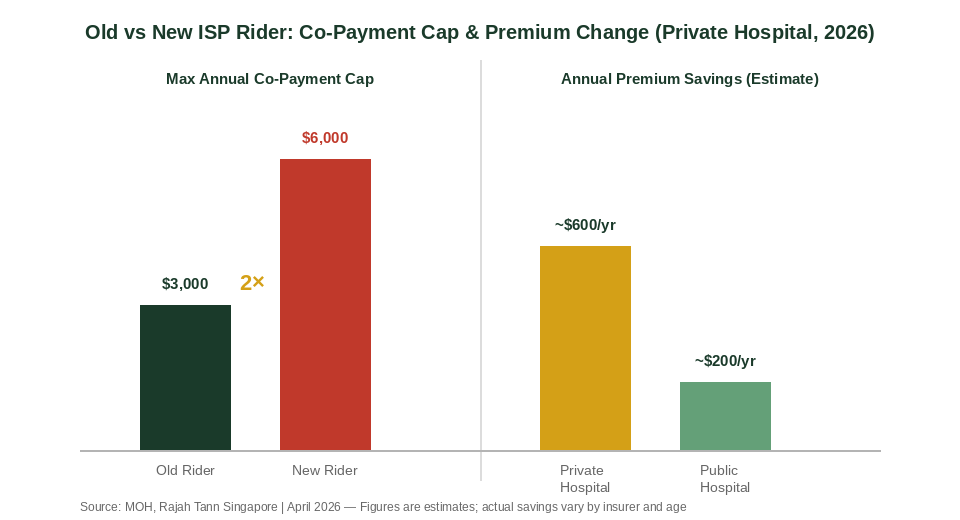
From 1 April 2026, insurers can no longer sell Integrated Shield Plan (ISP) riders that cover the minimum deductible. The new riders cost roughly 30% less — saving private hospital policyholders up to $600 a year — but come with a higher co-payment cap of $6,000 per year (up from $3,000). If you are wondering how these changes interact with the Medisave Additional Withdrawal Limit (AWL) and what they mean for your out-of-pocket exposure, this guide breaks it all down.
Not financial advice. All figures are for educational reference only. Data verified as at 14 October 2026.
What Changed on 1 April 2026?
Singapore’s Ministry of Health introduced significant changes to Integrated Shield Plan riders on 1 April 2026, building on earlier reforms to address rising premiums and unsustainable claims patterns. The changes are designed to encourage more cost-conscious use of private healthcare while still ensuring policyholders have meaningful coverage.
Three key rules now apply to all new ISP riders sold from 1 April 2026:
1. No covering of the minimum deductible. Insurers can no longer sell riders that pay the minimum IP deductible, which MOH sets at $1,500 to $3,500 per year depending on ward class. This means policyholders must pay at least this amount out-of-pocket — or from Medisave — before their rider kicks in.
2. Higher co-payment cap. The minimum annual co-payment cap has doubled from $3,000 to $6,000 per year. The minimum 5% co-payment rate on eligible claims remains unchanged. Only the maximum cap has risen, which means most routine hospitalisations are unaffected.
3. Lower premiums. In exchange for these reduced benefits, new riders are priced about 30% lower on average than equivalent old riders. According to MOH, private hospital rider holders can expect to save roughly $600 per year; public hospital rider holders around $200 per year. Older policyholders tend to see larger savings in absolute dollar terms.
Policyholders who bought existing (old-format) riders on or after 27 November 2025 were required by MAS rules to be informed that they would move to new-format riders no later than their first renewal after 1 April 2028. If you bought your rider before that date and have not yet renewed, you may still be on an old-format rider for now.
| Feature | Old Riders (before Apr 2026) | New Riders (from Apr 2026) |
|---|---|---|
| Minimum deductible coverage | Could be covered by rider | Cannot be covered |
| Min co-payment cap per year | $3,000 | $6,000 |
| Min co-payment rate | 5% | 5% (unchanged) |
| Estimated premium change | Baseline | ~30% lower on average |
Source: Rajah Tann Singapore, MOH briefing, April 2026
The Medisave AWL and How It Works
Your Medisave can pay for ISP premiums — but not without limits. There are two layers of withdrawal limits you need to understand when thinking about your medisave limit 2026 and ISP coverage.
MediShield Life premiums — the base layer of every ISP — are fully payable from Medisave with no annual cap. These premiums are set by the government and range from around $100 to over $2,000 per year depending on your age.
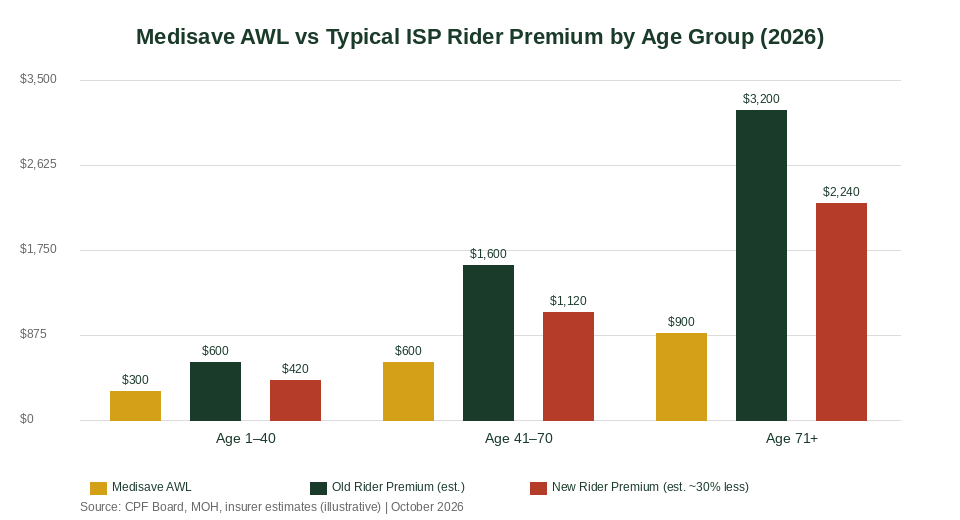
The Additional Withdrawal Limit (AWL) covers the top-up premium you pay for the private or restructured hospital tier above MediShield Life. The AWL is set by CPF Board and tiered by age next birthday:
| Age Next Birthday | AWL per Year (ISP Top-Up Premium) | Notes |
|---|---|---|
| 1 to 40 | $300 | New riders at ~30% lower premiums may fit within AWL |
| 41 to 70 | $600 | Mid-tier, Medisave covers more of the rider premium |
| 71 and above | $900 | Highest AWL — but premiums also rise sharply with age |
Source: CPF Board, as at October 2026
Any ISP top-up premium that exceeds the AWL must be paid in cash. Because new riders cost about 30% less than old ones, many policyholders — especially those under 40 in the $300 AWL bracket — may now find their entire ISP rider premium fits within the AWL and requires no cash top-up at all. For a fuller picture of how this works at different income levels, the rider vs no rider analysis walks through the decision in detail.
Will You Pay Less? Premium Savings Compared
The 30% average premium reduction sounds compelling, but actual savings depend on your age, insurer, and plan tier. Here is a worked example for a 45-year-old on a private hospital ISP rider, illustrating how the medisave limit 2026 AWL interacts with old and new rider premiums:
Old rider (pre-April 2026 format, illustrative):
- Hypothetical annual rider premium: $2,000
- Co-payment cap: $3,000 per year (rider-covered portion above 5% applies)
- Deductible: could be fully covered by rider
- Medisave AWL available: $600 (age 41–70)
- Cash required for rider premium: ~$1,400 per year
New rider (from April 2026, same person, illustrative):
- Estimated annual rider premium: ~$1,400 (30% lower than old rider)
- Co-payment cap: $6,000 per year
- Deductible: $1,500–$3,500 must be paid by policyholder (Medisave-claimable)
- Medisave AWL available: $600 (unchanged)
- Cash required for rider premium: ~$800 per year
- Annual cash savings on premium: ~$600
The trade-off is clear: you save $600 on premiums each year, but if you are hospitalised with a large bill, you face up to $6,000 in co-payments (excluding the deductible) rather than $3,000. For healthy policyholders who rarely claim, the new rider almost certainly offers better value. For those with chronic conditions or who use private hospital services frequently, the net position can look very different once you factor in actual claims.
The broader context matters here. As explained in our rising ISP premiums analysis, private hospital IP premiums rose an average of 8.6% per year from December 2021 to December 2024. Against that backdrop, even a 30% one-time reduction is meaningful, but it does not mean premiums stop rising going forward.
The New $6,000 Co-Payment Cap in Practice
The doubling of the co-payment cap from $3,000 to $6,000 is the change that most concerns policyholders. Here is what it means in concrete terms, with the maths laid out by bill size:
At a 5% co-payment rate, to hit the new $6,000 cap, your eligible claim amount would need to reach $120,000. For most routine hospitalisations — an appendectomy, knee surgery, or a short medical admission — you are very unlikely to reach this threshold in a single stay. The risk becomes more relevant for complex surgeries, extended ICU admissions, or treatment for serious illness.
| Eligible Bill Amount | 5% Co-Payment | Under Old Cap ($3,000) | Under New Cap ($6,000) |
|---|---|---|---|
| $20,000 (routine surgery) | $1,000 | $1,000 (cap not reached) | $1,000 (cap not reached) |
| $60,000 (major operation) | $3,000 | $3,000 — cap applies | $3,000 (cap not reached yet) |
| $120,000 (complex treatment) | $6,000 | Capped at $3,000 | $6,000 — cap now applies |
| $200,000+ (critical illness) | $10,000+ before cap | Capped at $3,000 | Capped at $6,000 |
Illustrative examples. Co-payments apply on eligible claim amounts after deductible. Deductible ($1,500–$3,500) is payable separately. Source: MOH rider specifications, April 2026
Critically, deductibles and co-payments are Medisave-claimable. You can draw on your Medisave balance to pay these amounts, subject to relevant withdrawal limits. This means your Medisave acts as a buffer for the higher out-of-pocket exposure under the new riders — reinforcing why keeping a healthy Medisave balance matters more under the new framework.
Looking at the broader picture: MOH data published in September 2026 showed that 128,200 Singaporeans downgraded or discontinued their ISP in 2025, and 181,800 discontinued their riders — the sharpest rise on record. The new lower-cost riders may slow this trend, but policyholders need to understand what they are giving up before switching. See our guide on the ISP downgrade decision framework for a detailed breakdown.
The true long-term cost of an ISP rider is examined in our ISP rider real cost analysis, which shows that for most healthy Singaporeans under 50, the new rider format is likely to offer better value on a premium-only basis — even accounting for the higher co-payment cap.
Should You Switch to a New Rider?
The decision to move to a new-format rider involves balancing lower guaranteed annual premiums against higher potential out-of-pocket exposure when you make a claim. Here is a practical framework:
New riders (from April 2026) are likely better suited to you if:
- You are under 60, in good health, and have been hospitalised rarely or not at all in recent years
- Your current ISP rider premium significantly exceeds your Medisave AWL and you are paying substantial cash top-ups
- You have a healthy Medisave balance that can absorb deductibles and co-payments if needed
- You prefer lower guaranteed annual costs and can accept more variable claim costs in a bad year
Keeping your old-format rider may suit you better if:
- You have a chronic condition, or you or a close family member regularly uses inpatient private hospital services
- You are in your 60s or 70s, where average claim sizes are significantly larger and the $3,000 cap provides real protection
- You value premium predictability over savings, and want your maximum co-payment capped at $3,000
- Your current premium already falls comfortably within your Medisave AWL, meaning you pay little to no cash out-of-pocket anyway
One warning: once you cancel an old-format rider, you cannot return to it. If you cancel now and want a rider again in future, you will only be able to buy the new format — potentially at an older age with higher premiums and possibly subject to underwriting exclusions. For guidance on what private hospital coverage actually costs when you need it, see our private hospital bill guide.
Always consult a licensed financial adviser before making changes to your ISP or rider coverage. Insurance decisions are personal and depend on your health history, Medisave balance, income, and risk tolerance.
Frequently Asked Questions
What is the new ISP rider co-payment rule from April 2026?
From 1 April 2026, new ISP riders in Singapore must have a minimum annual co-payment cap of $6,000, up from $3,000. New riders also cannot cover the minimum deductible set by MOH, which ranges from $1,500 to $3,500 per year depending on ward class. The minimum 5% co-payment rate is unchanged. Policyholders on old-format riders are not immediately required to switch, but must do so no later than their first renewal after 1 April 2028.
What is the Medisave AWL for ISP premiums in 2026?
The Medisave Additional Withdrawal Limit (AWL) for ISP top-up premiums in 2026 is $300 per year for those aged 1 to 40, $600 per year for those aged 41 to 70, and $900 per year for those aged 71 and above. These figures apply to the ISP premium above the MediShield Life base — the MediShield Life portion itself is fully payable from Medisave with no cap. Any ISP top-up premium exceeding the AWL must be paid in cash.
Can I use Medisave to pay the co-payment and deductible under the new April 2026 rules?
Yes. Deductibles and co-payments under your ISP are Medisave-claimable, subject to the relevant Medisave withdrawal limits for inpatient care. This means if you are hospitalised and face the deductible ($1,500 to $3,500) or your co-payment portion, you can draw on your Medisave balance to cover those costs — you do not have to pay them entirely in cash. However, large claims could result in co-payments reaching the new $6,000 cap, so maintaining a healthy Medisave balance is more important than ever under the new rider rules.
Should I keep my old ISP rider or switch to a new one in 2026?
This depends on your age, health status, and claims history. If you are young, healthy, and rarely hospitalised, the new rider’s lower premiums likely offer better value — you pay significantly less each year and are unlikely to hit the higher $6,000 co-payment cap. If you have chronic conditions, are older, or regularly use private hospital services, the old rider’s lower co-payment cap of $3,000 may be worth the higher premiums. Crucially, if you cancel an old-format rider, you cannot return to the old format. Consult a licensed financial adviser before making any changes.
How much can I save by switching to a new ISP rider in 2026?
MOH estimates average annual premium savings of about $600 for private hospital rider holders and $200 for public hospital rider holders who switch to a new-format rider. Older policyholders typically see larger absolute savings. The actual figure depends on your insurer, plan tier, age, and smoking status. Compare your current annual rider premium against the new-format equivalent offered by your insurer before deciding — the premium savings are real but must be weighed against the doubled co-payment cap exposure.
What is the medisave limit 2026 for paying ISP premiums?
Your Medisave can pay the full MediShield Life premium (the base of every ISP) with no cap. For the additional private or restructured hospital tier above MediShield Life, the Medisave Additional Withdrawal Limit (AWL) applies: $300 per year for those aged 1–40, $600 for ages 41–70, and $900 for ages 71 and above. Any ISP top-up premium that exceeds your AWL requires a cash top-up. With new riders costing around 30% less from April 2026, more policyholders may find their entire rider premium now falls within the AWL.
Review Your ISP Coverage in Light of the April 2026 Changes
The new rider rules are a chance to optimise your healthcare coverage and Medisave strategy. Compare carefully before switching.
Get Free Insurance Advice
Speak with a licensed insurance advisor. No obligation, no cost.
By submitting this form, you agree to our Privacy Policy.
This article was researched with the help of AI. While we strive to keep all information accurate and up to date, there may be errors. If you notice any discrepancies, please contact us.