Shariah-Compliant ETFs for Singapore Investors: Halal Investing Guide (2026)
How to screen, buy and hold halal ETFs from Singapore — LSE-listed vs US-listed options compared, with tax and CPF/SRS notes.
Shariah-compliant ETFs screen out interest-based debt, alcohol, gambling and other haram sectors, letting Muslim investors in Singapore build a diversified portfolio without compromising on faith. The two most accessible routes are LSE-listed, Ireland-domiciled funds like iShares MSCI World Islamic UCITS ETF (ISWD) — which carry a lower 15% US dividend withholding tax and no US estate tax exposure — or US-listed funds like SP Funds S&P 500 Shariah ETF (SPUS), which are simpler to buy but taxed less favourably for non-US investors.
Not financial advice. All figures are for educational reference only. Data verified as at October 2026 unless noted.
Table of Contents
What Is Shariah-Compliant (Halal) Investing?
Shariah-compliant investing applies Islamic finance principles to stock selection. A Shariah ETF tracks an index that has already been screened by a Shariah board or index provider (MSCI, S&P, FTSE) against two broad tests. The business screen excludes companies whose core activity is in conventional banking and insurance, alcohol, pork products, gambling, adult entertainment, weapons, or tobacco. The financial ratio screen then checks the remaining companies for excessive interest-based debt (typically total debt under 33% of market cap or total assets), excessive interest income or cash holdings relative to revenue, and excessive receivables. Companies that fail either test are dropped from the index.
Most Shariah indices also apply a purification step: a small percentage of each company’s revenue (usually under 5%) comes from minor non-compliant sources like interest income on cash balances. Observant investors who want to be fully compliant are expected to calculate this “impure” portion of their dividend income and donate it to charity — the fund itself doesn’t do this for you, so keep a note of your dividend receipts if this matters to you. For Singapore investors, the practical effect is a portfolio that looks similar to a normal global or S&P 500 ETF but holds noticeably fewer financial and highly-leveraged names, with technology and healthcare typically overweighted relative to a conventional index.
Why This Matters for Singapore Investors
Singapore is home to a sizeable Muslim community, and MAS-regulated brokers like Interactive Brokers (IBKR), Saxo and FSMOne all give retail access to London Stock Exchange (LSE) and US-listed Shariah ETFs — there is no local SGX-listed Shariah equity ETF as at October 2026 (the closest SGX product, the now-defunct Islamic REIT ETF, was delisted some years ago). That makes it a genuine gap: without routing through LSE or NASDAQ, a Singapore investor who wants to combine broad diversification with Shariah screening has very few local options. Separately, Singapore levies no capital gains tax and no dividend withholding tax of its own on either route, which means the tax drag a Singapore investor faces comes entirely from where the underlying ETF is domiciled and listed — not from Singapore itself.
For a Singapore investor holding SGD 50,000 in a Shariah ETF, the choice between an Ireland-domiciled LSE listing and a US-domiciled NASDAQ listing is worth roughly SGD 300–500 a year in withholding tax alone (covered in detail below), on top of a materially different estate tax exposure. That is a bigger swing than most people assume Shariah screening itself would add in cost.
Best Shariah ETFs for Singapore Investors
Four funds cover almost all practical Shariah ETF demand from Singapore: two Ireland-domiciled, LSE-listed UCITS funds from iShares, and two US-domiciled, NASDAQ-listed funds from SP Funds and Wahed Invest.
| ETF | Exchange | Domicile | Index Tracked | TER | AUM | Structure |
|---|---|---|---|---|---|---|
| ISWD | LSE | Ireland | MSCI World Islamic | 0.30% | ~US$1.5–1.7bn | Distributing |
| ISDE | LSE | Ireland | MSCI EM Islamic | 0.35% | ~US$500m+ | Distributing |
| SPUS | NASDAQ | USA | S&P 500 Shariah (industry exclusions) | 0.45% | ~US$2.8bn | Distributing |
| HLAL | NASDAQ | USA | FTSE USA Shariah | 0.50% | ~US$900m | Distributing |
Source: iShares ISWD/ISDE fund factsheets (Sep–Aug 2026 editions); SP Funds SPUS and Wahed Invest HLAL fund pages and third-party ETF data (Trackinsight, Pensions & Investments), July 2026.
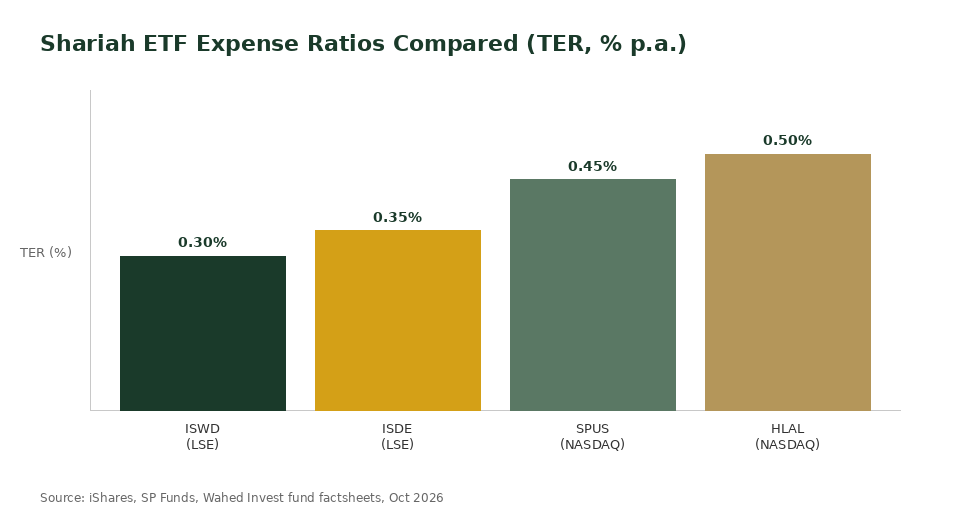
ISWD has the lowest TER of the four at 0.30% p.a. — on a SGD 50,000 holding that works out to roughly SGD 150 a year in fund fees, versus about SGD 250 a year for HLAL at 0.50%. ISWD also tracks the broadest index (developed-market global equities, ~387 holdings as at the September 2026 factsheet), while SPUS and HLAL are narrower, US-only baskets. ISDE is the only one of the four with direct emerging-market exposure, tracking ~402 Shariah-screened EM names.
Tax Comparison: LSE vs US-Listed Shariah ETFs
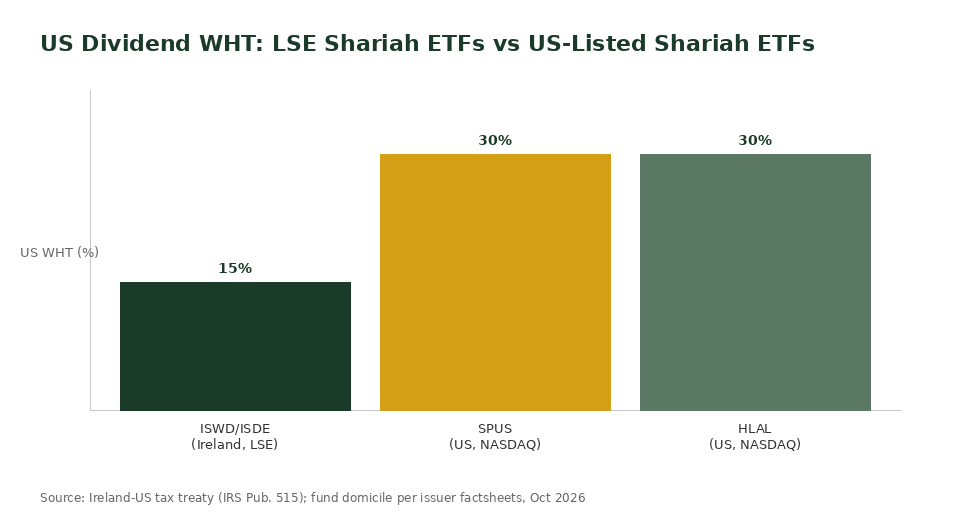
This is the single biggest cost difference between the two routes, and it has nothing to do with Shariah screening itself — it comes down to where each ETF is domiciled. Singapore REIT ETF investors run into the identical issue, and the mechanics are the same here: Ireland has a tax treaty with the US that caps the US dividend withholding tax (WHT) on an Ireland-domiciled fund’s US holdings at 15%, while a non-resident alien holding a US-domiciled fund directly faces the full 30% WHT rate with no treaty relief. On top of that, a US-domiciled ETF like SPUS or HLAL is itself a US-situs asset for US estate tax purposes — a non-US, non-resident investor holding more than USD 60,000 in US-situs assets at death faces US federal estate tax exposure (rates up to 40%) on the amount above that threshold, under current IRS rules for nonresidents with US assets. An Ireland-domiciled UCITS ETF like ISWD or ISDE carries no such exposure.
| Route | Domicile | US Dividend WHT | US Estate Tax Risk |
|---|---|---|---|
| ISWD / ISDE (LSE) | Ireland | 15% | None |
| SPUS / HLAL (NASDAQ) | USA | 30% | Yes (above USD 60,000) |
Worked example: a Singapore investor with a SGD 100,000 portfolio in a Shariah ETF yielding roughly 1.0–1.2% p.a. (both ISWD and SPUS have historically yielded in this range) would receive about SGD 1,100 in gross dividends a year. At 15% WHT via ISWD, that’s about SGD 165 withheld; at 30% WHT via SPUS, about SGD 330 withheld — a difference of roughly SGD 165 a year, before accounting for ISWD’s lower TER on top. The gap compounds over a multi-decade holding period, and it exists purely because of fund domicile, not performance.
How to Buy Shariah ETFs in Singapore
None of these four ETFs are listed on SGX, so you’ll need a broker with access to LSE (for ISWD/ISDE) and/or US exchanges (for SPUS/HLAL).
Interactive Brokers (IBKR): the most cost-effective option for larger portfolios and the only mainstream broker that reliably supports buying LSE-listed UCITS ETFs with SRS funds, since IBKR is an approved SRS investment-eligible platform. Fund your account, search the ticker with the correct exchange suffix (ISWD on LSE, SPUS or HLAL on NASDAQ), and place a limit order in GBP (for LSE) or USD (for NASDAQ).
Saxo Markets: similarly broad exchange access to both LSE and NASDAQ, with a cleaner mobile interface than IBKR but typically higher FX spreads on smaller trade sizes.
FSMOne: supports US-listed ETFs like SPUS and HLAL well, though LSE access for UCITS ETFs like ISWD/ISDE is more limited — check current exchange coverage before committing to this route if the LSE funds are your priority. Singapore investors comparing platforms broadly can also read our FSMOne referral code page for current sign-up terms.
moomoo Singapore: covers NASDAQ-listed SPUS and HLAL but does not currently offer LSE market access, so it only serves half of this ETF universe.
CPF Ordinary and Special Account funds cannot buy any of these four ETFs — none are on the CPFIS-approved list, which only covers select SGX-listed and unit trust products. SRS funds, however, can generally buy LSE- and NASDAQ-listed securities through SRS-linked brokers like IBKR, making SRS the more realistic tax-advantaged route for Shariah ETF investors in Singapore. If you haven’t mapped out your broader SRS strategy yet, our CPF investment strategy guide covers how SRS fits alongside CPF.
Risks and Limitations to Consider
Shariah screening removes an entire sector — conventional financials — from your portfolio, which means these ETFs will structurally underperform a broad market index in periods when banks and insurers rally (for example, during sustained rate-hike cycles when bank net interest margins expand). The screening methodology also means sector weights can shift meaningfully at each periodic index rebalance if a large holding’s debt ratio crosses the screening threshold, which adds a layer of turnover and tracking difference not present in a plain-vanilla index fund. US-listed options (SPUS, HLAL) carry US estate tax exposure as detailed above — this is a real, non-trivial risk for Singapore investors with larger US-situs holdings and is worth discussing with a tax advisor once your combined US asset exposure (across all US-domiciled holdings, not just Shariah ETFs) approaches the USD 60,000 threshold. Finally, none of these funds offer SGX liquidity — trading happens on LSE or NASDAQ during their market hours, which for Singapore investors usually means placing orders in the evening or via day/GTC limit orders rather than during SGX trading hours.
Who Should Buy Shariah ETFs?
These ETFs suit Muslim investors who want broad equity diversification without manually screening individual stocks, and anyone who prefers to avoid highly-leveraged financial companies as a matter of investment philosophy rather than faith. ISWD is the natural core holding for most Singapore-based investors — broadest diversification, lowest TER, and the most tax-efficient structure via the 15% WHT rate. ISDE can be added as a satellite allocation for EM exposure. SPUS and HLAL are worth considering only if your broker genuinely lacks LSE access, since the tax drag from the 30% WHT and added estate tax exposure typically outweighs any convenience benefit for portfolios above roughly SGD 20,000–30,000. Before committing new capital, it’s worth running your numbers through our Singapore retirement calculator to see how a Shariah-screened allocation fits your broader retirement timeline, and readers interested in the LSE-vs-US tax mechanics in more depth may also want our VWRA vs IWDA guide, which covers the same Ireland-domicile advantage for conventional (non-Shariah) global ETFs.
Frequently Asked Questions
What is a Shariah-compliant ETF and how is it different from a normal ETF?
A Shariah-compliant ETF tracks an index that has already been screened to exclude companies in conventional banking, insurance, alcohol, gambling, pork products, and similar sectors, and to exclude companies carrying excessive interest-based debt relative to their market value. The underlying structure — a basket of listed shares traded on an exchange — is otherwise identical to a conventional ETF.
Can I buy Shariah ETFs like ISWD or SPUS with my CPF or SRS funds in Singapore?
None of the four ETFs covered here (ISWD, ISDE, SPUS, HLAL) are on the CPFIS-approved investment list, so CPF Ordinary or Special Account funds cannot be used. SRS funds can generally be used through SRS-linked brokers such as Interactive Brokers, which support buying LSE- and NASDAQ-listed securities with SRS balances — check your specific broker’s SRS fund coverage before placing an order.
Which Shariah ETF has the lowest fees?
iShares MSCI World Islamic UCITS ETF (ISWD), listed on the London Stock Exchange, has the lowest total expense ratio of the four at 0.30% per annum as at its most recent 2026 fund factsheet, followed by iShares MSCI EM Islamic UCITS ETF (ISDE) at 0.35%.
Is it better to buy a Shariah ETF listed in the UK (LSE) or the US (NASDAQ) as a Singapore investor?
For most Singapore investors, the LSE-listed, Ireland-domiciled options (ISWD, ISDE) are more tax-efficient: they face a 15% US dividend withholding tax under the Ireland-US tax treaty and carry no US estate tax exposure, versus 30% withholding and potential US estate tax liability above USD 60,000 for the US-listed alternatives (SPUS, HLAL).
Are Shariah ETFs riskier than conventional ETFs?
Not inherently riskier, but differently concentrated — Shariah screening removes most conventional financial companies and tends to overweight technology and healthcare relative to a standard index, which can mean more sector concentration and periods of noticeable underperformance when financials rally, such as during sustained interest rate hikes.
What happens to the small amount of 'impure' income in a Shariah ETF?
Shariah indices allow a small tolerance (typically under 5% of a company’s revenue) for incidental non-compliant income, such as interest earned on cash holdings. The fund itself does not purify this automatically — observant investors are generally expected to calculate the non-compliant portion of their dividend income and donate it to charity separately.
Ready to Start Halal Investing?
Open a brokerage account with LSE and NASDAQ access and build your Shariah-screened portfolio today.
This article was researched with the help of AI. While we strive to keep all information accurate and up to date, there may be errors. If you notice any discrepancies, please contact us.