Infrastructure ETF Singapore: Best Global Infrastructure ETFs to Buy in 2026
INFR vs GII vs PAVE — fees, tax treatment, and how Singapore investors buy in.
Infrastructure ETFs give Singapore investors exposure to toll roads, power grids, airports and utilities — the physical assets powering the AI data centre boom. The iShares Global Infrastructure UCITS ETF (INFR) trades on the London Stock Exchange, is Ireland-domiciled, and carries a 0.65% TER. Compared to US-listed alternatives like GII, INFR avoids the 30% US dividend withholding tax and US estate tax exposure that trips up Singapore investors.
Not financial advice. All figures are for educational reference only. Data as at August 2026 unless noted.
- Infrastructure ETFs hold toll roads, utilities, pipelines and power grids — assets riding a US$200 billion global infrastructure investment supercycle and rising AI-driven electricity demand.
- INFR (LSE, TER 0.65%) is the tax-efficient pick for Singapore investors. GII and PAVE are US-listed alternatives that come with 30% withholding tax and US estate tax exposure.
- You buy INFR the same way you’d buy CSPX or VWRA — through IBKR, Saxo, or Syfe Brokerage. It’s not CPF-eligible, but it works with SRS through select brokers.
What Is an Infrastructure ETF?
An infrastructure ETF pools money into companies that own or operate physical assets: toll roads, airports, electricity grids, water utilities, and energy pipelines. Think of it as owning a slice of the pipes and wires that keep a country running.
Most of these businesses are regulated. That means their revenue is often set by government contracts or price caps tied to inflation. This makes infrastructure a defensive, bond-like sector — cash flows tend to be steady even when the stock market wobbles.
The iShares Global Infrastructure UCITS ETF (INFR) is a UCITS ETF — a European-regulated fund structure that’s popular with Singapore investors because it’s tax-efficient and well-regulated. INFR is domiciled in Ireland and lists on the London Stock Exchange (LSE). It tracks the FTSE Global Core Infrastructure Index, holding 264 companies across developed and emerging markets, according to the iShares factsheet (24 August 2026).
Its sector mix, per the same factsheet: utilities 53.5%, industrials 23.1%, energy 16.4%, and real estate 4.1%. That’s a very different risk profile from a broad market fund like VWRA — you’re betting on regulated cash flow, not corporate earnings growth.
Why Infrastructure ETFs Are Trending in 2026
Two forces are pushing infrastructure back into focus this year. The first is a straightforward capital cycle: global infrastructure fundraising hit close to US$200 billion in 2025, a record that beat the previous high of US$180 billion set in 2022, according to McKinsey’s 2026 infrastructure research.
The second is AI. Data centres need power, and a lot more of it. The International Energy Agency’s April 2026 update projects global data centre electricity consumption roughly doubling — from about 485 terawatt-hours in 2025 to around 950 terawatt-hours by 2030 — with AI-specific facilities tripling over that period.
That electricity has to travel somewhere. Utilities need new substations, transmission lines, and gas turbines to keep up. McKinsey separately estimates roughly US$6.7 trillion in data centre capital spending globally through 2030 — much of which flows through the same utility and industrial companies that infrastructure ETFs like INFR already hold at scale (utilities and industrials make up more than three-quarters of INFR’s portfolio).
For Singapore investors, this is a different way to play the AI theme than buying a semiconductor or data centre ETF directly. You’re one step removed from the hype — owning the regulated grid operators and toll-road companies that benefit either way, whether or not any single AI company succeeds.
Best Infrastructure ETFs for Singapore Investors
There are three infrastructure ETFs worth comparing if you’re investing from Singapore. Only one of them is genuinely tax-efficient for you.
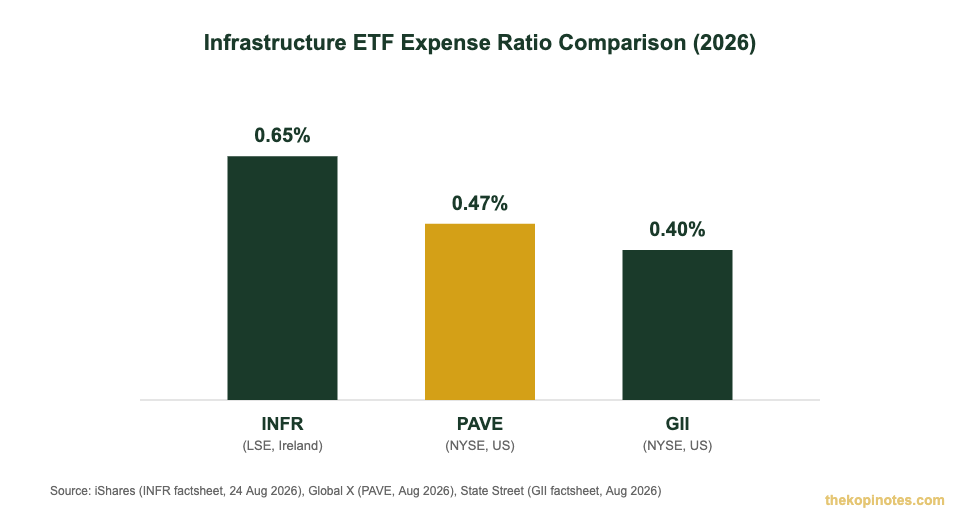
iShares Global Infrastructure UCITS ETF (INFR) is the LSE-listed, Ireland-domiciled option. It’s globally diversified across developed and emerging markets, with a 0.65% TER and USD 2.8 billion in net assets as at 24 August 2026. It pays quarterly distributions (an accumulating share class also exists) and has returned 10.68% year-to-date as at 21 August 2026, per the iShares factsheet.
SPDR S&P Global Infrastructure ETF (GII) is a US-listed fund tracking the S&P Global Infrastructure Index, with a lower 0.40% TER and around US$944 million in assets. It’s also globally diversified, but because it’s a US-domiciled fund, Singapore investors face a 30% dividend withholding tax and US estate tax exposure above USD 60,000 in holdings.
Global X US Infrastructure Development ETF (PAVE) is the largest by assets — around US$14 billion — but its exposure is US-only. PAVE tracks companies benefiting from US infrastructure spending (construction, engineering, industrial materials), not global infrastructure. Same US tax drawbacks apply: 30% withholding tax and estate tax exposure.
| Feature | INFR | GII | PAVE |
|---|---|---|---|
| Exchange | London Stock Exchange | NYSE Arca | Cboe BZX |
| Domicile | Ireland | United States | United States |
| Scope | Global (developed + emerging) | Global | US-only |
| TER | 0.65% p.a. | 0.40% p.a. | 0.47% p.a. |
| AUM | ~USD 2.8 billion | ~USD 944 million | ~USD 13.9 billion |
| Holdings | 264 | 73 | 100 |
| US Dividend WHT | 15% | 30% | 30% |
| US Estate Tax Risk | None | Yes (above USD 60k) | Yes (above USD 60k) |
Source: iShares INFR factsheet (24 August 2026), State Street GII factsheet (August 2026), Global X PAVE fund data (August 2026)
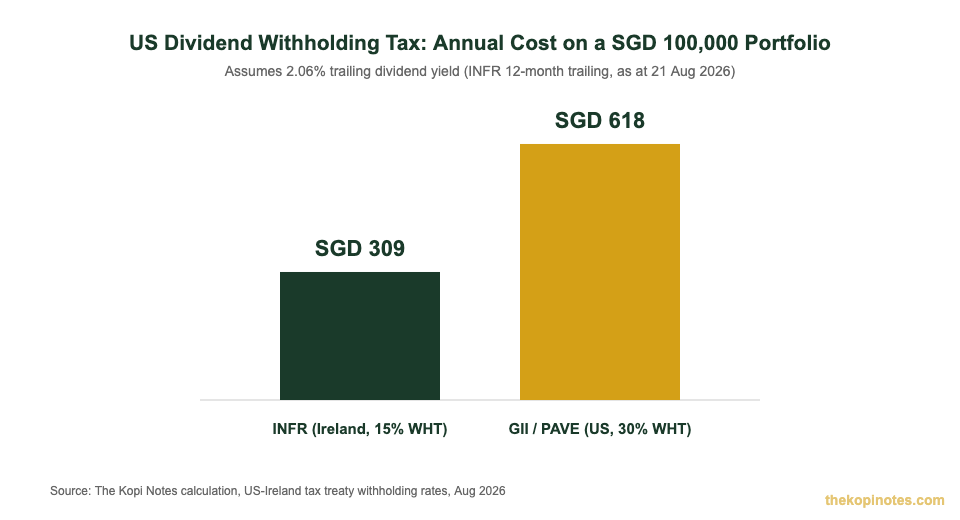
Here’s the tax drag in real numbers. On a SGD 100,000 position paying out at INFR’s 2.06% trailing 12-month dividend yield, you’d earn roughly SGD 2,060 in annual dividends. At 15% withholding tax, that’s about SGD 309 lost to tax. Hold the equivalent through GII or PAVE at 30% withholding, and you’d lose about SGD 618 — nearly double.
How to Buy Infrastructure ETFs in Singapore
Buying INFR works the same way as buying CSPX or VWRA. Here’s the process on the main brokers Singapore investors use.
Interactive Brokers (IBKR): Fund your account, search “INFR” in the order ticker, and select the London Stock Exchange as the listing venue. Place your order in GBP (or use the USD-denominated IDIN listing if you’d rather avoid a GBP conversion). IBKR is generally the cheapest option for larger, regular purchases thanks to low commissions and tight FX spreads.
Saxo Markets: Search “iShares Global Infrastructure” in the platform, confirm the LSE listing, and place your order. Saxo’s platform fees are higher than IBKR’s but the interface is more beginner-friendly.
Syfe Brokerage: Syfe lists a curated set of global ETFs, including LSE-listed UCITS funds. Check the current fund list in-app before assuming INFR is available, since curated broker lists change. Syfe is the simplest option if you want a guided, mobile-first experience.
MooMoo Singapore: Search the ticker under “US & Global Markets,” confirm the exchange is LSE, and place the trade. MooMoo’s LSE access has historically been more limited than IBKR’s, so double-check availability first.
One more thing to flag: infrastructure ETFs like INFR are not CPF-investable. If you’re using CPF Ordinary Account funds under the CPF Investment Scheme, you’ll need to stick to CPFIS-approved unit trusts or ETFs. SRS funds, on the other hand, generally work through brokers that support SRS trading — check with your broker directly.
Risks to Consider
Infrastructure isn’t risk-free, even though it behaves defensively most of the time. Three risks stand out.
Interest rate sensitivity: Regulated utilities behave like bond proxies. When interest rates rise, their steady, bond-like dividend yields become less attractive relative to actual bonds, and the share prices tend to fall. If Fed rate cuts don’t materialise as expected, infrastructure could underperform.
Concentration in a few sectors: More than three-quarters of INFR sits in utilities and industrials. That’s diversification within infrastructure, but not diversification away from it — a regulatory shock to utilities (say, a windfall tax) would hit the fund hard.
Currency and emerging-market exposure: INFR holds companies from emerging markets alongside developed ones. That adds currency risk and, in some countries, political risk around how infrastructure assets get regulated or nationalised.
Frequently Asked Questions
What is an infrastructure ETF and why do Singapore investors buy it?
An infrastructure ETF holds companies that own physical assets like toll roads, utilities, airports, and pipelines. Singapore investors buy them for defensive, inflation-linked income and as an indirect way to benefit from the AI-driven electricity demand boom without picking individual tech stocks.
Is INFR better than GII for Singapore investors?
For most Singapore investors, yes. INFR’s 15% US dividend withholding tax and lack of US estate tax exposure typically outweigh GII’s lower 0.40% TER, especially for a dividend-paying sector like infrastructure. GII may suit investors who already hold significant US assets and have estate planning in place.
Can I buy infrastructure ETFs using my CPF or SRS funds?
INFR is not CPFIS-approved, so you cannot use CPF Ordinary Account funds to buy it directly. SRS funds can generally be used through brokers that support SRS trading of LSE-listed ETFs — confirm with your specific broker first.
Which broker is best for buying INFR in Singapore?
Interactive Brokers (IBKR) is typically the most cost-effective for larger or recurring purchases due to low commissions and tight FX spreads. Syfe Brokerage is simpler for beginners but has a curated fund list, so confirm INFR is available before committing.
What is the minimum investment for an infrastructure ETF like INFR?
There’s no official minimum — you can buy a single share of INFR, which traded around USD 38.86 (NAV) as at 24 August 2026. In practice, brokerage minimum funding requirements and FX conversion costs mean a first purchase of a few hundred SGD is more practical than buying one unit at a time.
Are infrastructure ETFs safe? What are the risks?
Infrastructure ETFs are generally lower-volatility than broad equity funds because of regulated, inflation-linked cash flows, but they’re not risk-free. Rising interest rates, sector concentration in utilities, and emerging-market currency and political risk can all affect returns.
Ready to Start Investing in Infrastructure ETFs?
Open a brokerage account and buy your first infrastructure ETF today. You can also explore other ETF themes riding the same AI-driven demand cycle, like our data centre ETF Singapore guide and our clean energy ETF Singapore guide. New to LSE-listed ETFs? Start with our guide to why Singapore investors buy ETFs on the London Stock Exchange. Planning your broader portfolio? See our CPF investment strategy guide to see how it fits alongside your CPF and SRS accounts.
This article was researched with the help of AI. While we strive to keep all information accurate and up to date, there may be errors. If you notice any discrepancies, please contact us.