Clean Energy ETF Singapore: How to Buy INRG and ICLN in 2026
A complete Singapore investor’s guide — tax advantages, INRG vs ICLN comparison, step-by-step broker instructions, and 2026 fund data.
The best clean energy ETF for Singapore investors is INRG — the iShares Global Clean Energy Transition UCITS ETF listed on the London Stock Exchange. Ireland-domiciled with a TER of 0.65% and AUM of USD 4.82 billion as at May 2026, INRG tracks the S&P Global Clean Energy Transition Index across 107 holdings. Crucially, its Ireland domicile means only 15% US dividend withholding tax and zero US estate tax exposure — versus 30% WHT and full estate tax risk on the US-listed equivalent ICLN.
Not financial advice. All figures are for educational reference only. Data as at May 2026 unless noted.
Table of Contents
Contents — Click to expand
- What Is the Clean Energy ETF INRG?
- Key Facts at a Glance
- Why Singapore Investors Should Choose LSE-Listed Clean Energy ETFs
- INRG vs ICLN: The Critical Tax Difference
- Expense Ratio and Total Costs
- How to Buy Clean Energy ETFs in Singapore (Step-by-Step)
- Alternatives to INRG
- Who Should Buy a Clean Energy ETF?
- Frequently Asked Questions
What Is the Clean Energy ETF INRG?
INRG — the iShares Global Clean Energy Transition UCITS ETF — is a fund managed by BlackRock Asset Management Ireland and listed on the London Stock Exchange (LSE). It is denominated in USD and is a distributing fund, meaning it pays out any dividends collected from its underlying holdings rather than reinvesting them automatically.
The fund tracks the S&P Global Clean Energy Transition Index, which covers companies across the entire clean energy value chain — solar power, wind energy, hydrogen fuel cells, energy storage, smart grid technology, and utilities transitioning to renewable sources. As at May 2026, the fund holds 107 individual company positions globally, with major positions in solar manufacturers, energy technology firms, and renewable utilities.
INRG was launched on 6 July 2007, making it one of the oldest clean energy ETFs in existence. It has weathered multiple boom-and-bust cycles in the renewables sector — including the dramatic 2020–2021 run-up and subsequent correction — giving long-term investors a realistic track record to evaluate.
The fund’s current price on the LSE is approximately GBP 9.00 per share (900 GBX), with a 52-week range of 520–926 GBX as at May 2026. This relatively low per-share price makes it accessible for Singapore investors starting with smaller capital positions compared to some other LSE-listed ETFs.
It is important to note that INRG is a thematic ETF — unlike broad market ETFs such as CSPX (S&P 500) or VWRA (global all-world), clean energy ETFs concentrate exposure in a single sector. This means higher volatility and sector-specific risk, but also the potential to capture outperformance if clean energy themes accelerate.
Key Facts at a Glance
| Metric | Detail |
|---|---|
| Full Name | iShares Global Clean Energy Transition UCITS ETF USD (Dist) |
| Ticker (LSE) | INRG |
| ISIN | IE00B1XNHC34 |
| Index Tracked | S&P Global Clean Energy Transition Index |
| Domicile | Ireland (UCITS) |
| Structure | Distributing |
| TER (Expense Ratio) | 0.65% p.a. |
| AUM | USD 4.82 billion (as at May 2026) |
| Number of Holdings | 107 |
| Currency | USD (traded on LSE in GBP pence) |
| Launch Date | 6 July 2007 |
| Dividend Yield | ~0.87% (as at May 2026) |
Source: BlackRock / iShares fund data, JustETF, May 2026
Why Singapore Investors Should Choose LSE-Listed Clean Energy ETFs
When Singapore investors want clean energy exposure, they face a fundamental choice: buy the US-listed ICLN (traded on Nasdaq) or the LSE-listed INRG (traded on the London Stock Exchange). The financial case for INRG is compelling and comes down to three tax advantages.
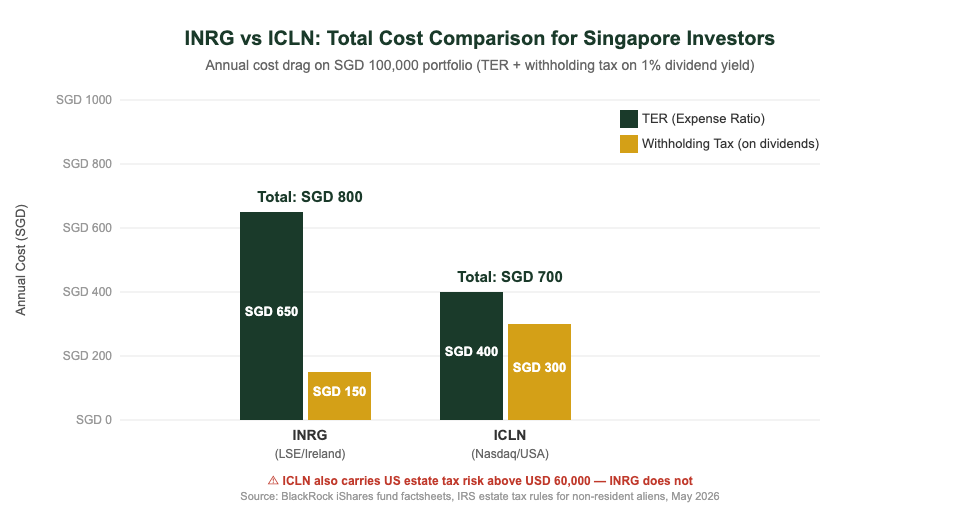
1. Lower withholding tax on US dividends. The S&P Global Clean Energy Transition Index holds many US-headquartered companies — solar manufacturers, grid technology firms, and renewable utilities. When those companies pay dividends, the Irish domicile of INRG benefits from a reduced 15% withholding tax rate under the Ireland-USA double taxation treaty. By contrast, a US-domiciled ETF like ICLN pays the full 30% withholding tax. For a SGD 100,000 portfolio generating a 1% dividend yield, that gap costs approximately SGD 150 per year in extra tax drag — money that never reaches your pocket.
2. No US estate tax exposure. The US estate tax threshold for non-resident aliens (including Singapore citizens) is just USD 60,000 — unchanged since 1976 and never inflation-adjusted. Any US-domiciled assets above this threshold are potentially subject to US estate tax at rates up to 40%. INRG, being Ireland-domiciled, falls outside this rule entirely. A Singapore investor holding SGD 200,000 in ICLN could face a significant US estate tax liability; the same investment in INRG has no such exposure.
3. No Singapore capital gains tax or dividend tax. Singapore does not tax capital gains or personal dividend income. This applies equally to LSE-listed ETFs — your gains from INRG are yours to keep in full. There is no additional SG-side tax layer to worry about.
These advantages are why savvy Singapore investors consistently prefer LSE-listed UCITS ETFs over their US equivalents — and it applies just as strongly to clean energy ETFs as to broad market funds. For more detail on this, see our guide on why Singapore investors choose ETFs on the London Stock Exchange.
INRG vs ICLN: The Critical Tax Difference
ICLN is the US-listed equivalent of INRG — also managed by iShares/BlackRock, also tracking a global clean energy index. For a US investor, ICLN makes perfect sense. For a Singapore investor, the tax treatment creates a meaningful cost disadvantage that compounds over time.
| Feature | INRG (LSE) | ICLN (Nasdaq) |
|---|---|---|
| Domicile | Ireland | USA |
| Exchange | London Stock Exchange | Nasdaq |
| TER | 0.65% p.a. | 0.40% p.a. |
| US Dividend WHT | 15% (Ireland-US treaty) | 30% (no SG-US WHT treaty) |
| US Estate Tax Risk | None | Yes (above USD 60,000) |
| SG Capital Gains Tax | None | None |
| Dividend Yield | ~0.87% | ~0.70% |
| Recommended for SG Investors? | Yes | No (tax inefficient) |
Source: BlackRock iShares fund factsheets, JustETF, May 2026. WHT rates per Ireland-US double taxation treaty and IRS rules for non-resident aliens.
Note that ICLN has a lower TER (0.40% vs 0.65%). However, that 0.25% TER saving is more than wiped out by the additional 15% withholding tax on dividends — particularly as the underlying companies mature and begin paying higher distributions. The total cost of ownership (TER plus WHT drag) consistently favours INRG for Singapore investors with meaningful portfolios.
Worked example: A Singapore investor with SGD 80,000 in a clean energy ETF earning a 1% dividend yield would pay approximately SGD 120 in WHT annually via INRG (15%), versus SGD 240 via ICLN (30%). Over a 20-year holding period, this WHT difference alone — compounded at 7% growth — could amount to several thousand dollars in additional wealth retained. That gap widens further once US estate tax planning costs are factored in for ICLN holders.
Expense Ratio and Total Costs
INRG carries a TER of 0.65% per annum — noticeably higher than broad market ETFs like CSPX (0.07%) or VWRA (0.22%). This is typical for thematic ETFs, which require more active index reconstitution and carry higher operational costs. The clean energy index rebalances periodically to reflect evolving definitions of “clean energy”, which adds complexity versus a simple market-cap index.
For a Singapore investor holding SGD 50,000 in INRG, the annual TER cost amounts to approximately SGD 325 per year in fund-level fees. This is deducted from the fund’s NAV daily rather than billed separately, so you will not see it as a line item on your brokerage statement — but it is a real, ongoing drag on returns.
Beyond the TER, total cost of ownership for Singapore investors includes: brokerage commissions (typically USD 1–3 per trade on IBKR), currency conversion spread (SGD to GBP), and LSE stamp duty. Importantly, INRG as an ETF is exempt from UK Stamp Duty Reserve Tax (SDRT). There is no SGD-denominated version of INRG available on SGX.
Compared to alternatives in the clean energy space, INRG’s 0.65% TER is competitive. Some niche solar-specific funds carry TERs above 0.70%, making INRG one of the more cost-efficient options in this thematic category. For investors who prefer cost minimisation, a small allocation to INRG within a broader portfolio anchored by low-cost broad ETFs such as CSPX or VWRA may be the most sensible approach. You can model the long-term impact of these cost differences using our Singapore retirement calculator.
How to Buy Clean Energy ETFs in Singapore (Step-by-Step)
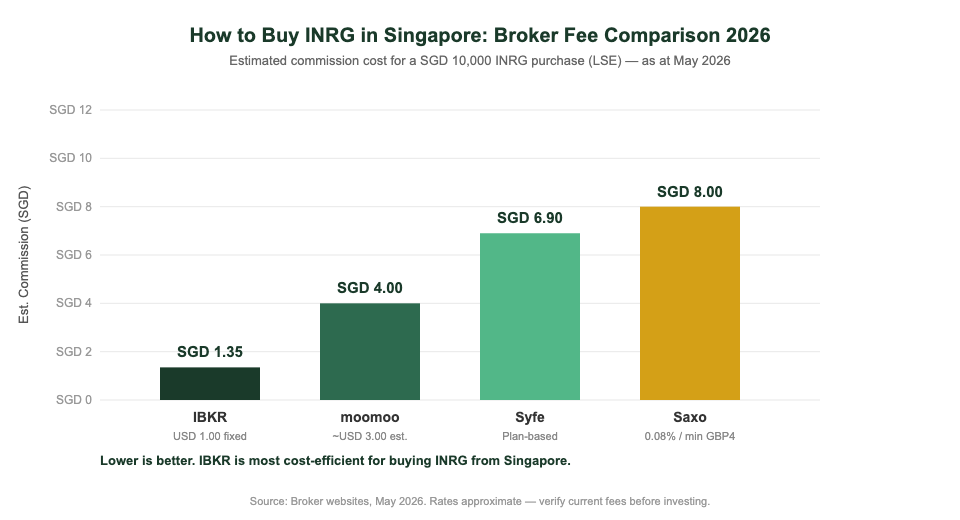
INRG is listed on the London Stock Exchange and can be purchased through any international brokerage that provides LSE access. Below are the four main options for Singapore-based investors in 2026.
Option 1: Interactive Brokers (IBKR) — Best for Cost-Conscious Investors
IBKR offers LSE access with commissions as low as USD 1.00 per trade (IBKR Pro tiered pricing). To buy INRG: open an IBKR account → fund with SGD or GBP → search “INRG” → select the LSE (London Stock Exchange) listing → place a limit order in GBP. IBKR’s FX conversion spread is typically 0.002%, making it the most cost-effective broker for regular purchases. IBKR is suitable for investors purchasing SGD 5,000 or more per transaction.
Option 2: Saxo Markets — Best for Platform Experience
Saxo Markets Singapore offers LSE access with a clean interface and strong charting tools. Commission for LSE trades is 0.08% of trade value, minimum GBP 4 per trade. To buy INRG on Saxo: log in → navigate to “Stocks & ETFs” → search “INRG” → select London Stock Exchange → place order. Saxo’s FX spreads are slightly wider than IBKR’s but the overall platform experience is more polished for less experienced investors.
Option 3: moomoo Singapore — Best for Mobile-First Investors
moomoo Singapore offers LSE access with a user-friendly mobile app. Commission structures vary by account tier. moomoo is a good entry point for investors making their first LSE purchase. For a full breakdown of fees and features, see our moomoo Singapore review with current fee data.
Option 4: Syfe Brokerage — Best for Beginners
Syfe’s brokerage platform provides access to LSE-listed ETFs including INRG. The platform is designed for investors who prefer a clean, guided experience over a full trading terminal. Use our Syfe referral code to get a sign-up bonus when opening your account. Syfe also offers managed portfolios with ESG/clean energy exposure if you prefer a hands-off approach.
Option 5: FSMOne — Best for Regular Savings Plans
FSMOne Singapore offers a Regular Savings Plan (RSP) feature that allows automatic monthly purchases of ETFs. If INRG is on the RSP eligible list, this is an excellent way to dollar-cost average into clean energy exposure without timing the market. Use our FSMOne referral code for account opening benefits.
SRS compatibility note: INRG can be purchased within a Supplementary Retirement Scheme (SRS) account via eligible brokers (primarily IBKR and Saxo). It is not CPF-investable under the CPFIS framework. For a comprehensive look at CPF investment options, see our CPF investment strategy Singapore guide.
Alternatives to INRG
INRG is the most liquid and best-known LSE-listed clean energy ETF for Singapore investors, but it is not the only option. Depending on your investment angle, the following alternatives may be worth considering.
| ETF | TER | Focus | Exchange | Domicile |
|---|---|---|---|---|
| INRG | 0.65% | Global clean energy transition, 107 holdings | LSE | Ireland ✓ |
| ICLN | 0.40% | Global clean energy, similar holdings to INRG | Nasdaq | USA ✗ (WHT & estate tax) |
| RNEW | 0.49% | L&G Clean Energy ETF — broader renewable exposure | LSE | Ireland ✓ |
| XDGE | 0.35% | Xtrackers MSCI SDG 7 Clean Energy equities | LSE / Xetra | Ireland ✓ |
| CSPX / VWRA | 0.07% / 0.22% | Broad market (includes some clean energy exposure) | LSE | Ireland ✓ |
Source: JustETF, fund factsheets, May 2026. TERs subject to change — verify before investing.
An important consideration: broad market ETFs like CSPX and VWRA already include meaningful clean energy exposure through their market-cap weightings. If you are starting out, it may make more sense to build a core position in these broad ETFs before adding thematic satellite positions like INRG. Thematic ETFs are typically used as a 5–15% satellite allocation within a broader portfolio — not as the core holding.
Who Should Buy a Clean Energy ETF?
INRG is a good fit if you:
- Believe the global energy transition is a multi-decade structural theme that will outperform broad markets over the long run
- Want focused exposure to solar, wind, hydrogen, and storage companies without picking individual stocks
- Already have a core portfolio of broad ETFs (CSPX, VWRA) and are looking to add a thematic satellite position of 5–15%
- Are comfortable with higher short-term volatility in exchange for sector concentration
- Have a long investment horizon (10+ years) to ride out clean energy sector cycles
Consider alternatives if you:
- Are investing for the first time — start with broad ETFs before adding thematic exposure
- Need lower volatility or more predictable returns for near-term goals
- Want higher dividend income — INRG’s 0.87% yield is modest; consider passive income Singapore strategies including S-REITs or dividend ETFs instead
- Are looking for CPF-investable options — LSE ETFs cannot be purchased with CPF funds
Clean energy ETFs like INRG suit investors who are positioned to accept sector-level risk in pursuit of the long-term structural opportunity in the global energy transition. They work best as part of a diversified portfolio — not as a standalone strategy. Use our Singapore retirement calculator to model how a 10% INRG satellite allocation alongside core ETFs affects your long-term projections.
Not financial advice. Past performance is not indicative of future results. Please consult a licensed financial adviser before making investment decisions.
Frequently Asked Questions
What is the best clean energy ETF for Singapore investors?
For Singapore investors, INRG (iShares Global Clean Energy Transition UCITS ETF, listed on the London Stock Exchange) is the top choice. Its Ireland domicile means only 15% US dividend withholding tax versus 30% for the US-listed ICLN, and there is no US estate tax exposure. It has an AUM of USD 4.82 billion and tracks the S&P Global Clean Energy Transition Index across 107 holdings as at May 2026.
Can I buy clean energy ETFs in Singapore through CPF?
No — LSE-listed clean energy ETFs like INRG are not approved for purchase under the CPF Investment Scheme (CPFIS). CPF funds can only be invested in certain SGX-listed securities and approved unit trusts. INRG can, however, be purchased within an SRS (Supplementary Retirement Scheme) account through eligible international brokers such as IBKR or Saxo.
What is the difference between INRG and ICLN?
Both INRG and ICLN are iShares clean energy ETFs managed by BlackRock. INRG is Ireland-domiciled and listed on the LSE, offering 15% US dividend WHT and no US estate tax risk for Singapore investors. ICLN is US-domiciled (Nasdaq-listed), carrying 30% WHT and US estate tax exposure above USD 60,000. ICLN has a lower TER (0.40% vs 0.65%), but for Singapore residents, INRG is consistently the more tax-efficient and preferred choice.
How much does it cost to invest in INRG from Singapore?
INRG’s total expense ratio is 0.65% p.a., deducted from the fund’s NAV daily. Brokerage commissions also apply: IBKR charges from USD 1.00 per LSE trade, while Saxo charges 0.08% (minimum GBP 4). There is no SGX stamp duty on INRG — ETFs are exempt from UK SDRT. At approximately GBP 9.00 per share (around SGD 15.30 at May 2026 rates), you can start with a relatively small number of shares.
Is clean energy a good investment in 2026?
Clean energy ETFs carry higher sector-specific risk than broad market ETFs — they are more volatile and concentrated in a single theme. The long-term structural case (global decarbonisation, falling renewable costs, government mandates) remains strong, but the sector has experienced significant drawdowns historically. Most financial educators recommend clean energy as a 5–15% satellite allocation within a diversified portfolio anchored by broad market ETFs like CSPX or VWRA — not as the core strategy. This is not financial advice; consult a licensed financial adviser for personalised guidance.
Does INRG pay dividends?
Yes — INRG is a distributing ETF that pays out dividends from its underlying holdings. As at May 2026, the distribution yield is approximately 0.87%. Distributions are paid in USD. Singapore investors receive these dividends without any additional SG-side tax, though the 15% US withholding tax has already been deducted at the fund level before distributions are paid out. To reinvest automatically, you would need to do so manually through your broker or look for an accumulating share class.
Are there any clean energy ETFs listed on the SGX?
As at May 2026, there is no dedicated clean energy ETF listed on the Singapore Exchange (SGX). Singapore investors seeking clean energy exposure must access it through international brokers providing LSE or US market access. The iShares INRG on the LSE is the most accessible and liquid option. SGX does list some ESG-tilted broad market ETFs, but these are not dedicated clean energy funds.
Can I use SRS funds to invest in INRG?
Yes — INRG can be purchased using Supplementary Retirement Scheme (SRS) funds through eligible brokers, primarily Interactive Brokers (IBKR) and Saxo Markets. Using SRS to invest in INRG provides additional tax efficiency: SRS contributions reduce your chargeable income, and withdrawals at retirement are only 50% taxable. This makes the SRS route one of the most tax-efficient ways for Singapore investors to gain clean energy ETF exposure.
Ready to Start Investing in ETFs?
Open a brokerage account and buy your first ETF today. Use our referral links for exclusive sign-up bonuses.
This article was researched with the help of AI. While we strive to keep all information accurate and up to date, there may be errors. If you notice any discrepancies, please contact us.