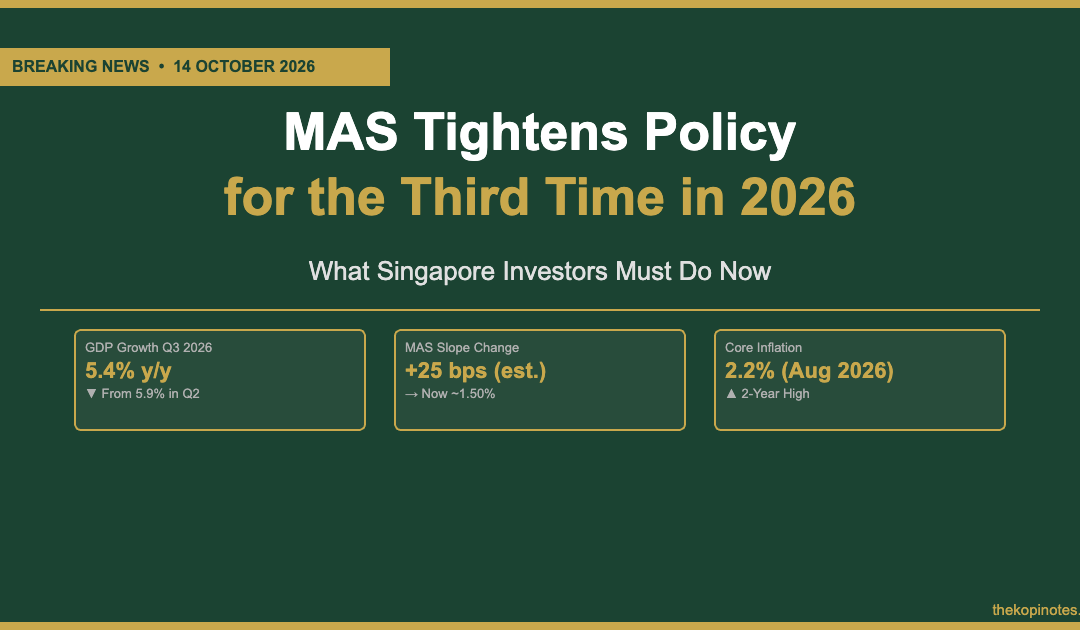
Singapore’s Monetary Authority surprised markets on 14 October 2026 by holding its policy settings unchanged — maintaining the existing rate of appreciation of the S$NEER band, with no change to its width or centre level. Markets had widely expected a third tightening this year. On the same morning, advance GDP data confirmed Q3 2026 growth of 5.4% year-on-year, slightly slower than Q2’s 5.9%. For Singapore retail investors, the combination signals borrowing costs and savings yields are at or near their cycle peak.
This is an editorial analysis. Not financial advice. Data verified as at 14 October 2026.
MAS Holds in October 2026: What the Statement Actually Says
In its October 2026 Monetary Policy Statement, MAS confirmed: “MAS will therefore maintain the rate of appreciation of the policy band. There will be no change to the width of the band and the level at which it is centred.”
This was a genuine surprise. A Reuters poll of 10 economists ahead of the meeting had unanimously expected a +25 basis point slope increase — the third tightening of 2026 following the +50 bps move in April and the surprise +25 bps in July. The S$NEER had already strengthened into the upper half of the policy band since July, giving MAS confidence that existing settings were doing their job.
MAS cited two reasons for the hold. First, core inflation, while elevated at 2.1% y/y in July–August (up from 1.5% in Q2), is expected to ease from mid-2027 as imported cost pressures moderate and domestic wage growth stays contained. Second, the output gap is expected to narrow through 2027 as the AI investment boom moderates. MAS flagged that the “current appreciating policy band will allow the S$NEER to continue to strengthen and lean against the anticipated near-term rise in imported inflation” — in other words, the existing policy is still working.
For a full recap of the lead-up to this decision, see our MAS October 2026 Preview and our analysis of the July 2026 surprise tightening.
Singapore Q3 2026 GDP: 5.4% Growth, Led by Tech
Released at 8am this morning by the Ministry of Energy, Trade and Industry (METI), Singapore’s advance GDP estimate for Q3 2026 showed the economy grew 5.4% year-on-year, compared to 5.9% in Q2 2026 and 6.3% in Q1. On a quarter-on-quarter seasonally-adjusted basis, growth came in at 1.1%, slightly slower than the preceding quarter.
According to MAS, “growth was led by robust expansions in the technology-related sectors of the economy.” Construction, financial services, and real estate also performed well, while consumer-facing segments showed some softness. This aligns with the broader theme of Singapore’s economy being split between its globally-connected tech and finance sectors (which are booming) and its domestically-oriented segments (which are feeling the squeeze from higher prices and cautious consumer spending).
Singapore’s 2026 GDP forecast remains at 4.5–5.5%, upgraded by MTI in August when first-half growth came in at 6.1% y/y. Full-year government forecasts will be announced in November. The economy’s positive output gap is expected to narrow through 2027, which is one reason MAS sees no need to tighten further right now.
Check our Singapore Q3 2026 Market Wrap for the full equity market context.
What the Hold Means for Your Savings Rates
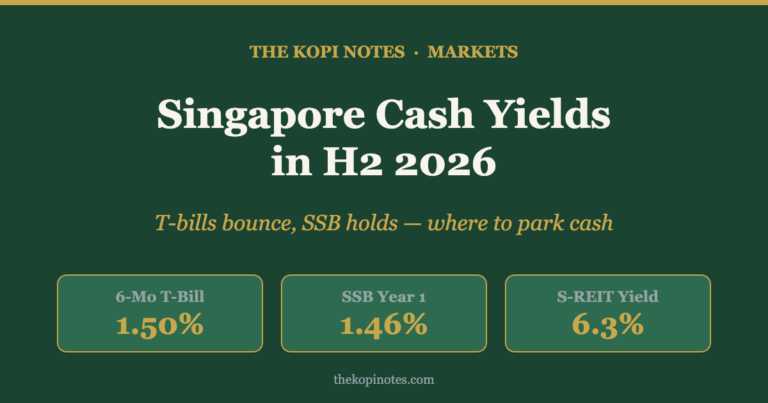
Singapore’s savings environment has been a challenging one in 2026. As our core inflation guide noted, most cash instruments — T-bills, fixed deposits, SSBs — have been losing ground to inflation in real terms. The policy hold does not immediately improve yields, but it does signal that rates are likely to stabilise rather than continue climbing.
Here is where key Singapore rate benchmarks stand as of October 2026:
| Instrument | Current Rate | Notes |
|---|---|---|
| MAS S$NEER Slope | Maintained (held Oct 2026) | No change; same as post-July level |
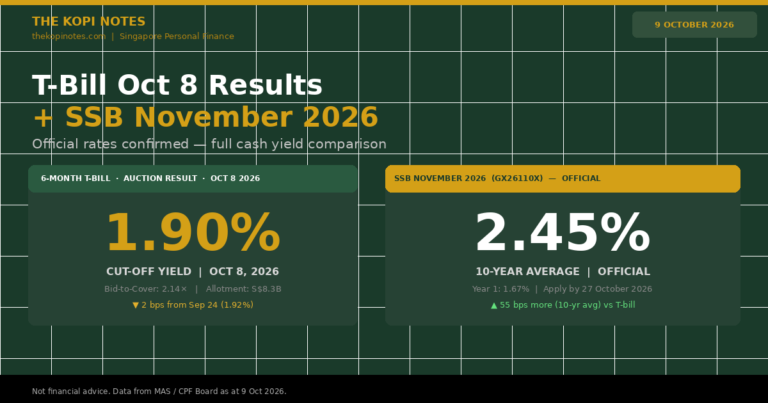
| 6-month T-bill (Oct 8 auction) | 1.90% p.a. | Slightly down from 1.92% in Sept |
| SSB Nov 2026 (10-year avg) | 2.45% p.a. | Up from 2.32% on previous issue |
| Best FD (6-month, HL Bank) | 2.05% p.a. | Min. S$10,000 |
| Best FD (12-month, Singapura Finance) | 2.08% p.a. | Min. S$10,000 |
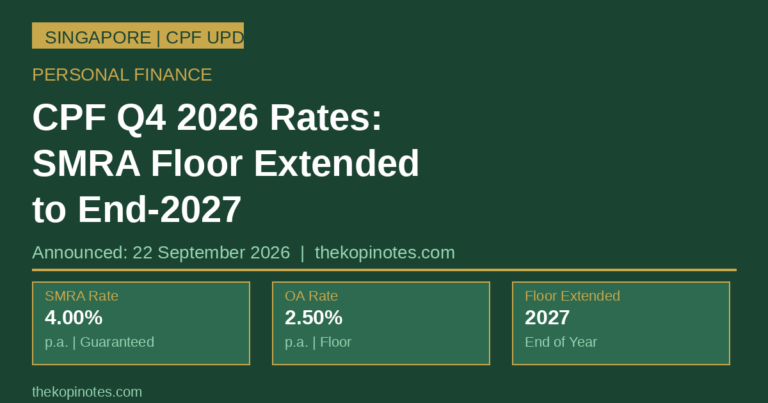
| CPF SMRA (SA/MA/RA) | 4.00% p.a. | Floor extended to end-2027 |
| MAS Core Inflation (Jul–Aug 2026) | 2.1% y/y | Expected to ease from mid-2027 |
The chart below visualises the savings rate landscape against core inflation:
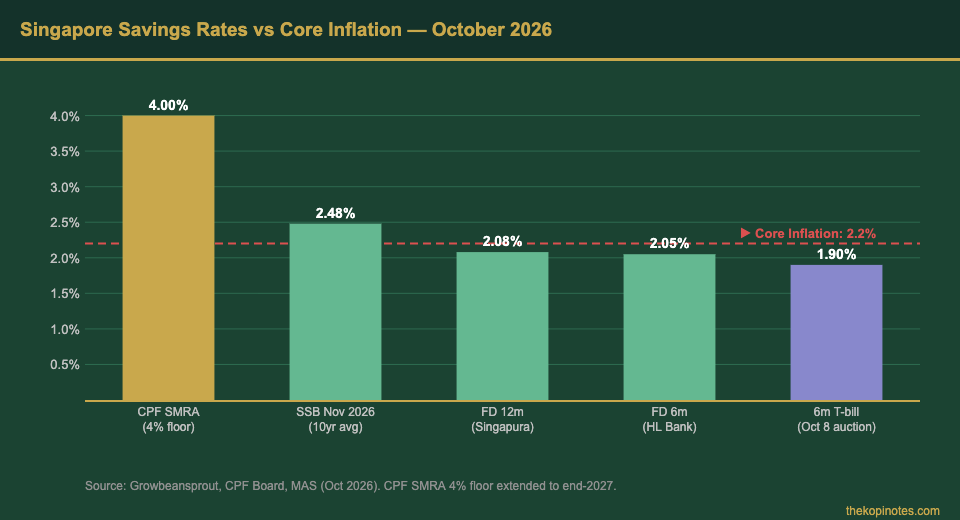
The CPF SMRA advantage remains the standout. At 4.00% (with the floor guaranteed until end-2027), it is the only Singapore dollar instrument comfortably beating the 2.1% core inflation rate. If you have not yet maxed out your CPF Special Account top-up (S$8,000 per year for the cash top-up relief), now is the time. SSBs, at 2.45% over 10 years, are the next best liquid option for most retail investors — but only if held to maturity. Short-term T-bills and FDs are losing to inflation in real terms, though they remain useful for liquidity management.
S-REITs: A Policy Pause Is the Relief They Needed
The iEdge S-REIT Index has been the worst-performing major Singapore asset class in 2026, down approximately 8.2% year-to-date as of the end of Q3. The primary culprit has been the “higher for longer” narrative — rising SORA rates (which track global rates) increase financing costs for REITs, compress distribution yields against risk-free alternatives, and weigh on property valuations.
A MAS policy hold is positive news for S-REITs on two counts. First, it removes the fear of a further SGD appreciation that would make offshore property assets (held by many Singapore REITs) worth less in SGD terms. Second, and more importantly, it signals that we may be near the top of the rate cycle, which reduces the risk of further SORA increases in the short term.
However, investors should not expect an immediate SREIT rally to match what we saw in 2023–2024. The key variables to watch are:
- SORA trajectory: MAS does not set SORA directly; it tracks global short-term rates. With the US Fed funds rate at 3.75–4.00% (raised in September 2026), SORA relief depends on when the Fed begins cutting.
- Gearing ratios: REITs with high leverage (above 40% aggregate leverage) face more refinancing risk. Focus on those with lower gearing and staggered debt maturity profiles.
- DPU growth: REITs with organic DPU growth — such as CICT (+7.1% in 1H 2026), LREIT (+3.0%), and AIMS APAC REIT (+2.5%) — are more resilient than those relying on acquisitions to boost distributions.
For the full S-REIT earnings picture, see our S-REIT October 2026 Earnings Preview.
The MAS Tightening Cycle: Where Are We Now?
The chart below shows the trajectory of the MAS S$NEER slope since January 2026:
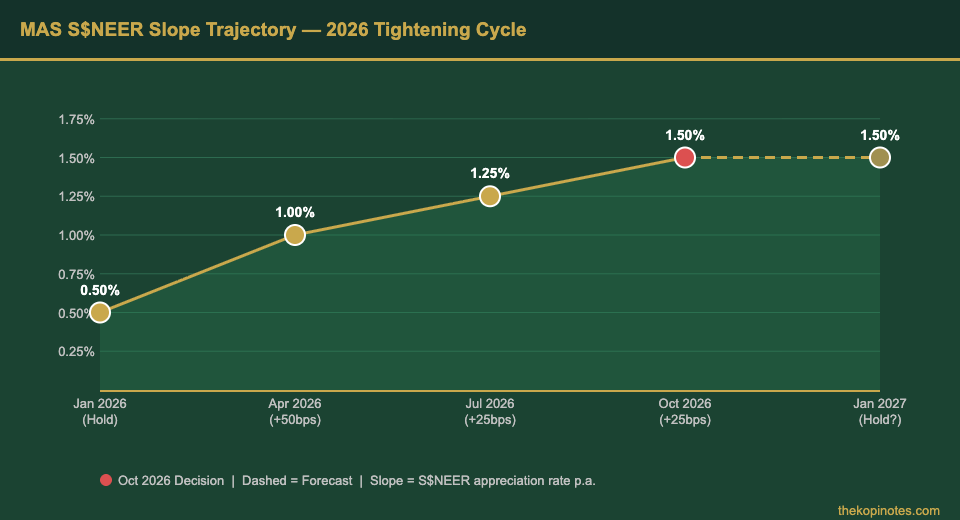
From a baseline slope of approximately 0.50% at the start of 2026, MAS tightened aggressively in April (+50 bps to 1.00%), then surprised markets with a July tightening (+25 bps to 1.25%). The October hold keeps the slope at 1.25%. MAS has signalled it expects inflation to ease from mid-2027, and the output gap to narrow — suggesting the next move, if any, could be a modest loosening in the first half of 2027 rather than further tightening.
For Singapore investors, this is important context: the tightening cycle appears to have peaked. Rate-sensitive assets — REITs, long-duration bonds, growth stocks — tend to re-rate positively when the market prices in a rate-cycle peak, even before actual cuts begin.
Mortgages: SORA Borrowers Get Near-Term Stability
Most Singapore home loans are pegged to SORA (Singapore Overnight Rate Average), not directly to the MAS policy band. However, the two are related — a pause in MAS tightening removes upward pressure on SORA, and if global rates begin to ease in 2027, Singapore floating-rate borrowers will feel the benefit.
If you are approaching a loan repricing date in the next six months, MAS’s hold gives you slightly more confidence that SORA will not spike further before your repricing. That said, given the US Fed remains at 3.75–4.00%, there is limited room for SORA to fall in the near term. Borrowers on floating rates who are uncomfortable with uncertainty may still find value in locking into a two-year fixed package at current levels — check with your bank for the latest offerings.
Bank Stocks: Strong, But Rate-Driven Upside May Have Peaked
DBS, OCBC, and UOB — which together account for roughly half the STI’s weight — have been the star performers of 2026, helping drive the index to its September record high of 5,801.96. Their net interest margins expanded significantly as SORA rose, and their loan books remained resilient despite higher rates.
A MAS policy hold does not hurt the banks directly — their NIMs are already at elevated levels. But it does reduce the upside scenario of further margin expansion from additional SGD rate increases. Analysts are now more likely to model NIM stability (rather than NIM expansion) into 2027. Bank stocks may continue to benefit from Singapore’s economic growth and strong dividend payouts, but the outsized rate-driven multiple expansion of 2025–2026 is unlikely to repeat.
For a full breakdown of dividend investing opportunities in Singapore, see our Dividend Investing Singapore 2026 guide.
Bottom Line for SG Investors
Today’s MAS hold is a meaningful pivot for Singapore retail investors — not because rates are falling, but because the direction of risk has shifted. Here is your action checklist:
- CPF top-ups remain the #1 move. The 4% SMRA floor until end-2027 is unbeatable in today’s rate environment. Maximise your S$8,000 cash top-up for tax relief.
- SSBs over short FDs for new cash. With rates likely to stabilise or fall, locking in 2.45% on a 10-year SSB beats rolling short T-bills at 1.90%. Apply before the November SSB closes.
- Review S-REIT exposure. The worst of the rate headwind may be behind us. Focus on REITs with low gearing, long debt tenors, and visible DPU growth — not just the cheapest P/NAV multiples. See our Best Investments in Singapore 2026 for a full framework.
- Watch the US Fed. Singapore rates cannot fall meaningfully until the Fed starts cutting. The next Fed meeting is the key catalyst for SORA relief.
- Don’t over-rotate on the STI pullback. The STI’s 3.3% dip from its September record is not a crisis — it is a normal consolidation after a 56% two-year run. Continue dollar-cost averaging into diversified ETFs (CSPX, VWRA, IWDA).
Frequently Asked Questions
Did MAS raise rates at the October 2026 meeting?
No. MAS maintained its policy settings unchanged in October 2026 — keeping the same rate of appreciation of the S$NEER policy band, with no change to the band’s width or centre. This was a surprise hold; most economists had expected a third tightening.
What is the MAS S$NEER policy band and how does it work?
Unlike most central banks that set a benchmark interest rate, MAS conducts monetary policy through the Singapore dollar’s exchange rate. It manages the S$NEER (Singapore dollar nominal effective exchange rate) within a policy band. “Tightening” means allowing the SGD to appreciate faster (steeper slope). “Easing” means slowing appreciation or allowing depreciation. The current policy allows the SGD to continue appreciating at its existing pace.
What does the MAS hold mean for my CPF interest rates?
CPF interest rates are set separately from MAS monetary policy. The CPF Special Account, MediSave Account, and Retirement Account (SMRA) rates are currently at the 4.00% floor, which has been extended to 31 December 2027. The OA rate remains at 2.50% (with an effective 3.50% on the first S$20,000 for members under 55). Neither of these is directly affected by today’s MAS decision.
Will Singapore savings and fixed deposit rates fall now?
Not immediately. T-bill yields and FD rates are driven by market forces including the US Fed rate (currently 3.75–4.00%). A MAS hold does not directly cut these rates. However, if MAS’s hold signals the peak of the tightening cycle, banks may begin to gradually reduce FD promotional rates over the next 6–12 months, especially once the Fed begins cutting. Monitor yields at each T-bill auction.
Will S-REIT prices recover now that MAS has paused?
The MAS hold removes a near-term headwind for S-REITs — no further SGD appreciation pressure and a signal that the rate cycle may have peaked. However, a meaningful S-REIT recovery requires SORA to fall, which depends on the US Fed. Expect a gradual improvement rather than an immediate sharp rebound. Focus on quality REITs with strong DPU growth and manageable gearing rather than trying to time a sector rally.
What should I do with my cash sitting in savings accounts or short FDs?
With the rate cycle likely near its peak, consider gradually shifting idle cash from rolling T-bills (1.90%) into the November SSB (10-year average: ~2.45–2.48%) for cash you don’t need in the next 12 months. For 6–12 month horizons, HL Bank’s 6-month FD at 2.05% or Singapura Finance’s 12-month FD at 2.08% remain competitive. Most importantly, if you have not yet topped up your CPF SA this year, prioritise the S$8,000 cash top-up for the 4% risk-free return and tax relief.
This article was researched with the help of AI. While we strive to keep all information accurate and up to date, there may be errors. If you notice any discrepancies, please contact us.