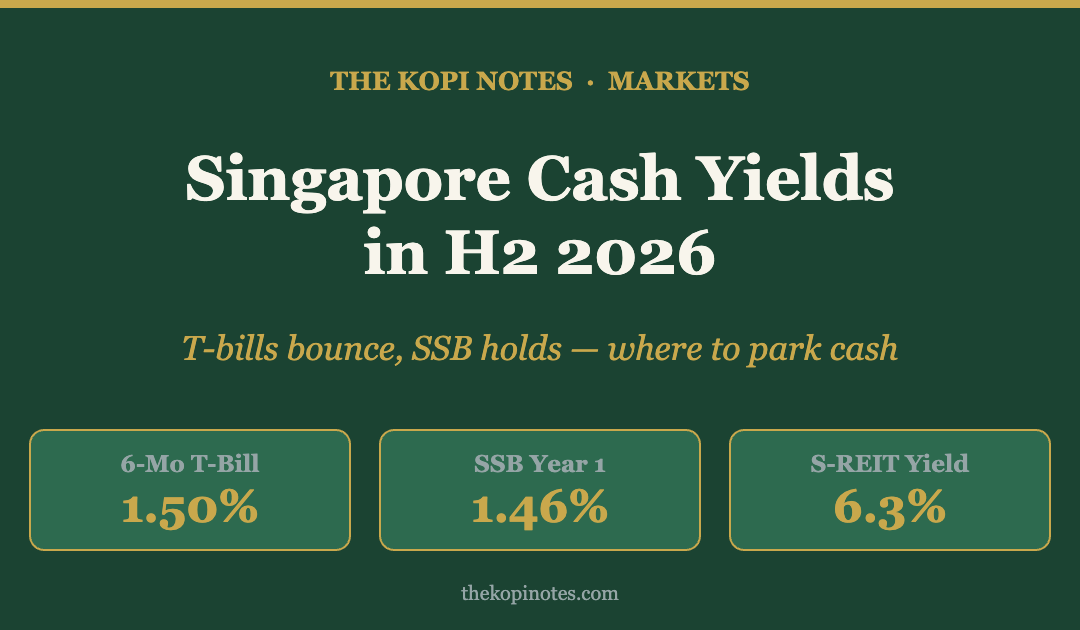
Singapore’s cash yields have stopped falling — for now. The 6-month T-bill cut-off yield ticked up to 1.50% at the 2 July 2026 auction, its highest of the year, even as the July Singapore Savings Bond (SSB) held flat at a 1.46% first-year rate and the best 12-month fixed deposits sit near 1.50–1.60%. After a brutal two-year slide from 4%-plus, the “risk-free” cash trade is quietly running out of road, and that has real consequences for where retail investors park money in the second half of 2026.
This is an editorial analysis. Not financial advice. All figures are for educational reference only. Data as at 7 July 2026 unless noted.
What Just Happened to Singapore Cash Yields
For most of 2023 and 2024, parking cash in Singapore was almost embarrassingly easy. Six-month T-bills cleared above 3.7%, fixed deposits crossed 4%, and savers were rewarded for doing nothing. That era is over. Three-month compounded SORA — the benchmark that anchors local borrowing and deposit rates — has collapsed from a 2023 peak near 4% to roughly 1.1% by mid-2026.
The latest data point complicates the “yields only go down” narrative. At the auction on 2 July 2026, the 6-month T-bill cut-off yield rose to 1.50%, up from 1.47% on 18 June and the highest print of the year, on a record S$8.7 billion issue size (Growbeansprout). It is a small bounce, but it hints that the steepest part of the decline may be behind us.
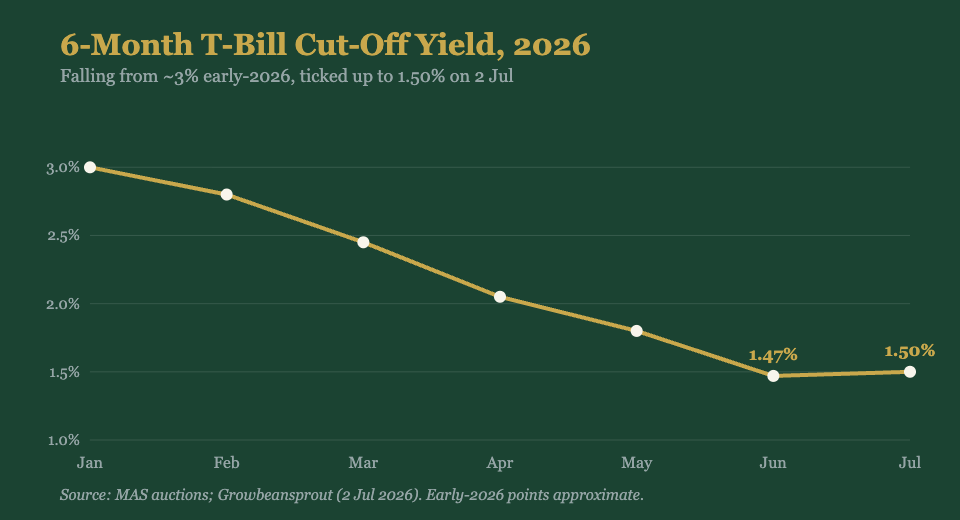
What this means for Singapore retail investors: the window to lock in “high” risk-free yields has largely closed, but it has not slammed shut. Cash is no longer a free lunch, yet the recent stabilisation gives savers a moment to plan rather than panic.
The Numbers: Singapore Cash Instruments Compared
Here is how the main capital-guaranteed and near-cash options stack up as at early July 2026. The spread between them is now measured in basis points, not percentage points.
| Instrument | Latest yield | Liquidity / lock-in | Tax on interest |
|---|---|---|---|
| SSB (July 2026, Year 1) | 1.46% | Redeem any month, capital-guaranteed | Tax-exempt |
| SSB (July 2026, 10-yr average) | 2.11% | Step-up to 2.81% by Year 10 | Tax-exempt |
| 6-month T-bill (2 Jul 2026) | 1.50% | Held to maturity (6 months) | Tax-exempt |
| Best 12-month fixed deposit | ~1.50–1.60% | Locked for tenure; penalty on early exit | Tax-exempt |
| iEdge S-REIT Index (avg yield) | ~6.30% | Fully liquid; capital not guaranteed | Distributions generally tax-exempt for individuals |
Sources: MAS, Turtle Investor, StashAway, SGX iEdge S-REIT Index (May 2026).
Our full running trackers break down each option in detail: the Singapore Savings Bond guide and the latest T-bill auction results.
Why Yields Fell — and Why T-Bills Bounced
Singapore does not set interest rates directly. MAS manages the Singapore dollar’s exchange rate, and local rates like SORA are largely imported from global USD conditions and expectations of SGD appreciation. When MAS raised the S$NEER appreciation slope to about 1% in April 2026, a stronger expected Singapore dollar pushed domestic rates down — dragging SORA to roughly 1.06% by June.
So why did the 6-month T-bill just tick higher? Auction yields reflect supply and demand as much as macro trends. The 2 July issue was the largest 6-month T-bill on record at S$8.7 billion; a heavier supply, combined with slightly firmer global rates and MAS keeping the door open to tightening at its July review, nudged the cut-off up. It is a reminder that these yields wobble auction to auction rather than moving in a straight line.
What this means for Singapore retail investors: do not read a single auction as a trend reversal. The structural direction — lower domestic rates driven by a firm SGD — remains intact, but month-to-month bounces mean laddering across auctions still beats trying to time the exact bottom.
What Falling Cash Yields Mean for Your Portfolio
The uncomfortable truth is that inflation has not fallen as fast as yields. In April 2026, MAS raised its core and headline inflation forecasts for the year to 1.5%–2.5%, citing higher oil import prices. With the SSB first-year rate at 1.46% and top fixed deposits near 1.5%, the real (after-inflation) return on cash is now hovering around zero — or negative if inflation runs at the upper end.
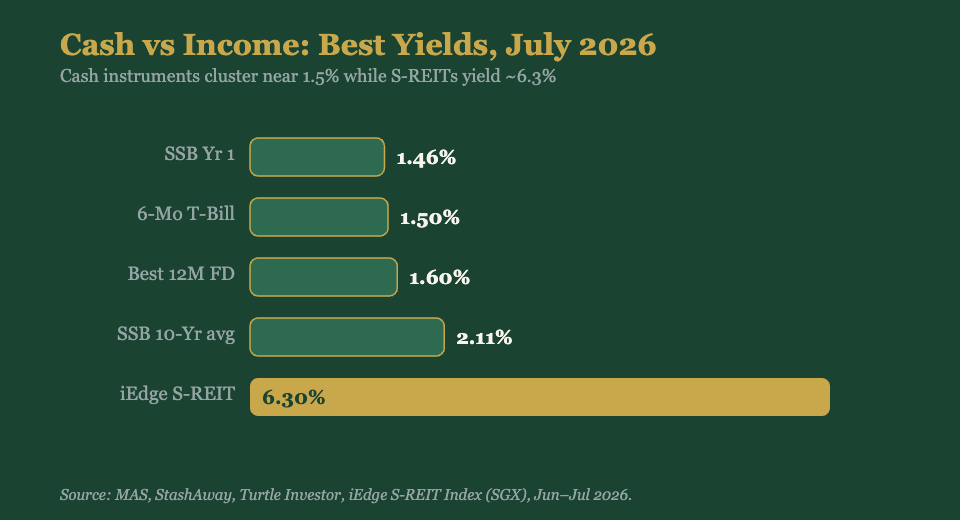
The chart above frames the core dilemma of H2 2026: every capital-guaranteed option now clusters around 1.5%, while income assets such as S-REITs offer roughly 6.3% — but with capital risk. The gap between “safe” and “income” has widened to more than four percentage points, the widest in years.
What this means for Singapore retail investors: holding a large cash pile is no longer a low-cost decision. The opportunity cost of sitting in cash has risen sharply, which forces a genuine choice about how much liquidity you actually need versus how much is simply idle.
Should You Lock In Now, or Stay Liquid?
For your genuine emergency fund — typically three to six months of expenses — liquidity beats yield. An SSB remains the standout here: it is capital-guaranteed, redeemable in any month with accrued interest, tax-exempt, and its 10-year average of 2.11% (stepping up to 2.81% by Year 10) rewards patience without a hard lock-in. That flexibility is worth more than the extra few basis points a fixed deposit might offer.
For money you are certain you will not touch for six to twelve months, a T-bill or fixed deposit can squeeze out marginally more. But with the whole complex compressed near 1.5%, the reward for locking up capital is thin. Laddering — splitting funds across several T-bill auctions or FD tenures — keeps you liquid and lets you reinvest if yields firm again, as the July auction hinted they might.
What this means for Singapore retail investors: match the instrument to the job. Emergency cash belongs in flexible SSBs; known short-term obligations can sit in laddered T-bills; but do not lock up long-term savings at 1.5% simply because it feels safe.
The Pivot: From Cash to Income Assets
Falling domestic rates cut both ways. They squeeze savers, but they are a tailwind for borrowers — and S-REITs are among the most rate-sensitive borrowers on the SGX. Roughly 80% of S-REITs are expected to benefit from stable or lower benchmark rates in 2026: every tranche of SGD debt that refinances now reprices at materially lower cost, and that saving flows straight into distributable income and potentially higher DPU.
That does not make S-REITs a cash substitute — unit prices fluctuate and distributions are not guaranteed. But for investors with a multi-year horizon and appropriate risk tolerance, the ~6.3% average yield on the iEdge S-REIT Index looks increasingly compelling against sub-2% cash. Balance-sheet quality matters more than headline yield: prioritise REITs with well-staggered debt maturities, a high share of fixed-rate borrowing and strong interest coverage. We cover the screening in our best S-REITs for 2026 and high-yield S-REITs guides, and the wider rate backdrop in our Singapore rates versus the Fed analysis.
What this means for Singapore retail investors: the same force hurting your deposit rate is quietly helping income assets. A gradual, staggered shift of surplus cash into diversified income holdings — not a wholesale dump of your emergency fund — is the rational response to a sub-2% cash world.
Bottom Line for SG Investors
Singapore’s cash yields have compressed to around 1.5% across T-bills, fixed deposits and the July SSB, with only a modest July T-bill bounce to 1.50% interrupting the two-year slide. With inflation forecast at 1.5%–2.5%, real returns on cash are now close to zero. Keep your emergency fund liquid and capital-guaranteed — the flexible, tax-exempt SSB is hard to beat for that role — and ladder any short-term surplus across T-bill auctions rather than chasing a single “best” rate. But recognise that the opportunity cost of large idle cash balances has climbed, and that the same falling-rate dynamic is a tailwind for quality income assets like well-financed S-REITs. The winning move in H2 2026 is not to abandon cash, but to hold only as much as you genuinely need and put the rest to work with eyes open.
Frequently Asked Questions
What is the July 2026 Singapore Savings Bond interest rate?
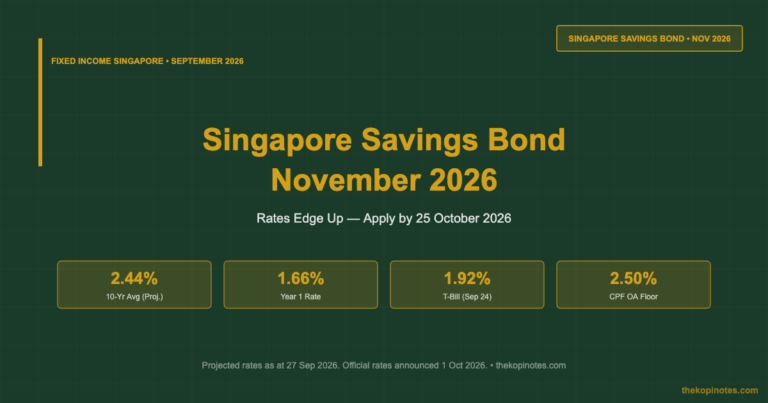
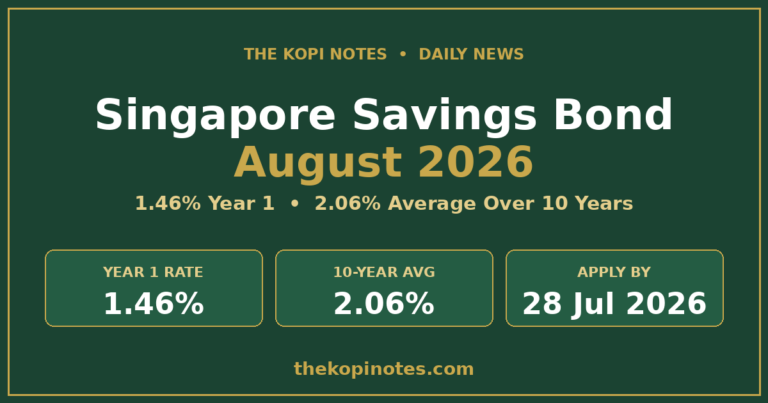
The July 2026 SSB pays a first-year interest rate of 1.46% and a 10-year average return of 2.11%, stepping up to 2.81% by Year 10. Interest is tax-exempt and you can redeem in any month without penalty.
What is the latest 6-month Singapore T-bill yield?
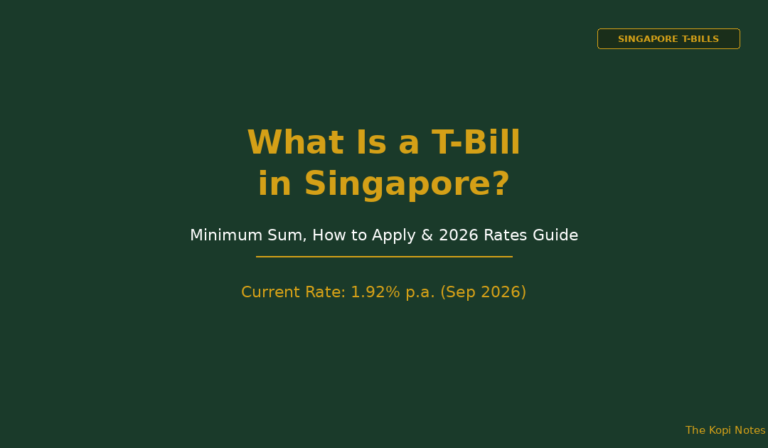
The 6-month T-bill cut-off yield rose to 1.50% at the 2 July 2026 auction, its highest of the year, up from 1.47% on 18 June, on a record S$8.7 billion issue size.
Are fixed deposits still worth it in Singapore in 2026?
The best 12-month fixed deposits currently sit near 1.50–1.60%, broadly in line with T-bills and SSBs. They can make sense for money you are certain you will not need before maturity, but the yield premium over more flexible options is now very small.
Why are Singapore interest rates falling?
MAS manages the Singapore dollar exchange rate rather than setting interest rates directly. A firmer expected SGD, after MAS raised the currency’s appreciation slope in April 2026, has pushed local benchmarks like SORA down toward 1.1%.
Should I move my cash into S-REITs?
S-REITs offer a much higher average yield (~6.3%) but carry capital risk and their distributions are not guaranteed, so they are not a direct cash substitute. For long-horizon investors, a gradual, diversified shift of surplus cash — not emergency funds — into quality REITs can be reasonable. This is not personalised financial advice.
Where should I keep my emergency fund now?
Liquidity and capital preservation matter most for an emergency fund. A Singapore Savings Bond is well suited: it is capital-guaranteed, redeemable in any month with accrued interest, and tax-exempt, so you keep flexibility while still earning a modest return.
This article was researched with the help of AI. While we strive to keep all information accurate and up to date, there may be errors. If you notice any discrepancies, please contact us.