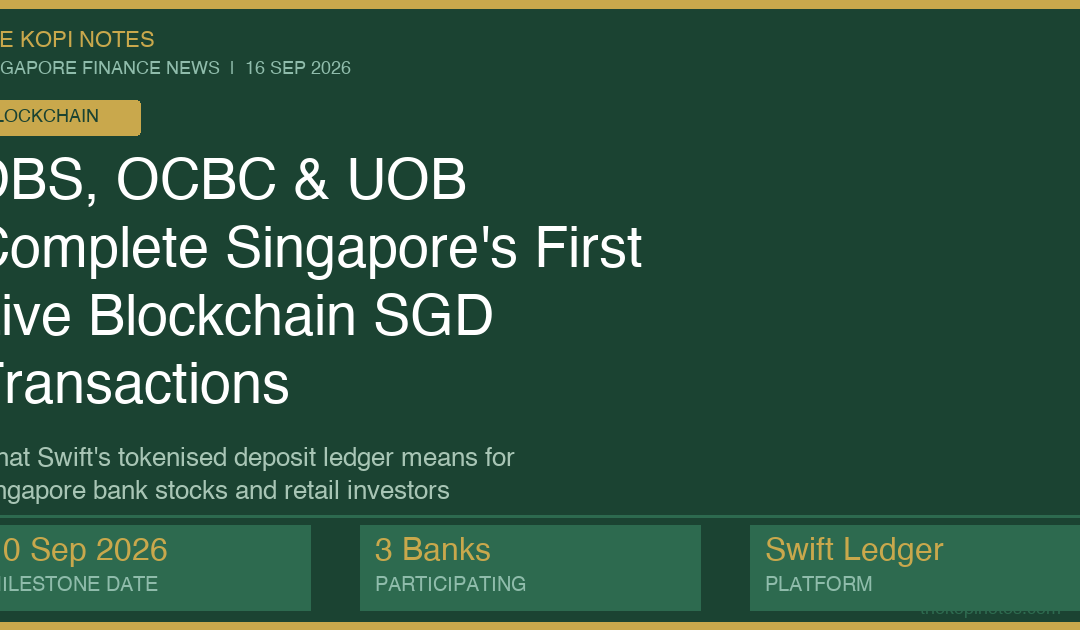
Singapore’s three major banks — DBS, OCBC, and UOB — completed the country’s first live blockchain-based SGD transactions on Swift’s new tokenised deposit ledger on 10 September 2026. The milestone marks a turning point for Singapore’s financial infrastructure, with real-world implications for bank efficiency, cross-border payments, and long-term shareholder value that retail investors should understand.
What Happened: Singapore’s Blockchain Banking Milestone
On 10 September 2026, DBS Bank, OCBC Bank, and United Overseas Bank (UOB) jointly completed Singapore’s first live interbank transactions using tokenised SGD deposits on Swift’s new distributed ledger. The transactions were processed in real-time — a stark contrast to the conventional interbank settlement process that typically takes one to two business days.
Swift, the global financial messaging network used by over 11,000 financial institutions worldwide, launched its tokenised deposit ledger as part of its multi-year strategy to modernise cross-border payments. Singapore was chosen as one of the first markets for live deployment, given its position as a leading global financial hub and the Monetary Authority of Singapore’s (MAS) proactive stance on financial technology innovation.
The three banks participated in a coordinated pilot that involved genuine interbank settlements — not a sandbox or simulated environment — using tokenised representations of SGD deposits on a shared blockchain ledger. Transactions settled instantly, with programmable conditions automatically verified before funds were released.
This wasn’t just a technical proof-of-concept. The banks processed actual payments, representing a genuine leap from the traditional RTGS (Real-Time Gross Settlement) system that has underpinned Singapore interbank transactions for decades.
The Swift Tokenised Deposit Ledger: How It Works
To understand why this matters, it helps to know what Swift’s tokenised deposit ledger actually does — and how it differs from the existing system.
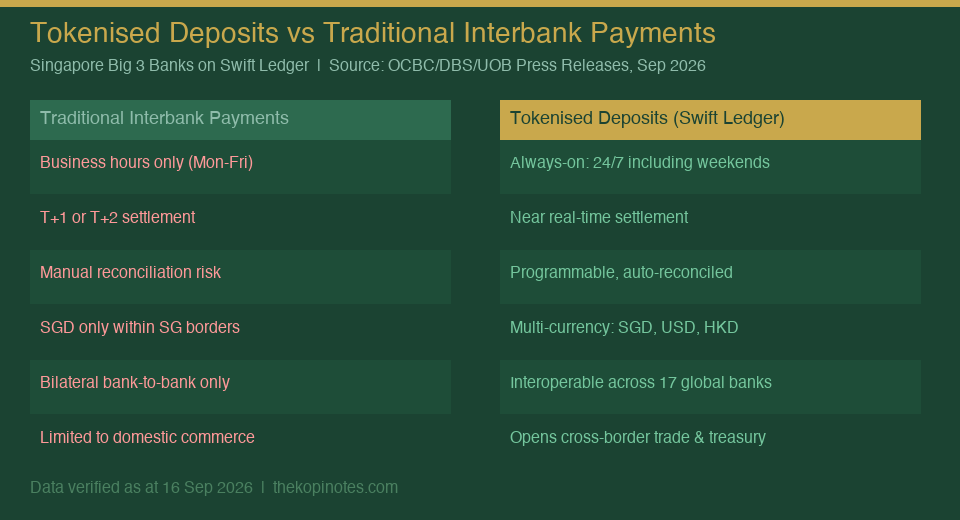
Traditional interbank payments in Singapore run through MAS Electronic Payment System (MEPS+), which handles large-value SGD transactions. While MEPS+ is reliable, it operates during business hours (typically 8am to 6pm), processes transactions sequentially, and does not support programmable conditions or multi-currency atomic settlement.
Swift’s tokenised deposit ledger changes this fundamentally. When a bank “tokenises” a deposit, it creates a digital representation of that deposit on a shared blockchain ledger. These tokens can be:
- Transferred instantly, 24/7 — no cut-off times, no business-hours restriction
- Settled atomically — payment and delivery happen simultaneously, eliminating settlement risk
- Programmed with conditions — smart contracts can release funds only when specified conditions are met
- Used across currencies — the same infrastructure supports USD, EUR, and other tokenised deposits
For Singapore’s Big 3 banks, participation in Swift’s ledger means they can now offer corporate clients instant, programmable cross-border settlements — a capability that was previously the domain of crypto-native fintech firms. The key difference: these are bank-issued, regulated tokenised deposits, not decentralised cryptocurrencies.
Singapore Bank Q2 2026 Performance: A Strong Foundation
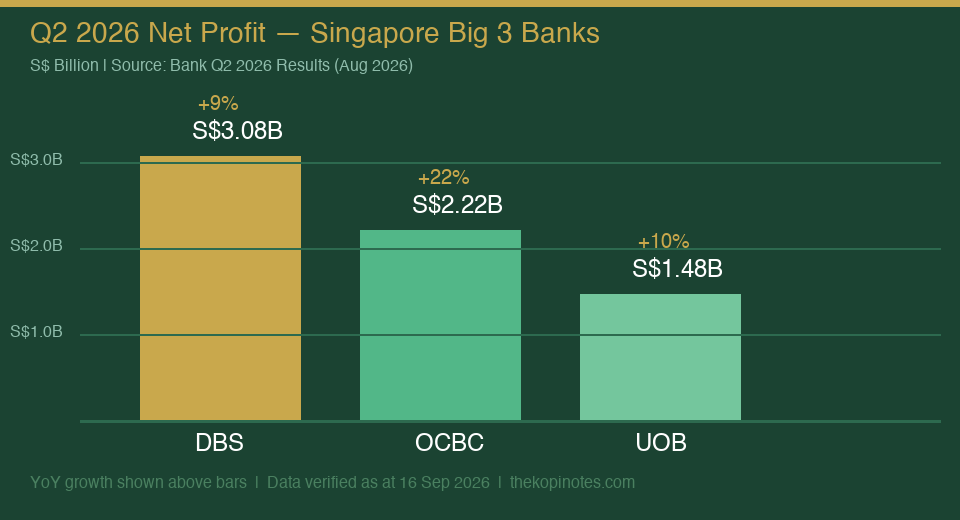
The blockchain milestone comes on the back of an exceptionally strong first half of 2026 for Singapore’s banking sector. All three banks reported record or near-record earnings in Q2 2026, providing a healthy financial foundation to invest in next-generation infrastructure.
| Bank | Q2 2026 Net Profit | YoY Growth | Dividend (FY2026E) | Dividend Yield |
|---|---|---|---|---|
| DBS Bank | S$3.08 billion | +9% | S$2.40/share | ~5.5% |
| OCBC Bank | S$2.22 billion | +22% | S$0.70/share (Q2) | ~5.8% |
| UOB | S$1.48 billion | +10% | S$0.88/share (H1) | ~5.2% |
Source: Company earnings releases, Q2 2026. Dividend yield estimates are approximate based on prevailing share prices. Not investment advice.
What It Means for Singapore Bank Shareholders
For retail investors who hold DBS, OCBC, or UOB shares — or are considering doing so — the tokenised deposit milestone has several meaningful implications.
1. New Revenue Streams from Corporate Treasury Services
The ability to offer programmable, real-time cross-border settlements opens entirely new product categories for Singapore’s banks. Large multinationals managing treasury operations across Asia can now consolidate liquidity management through their Singapore banking relationships in ways that were previously only possible with specialised custody banks or fintech intermediaries.
Transaction fees, custody fees, and premium treasury services for tokenised assets represent incremental revenue opportunities — modest in the near term, but potentially significant as adoption scales.
2. Cost Efficiency Through Settlement Automation
Atomic settlement eliminates the need for reconciliation processes that currently consume significant back-office resources. When a transaction is programmably verified and instantly settled, the layers of manual checking, exception handling, and correspondent banking overhead are dramatically reduced.
Analysts at DBS’s 2026 investor day estimated that widespread tokenised settlement adoption could reduce back-office operational costs by 15–25% over a five-year horizon — a material improvement to the banks’ already-healthy cost-to-income ratios (currently around 38–45% across the Big 3).
3. Positioning Against Regional Competition
Singapore’s banks compete with Hong Kong-based HSBC and Standard Chartered, as well as regional banks from Malaysia, Indonesia, and Thailand, for large corporate mandates. Being first-movers on Swift’s tokenised ledger gives DBS, OCBC, and UOB a concrete technological differentiator in pitching for regional treasury mandates.
For long-term investors, this represents a defensive moat: the institutional infrastructure being built today takes years to replicate, giving Singapore’s banks a window of competitive advantage.
4. Regulatory Tailwinds from MAS
The Monetary Authority of Singapore has been one of the most proactive central banks globally in developing frameworks for digital asset regulation and tokenised finance. MAS’s Project Orchid (retail CBDC), Project Guardian (tokenised assets with private banks), and its support for the Swift tokenised deposit pilot reflect a coherent, enabling regulatory environment.
For investors, this means Singapore’s banks are developing these capabilities within a clear legal framework — reducing the regulatory risk that has plagued tokenised finance in other jurisdictions.
What Retail Investors Need to Know Right Now
If you’re a retail investor holding Singapore bank stocks, here’s the practical takeaway from this development:
This is a medium-to-long-term catalyst, not a short-term price driver. The blockchain milestone does not immediately change DBS, OCBC, or UOB’s quarterly earnings. The revenue benefits from tokenised deposits will materialise gradually over 3–5 years as corporate clients migrate workflows and as the Swift tokenised ledger gains broader adoption globally.
Watch for management guidance in H2 2026 earnings calls. All three banks will report their Q3 2026 results between October and November 2026. Listen for specific mentions of tokenised deposit product launches, client pipeline, and any quantified revenue opportunity guidance from management — these would be early signals of commercial traction.
Singapore bank valuations remain attractive. As of September 2026, DBS trades at approximately 1.6x book value, OCBC at 1.2x, and UOB at 1.1x. Given the strong Q2 profitability and the strategic optionality from tokenised finance positioning, the Big 3 continue to look attractively valued relative to regional peers trading at higher multiples.
Dividend income remains robust. For income-focused investors, Singapore banks continue to offer one of the most reliable dividend streams in the STI. The tokenised finance initiative does not cannibalise dividends — the banks’ capital generation is more than sufficient to fund both technology investment and continued shareholder returns.
For a deeper comparison of Singapore bank stocks and their dividend track records, see our guide to Singapore dividend stocks and our analysis of DBS vs OCBC vs UOB for long-term investors.
Related TKN Reading
- Best Singapore ETFs to Buy in 2026 — including STI ETFs with heavy bank weightings
- How to Invest Your CPF: CPFIS Guide for 2026
- Syfe Review 2026 — robo-advisor with OCBC banking partnership
- Endowus Review 2026 — DBS-backed wealth management platform
- Singapore Savings Bonds (SSB) vs Bank Fixed Deposits
- Trust Bank Account Review — digital bank backed by Standard Chartered & FairPrice
Frequently Asked Questions
What exactly did Singapore banks do with blockchain on 10 September 2026?
DBS, OCBC, and UOB completed the first live interbank SGD transactions on Swift’s tokenised deposit ledger — a blockchain-based platform that allows banks to transfer tokenised representations of bank deposits instantly, 24/7, with programmable conditions. These were real transactions, not a test or simulation.
Does this mean Singapore is launching a digital SGD (CBDC)?
No. The Swift tokenised deposit ledger uses commercial bank deposits, not a central bank digital currency (CBDC). The deposits are issued and backed by DBS, OCBC, and UOB respectively — they are regulated bank liabilities. MAS’s retail CBDC project (Project Orchid) is a separate initiative that remains in the research and pilot phase.
How does this affect ordinary Singapore savers?
In the near term, most ordinary savers will not notice any difference. The tokenised deposit ledger is primarily aimed at large corporate treasury clients and institutional participants. However, over time, the efficiency gains may flow through as lower transaction costs, faster international transfers, and new savings or investment products offered by the banks.
Is this the same as cryptocurrency?
No. Tokenised bank deposits are fundamentally different from cryptocurrencies like Bitcoin or Ethereum. They are issued by regulated banks, backed by the bank’s balance sheet, protected by Singapore’s deposit insurance scheme (up to S$75,000 per depositor), and governed by MAS regulations. The only similarity is the use of distributed ledger technology as the underlying infrastructure.
Should I buy DBS, OCBC, or UOB shares because of this news?
The tokenised deposit milestone is a positive long-term strategic development, but it is not a reason to buy bank shares immediately on its own. Any investment decision should consider valuation, dividend yield, personal financial goals, and risk tolerance. Singapore bank shares are generally considered blue-chip holdings but they carry market risk. This article is not financial advice — consult a licensed financial adviser before making investment decisions.
Which Singapore bank leads in digital innovation?
DBS has been consistently ranked among the world’s best digital banks by Euromoney and Global Finance, and it has the largest technology investment budget among Singapore’s Big 3. OCBC has been active in open banking and SME digital lending. UOB has focused on ASEAN digital banking expansion through its TMRW digital bank. All three participated equally in the Swift tokenised deposit pilot, suggesting institutional collaboration on this infrastructure rather than individual competition.
The Bottom Line
Singapore’s Big 3 banks completing live blockchain SGD transactions on Swift’s tokenised deposit ledger is a genuine technological milestone — not marketing hype. It represents the convergence of global financial infrastructure modernisation and Singapore’s first-mover advantage in regulated digital finance.
For retail investors, the takeaway is straightforward: DBS, OCBC, and UOB remain fundamentally strong businesses with robust earnings, attractive dividends, and now a credible long-term growth optionality from tokenised finance. The revenue from this initiative will take years to fully materialise, but the strategic positioning being established today has real and lasting value.
Watch for management commentary in Q3 2026 earnings. That’s where we’ll get the first commercial signals on whether the banks are converting this technological capability into actual client adoption and revenue pipeline.
Disclaimer: This article is for informational and educational purposes only and does not constitute financial, investment, or legal advice. All information is accurate to the best of our knowledge at time of publication (16 September 2026). Investments involve risk, including the possible loss of principal. Past performance is not indicative of future results. The Kopi Notes does not hold positions in DBS, OCBC, or UOB at time of publication. Please consult a MAS-licensed financial adviser before making investment decisions. Singapore bank shares are listed on the Singapore Exchange (SGX) and are subject to market risk.
This article was researched with the help of AI. While we strive to keep all information accurate and up to date, there may be errors. If you notice any discrepancies, please contact us.