Child Endowment Plan Singapore 2026: Is It Worth It for Parents?
An honest analysis of education endowment plans — guaranteed returns, real costs, and smarter alternatives for Singapore parents.
A child endowment plan in Singapore is a participating insurance policy designed to grow savings over 10–18 years, typically to fund university education. Guaranteed returns run at 1.5–2.5% p.a., with MAS-regulated illustrated returns of up to 4.25% p.a. depending on the insurer’s par fund performance. Whether it beats alternatives like CPF SA top-ups or the Singapore Savings Bond depends on your time horizon, flexibility needs, and risk tolerance. This guide gives you an honest breakdown. Data verified as at October 14, 2026.
Not financial advice. All figures are for educational reference only. Always request a policy illustration from a licensed financial adviser before committing to any plan.
Table of Contents
Contents — Click to expand
- What Is a Child Endowment Plan?
- How Much Does a Singapore University Education Cost in 2026?
- How a Child Endowment Plan Works
- Guaranteed vs Illustrated Returns Explained
- Top Child Endowment Plans in Singapore 2026
- Child Endowment Plan vs Alternatives
- Pros and Cons for Singapore Parents
- Who Should Consider a Child Endowment Plan?
- Frequently Asked Questions
What Is a Child Endowment Plan?
A child endowment plan is a participating (par) life insurance policy that combines a savings component with a small life insurance cover. Parents pay regular premiums over a fixed term — commonly 10, 15, or 18 years — and receive a lump-sum payout at maturity, typically timed to coincide with the child entering university.
Unlike a pure savings account, an endowment plan locks in a guaranteed sum at maturity and adds non-guaranteed bonuses drawn from the insurer’s par fund. The plan also provides a death or total permanent disability (TPD) benefit on the life assured, which is usually the child or the parent, depending on the structure.
In Singapore, endowment plans are regulated by the Monetary Authority of Singapore (MAS) under the Insurance Act. Under MAS Notice 126, insurers must illustrate projected benefits at two par fund return scenarios: a lower rate of 3.00% p.a. and an upper rate of 4.25% p.a. These are projections only — not guarantees.
Major providers of child-focused endowment plans in Singapore include AIA (Smart Flexi Saver), Prudential (PRUFlexiCash), Great Eastern (Living Endowment Saver), Manulife, and NTUC Income. Each plan differs in premium structure, guaranteed amounts, and surrender value schedules.
How Much Does a Singapore University Education Cost in 2026?
Before choosing a savings target, parents need a realistic number. Based on 2026 figures from the Ministry of Education (MOE), tuition fees at NUS and NTU for Singapore citizens in popular faculties such as Arts, Social Sciences, and Business run at approximately S$38,790 for a four-year degree. Engineering and computing faculties are slightly higher at around S$40,000–S$44,000.
Beyond tuition, a student living on campus or independently in Singapore will spend approximately S$10,775 per year on living costs — covering accommodation, food, transport, and personal expenses. Over four years, that adds approximately S$43,100 in living expenses.
Adding tuition and living costs together gives a realistic total target of roughly S$82,000 for a four-year local university education at NUS or NTU as at 2026. This is the benchmark used in the savings illustration table in this article.
If your child may study overseas — the UK, Australia, or the US — costs are two to five times higher. In that scenario, an endowment plan alone is unlikely to be sufficient, and a higher-growth vehicle such as a globally diversified equity portfolio may be necessary to keep pace.
| Education Scenario | Estimated Total Cost (2026 S$) | Notes |
|---|---|---|
| NUS/NTU (Singapore citizen, local) | ~S$82,000 | Tuition ~S$38,790 + living costs ~S$43,100 |
| SMU / SIT / SUSS (local private) | ~S$85,000–S$95,000 | Higher tuition, similar living costs |
| UK University (4 years) | ~S$250,000–S$350,000 | Tuition £9,250–£30,000/yr + living costs |
| Australia / USA (4 years) | ~S$300,000–S$500,000 | Significant FX and tuition inflation risk |
Source: MOE FY2024 Annual Report (published April 2026); SingSaver living cost estimates 2026.
How a Child Endowment Plan Works
When you take out a child endowment plan, you commit to paying a fixed monthly or annual premium for the chosen tenor. The insurer pools your premiums with other policyholders’ funds into a participating fund, which is invested primarily in bonds and equities.
At maturity, you receive:
- Guaranteed sum: A fixed amount stated in the policy, typically equal to the sum assured plus any guaranteed bonuses. This amount is contractually owed regardless of fund performance.
- Non-guaranteed reversionary bonuses: Annual bonuses declared by the insurer based on par fund performance. Once declared, these bonuses are added to the policy and cannot be taken away, but the rate varies year to year.
- Non-guaranteed terminal bonus: A one-off bonus paid at maturity or upon a claim, at the insurer’s discretion. These can be significant but are the most variable element.
If you need to exit the policy early, you receive the surrender value, which is typically well below total premiums paid in the first two to five years due to front-loaded distribution costs and insurer expenses. Surrendering early is the single biggest risk of endowment plans and should be factored into your decision before committing.
Guaranteed vs Illustrated Returns Explained
This is where parents most often get confused. An endowment plan illustration shows two return scenarios, which MAS requires under Notice 126:
- Lower scenario (3.00% p.a. par fund return): Represents a more conservative outcome. The illustrated total maturity value at this rate should be the baseline expectation.
- Upper scenario (4.25% p.a. par fund return): Represents a more favourable outcome, but not a guarantee. The non-guaranteed bonuses shown under this scenario may not materialise.
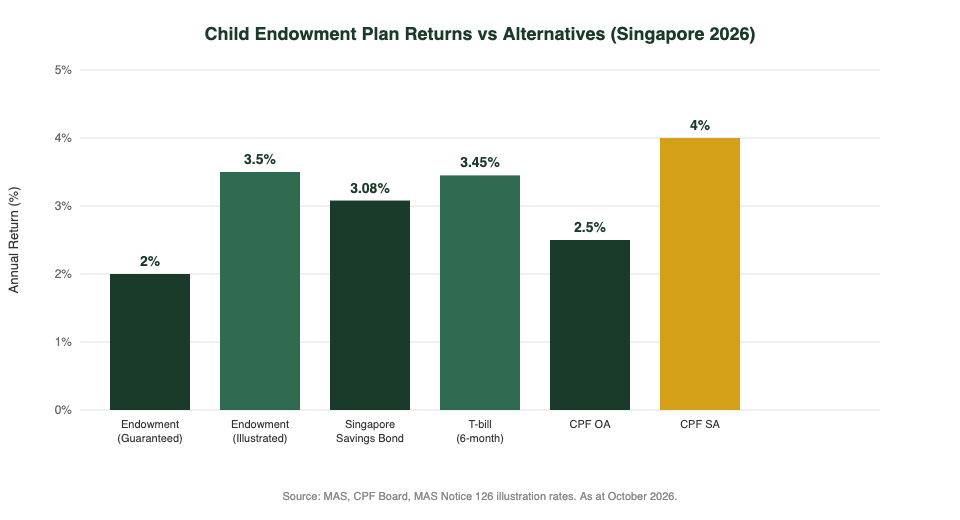
In practice, actual matured policy returns at major Singapore insurers have historically ranged from 1.5% to 3.5% p.a. effective yield on total premiums paid, according to industry data. The guaranteed portion alone has typically delivered 1.5–2.5% p.a. effective return.
For a Singapore parent planning for a local university education, a realistic planning assumption is 2.5–3.5% p.a. on total premiums paid if the plan is held to maturity without interruption. This is meaningful, but it is worth comparing this against other vehicles before committing to a 15-year lock-in.
Top Child Endowment Plans in Singapore 2026
The major insurers in Singapore each offer a range of endowment plans suitable for child education savings. Note that product names and terms change periodically — always request a current policy illustration directly from the insurer or through a licensed financial adviser.
| Insurer | Plan Name | Min. Tenor | Premium Mode | Key Feature |
|---|---|---|---|---|
| AIA | Smart Flexi Saver | 10 years | Regular / Single | Flexible premium payment period |
| Prudential | PRUFlexiCash | 10 years | Regular | Cash payouts at intervals |
| Great Eastern | Living Endowment Saver | 10 years | Regular | Strong guaranteed component |
| Manulife | ReadyBuilder | 10 years | Regular / Single | Competitive par fund returns historically |
| NTUC Income | Gro Saver Flex Pro | 10 years | Regular | Cooperative model, consistent bonuses |
Source: Insurer websites, SingSaver comparison as at October 2026. Product availability subject to change — verify directly with insurers.
When comparing plans, look beyond the illustrated maturity value at the upper scenario. Ask for: (1) the guaranteed maturity amount, (2) the surrender value at years 2, 5, and 10, and (3) the historical par fund bonus rate declared over the past five years. This gives a much more honest picture of what to expect.
Child Endowment Plan vs Alternatives
A child endowment plan is not the only way to save for your child’s education in Singapore. Here is how it compares to other common approaches, keeping in mind your goal is to accumulate roughly S$82,000 over 15–18 years for a local university education.
| Vehicle | Expected Return | Liquidity | Capital Guarantee | Best For |
|---|---|---|---|---|
| Child Endowment Plan | 1.5–3.5% p.a. | Low (penalty if exit early) | Yes (guaranteed sum) | Disciplined savers, local university target |
| Singapore Savings Bonds | ~3.08% p.a. (Oct 2026 issue) | High (redeem any month) | Yes (backed by Singapore govt) | Conservative savers needing flexibility |
| CPF SA Top-Up (parent’s) | 4.0% p.a. (guaranteed floor) | Very low (locked until 55) | Yes | Parents who can fund university from other sources |
| Unit Trusts / Robo-Advisors | 5–8% p.a. historical (no guarantee) | High (redeem within days) | No | Parents comfortable with market risk |
| Child Development Account (CDA) | 2.0% p.a. (POSB Saver rate) | High (withdraw freely) | Yes | All parents — maximise govt co-contribution first |
Source: MAS, CPF Board, Singapore Savings Bond Oct 2026 issue rate. Returns are indicative and not guaranteed where noted.
One often-overlooked point: the Child Development Account (CDA) should be maximised before considering any endowment plan. The government matches dollar-for-dollar up to S$3,000–S$9,000 depending on birth order — that matching is an instant guaranteed 100% return on your contribution that no endowment plan can replicate. For the CPF investment strategy approach, parents who redirect their own CPF SA contributions in peak earning years may accumulate more by retirement than they would via an endowment plan alone.
Pros and Cons for Singapore Parents
No savings vehicle is universally best. Here is an honest assessment of child endowment plans specifically for Singapore parents targeting local university education in 2026.
| Pros | Cons |
|---|---|
| Guaranteed capital at maturity — no market risk on the guaranteed sum | Low liquidity — early surrender in years 1–5 often returns less than premiums paid |
| Built-in death/TPD protection for the premium payer or child | Returns are typically lower than equity-based investments over 15+ years |
| Forced savings discipline — premiums due monthly prevent ad hoc spending | Non-guaranteed bonuses are not assured and can decrease if par fund underperforms |
| Predictable maturity timeline aligned to child’s university entry age | If child studies overseas, the maturity amount may fall far short of actual costs |
| No capital gains tax or dividend tax on maturity proceeds in Singapore | Front-loaded distribution costs reduce early surrender value significantly |
Who Should Consider a Child Endowment Plan?
A child endowment plan makes the most sense for parents who:
- Are targeting a local Singapore university education (NUS, NTU, SMU) and want to hit a defined savings goal of approximately S$82,000 by the time the child turns 17–18
- Value capital guarantees over potentially higher but uncertain returns from equity markets
- Need the forced savings discipline that regular premium commitments provide — if you would otherwise spend the money, an endowment’s lock-in is a feature, not a bug
- Are in a stable income situation with no expectation of needing to access the funds early before maturity
An endowment plan is likely not the right primary vehicle if you are planning for overseas education, have a high risk tolerance and long investment horizon, or if you need flexible access to your savings. In those cases, a managed portfolio through a platform like Endowus referral code or the Syfe referral code that gives access to globally diversified low-cost funds may serve you better over a 15-year horizon. You can also use the Singapore retirement planning calculator to model how a higher-growth portfolio might compare to an endowment plan payout for your specific target amount and timeline. For education savings via FSMOne, regular savings plan (RSP) options allow systematic equity investing from as little as S$50/month.
Frequently Asked Questions
What is a child endowment plan in Singapore?
A child endowment plan is a participating insurance policy that combines savings with a small life insurance cover. Parents pay regular premiums over a fixed term (typically 10–18 years) and receive a guaranteed lump sum plus non-guaranteed bonuses at maturity. It is commonly used to fund a child’s university education. The guaranteed component is contractually promised by the insurer, while bonuses depend on the performance of the insurer’s participating fund.
How much should I save monthly for my child's university education in Singapore?
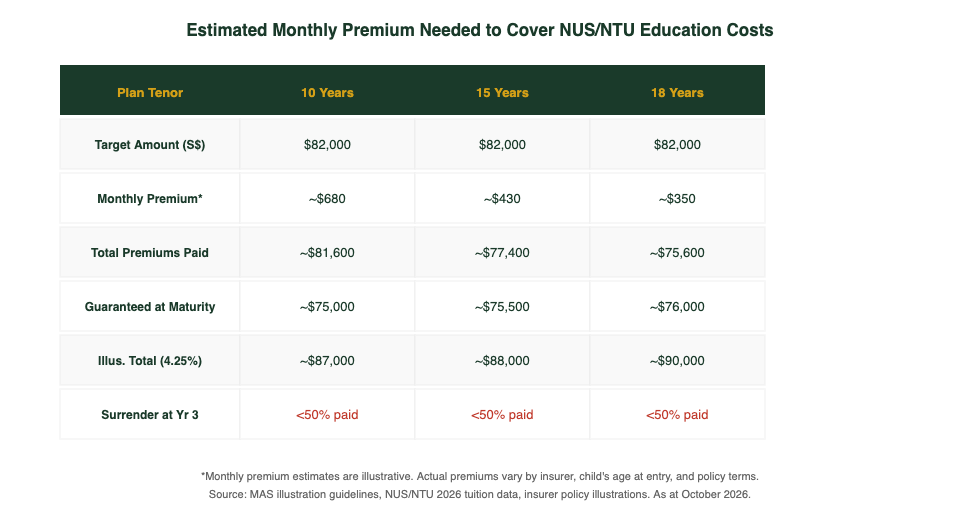
For a local NUS or NTU degree, a realistic total savings target is around S$82,000, covering tuition (approximately S$38,790) and four years of living costs (approximately S$43,100). Spread over an 18-year endowment plan started at birth, the illustrative monthly premium required is approximately S$350–S$400 per month, depending on the insurer and plan design. Over 15 years, this rises to around S$430/month. Always request a formal policy illustration to confirm exact figures for your target sum.
Are the returns on a child endowment plan guaranteed?
Only partly. Every endowment plan has a guaranteed sum stated in the policy, which the insurer must pay at maturity regardless of investment performance — typically delivering an effective return of 1.5–2.5% p.a. on total premiums paid. The non-guaranteed bonuses (reversionary and terminal bonuses) depend on the insurer’s participating fund performance and are not contractually promised. Under MAS Notice 126, insurers must illustrate returns at par fund rates of 3.00% p.a. (lower) and 4.25% p.a. (upper) — but these are projections, not guarantees.
What happens if I surrender my child endowment plan early?
Early surrender is the biggest risk of endowment plans. In the first two to five years, the surrender value is typically below the total premiums you have paid, because distribution commissions and insurer expenses are front-loaded into the policy. Surrendering early locks in a loss. If you anticipate any possibility of needing the funds within five years of starting the plan, an endowment plan is not appropriate — consider Singapore Savings Bonds or a fixed deposit instead, both of which offer full or near-full capital return on early redemption.
Is a child endowment plan better than investing in the stock market for education savings?
It depends on your risk tolerance and flexibility needs. Over a 15–18 year horizon, a globally diversified equity portfolio has historically delivered 6–8% p.a. nominal returns — significantly outpacing an endowment plan’s 2–3.5% effective yield. However, equity markets carry capital risk: your portfolio could be worth less than invested if markets fall near the withdrawal date. An endowment plan’s guarantee ensures you hit your savings target regardless of market conditions. A common approach for Singapore parents is to split savings: endowment plan for the guaranteed base amount plus equity investments for upside potential.
Can I use my CPF to pay for a child endowment plan?
Generally, no. CPF OA funds can be used to invest in certain insurance products under the CPF Investment Scheme (CPFIS), but most regular premium endowment plans are not CPFIS-approved for CPF OA funds. Some single-premium endowment plans are approved — check the CPF Board’s approved product list at cpf.gov.sg for the current list of qualifying policies. Cash premiums paid for endowment plans do qualify for the Life Insurance Relief of up to S$5,000 per year if you are not making CPF contributions on the insured’s behalf, providing some income tax relief.
What is the best age to start a child endowment plan in Singapore?
The earlier the better, because a longer tenure reduces the monthly premium required to reach your target. Starting at birth (age 0) over an 18-year plan gives you the lowest monthly commitment — roughly S$350/month for an S$82,000 target at illustrative rates. Starting at age five for a 13-year plan increases the monthly premium to approximately S$490–S$550. However, starting early locks you in for longer, so if your income situation is uncertain, a slightly shorter tenor with a manageable premium may be more practical than maximum tenor.
Start Building Your Child’s Education Fund Today
Whether you choose an endowment plan or a higher-growth investment vehicle, the best time to start is now. Use our tools and referral bonuses to get started.
Get Free Insurance Advice
Speak with a licensed insurance advisor. No obligation, no cost.
By submitting this form, you agree to our Privacy Policy.
This article was researched with the help of AI. While we strive to keep all information accurate and up to date, there may be errors. If you notice any discrepancies, please contact us.