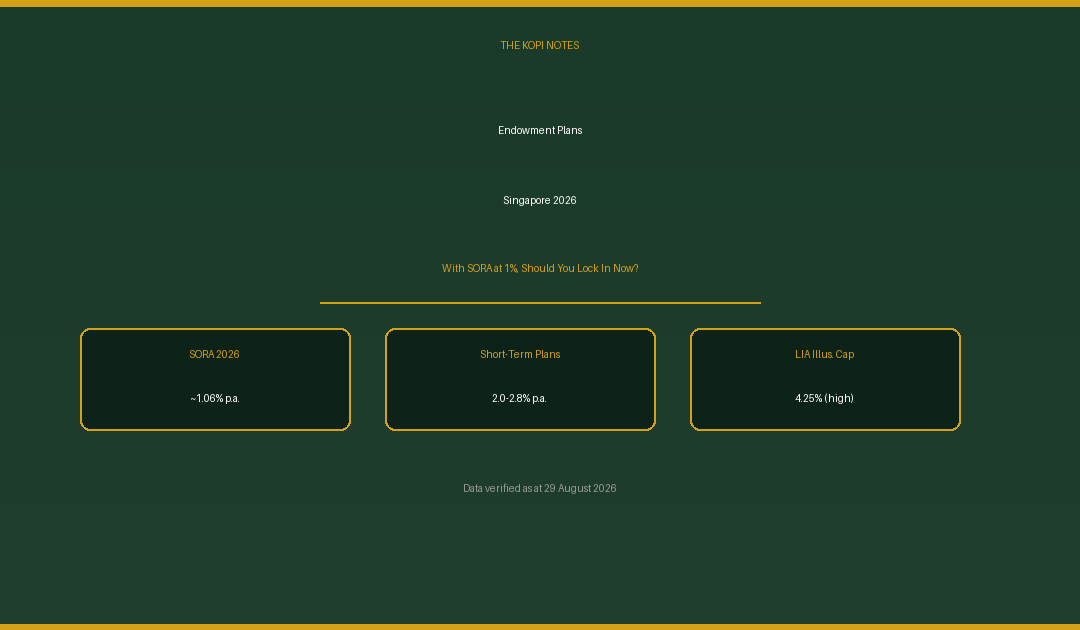
Endowment Plans Singapore 2026: With SORA at 1%, Should You Lock In Now?
Singapore's benchmark interest rate SORA has fallen from nearly 3% in early 2025 to around 1.06% as of mid-2026. Yet short-term endowment plans from major insurers still offer guaranteed returns of 2.0%–2.8% p.a.
That gap is real money. But endowment plans lock up your capital for 1–5 years. Is the premium worth it — and should you act now before insurers reprice further?
Data verified as at 29 August 2026. Rates change frequently — always confirm current rates with your insurer or financial adviser before committing.
What Is an Endowment Plan?
An endowment plan is a life insurance-savings hybrid sold by MAS-licensed insurers in Singapore. You pay a lump-sum (single premium) or regular premiums, and the insurer guarantees a return at maturity — typically 1 to 30 years. Most plans include a basic death benefit.
There are two main types:
- Non-participating (non-par) plans — fully guaranteed returns, no bonus upside. Most short-term plans (1–3 years) are non-par.
- Participating (par) plans — a portion of returns is non-guaranteed, paid as annual or terminal bonuses from the insurer's par fund. LIA caps participating plan illustrations at 4.25% p.a. (high scenario) and 3.00% p.a. (low scenario). Long-term plans (10–25 years) are typically par plans.
For a deep dive into how endowment plan interest rates are regulated in Singapore, see our Endowment Plan Interest Rate Guide.
Where Singapore Rates Stand in 2026
Singapore's 3-month compounded SORA peaked near 3% in early 2025 and has since dropped to approximately 1.056% as of June 2026, following three US Federal Reserve rate cuts in late 2025. This has directly affected what you earn on “safe” savings products.
| Product | Typical Rate (2026) | Capital Guaranteed? | Lock-in? |
|---|---|---|---|
| Bank savings account (base) | 0.05% p.a. | Yes (SDIC up to S$100k) | None |
| High-yield savings (conditional) | 1.5%–3%+ p.a.* | Yes (SDIC up to S$100k) | None (but rates depend on monthly conditions) |
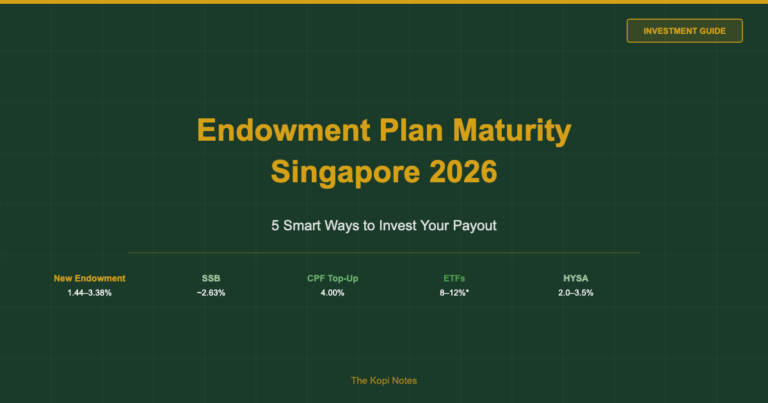
| Singapore Savings Bonds (SSB) | ~2.3%–2.8% p.a. avg | Yes (government-backed) | Flexible — redeem monthly with no penalty |
| Short-term endowment plans | 2.0%–2.8% p.a. guaranteed | Yes (insurer liability) | Yes — 1 to 3 years |
*High-yield savings rates require conditions such as salary credit, credit card spending, insurance purchase, or investment holdings to unlock bonus tiers.
The key insight: endowment plans now offer a genuine guaranteed premium over base savings — without the hoops of high-yield savings accounts. The trade-off is capital lock-in. Whether that trade-off is worth it depends on your situation.
Short-Term Endowment Plan Rates 2026: Side by Side
Short-term endowment plans are sold in tranches — each tranche has a different rate, minimum premium, and open window. Rates shown are verified as at August 2026 from public sources. Always confirm the current tranche rate with the insurer before applying.
| Plan | Insurer | Term | Guaranteed Yield | Min Premium |
|---|---|---|---|---|
| SavvyEndowment 22 | DBS / Manulife | 2 years | 1.88% p.a. | S$5,000 |
| Max Saver II | Singlife | 2 years | 2.00% p.a. | S$20,000 |
| 2-Year Endowment Plan | OCBC | 2 years | ~2.80% p.a.* | S$20,000 |
*OCBC rate is an indicative campaign rate as of July 2026; actual rate varies by tranche. Sources: MoneySmart SG, insurer product pages (Aug 2026).
For comparison: SSB issued in Aug 2026 yields around 2.3%–2.8% p.a. average over 10 years with no lock-in. If SSB subscriptions are oversubscribed in your application month, endowment plans offer a reliable alternative for capital-guaranteed returns.
For a detailed comparison of endowment plans vs other savings alternatives, read our guide: Endowment Plans vs Cash Management Accounts Singapore 2026.
Long-Term Endowment Plans: Are They Worth It in 2026?
Long-term participating endowment plans (10–25 years) work differently from short-term plans. Part of the return comes from non-guaranteed bonuses declared annually by the insurer's par fund. LIA allows illustrative returns of up to 4.25% p.a. (high scenario) — but this is an illustration, not a promise.
Arguments for long-term par plans:
- Par fund returns are smoothed — they don't swing as sharply as direct market investments in a bad year.
- Most reputable insurers have historically declared bonuses reasonably close to their illustrated rates — though past performance doesn't guarantee future results.
- The guaranteed cash value grows each year, which can be pledged as collateral or borrowed against via policy loans.
- Some plans include waiver of premium on disability, adding protection value beyond pure savings.
Arguments against (or for alternatives):
- Surrendering early typically means receiving less than total premiums paid — sometimes significantly less in the first 5–7 years.
- A diversified global ETF portfolio (e.g. VWRA or CSPX) has historically delivered higher returns over 20+ year horizons, though with substantially more year-to-year volatility.
- CPF OA still earns a guaranteed 2.5% p.a., making voluntary CPF top-ups an often-overlooked alternative for long-term guaranteed savings. See our CPF Investment Strategy Guide for details.
If you're weighing an ILP against a robo-advisor instead of an endowment plan, see our ILP vs Robo-Advisor comparison. Or compare the full landscape with our 7 Types of Savings Plans in Singapore, Ranked.
Who Should Consider Locking In Now
A short-term endowment plan at 2.0%–2.8% p.a. guaranteed makes most sense if:
- You have surplus cash beyond your emergency fund — the golden rule: never put money in an endowment plan that you might need before maturity. Start by using our Retirement Planning Calculator to confirm you're on track first.
- You want certainty over conditions — you don't want to track monthly salary credits, card spending, or investment holdings to unlock high-yield savings bonuses.
- SSB is oversubscribed — in months when Singapore Savings Bond applications exceed allotment, endowment plans are a practical capital-guaranteed alternative at comparable rates.
- You're risk-averse — if market volatility is not acceptable for this portion of your savings, a guaranteed 2–2.8% beats leaving funds in a standard savings account at 0.05%.
- You want to lock in rates before further repricing — if SORA continues to drift lower, insurers will reprice endowment plans downward. Locking in now at 2.8% captures today's rate for the full 2-year term.
Who Should Wait or Skip Endowment Plans
- You may need the money during the lock-in period — surrendering early typically means a financial penalty. Endowment plans are not for your emergency fund or money with uncertain timing.
- You can reliably hit high-yield savings account conditions — if you naturally salary credit, spend on a credit card, and hold investments with a bank, your all-in rate on a high-yield account may already match or beat endowment plans, with full liquidity.
- You have a higher risk tolerance — investors comfortable with market volatility may find that S-REITs (yielding 5%–7% p.a.) or diversified ETFs offer better long-run returns than guaranteed 2%–3% plans.
- You want flexibility — SSBs offer government-backed returns of roughly 2.3%–2.8% p.a. average with monthly redemption flexibility. For conservative investors, SSB first, endowment plan second.
Explore Alternatives to Endowment Plans
If you're looking for a managed, diversified approach to growing your savings without locking into a single insurance product, robo-advisors can complement endowment plans in your overall portfolio.
Frequently Asked Questions
Are endowment plan returns guaranteed?
For non-participating (non-par) plans, yes — the maturity benefit and guaranteed yield are contractually fixed. For participating (par) plans, only the guaranteed portion is fixed; annual bonuses and terminal bonuses from the par fund are not guaranteed and may be lower than illustrated.
What happens if I surrender an endowment plan early?
Surrendering early typically returns the surrender value — which in the early years is often less than total premiums paid. Exact surrender values vary by plan and year of surrender. Always check the product illustration for your specific plan's surrender schedule before committing.
Is my money protected if the insurer fails?
Singapore's Policy Owners' Protection (PPF) Scheme covers life insurance policies, including endowment plans, up to 90% of the guaranteed sum assured and 100% of surrender value (up to S$500,000 aggregate) for individual policyholders. The PPF is administered by SDIC. This is separate from bank deposit insurance.
How do endowment plans compare to Singapore Savings Bonds (SSB)?
SSBs offer government-backed returns (~2.3%–2.8% p.a. average over 10 years as of Aug 2026) with monthly redemption flexibility — you can get your money back any month with no penalty. Endowment plans may offer slightly higher guaranteed rates but require commitment for the full term. For maximum flexibility, SSB is generally preferred; for potentially higher guaranteed returns in a specific window, endowment plans can be competitive — especially when SSB is oversubscribed.
What is SORA and why does it affect endowment plan rates?
SORA (Singapore Overnight Rate Average) is the benchmark overnight interest rate for Singapore's financial market, published by MAS. It influences deposit rates, loan rates, and how insurers price new endowment plan tranches. When SORA falls — as it has, from ~3% in early 2025 to ~1.06% in mid-2026 — insurers typically reprice new endowment plan tranches with lower guaranteed yields over time.
What does the LIA illustration rate cap mean for me?
The Life Insurance Association (LIA) caps participating plan illustrations at 4.25% p.a. (high scenario) and 3.00% p.a. (low scenario). This means the best-case returns shown in a par endowment plan's product illustration cannot exceed 4.25% p.a. — these are illustrations, not guarantees. When comparing plans, focus on the guaranteed maturity value rather than the illustrated non-guaranteed projection.
Can I use my CPF to buy an endowment plan?
You can use CPF Ordinary Account (OA) funds to purchase certain approved life insurance products, including some endowment plans. However, your CPF OA already earns a guaranteed 2.5% p.a., so only consider using CPF for endowment plans if the plan's guaranteed return clearly exceeds 2.5% over the term — after accounting for any lock-in risk.
How much should I put in a short-term endowment plan?
A practical rule: only invest money that you're certain you won't need for the full term of the plan. Keep 3–6 months of expenses in liquid savings first. Short-term endowment plans work well for the portion of your savings beyond your emergency fund — money you know won't be needed for 1–2 years. Use our Retirement Planning Calculator to understand your overall savings needs before committing.
Are endowment plan returns subject to income tax in Singapore?
In Singapore, proceeds from a life insurance policy (including endowment plans) are generally not subject to income tax if the policy is a genuine insurance/savings product — not one structured primarily as an investment. The maturity benefit and bonuses you receive at the end of the term are typically tax-free. Always confirm with your financial adviser for your specific situation, especially for large single-premium policies.
Get Free Insurance Advice
Speak with a licensed insurance advisor. No obligation, no cost.
By submitting this form, you agree to our Privacy Policy.
This article was researched with the help of AI. While we strive to keep all information accurate and up to date, there may be errors. If you notice any discrepancies, please contact us.