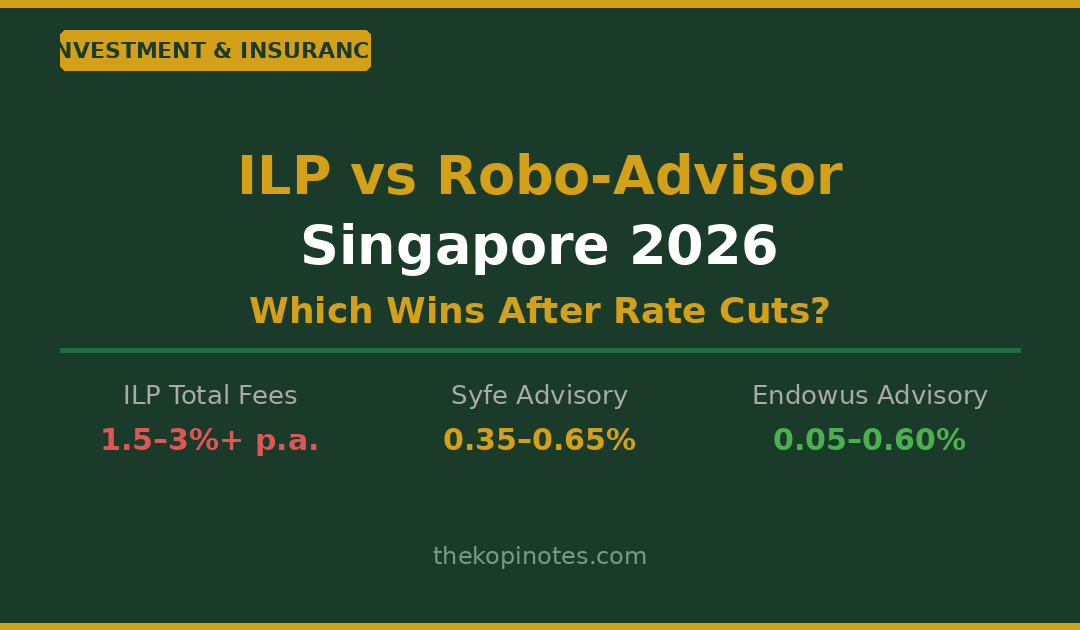
ILP vs Robo-Advisor Singapore 2026: Which Wins After Rate Cuts?
Data verified as at 28 August 2026 | Category: Investment & Insurance
After the Federal Reserve’s Jackson Hole summit this week, rate cuts are now firmly priced in for late 2026 and 2027. For Singapore investors holding — or considering — an Investment-Linked Policy (ILP), the question is timely: does a falling-rate environment finally tip the scales in favour of ILPs, or do robo-advisors like Syfe and Endowus still win on fees and flexibility? This guide runs the honest numbers.
What Is an Investment-Linked Policy (ILP)?
An Investment-Linked Policy (ILP) bundles life insurance protection with market-linked investment into a single product. You pay premiums; part goes toward insurance coverage (mortality charges), and the rest buys units in sub-funds managed by the insurer. The leading ILP providers in Singapore are AIA, Prudential, Great Eastern, Manulife, and NTUC Income.
ILPs come in two broad types: regular premium ILPs (you pay monthly/annually, with a long commitment period) and single premium ILPs (lump sum invested, shorter lock-in). For most retail investors, regular premium ILPs — with premiums starting from S$200/month (Great Eastern) — are the most commonly sold product.
Under MAS’s 2026 regulatory framework, ILPs are now classified as complex products. This means they carry an enhanced Product Highlights Sheet disclosing the Reduction in Yield (RIY) — the all-in annual cost that erodes your effective return — and require financial advice before purchase for vulnerable customers.
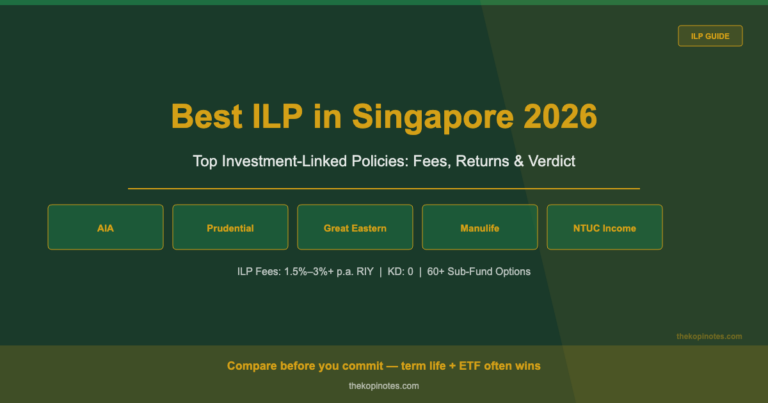
For more detail on the best ILPs available today, see our full guide: Best ILP Singapore 2026 →
What Is a Robo-Advisor?
Robo-advisors are digital investment platforms that build and manage a diversified portfolio of low-cost ETFs on your behalf. In Singapore, the two most relevant for comparison are:
- Endowus — one of the few platforms supporting CPF OA, CPF SA, SRS, and cash investing (AutoWealth also now offers CPF OA portfolios). Advisory fee: 0.05%–0.60% p.a. (scales with portfolio size). Fund expense ratios: typically 0.05%–0.40% depending on the fund selected.
- Syfe — SRS and cash investing, no minimum deposit. Advisory fee: 0.35%–0.65% p.a. ETF expense ratios: typically 0.05%–0.40%.
Crucially, robo-advisors provide no life insurance coverage. They are pure investment vehicles. This is the core trade-off to understand before comparing them against ILPs.
Fee Comparison: ILP vs Syfe vs Endowus vs DIY ETF
Fees are where ILPs lose ground decisively. Below is a side-by-side comparison based on publicly disclosed figures (as at August 2026):
| Metric | ILP (Regular Premium) |
Syfe | Endowus | DIY ETF (e.g. VWRA) |
|---|---|---|---|---|
| Advisory / Policy Fee | 1.5–3%+ p.a. | 0.35–0.65% | 0.05–0.60% | 0% |
| Fund Management Charge | 0.75–2.5% p.a. | 0.05–0.40% (ETF ER) | 0.05–0.40% (ETF ER) | 0.07–0.20% (ETF ER) |
| Policy / Admin Fee | S$6–10/month | None | None | None |
| Life Insurance Included | ✓ Yes | ✗ No | ✗ No | ✗ No |
| CPF Access | No (post-2018) | SRS only | CPF + SRS + Cash | CPFIS (limited) |
| Surrender Charge | 5–15% (years 1–5) | None | None | None |
| Break-Even Timeline | 10–15 years | Immediate | Immediate | Immediate |
| Min. Investment | ~S$200/month | S$0 | S$0 | ~S$100 |
Sources: MoneySense.gov.sg (ILP fee disclosures), Syfe and Endowus official fee schedules (August 2026). ILP post-2018 CPF restriction per CPF Board guidelines.
The Compounding Fee Drag
Here’s the starkest way to see the difference. Assume S$500/month invested over 20 years, 8% gross annual return from a global equity fund:
- ILP (2% annual fee drag): Effective return ~6% p.a. → terminal value ~S$231,000
- Robo-advisor (0.5% fee drag): Effective return ~7.5% p.a. → terminal value ~S$269,000
- DIY ETF (0.15% fee drag): Effective return ~7.85% p.a. → terminal value ~S$281,000
The ILP investor ends up with roughly S$38,000–S$50,000 less in investment returns — a gap that grows larger the longer the horizon. This does not account for ILP mortality charges (which increase with age) or surrender charges if you exit early.
For endowment plan comparisons, see: Endowment Plan Interest Rates Singapore 2026 →
How Rate Cuts Affect ILPs vs Robo-Advisors
The Federal Reserve’s Jackson Hole 2026 signal means rate cuts are coming. Here’s how each product responds:
ILP Sub-Funds in a Rate Cut Environment
- Bond sub-funds: short-term gain. When rates fall, existing bond prices rise (duration effect). ILP sub-funds invested in long-duration bonds (e.g. government bond funds) will see unit prices tick up — but this is a one-time repricing, not an ongoing yield boost.
- Equity sub-funds: mild tailwind. Lower discount rates benefit equity valuations, which is positive for equity ILP sub-funds. However, ILP FMCs (0.75–2.5%) mean you capture less of this upside than direct ETF investors.
- Cash/money market sub-funds: headwind. These earn short-term rates. As rates fall, yields on money market sub-funds drop. Investors holding ILPs primarily in money market sub-funds will see lower returns in 2026–2027.
- Mortality charges don’t fall with rates. The fee drag from insurance costs and policy fees remains constant regardless of the rate environment — negating much of the macro tailwind.
Robo-Advisors in a Rate Cut Environment
- Endowus and Syfe automatically rebalance into the optimal allocation — capturing bond price gains and equity upside with very low fee drag.
- Endowus Cash Smart (a cash management product, not equity) will see yield compression as rates fall — similar to ILP money market sub-funds, but at a much lower cost layer.
- ETF-based equity portfolios on Syfe and Endowus capture rate-cut tailwinds at total costs of 0.40–1.05% p.a. vs ILP’s 2–4% — meaning you keep significantly more of the gain.
Bottom line on rate cuts: A falling-rate environment helps both ILPs and robo-advisors — but robo-advisors benefit more because the same macro tailwind is captured with far lower fee erosion. Rate cuts do not change the structural fee disadvantage of ILPs.
See also: Savings Plan Singapore 2026: 7 Types Ranked by Returns & Risk →
When an ILP Still Makes Sense
Despite the fee disadvantage, ILPs are not without merit for certain investor profiles:
- You genuinely need bundled insurance + investment. If you cannot qualify for standalone term life insurance (e.g. pre-existing health conditions), an ILP may be the only way to get life coverage plus a market-linked investment in one product.
- You prefer managed behavioural discipline. The forced monthly premium structure keeps some investors invested through market volatility in a way that self-directed ETF accounts do not.
- Waiver of premium benefit. Insurers like Manulife continue contributing to your sub-fund on your behalf if you suffer death or total permanent disability — a meaningful protection layer not replicable with a robo-advisor.
- SRS tax optimisation with an ILP. Funding an ILP via Supplementary Retirement Scheme (SRS) gives you income tax relief upfront. However, Endowus also accepts SRS, giving you the same tax benefit with lower fees — so this is not a unique ILP advantage.
For most working Singaporeans aged 25–45 with no coverage gaps, the buy-term-invest-the-rest approach — pairing a low-cost term life policy with a robo-advisor or ETF portfolio — will likely outperform a regular premium ILP over a 20+ year horizon.
To plan your retirement allocation, try our free tool: Retirement Planning Calculator Singapore →
Verdict: ILP vs Robo-Advisor — Which Should You Choose?
| Your Situation | Recommended |
|---|---|
| You want pure investment growth, no insurance needed | Robo-Advisor (Syfe / Endowus) |
| You want to invest CPF OA/SA savings | Endowus or AutoWealth (CPF-eligible) |
| You need life insurance + investment bundled | ILP (consider Manulife / Great Eastern) |
| You want SRS tax savings with lowest fees | Endowus SRS (beats ILP on cost) |
| You have a health condition limiting term life access | ILP (bundled coverage advantage) |
| You want maximum long-term wealth accumulation | DIY ETF or Robo-Advisor |
For most Singapore investors prioritising long-term wealth accumulation in 2026, robo-advisors offer a structurally better fee-adjusted return profile. ILPs remain relevant for specific needs — particularly bundled coverage or waiver of premium — but rate cuts alone are not enough to close the fee gap.
Frequently Asked Questions
”Is
”What
”Do
”Can
”What
”Which
”How
”Should
”Is
Start Investing Smarter in 2026
Whether you’re switching from an ILP or starting fresh, these platforms offer low-cost, MAS-regulated investment options for Singapore residents:
Disclaimer: This article is for general information and educational purposes only. It does not constitute personalised financial or investment advice. All fee figures sourced from MoneySense.gov.sg, Syfe, and Endowus official disclosures (August 2026). Past performance of sub-funds does not guarantee future returns. Please consult a MAS-licensed financial adviser before making any investment or insurance decisions. Data verified as at 28 August 2026.
Get Free Insurance Advice
Speak with a licensed insurance advisor. No obligation, no cost.
By submitting this form, you agree to our Privacy Policy.
This article was researched with the help of AI. While we strive to keep all information accurate and up to date, there may be errors. If you notice any discrepancies, please contact us.