Best Savings Plans for Your SRS Funds in Singapore (2026 Guide)
Your SRS account earns just 0.05% interest if you leave it as cash. With an annual contribution limit of S$15,300 (citizens and PRs) or S$35,700 (foreigners), that’s a lot of retirement money doing almost nothing. Single-premium savings plans — also known as single-premium endowment plans — are one of the most popular ways to put your SRS funds to work. They offer capital-guaranteed returns, fixed tenors, and are fully SRS-eligible. This guide breaks down how to pick the best savings plan for your SRS funds in 2026.
Not financial advice. All figures are for educational reference only. Data verified as at 31 August 2026 — verify SRS rules and product rates with your SRS operator and insurer.
- SRS cash earns only 0.05% p.a. — single-premium endowment plans offer significantly better guaranteed returns
- SRS contribution: max S$15,300/year for citizens and PRs — reduces assessable income dollar-for-dollar
- At retirement age (64 from July 2026), only 50% of SRS withdrawals are taxable — effective returns improve further
- Compare plans by tenor, minimum premium, guarantee type and insurer financial strength
Table of Contents
Contents
- What Is SRS and Why You Need to Invest It
- How SRS Tax Relief Works (With Real SGD Examples)
- What Makes a Savings Plan SRS-Eligible?
- How to Compare SRS Savings Plans — 5 Key Factors
- Top SRS Savings Plan Providers in Singapore 2026
- How to Invest Your SRS in a Savings Plan (Step by Step)
- SRS Savings Plan vs Other SRS Investment Options
- When a Savings Plan Is Right for Your SRS — and When It Isn’t
- Frequently Asked Questions
What Is SRS and Why You Need to Invest It
The Supplementary Retirement Scheme (SRS) is a voluntary government scheme to encourage retirement savings alongside CPF. You open an SRS account with one of three operators — DBS, OCBC, or UOB — and contribute cash from your own funds. Every dollar you contribute reduces your taxable income by exactly one dollar.
The catch? Uninvested SRS cash earns just 0.05% per year. On a S$15,300 contribution, that’s S$7.65 annually. Your retirement funds deserve better.
By investing SRS funds in approved instruments — such as single-premium savings plans — you can earn meaningfully higher returns while keeping your money within the SRS tax wrapper until withdrawal. Learn more in our guide to the DBS SRS account, or use our free SRS tax savings calculator to see your personal tax savings.
Savings plan guaranteed returns: significantly higher
How SRS Tax Relief Works (With Real SGD Examples)
Every dollar you put into SRS reduces your assessable income by one dollar. The more you earn, the higher your marginal rate — and the bigger your upfront tax saving.
| Annual Income | Marginal Rate | SRS Contribution | Est. Tax Saved |
|---|---|---|---|
| S$60,000 | 7% | S$15,300 | ~S$1,071 |
| S$80,000 | 11.5% | S$15,300 | ~S$1,760 |
| S$120,000 | 15% | S$15,300 | ~S$2,295 |
| S$160,000 | 18% | S$15,300 | ~S$2,754 |
| S$200,000 | 19% | S$15,300 | ~S$2,907 |
| Foreigners | Any | Up to S$35,700 | Higher relief |
Source: IRAS individual income tax rates 2026. Estimates use the marginal rate on the contributed amount. Actual savings depend on your full income profile — verify at IRAS.gov.sg.
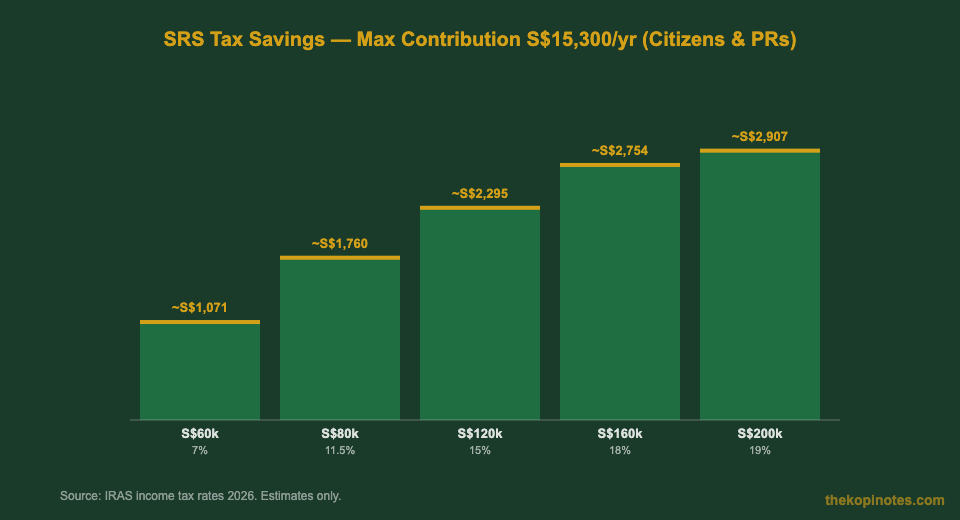
The double benefit at withdrawal is equally important. When you withdraw from SRS at the statutory retirement age (64 from July 2026, rising to 65 by 2030), only 50% of each withdrawal is taxable. Spread your withdrawals over the 10-year window to stay in lower tax brackets. This turns SRS into a powerful tax-averaging vehicle, not just a one-year relief.
What Makes a Savings Plan SRS-Eligible?
Not every savings plan accepts SRS funds. The crucial distinction is single-premium vs. regular-premium.
Single-premium savings plans require one lump-sum payment upfront — directly debited from your SRS account. These are generally SRS-eligible. Regular-premium plans require ongoing monthly or annual top-ups from cash. These cannot use SRS funds because SRS accounts don’t support recurring debits.
For a plan to be SRS-eligible, it must: be offered by a licensed Singapore insurer; accept single-premium payment; be designated SRS-approved by the insurer; and be purchasable via your SRS operator’s platform or the insurer’s direct SRS channel.
Most major insurers — NTUC Income, Manulife, Great Eastern, Prudential, Singlife, and AIA — offer SRS-eligible single-premium plans. But tranches are limited and plans are refreshed periodically. Always confirm SRS eligibility with the insurer before applying.
How to Compare SRS Savings Plans — 5 Key Factors
1. Tenor (Lock-In Period)
Tenors range from 2 to 10+ years. Match the tenor to your expected SRS withdrawal timeline. If you plan to start withdrawals in 3 years, a 2-year plan gives you flexibility. If retirement is 7+ years away, a longer tenor typically earns higher guaranteed returns.
2. Guaranteed vs. Non-Guaranteed Returns
Some plans offer a 100% guaranteed maturity value. Others include non-guaranteed bonuses tied to the insurer’s participating fund performance. For SRS funds, most investors prefer fully guaranteed plans — you know exactly what you’ll receive.
3. Minimum Premium
SRS savings plan minimums typically range from S$5,000 to S$20,000 per application. Confirm the minimum matches your SRS account balance and planned contribution amount.
4. Capital Guarantee
Is your principal protected at maturity? Most single-premium endowment plans are 100% capital-guaranteed at maturity. However, surrendering early (before the tenor ends) can result in a loss — these are not emergency funds.
5. Insurer Financial Strength
Your guaranteed return depends on the insurer’s ability to pay. All Singapore insurers are MAS-regulated under the Insurance Act, but financial strength still varies. Check each insurer’s MAS supervisory returns and credit ratings before committing.
Top SRS Savings Plan Providers in Singapore 2026
Here are the major insurers offering SRS-eligible single-premium savings plans. Note that specific rates and tranches change frequently — always request a current product illustration before committing.
| Insurer | Typical Tenors | Min. Premium | Capital Guarantee | SRS-Eligible |
|---|---|---|---|---|
| NTUC Income | 2–5 years | ~S$10,000 | Yes (at maturity) | ✓ Yes |
| Manulife | 3–10 years | ~S$10,000 | Yes (at maturity) | ✓ Yes |
| Great Eastern | 2–5 years | ~S$10,000 | Yes (at maturity) | ✓ Yes |
| Prudential | 3–7 years | ~S$10,000 | Yes (at maturity) | ✓ Yes |
| Singlife | 2–5 years | ~S$20,000 | Yes (at maturity) | ✓ Yes |
| AIA | 2–5 years | ~S$10,000 | Yes (at maturity) | ✓ Yes |
Source: Insurer product pages, August 2026. Minimum premiums and tenor ranges are indicative — confirm with the insurer for current plan availability and exact rates. Capital guarantee applies at maturity; early surrender may result in capital loss.
When comparing plans, focus on the effective yield at maturity — the guaranteed return expressed as an annualised percentage of your premium. Our earlier guide on 7 types of savings plans ranked explains how to evaluate these in detail.
How to Invest Your SRS in a Savings Plan (Step by Step)
Step 1: Make your SRS contribution. Log in to your SRS operator (DBS, OCBC, or UOB) and transfer cash into your SRS account before the 31 December deadline to claim that year’s tax relief.
Step 2: Choose your plan. Request product illustrations from multiple insurers. Compare guaranteed maturity value, tenor, minimum premium, and surrender value schedule. Don’t rush — the funds are locked once purchased.
Step 3: Apply via the insurer or your SRS bank. DBS digibank and OCBC online banking list SRS-eligible investment options directly. For other insurers, apply through their financial advisory channel. Specify that you’re paying via SRS.
Step 4: Authorise the SRS deduction. The premium is debited from your SRS account balance — not from cash. You receive a policy document confirming the purchase.
Step 5: Track to maturity and reinvest. At maturity, proceeds return to your SRS account (not paid as cash). You then decide whether to reinvest in another savings plan, park in T-bills, or withdraw at retirement.
For broader retirement planning, use our Singapore retirement calculator to project your total SRS and CPF wealth at different contribution rates. Consider pairing your savings plan with Endowus SRS (code 2V343) for ETF exposure, or Syfe (code SRPRFFFCD) for managed SRS portfolios.
SRS Savings Plan vs Other SRS Investment Options
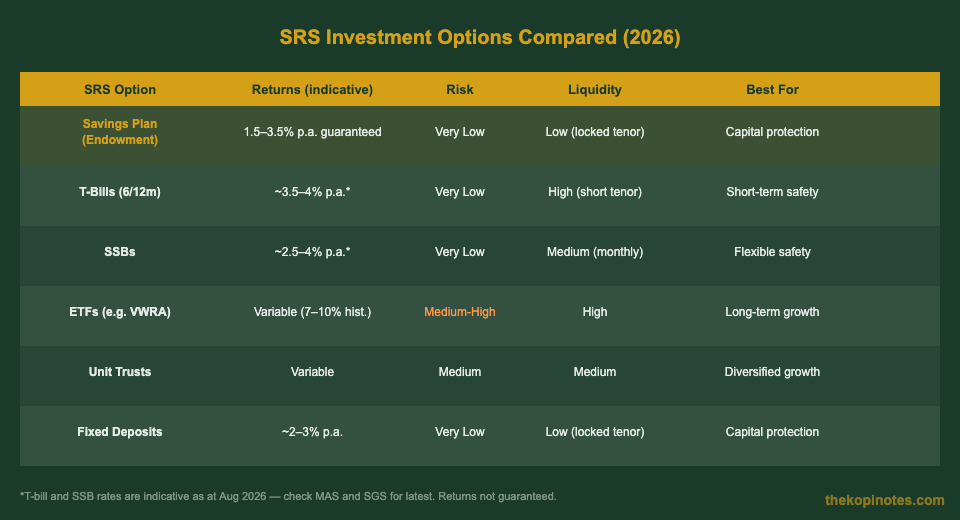
Savings plans aren’t your only choice. Here’s how they stack up against other popular SRS-approved instruments:
| SRS Option | Returns (indicative) | Risk | Liquidity | Best For |
|---|---|---|---|---|
| Savings Plan | 1.5–3.5% p.a.* | Very Low | Low (locked) | Capital protection + guaranteed return |
| T-Bills (6/12 mth) | ~3.5–4%* | Very Low | High | Short-term safety |
| SSBs | ~2.5–4%* | Very Low | Medium | Flexible safe income |
| ETFs (via Endowus/Syfe SRS) | Variable (7–10% hist.) | Medium-High | High | Long-term wealth growth |
| Unit Trusts (via FSMOne SRS) | Variable | Medium | Medium | Managed diversification |
| SRS Fixed Deposits | ~2–3%* | Very Low | Low (locked) | Short-term capital safety |
*Returns are indicative ranges based on market conditions as at August 2026. T-bill and SSB rates change with each auction — check MAS and SGS.gov.sg for current rates. Past ETF returns do not guarantee future performance. Savings plan rates vary by insurer and tranche.
If you’re close to retirement, pair a savings plan (capital floor) with SSBs or T-bills. If you have 15+ years ahead, adding ETF exposure via FSMOne SRS alongside your savings plan gives growth potential without abandoning capital protection entirely. Model your own scenario using our SRS tax savings calculator.
When a Savings Plan Is Right for Your SRS — and When It Isn’t
Choose an SRS savings plan when:
- You’re within 5–10 years of retirement and prioritise capital protection over growth
- You want to lock in guaranteed returns before interest rates fall further
- You prefer simplicity — one premium, one fixed maturity value, no ongoing investment decisions
- Your SRS balance meets the minimum premium and you don’t need the funds before the tenor ends
Think twice if:
- You’re 20+ years from retirement — ETFs in your SRS will likely outperform significantly over that horizon
- You might need the funds before the tenor ends — early surrender typically means capital loss and SRS tax penalties
- Current T-bill or SSB rates are equal or higher with better liquidity — a direct comparison is worth doing
- Your SRS balance is below S$5,000–S$10,000 and doesn’t meet minimum premiums
The bottom line: for conservative investors 5–10 years from retirement, parking SRS funds in a capital-guaranteed savings plan beats the 0.05% default rate by a wide margin — and keeps your funds fully within the SRS tax wrapper until withdrawal.
Frequently Asked Questions
Can I use SRS funds to buy any savings plan in Singapore?
What happens to my savings plan proceeds when it matures?
What is the penalty for withdrawing SRS funds before retirement age?
Are the returns from an SRS savings plan taxed at maturity?
Can foreigners in Singapore use SRS to buy savings plans?
Should I choose a 2-year or 5-year SRS savings plan?
Make Your SRS Funds Work Harder
Compare top platforms for SRS investing — from capital-guaranteed endowment plans to ETF portfolios for long-term growth.
Get Free Insurance Advice
Speak with a licensed insurance advisor. No obligation, no cost.
By submitting this form, you agree to our Privacy Policy.
This article was researched with the help of AI. While we strive to keep all information accurate and up to date, there may be errors. If you notice any discrepancies, please contact us.