Medisave Limit 2026: ICU and HDU Coverage — What Your ISP Actually Pays
Updated October 2026 · Integrated Shield Plans · 11 min read
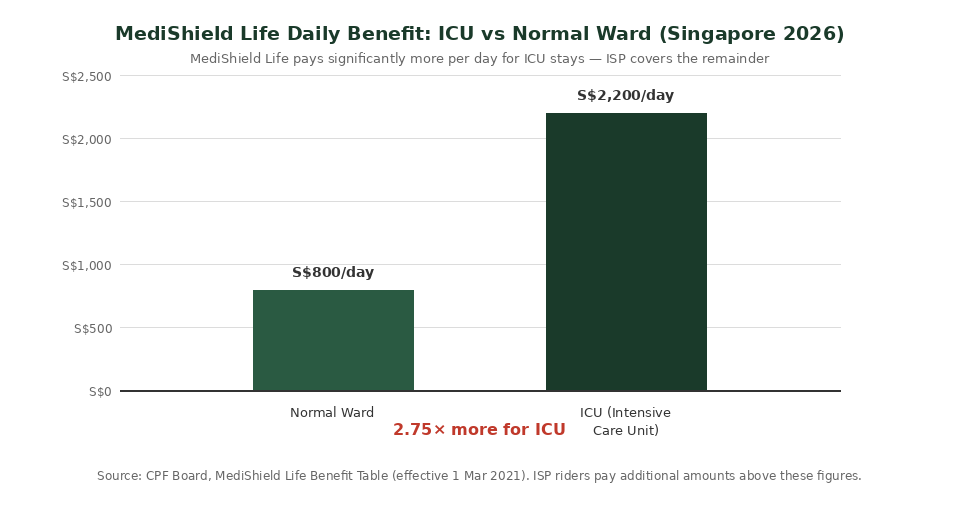
Your Integrated Shield Plan covers ICU and High Dependency Ward (HDU) stays under the same policy terms as a regular ward admission — there is no special ICU exclusion. MediShield Life pays up to S$2,200 per day for ICU (versus S$800 for a normal ward), and your ISP rider covers the bulk of what MediShield Life does not. With a rider, you typically pay only a 10% co-payment capped at around S$3,000 per year, regardless of how long the ICU stay lasts.
Not financial advice. All figures are for educational reference only. Data as at October 2026 unless noted. Always verify current limits with your insurer or CPF Board before making decisions.
In This Guide
- ICU vs HDU: What’s the Difference?
- What MediShield Life Pays for ICU Stays
- What Your ISP Rider Adds for ICU and HDU
- Letter of Guarantee for ICU Stays
- What MediSave Covers for ICU Bills
- Real Cost Scenarios: 5-Day and 14-Day ICU Stays
- 5 ICU Billing Surprises (and How to Avoid Them)
- Frequently Asked Questions
ICU vs HDU: What’s the Difference?
Singapore private hospitals have two tiers of intensive care above a standard ward. Knowing the distinction matters because doctors decide which level of care your condition requires — and both are covered by your ISP.
ICU (Intensive Care Unit) is the highest level of hospital care. Patients in ICU require continuous monitoring by dedicated nursing staff and have access to life-support equipment such as mechanical ventilators, haemodynamic monitoring, and renal replacement therapy. ICU admission is typically for critically ill patients following major surgery, cardiac events, severe infections (including sepsis), or trauma. At a private hospital in Singapore, the ICU room charge alone is approximately S$998 per day at Mount Elizabeth Hospital (as at April 2025), but the total daily cost including doctors, procedures, medication, and nursing typically reaches S$3,000–S$10,000 per day.
HDU (High Dependency Unit) — also called High Dependency Ward — sits one step below ICU. Patients in HDU require closer monitoring than a general ward provides but are stable enough not to need full ICU resources. HDU is common after procedures like cardiac catheterisation, major orthopaedic surgery, or when monitoring is needed post-anaesthesia. The HDU room charge at Mount Elizabeth is approximately S$899 per day. Total daily costs in HDU are typically lower than ICU but still substantially above a standard single room (S$450–S$750/day at major private hospitals).
Neither ICU nor HDU requires a different policy section or a separate claim — your ISP treats these as standard inpatient hospitalisation admissions. However, the higher daily cost means the bills accumulate faster, which is exactly why understanding how your coverage layers together matters.
What MediShield Life Pays for ICU Stays
MediShield Life is the government’s mandatory basic health insurance that sits beneath all ISPs. Its coverage schedule sets specific daily claim limits by ward type. For ICU stays (effective 1 March 2021, the most recent revision), the benefit table shows:
| Ward / Setting | MediShield Life Daily Benefit | Additional (First 2 Days) |
|---|---|---|
| Normal ward (any) | S$800/day | +S$200/day |
| ICU (Intensive Care Unit) | S$2,200/day | +S$200/day |
| HDU (High Dependency Unit) | S$800–S$2,200/day* | +S$200/day |
Source: CPF Board, MediShield Life Benefit Schedule, effective 1 March 2021. *HDU billing classification varies by hospital — confirm with your hospital’s billing department. MOH reviews benefit tables periodically; verify the latest at cpf.gov.sg.
The MediShield Life ICU daily benefit of S$2,200 is 2.75 times the normal ward benefit. This reflects the substantially higher cost of intensive care. However, even S$2,200 per day covers a modest portion of a real private hospital ICU bill — if the total daily cost is S$6,000, MediShield Life covers about 37% of the room-and-board portion, and your ISP fills the gap.
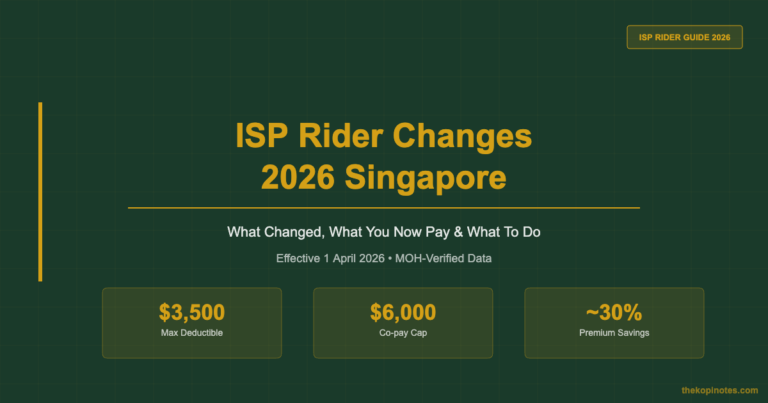
Importantly, MediShield Life’s claim limits apply after the annual deductible is met and before your ISP’s top-up kicks in. For private hospital admissions in 2026, the MediShield Life deductible is S$3,500 per policy year (not per admission — if you paid it earlier in the year, you do not pay it again for the ICU stay).
What Your ISP Rider Adds for ICU and HDU
Your Integrated Shield Plan — whether from AIA, Great Eastern, Prudential, Singlife, or Income — covers the gap between what MediShield Life pays and what the hospital charges, for all covered conditions. ICU and HDU stays are covered on the same policy terms as any other inpatient hospitalisation. There is no separate ICU section, no special exclusion for intensive care, and no requirement to upgrade your plan to cover ICU.
What your ISP actually pays depends on three things:
- Your ward entitlement: Your ISP covers up to a specific ward class (B1, A, or Private). ICU at a private hospital falls under the Private ward class entitlement. If your ISP only covers Class A, you can still be admitted to a private hospital ICU, but the excess above Class A rates is your own cost.
- Your rider: An ISP rider dramatically reduces out-of-pocket costs. With a rider (post-April 2021), you pay a minimum 5% co-payment for Class A and below, or 10% for private hospital. Without a rider, you pay the MediShield Life co-insurance percentage on top of the deductible.
- Annual claim limit: ISPs have annual and lifetime claim limits. A prolonged ICU stay (14+ days) can approach the annual limit of some entry-level ISPs. Premium ISPs typically have higher or unlimited annual limits — check your policy schedule.
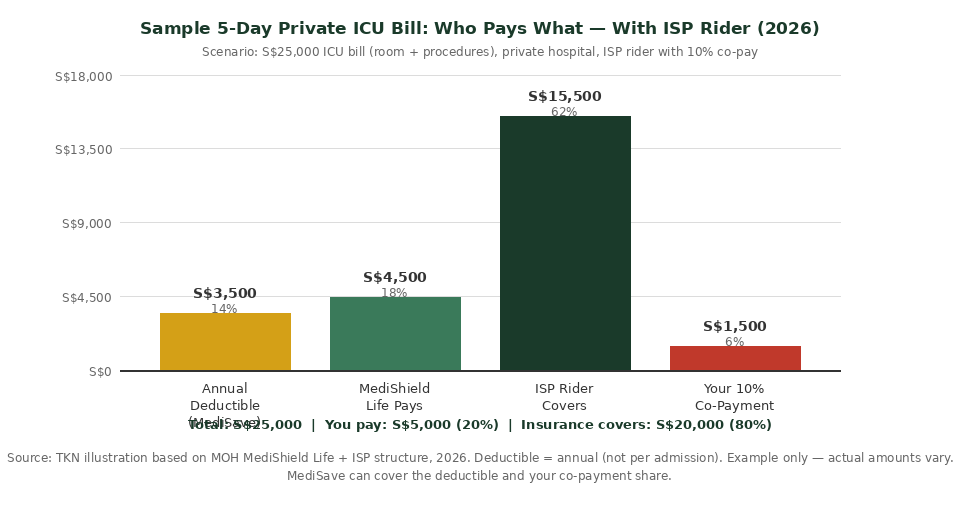
For a concrete example: if a 5-day private hospital ICU stay generates a total bill of S$25,000 and your annual deductible is already met, your ISP with rider would see you paying approximately S$1,500–S$2,500 in co-payment, while your ISP + MediShield Life covers the remaining S$22,500–S$23,500.
For a detailed comparison of how each of the five ISPs handles coverage limits, annual caps, and ICU billing, the ISP comparison guide 2026 walks through the specifics side by side. If you’re assessing whether your current plan’s rider is still worth holding given the 2021 co-payment changes, the shield plan comparison Singapore 2026 guide has the cost-benefit breakdown.
Letter of Guarantee for ICU Stays
For planned admissions where ICU time is anticipated — for example, before a major cardiac bypass surgery or a complex spinal procedure — request a Letter of Guarantee (LOG) from your insurer before the procedure. If ICU is planned post-surgery, include ICU time explicitly in the LOG request. Most insurers will pre-authorise the expected ICU stay as part of the overall surgical admission.
For emergency ICU admissions — where the patient arrives via A&E and is transferred directly to ICU — the LOG process works differently. You (or a family member) should notify the insurer’s 24-hour emergency line as soon as practicable, ideally within 24 hours of admission. Most ISPs provide a 7-day post-admission notification window for emergencies, but acting promptly avoids complications in the claim. Give the hospital’s insurance coordinator the policy number and insurer contact — the coordinator handles the direct billing paperwork on your behalf.
For step-by-step guidance on the full claims and LOG process, see the Medisave limit 2026: step-by-step ISP claim guide which covers the entire flow from pre-admission to post-discharge verification.
What MediSave Covers for ICU Bills
MediSave can be withdrawn to cover your out-of-pocket portion of an ICU bill — primarily the deductible (S$3,500 for private hospital) and your share of the co-payment. The deductible can be paid entirely from MediSave at the billing counter; you authorise the deduction at discharge and it happens automatically.
For ward charges specifically, the CPF Board’s approved hospital daily withdrawal limits apply. As at April 2025:
| Setting | MediSave Per-Day Limit (Ward Charges) |
|---|---|
| Approved hospital — first 2 days | S$1,130 per day |
| Approved hospital — from day 3 onwards | S$400 per day |
Source: CPF Board, MediSave Withdrawal Limits schedule, effective 1 April 2025. Note: this covers the ward charge portion only. Check cpf.gov.sg for the current full schedule.
The Basic Healthcare Sum (BHS) for 2026 is S$79,000 — this is the target balance for your MediSave account, not an annual withdrawal cap. There is no annual ceiling on total MediSave withdrawals for hospitalisation: as long as your MediSave balance is sufficient, it can cover your deductible and co-payment without limit.
For a deeper look at MediSave across your entire hospitalisation budget — including what happens when MediSave runs low — see the guide on what happens when your Medisave limit runs out in 2026. For MediSave use during a family member’s hospitalisation, see the guide on using Medisave to pay for a family member’s hospitalisation in 2026.
Real Cost Scenarios: 5-Day and 14-Day ICU Stays
To make the coverage layers concrete, here are two worked examples using realistic figures from a major Singapore private hospital. Both scenarios assume the annual deductible (S$3,500) has not yet been paid this policy year, and that the patient holds a private hospital-tier ISP with a rider.
Scenario 1: 5-day private hospital ICU stay (e.g., post-cardiac surgery)
| Bill Component | Estimated Amount | Who Pays |
|---|---|---|
| Total hospital bill (ICU 5 days) | ~S$25,000 | — |
| Annual deductible | S$3,500 | You (from MediSave) |
| MediShield Life pays | ~S$4,500 | MediShield Life |
| ISP rider covers | ~S$15,500 | Your insurer |
| Your 10% co-payment (private) | ~S$1,500 | You (MediSave or cash) |
Example only. Actual amounts depend on your exact ISP policy terms, procedures, specialist fees, and medications. Deductible is per policy year.
Scenario 2: 14-day private hospital ICU stay (e.g., post-stroke, sepsis)
| Bill Component | Estimated Amount | Who Pays |
|---|---|---|
| Total hospital bill (ICU 14 days) | ~S$80,000–S$120,000 | — |
| Annual deductible (if not met) | S$3,500 | You (from MediSave) |
| MediShield Life pays | ~S$15,000–S$20,000 | MediShield Life |
| ISP rider covers | ~S$55,000–S$90,000 | Your insurer |
| Your 10% co-pay (capped ~S$3,000/yr) | ~S$3,000 | You (MediSave or cash) |
Example only. A 14-day ICU stay may approach or exceed some ISPs’ annual claim limits. Verify your policy’s annual and lifetime cap. Premium-tier ISPs typically have unlimited annual limits.
The annual co-payment cap (typically S$3,000/year for most ISP riders) means that even a catastrophic S$100,000 ICU bill caps your out-of-pocket at roughly S$3,000 + S$3,500 deductible = S$6,500 for the year — assuming you are within your ISP’s annual claim limit and all procedures are covered.
5 ICU Billing Surprises (and How to Avoid Them)
1. Specialist consultants billing outside the ISP’s panel. In ICU, your patient may be seen by multiple specialists — a pulmonologist, an infectious disease specialist, a nephrologist — not just your primary surgeon. If any specialist is not on your insurer’s panel, their fees may not be fully covered by your ISP and are charged at private rates. Ask the ICU charge nurse for the full list of consultants seeing the patient, and check each one’s panel status with your insurer.
2. Procedure costs beyond the ICU room charge. The S$998/day ICU room rate is only the room. Procedures such as renal dialysis, bronchoscopy, central line insertion, and specialist nursing attract separate charges. These are typically covered by your ISP if the underlying condition is covered, but each has its own billing line — request an itemised bill mid-stay rather than waiting for discharge.
3. Transfer from a public ICU to a private ICU mid-admission. If a patient is stabilised in a public hospital ICU and then transferred to a private hospital ICU, the two hospitalisations are billed separately. The annual deductible may reset differently depending on your policy year and each insurer’s counting rules. Clarify with your insurer before authorising a transfer.
4. Exceeding the ISP annual claim limit. Entry-level ISPs may cap annual claims at S$150,000–S$200,000. A prolonged private hospital ICU stay with complications can approach or breach this limit. If the patient is approaching the cap, speak to the insurer’s case manager about switching to a ward class that would extend coverage or transferring to a restructured hospital where bills are lower.
5. Not notifying the insurer within the emergency window. For unplanned ICU admissions, most ISPs require notification within 5–7 business days. Missing this window doesn’t void coverage, but it can delay claim processing significantly and result in the hospital requesting a larger upfront cash deposit from the family.
Understanding the full range of ISP coverage is covered in the integrated shield plan Singapore guide. For new ISP rider co-payment rules that came into effect from April 2021, the new ISP rider rules 2026 guide has the details. To plan for long-term healthcare costs including ICU scenarios, use the Singapore retirement planning calculator.
Not financial advice. ISP terms, deductibles, co-payment rules, and claim limits are subject to change. Always verify current terms directly with your insurer or a licensed financial adviser before making decisions, and check current CPF Board and MOH schedules at moh.gov.sg and cpf.gov.sg.
Frequently Asked Questions
Does my ISP automatically cover ICU stays, or do I need a separate rider?
Your ISP covers ICU stays under the same policy terms as any other inpatient hospitalisation — there is no separate ICU rider or upgrade required. ICU admission is covered if the underlying medical condition is a covered benefit under your policy. The only variable is your ward entitlement (Class A vs Private) and whether the treating specialists are on your insurer’s panel. Adding a rider reduces your co-payment to a minimum of 5–10% but does not change whether ICU is covered.
How much does MediShield Life pay per day for an ICU stay?
Under the MediShield Life benefit table effective 1 March 2021, the daily ICU benefit is S$2,200 per day, plus an additional S$200 per day for the first two inpatient days. This is compared to S$800 per day (plus S$200 for the first 2 days) for a normal ward. The total daily bill at a private hospital ICU typically exceeds these benefit amounts, and your ISP covers the remainder above MediShield Life’s payment, up to your policy’s annual limit.
What is the Medisave limit for an ICU stay at a private hospital in 2026?
MediSave can be used to cover the annual deductible (S$3,500 for private hospital) and your out-of-pocket co-payment. For ward charges, the CPF Board’s approved hospital limits as at April 2025 are S$1,130 per day for the first two days and S$400 per day thereafter — these apply to the ward charge component. The annual deductible has no daily limit and can be fully paid from MediSave in one transaction at discharge. There is no annual ceiling on MediSave withdrawals for hospitalisation: as long as your balance is sufficient, it can cover your share of any ICU bill.
Is the ISP deductible charged separately for an ICU stay vs the preceding ward stay?
No — the annual deductible is per policy year, not per admission or per ward type. If you were already in a general ward before being transferred to ICU within the same hospitalisation episode, the deductible you paid for the general ward charges applies to the ICU charges too. Similarly, if you paid the annual deductible during an earlier hospitalisation that year, you do not pay it again for the ICU admission. Verify the exact application with your insurer, as some policies treat re-admissions within 90 days as a continuous episode.
Can I use MediSave to pay for a family member's ICU bill in 2026?
Yes. MediSave can be used for immediate family members’ hospitalisation, including ICU stays. Eligible family members include your spouse, children, parents, grandparents, and siblings. The withdrawal limits and deductible rules are the same as for your own hospitalisation. You must authorise the MediSave deduction at the hospital’s billing counter, and the hospital processes the withdrawal on your behalf. For the complete rules on using MediSave for a family member’s hospitalisation, see the dedicated guide on using Medisave for a family member’s hospitalisation in 2026.
If the ICU patient is unconscious, can a family member request the Letter of Guarantee?
Yes. The hospital’s insurance coordinator handles LOG requests on behalf of patients who are unconscious or incapacitated. A family member can provide the patient’s NRIC, ISP policy number, and insurer contact to the coordinator, who then liaises with the insurer directly. For emergency ICU admissions, most insurers have a 5–7 business day notification window after admission — acting within this window ensures the claim proceeds without delay. If the insurer cannot be reached immediately, the hospital can still provide emergency treatment; the billing is resolved once the LOG is obtained.
Know Your ISP Coverage Before You Need It
Compare all five ISPs in Singapore, understand your true out-of-pocket costs, and plan for long-term healthcare expenses.
Get Free Insurance Advice
Speak with a licensed insurance advisor. No obligation, no cost.
By submitting this form, you agree to our Privacy Policy.
This article was researched with the help of AI. While we strive to keep all information accurate and up to date, there may be errors. If you notice any discrepancies, please contact us.