MediShield Life Claim Limits 2026: Ward Classes, Co-Payment & ISP Rider Changes
Enhanced from 1 June 2026 | New ISP rider deductibles from 1 April 2026
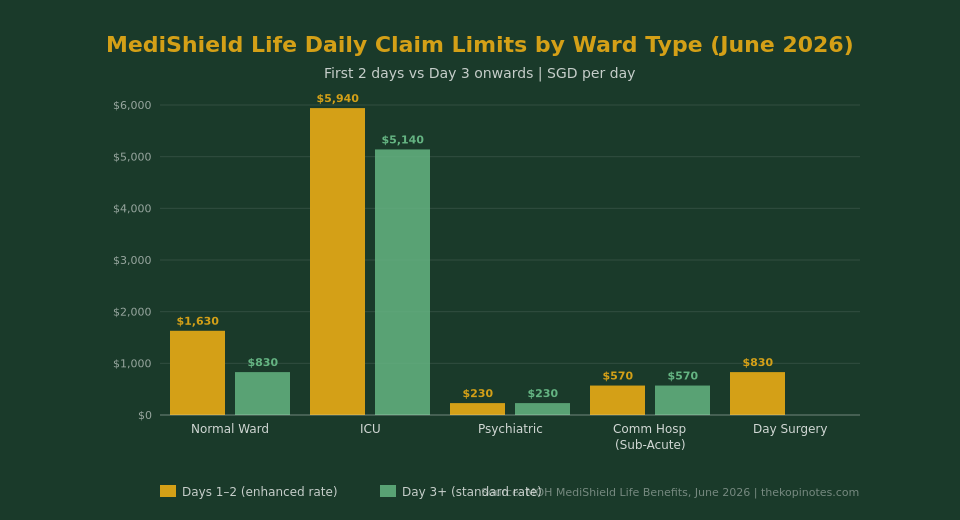
MediShield Life’s 2026 enhanced claim limits took effect on 1 June 2026, raising the normal ward daily limit to $1,630 for the first two days and $830 from day three onward. Combined with the April 2026 ISP rider changes — which now require you to bear a mandatory deductible of up to $3,500 before your rider kicks in — your actual out-of-pocket hospital bill in Singapore has changed significantly. This guide breaks down every figure by ward class, with worked examples.
Not financial advice. All figures are for educational reference only and are based on MOH and CPF Board data as at September 2026.
In This Guide
- What Are MediShield Life Claim Limits?
- 2026 Enhanced Claim Limits by Ward Type
- The April 2026 ISP Rider Changes Explained
- Your Co-Payment Breakdown by Ward Class
- Real Bill Examples: How Much Will You Pay?
- Choosing Your Ward Class: Financial Trade-Offs
- ISP Rider Strategy After April 2026
- Frequently Asked Questions
What Are MediShield Life Claim Limits?
MediShield Life is Singapore’s mandatory basic health insurance, administered by the CPF Board and covering all Singapore Citizens and Permanent Residents automatically. It provides a safety net for large hospitalisation bills, paying out up to a set maximum for each cost component — the daily ward charge, surgical procedures, implants, and selected outpatient treatments like dialysis and chemotherapy.
The claim limit is the ceiling amount MediShield Life will reimburse for any given component. If your actual hospital charge exceeds that limit — because you chose a higher ward class, a private hospital, or a complex procedure — the excess is covered by your Integrated Shield Plan (ISP) rider, or falls on you if you have no ISP.
Many Singaporeans believe MediShield Life covers most of their hospital bill. In practice, MediShield Life typically covers a portion. After you subtract the mandatory deductible and the co-insurance you owe (the 5% you must pay), the base scheme’s claim limits mean that a small- or medium-complexity Class B1 hospitalisation might still leave a few thousand dollars for you to pay out-of-pocket before MediSave and rider coverage.
The June 2026 enhancement — the first major upgrade to MediShield Life since 2015 — significantly raised these daily limits, particularly for ICU stays and the first two days of any hospitalisation. Understanding the new limits is critical for assessing whether your current ISP provides adequate coverage, and what you should budget for in the event of a hospital admission. See our full breakdown of the MediSave hospitalisation and claim limits guide for MediSave withdrawal limits that offset your co-payment.
2026 Enhanced MediShield Life Claim Limits by Ward Type
The following limits took effect for all admissions from 1 June 2026. For stays longer than two days, the enhanced top-up applies only to days one and two; the standard rate applies from day three onward.
| Ward / Service Type | Days 1-2 (SGD/day) | Day 3+ (SGD/day) |
|---|---|---|
| Normal Ward (all classes) | $1,630 | $830 |
| ICU / High Dependency | $5,940 | $5,140 |
| Psychiatric Ward | $230 | $230 (max 60 days/year) |
| Community Hospital – Sub-Acute | $570 | $570 |
| Community Hospital – Rehabilitative | $370 | $370 |
| Day Surgery (non-subsidised) | $830 per visit | – |
| Annual Claim Limit | $200,000 per policy year | |
| Lifetime Limit | None | |
Source: Ministry of Health, MediShield Life Benefits Schedule, effective 1 June 2026.
Note that MediShield Life’s claim limits apply uniformly regardless of whether you are in a Class A, B1, B2, or C ward. The limits represent the maximum the base scheme will pay — your ISP (if held) covers the gap between the MediShield Life payout and your actual bill, minus your co-payment obligations.
New in 2026: MediShield Life now also covers fertility preservation procedures for medical reasons (e.g. before cancer treatment), and includes expanded coverage for outpatient cancer drugs listed under the MSHL drug list.
The April 2026 ISP Rider Changes Explained
Alongside the June 2026 claim limit enhancements, MOH introduced sweeping changes to how Integrated Shield Plan riders can be structured. Effective 1 April 2026, all ISP riders sold (or renewed after the transition window) must comply with new co-payment requirements designed to ensure policyholders retain “skin in the game”.
1. Mandatory Minimum Deductibles (riders cannot cover this)
Riders are now prohibited from covering the minimum deductible for each ward class. You pay this amount before any insurance kicks in:
| Ward Class | Minimum Annual Deductible |
|---|---|
| Class A / Private Hospital Ward | $3,500 |
| Class B1 | $2,500 |
| Class B2 | $2,000 |
| Class C | $1,500 |
| Day Surgery (non-subsidised) | $2,000 |
| Day Surgery (subsidised) | $1,500 |
Source: MOH ISP Rider Changes, effective 1 April 2026.
2. Annual Co-Payment Cap Doubled
The 5% co-insurance rate itself has not changed. However, the annual cap on your co-payment has doubled from $3,000 to $6,000 per policy year. For most hospitalisations with a rider, you will hit the cap before the year ends, making the annual figure more predictable. In a worst-case scenario with multiple admissions, your maximum out-of-pocket exposure has doubled.
3. Transitional Protection for Existing Policyholders
If you purchased a “full rider” (covering 100% of co-payment) before 26 November 2025, you are grandfathered in under the old rules until your rider next renews after 1 April 2028. Renewals from 1 April 2028 onward must comply with the new co-payment structure.
Read our detailed breakdown of the new ISP rider co-payment structure and the legacy rider transition to 2028 for the full picture on grandfathering timelines.
Your Co-Payment Breakdown by Ward Class
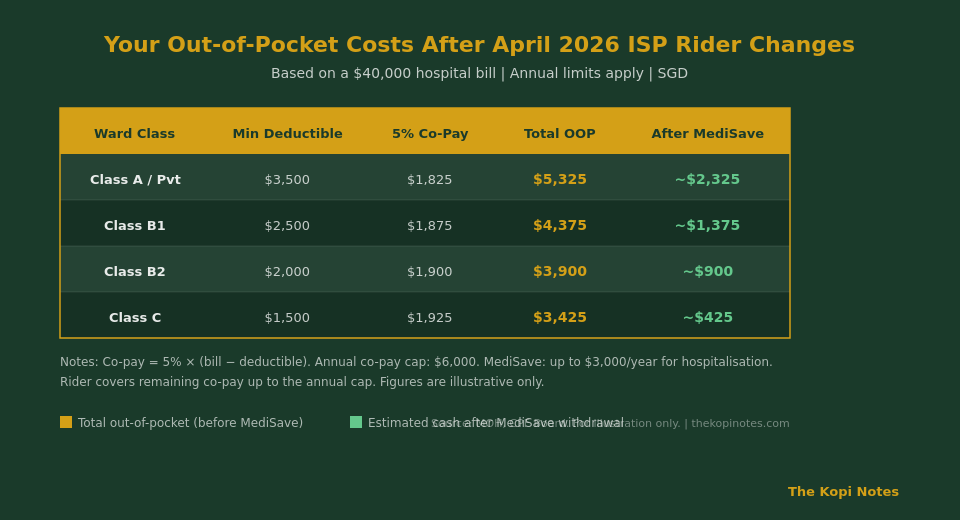
With a new or renewed ISP rider (post-April 2026), here is how your out-of-pocket costs are structured for a $40,000 hospital bill:
| Ward Class | Deductible | 5% Co-Pay | Total OOP | After MediSave |
|---|---|---|---|---|
| Class A / Private | $3,500 | $1,825 | $5,325 | ~$2,325 |
| Class B1 | $2,500 | $1,875 | $4,375 | ~$1,375 |
| Class B2 | $2,000 | $1,900 | $3,900 | ~$900 |
| Class C | $1,500 | $1,925 | $3,425 | ~$425 |
Notes: Co-pay = 5% x (bill minus deductible). Annual co-pay cap: $6,000. MediSave: approx $3,000/year hospitalisation withdrawal. Figures are illustrative. Source: MOH, CPF Board, 2026.
Key insight: Class C carries the lowest deductible ($1,500) and lowest total out-of-pocket before MediSave. A Class A admission at the same bill size costs you approximately $1,900 more. However, the premium gap between ISP plans at ages 35-50 can be only $500-$1,000/year, so the equation depends on how frequently you hospitalise.
See our integrated shield plan co-payment 2026 full guide for how to calculate the deductible across multiple admissions in the same policy year.
Real Bill Examples: How Much Will You Pay?
Let’s put the numbers together with two realistic hospital admission scenarios.
Example 1: Appendectomy, 5-Day Stay in Class B1 Ward
Scenario: 38-year-old, Class B1 ward at a restructured hospital, with a new ISP rider (post-April 2026).
| Total Hospital Bill | $18,000 | |
| Mandatory Deductible (B1) | You pay first | -$2,500 |
| 5% Co-Payment | 5% x ($18,000 – $2,500) | -$775 |
| MediShield Life + ISP Rider Cover | Remainder after your obligations | $14,725 |
| Your Total Out-of-Pocket | Deductible + co-pay | $3,275 |
| MediSave Withdrawal (approx) | Annual hospitalisation limit | ~$3,000 |
| Estimated Cash Payable | ~$275 | |
Example 2: Major Surgery, 10-Day Stay in Class A Ward
Scenario: 52-year-old, Class A ward at a private hospital, with a new ISP rider (post-April 2026).
| Total Hospital Bill | $40,000 | |
| Mandatory Deductible (Class A) | You pay first | -$3,500 |
| 5% Co-Payment | 5% x ($40,000 – $3,500) | -$1,825 |
| MediShield Life + ISP Rider Cover | Remainder after your obligations | $34,675 |
| Your Total Out-of-Pocket | Deductible + co-pay | $5,325 |
| MediSave Withdrawal (approx) | Annual hospitalisation limit | ~$3,000 |
| Estimated Cash Payable | ~$2,325 | |
These examples assume one admission in the policy year (deductible resets annually). If you have already met the deductible from a prior admission in the same year, subsequent claims incur only the 5% co-payment, up to the $6,000 annual cap — after which your rider covers 100%.
For a full walkthrough of how MediSave can be used to offset hospitalisation costs, read our MediSave hospitalisation 2026 claim limits and rider changes guide.
Choosing Your Ward Class: Financial Trade-Offs
Choosing a ward class is about balancing premium costs, out-of-pocket exposure, and the level of comfort and specialist access you want. After the April 2026 changes, the financial equation has shifted:
| Factor | Class A / Private | Class B1 | Class C |
|---|---|---|---|
| Min Deductible | $3,500 | $2,500 | $1,500 |
| Max Annual Co-Pay Cap | $6,000 (same for all classes) | ||
| Specialist Choice | Any (incl. private) | Restructured specialists | Assigned (subsidised) |
| Typical ISP Premium (age 40) | ~$800-$1,800/yr | ~$400-$900/yr | ~$150-$400/yr |
| Ward Amenities | Private/single room | 4-bedded room | 6+ bedded ward |
Premium ranges are indicative estimates for non-rider base ISP coverage, based on market data as at mid-2026. Actual premiums depend on insurer, age, and plan tier.
For comprehensive help modelling your long-term healthcare costs alongside CPF planning, try our Singapore retirement planning calculator and read our guide on CPF investment strategy.
ISP Rider Strategy After April 2026
If you hold a pre-26 November 2025 full rider, you are grandfathered in until the rider’s first renewal after 1 April 2028. There is no financial incentive to voluntarily switch to a new co-payment rider before then — your full rider continues to cover 100% of co-payments during this window.
For everyone else buying new coverage or whose rider renews from 1 April 2026, these are the key strategic points:
- Budget for the deductible as a recurring cash expense. Even with a rider, you will pay up to $3,500 out-of-pocket per year (Class A) for any hospitalisation. Keep a dedicated healthcare buffer equal to at least one year’s deductible.
- New riders are significantly cheaper. Post-April 2026 riders that incorporate the mandatory co-payment tend to be approximately 30% cheaper in premium than full riders were. This premium saving partially offsets your deductible exposure in years when you do not hospitalise.
- Consider downgrading ward class if premiums are straining your budget. The $2,000 deductible difference between Class A and Class B2 may not justify a premium gap, depending on your hospitalisation frequency.
- Review annually. ISP premiums step up sharply at ages 60, 65, 70, and 75. Re-evaluate ward class at each renewal.
For ISP plan comparisons and insurer-specific details, read our ISP rider cancellation 2025-2026 guide and our overview of the legacy rider transition timeline to 2028.
Frequently Asked Questions
What are the MediShield Life claim limits for normal wards in 2026?
From 1 June 2026, MediShield Life pays up to $1,630 per day for normal ward stays during the first two days of each hospitalisation. From day three onward, the standard rate of $830 per day applies. These daily limits apply uniformly across all ward classes (A, B1, B2, C) — the difference in your bill is covered by your ISP rider, not by higher MediShield Life limits for premium wards.
How much do I pay out-of-pocket with a new ISP rider after April 2026?
With a new or renewed ISP rider from 1 April 2026, you pay: (1) the mandatory minimum deductible (e.g. $3,500 for Class A, $2,500 for Class B1, $1,500 for Class C); and (2) 5% co-insurance on the bill above the deductible, capped at $6,000 per policy year. MediSave can offset a portion of this. Your rider covers the remaining balance beyond your deductible and co-payment obligations.
Is my co-payment capped at $6,000 per year under the new ISP rules?
Yes. From 1 April 2026, the annual co-payment cap is $6,000 per policy year. Once your cumulative 5% co-payment across all claims in that year reaches $6,000, your rider covers 100% of further co-payments for the rest of that policy year. Note that the mandatory deductible (up to $3,500) is separate from this cap — your total maximum exposure is deductible plus co-pay cap (e.g. $3,500 + $6,000 = $9,500 for Class A in a worst-case year).
Does MediShield Life cover Class A ward bills?
Yes, but with important limitations. MediShield Life pays up to its published daily limits (e.g. $830/day from day 3 for normal wards) regardless of whether you are in Class A, B1, B2, or C. However, Class A ward charges are typically far higher than the MediShield Life daily limit — the difference is covered by your ISP rider. Without an ISP, you would pay the gap between the actual Class A bill and the MediShield Life payout, which can run into tens of thousands of dollars for a complex case.
What is the deductible for a Class B1 ward stay in 2026?
From 1 April 2026, the mandatory minimum deductible for Class B1 ward admissions is $2,500 per policy year. Your ISP rider cannot cover this deductible — you pay it from your own funds or MediSave. The deductible is per policy year, not per admission: if you have two hospitalisation claims in the same year, you pay the deductible once in total (for the first claim that meets or exceeds it), not twice.
How do the 2026 ISP rider changes affect my current hospital plan?
If your current full rider was purchased before 26 November 2025, you are fully grandfathered under the old rules until your rider’s first renewal after 1 April 2028. You can continue claiming 100% co-payment coverage during this window. From your first renewal after 1 April 2028, the new deductible and co-payment rules will apply. If your rider was purchased or renewed on or after 1 April 2026, the new deductible and co-payment rules already apply to you.
Plan Your Healthcare Coverage
Compare ISP plans and model your medical expenses alongside your long-term financial goals.
Get Free Insurance Advice
Speak with a licensed insurance advisor. No obligation, no cost.
By submitting this form, you agree to our Privacy Policy.
This article was researched with the help of AI. While we strive to keep all information accurate and up to date, there may be errors. If you notice any discrepancies, please contact us.