4 New Ireland-Domiciled ETFs on SGX: XUS, XND, XWR & EUS Guide (2026)
Xtrackers brings 4 UCITS ETFs to SGX — S&P 500, Nasdaq 100, MSCI World and Equal Weight, all in SGD with 15% withholding tax.
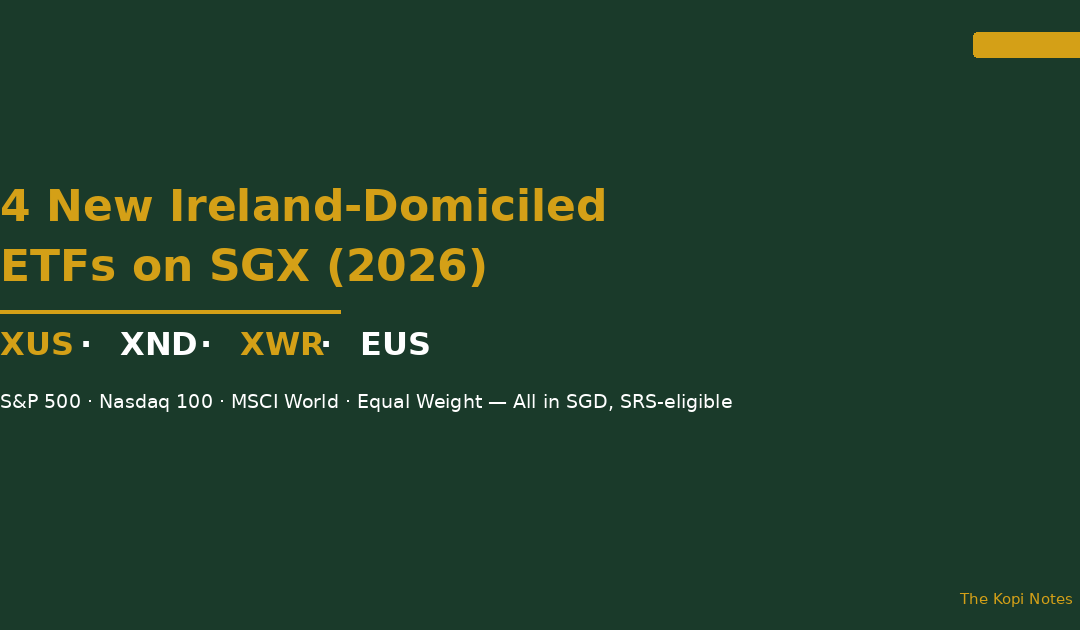
Four new Ireland-domiciled UCITS ETFs are coming to SGX — XUS (S&P 500, 0.03% TER), XND (Nasdaq 100, 0.20%), XWR (MSCI World, 0.12%) and EUS (S&P 500 Equal Weight, 0.15%). Issued by Xtrackers (DWS), these accumulating funds trade in SGD, are SRS-eligible, and benefit from 15% withholding tax on US dividends under the Ireland-US tax treaty — half the 30% rate on US-domiciled ETFs like VOO.
Not financial advice. All figures are for educational reference only. Data as at September 2026 unless noted.
Table of Contents
Contents — Click to expand
What’s Happening: 4 Xtrackers UCITS ETFs on SGX
Singapore investors will soon have direct SGX access to four Ireland-domiciled UCITS ETFs, scheduled to begin trading on 13 October 2026. These are cross-listings of existing Xtrackers UCITS ETFs managed by DWS, a European asset manager. The existing funds have combined assets under management ranging from approximately US$2.6 billion to US$30.7 billion as at end August 2026, so these are not untested new launches — they are established funds now accessible through a new listing venue.
Here is what each ETF covers:
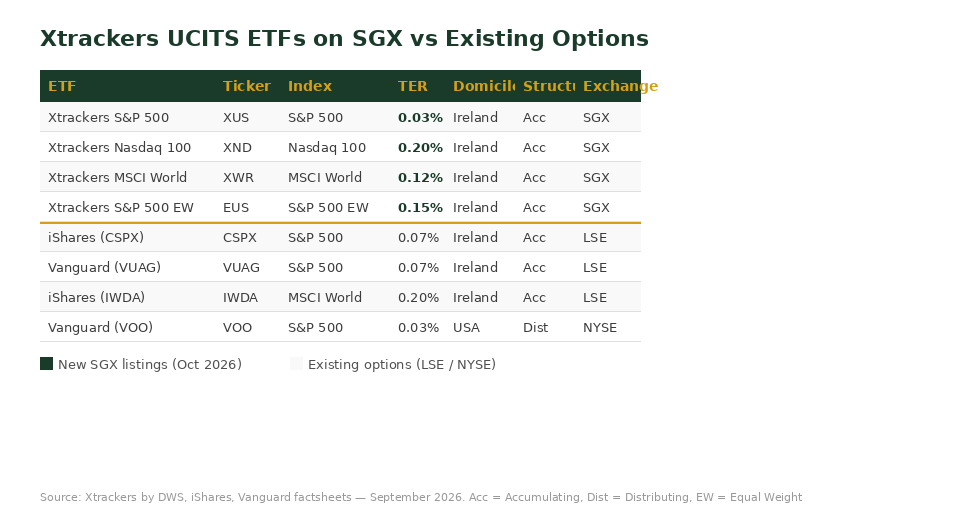
- XUS — Tracks the S&P 500 Index (500 largest US companies, market-cap weighted). TER: 0.03%.
- XND — Tracks the Nasdaq 100 Index (100 largest non-financial companies on Nasdaq, tech-heavy). TER: 0.20%.
- XWR — Tracks the MSCI World Index (large and mid-cap companies across developed markets — note: this does not include emerging markets). TER: 0.12%.
- EUS — Tracks the S&P 500 Equal Weight Index (same 500 companies as XUS, but each given roughly equal weighting, reducing mega-cap concentration). TER: 0.15%.
All four ETFs are accumulating — dividends are automatically reinvested into the fund rather than paid out. They trade in SGD on SGX during Singapore market hours, with a minimum lot size of one share once secondary trading begins. Based on indicative prices as at 15 September 2026, XUS was approximately S$20 per share, EUS around S$85, XND around S$150 and XWR around S$200.
Critically, all four are expected to qualify for SRS investment, subject to eligibility requirements and platform support. For Singapore investors who have been using their Singapore retirement calculator to plan their portfolio, these new SGX-listed options could simplify the process of deploying SRS funds into low-cost global index ETFs.
All 4 ETFs at a Glance
| ETF | SGX Ticker | Index Tracked | TER | Indicative Price (SGD) |
|---|---|---|---|---|
| Xtrackers S&P 500 UCITS ETF | XUS | S&P 500 | 0.03% | ~S$20 |
| Xtrackers MSCI World UCITS ETF | XWR | MSCI World | 0.12% | ~S$200 |
| Xtrackers S&P 500 Equal Weight UCITS ETF | EUS | S&P 500 Equal Weight | 0.15% | ~S$85 |
| Xtrackers Nasdaq 100 UCITS ETF | XND | Nasdaq 100 | 0.20% | ~S$150 |
Source: Xtrackers by DWS, indicative prices as at 15 September 2026. All ETFs are Irish-domiciled, accumulating, and traded in SGD.
Why Ireland-Domiciled Matters for Singapore Investors
The domicile of an ETF — where it is legally registered — has a direct impact on how much tax a Singapore investor pays on dividends from US equities. This is the single most important reason Singapore investors have historically looked beyond SGX-listed ETFs and bought Ireland-domiciled UCITS ETFs on the London Stock Exchange instead.
Here is how the tax structure works:
US-domiciled ETFs (e.g. VOO, QQQ, SPY) — listed on NYSE or Nasdaq. Under US tax law, Singapore investors who are non-US tax persons face a 30% withholding tax on all dividend distributions. On top of that, if your total US-situs assets exceed USD 60,000, your estate could be subject to US estate tax of up to 40% upon death — a risk that many investors underestimate.
Ireland-domiciled ETFs (e.g. CSPX, VWRA, and now XUS, XND, XWR, EUS) — registered in Ireland under the UCITS framework. Under the Ireland-US tax treaty, these funds pay only 15% withholding tax on US-sourced dividends at the fund level. There is no US estate tax exposure for the end investor, regardless of portfolio size.
| ETF Domicile | US Dividend WHT | US Estate Tax Risk | Examples |
|---|---|---|---|
| Ireland (UCITS) | 15% | None | XUS, XND, XWR, EUS, CSPX, VWRA |
| United States | 30% | Yes (above USD 60,000) | VOO, QQQ, SPY, VTI |
Source: IRS withholding tax rates for non-resident aliens, Ireland-US Double Taxation Treaty. September 2026.
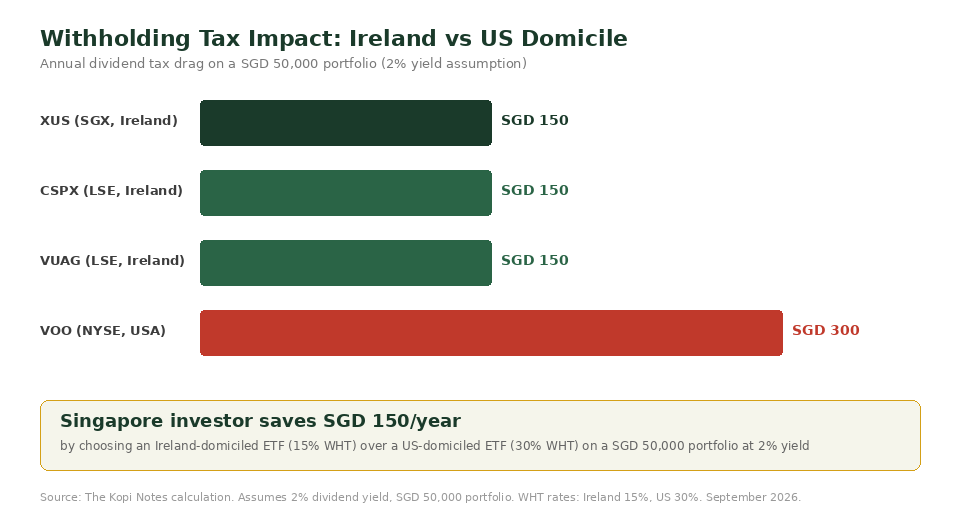
What this means in dollar terms: A Singapore investor with a SGD 100,000 portfolio in S&P 500 ETFs (assuming a 2% dividend yield) would see approximately SGD 300 withheld annually in a US-domiciled ETF like VOO, versus SGD 150 in an Ireland-domiciled ETF like XUS or CSPX. That is SGD 150 per year in tax savings — and it compounds over decades. For an accumulating ETF like XUS, these dividends are reinvested within the fund after the 15% WHT, so Singapore investors face no additional dividend tax on their end.
The key development here is that Singapore investors can now access these Ireland-domiciled tax advantages directly on SGX, without needing an overseas brokerage account that provides access to the London Stock Exchange.
How to Subscribe via Moomoo (IOP Details)
The initial offer period (IOP) for all four Xtrackers UCITS ETFs opened on 21 September 2026, with moomoo Singapore as the exclusive participating dealer. During the IOP, investors can subscribe at a price based near the ETF’s net asset value (NAV) with a 0% subscription fee — there is no bid-ask spread to worry about, unlike buying on the secondary market after listing. The minimum subscription is S$1,000 per ETF, and there is no limited allotment — you will receive what you subscribe for.
The subscription deadlines differ by ETF:
| ETF | Subscription Deadline |
|---|---|
| XWR — MSCI World | 30 September 2026, 12pm SGT |
| XUS — S&P 500 | 1 October 2026, 12pm SGT |
| EUS — S&P 500 Equal Weight | 1 October 2026, 12pm SGT |
| XND — Nasdaq 100 | 1 October 2026, 12pm SGT |
Source: Moomoo Singapore, Xtrackers by DWS. September 2026.
If you do not already have a moomoo Singapore account, you can sign up using referral code 7KNTEY4M at our moomoo referral code page for exclusive sign-up bonuses. Once your account is set up and funded, search for the ETF ticker (e.g. XUS.SG) within the moomoo app and look for the subscription option during the IOP window.
After the IOP closes, all four ETFs are tentatively scheduled to begin secondary trading on SGX on 13 October 2026. Once trading starts, investors will be able to buy and sell through any brokerage platform that supports the respective SGX counters — not just moomoo.
How They Compare to CSPX, VWRA, VOO & IWDA
If you already invest in Ireland-domiciled UCITS ETFs on the London Stock Exchange, the natural question is: how do these new SGX-listed Xtrackers ETFs stack up against established names like CSPX, VWRA and IWDA?
| Feature | XUS (SGX) | CSPX (LSE) | VOO (NYSE) | XWR (SGX) | IWDA (LSE) |
|---|---|---|---|---|---|
| Index | S&P 500 | S&P 500 | S&P 500 | MSCI World | MSCI World |
| TER | 0.03% | 0.07% | 0.03% | 0.12% | 0.20% |
| Domicile | Ireland | Ireland | USA | Ireland | Ireland |
| US Dividend WHT | 15% | 15% | 30% | 15% | 15% |
| US Estate Tax | No | No | Yes (>USD 60k) | No | No |
| Structure | Accumulating | Accumulating | Distributing | Accumulating | Accumulating |
| Trading Currency | SGD | USD | USD | SGD | USD |
| Exchange | SGX | LSE | NYSE | SGX | LSE |
| SRS Eligible | Yes | Broker-dependent | No | Yes | Broker-dependent |
Source: Xtrackers by DWS, iShares, Vanguard fund factsheets. September 2026.
Several things stand out. XUS matches VOO’s rock-bottom 0.03% TER while keeping the Ireland-domiciled tax advantage — something CSPX at 0.07% TER cannot quite match. For S&P 500 exposure, XUS on paper offers the lowest total cost option among Ireland-domiciled ETFs available to Singapore investors. Meanwhile, XWR at 0.12% TER undercuts IWDA’s 0.20% for MSCI World exposure, though both track the same index.
However, a critical caveat: TER is not the same as total cost. Once these ETFs start trading on SGX, investors should watch the bid-ask spread carefully. New listings often have wider spreads initially, and brokerage commissions on SGX may differ from what you pay on the LSE through platforms like Interactive Brokers. The total cost comparison will only become clear after 13 October 2026 when actual trading data is available.
One important distinction for VWRA investors: XWR tracks the MSCI World Index, which covers developed markets only. VWRA tracks the FTSE All-World Index, which includes both developed and emerging markets. If emerging market exposure matters to your portfolio, XWR is not a direct substitute for VWRA.
For investors interested in the equal-weight S&P 500 approach, EUS provides a way to reduce mega-cap concentration risk — the top 10 holdings account for roughly 20% of a market-cap weighted S&P 500 ETF. EUS spreads the allocation more evenly, which can perform differently during periods when mega-cap tech stocks diverge from the broader market.
Should You Buy on SGX or Stick With the LSE?
This is the practical question many Singapore passive investors are asking right now. Here is how to think about it:
Reasons to consider the new SGX-listed ETFs
Simpler brokerage access. You do not need an overseas brokerage that supports the London Stock Exchange. SGX is accessible through most local brokerages, including those many Singaporeans already use for local stocks and REITs. This matters most for investors who find platforms like Interactive Brokers intimidating or do not want to maintain a separate overseas account.
SRS eligibility. Deploying SRS funds into Ireland-domiciled UCITS ETFs was previously limited by whether your broker’s SRS arrangement supported overseas exchanges. With SGX-listed options, this becomes significantly easier. If you are contributing to SRS and want global equity exposure, this is a meaningful improvement.
SGD-denominated trading. You buy and sell in SGD, avoiding the need for a separate FX conversion through your broker. This is a convenience factor — it does not remove underlying currency exposure to USD and other currencies in the ETF’s holdings, but it does eliminate one layer of transaction friction and FX spread costs.
CDP custody option. Some brokers may support holding these ETFs through your CDP account, giving investors who prefer direct custody an additional option beyond custodian-held accounts.
Reasons to stay with LSE-listed ETFs
Proven liquidity and tight spreads. CSPX, VWRA and IWDA have deep trading volumes on the LSE with tight bid-ask spreads. The SGX counters will be brand new, and initial liquidity may be thin. For larger portfolio allocations, the cost of wider spreads could outweigh TER savings.
Established track record. While the underlying funds are the same (these are cross-listings), the SGX trading line itself is new. Some investors prefer to wait until there is sufficient trading history and market-maker depth before committing capital.
VWRA includes emerging markets. If you want both developed and emerging market exposure in a single fund, VWRA remains the better choice. XWR’s MSCI World index covers only developed markets.
Our suggestion: if you are starting fresh and prefer simplicity, subscribing to XUS or XWR during the IOP via moomoo is a low-friction way to begin — 0% subscription fee, NAV-based pricing, and no need for an overseas brokerage. If you already hold CSPX or VWRA on the LSE, there is no urgency to switch. Monitor the SGX bid-ask spreads and total trading costs after listing before making a decision. Consider using the Syfe referral code or our moomoo referral code for sign-up bonuses if you are opening a new account to access these ETFs.
Not financial advice. All figures are for educational reference only. TKN may earn referral fees from broker sign-ups through our referral links. Data as at September 2026.
Frequently Asked Questions
What are the 4 new Ireland-domiciled ETFs on SGX?
The four ETFs are Xtrackers S&P 500 UCITS ETF (XUS), Xtrackers Nasdaq 100 UCITS ETF (XND), Xtrackers MSCI World UCITS ETF (XWR) and Xtrackers S&P 500 Equal Weight UCITS ETF (EUS). All are Irish-domiciled, accumulating UCITS ETFs managed by DWS that are cross-listed on SGX and scheduled to begin trading on 13 October 2026.
Is XUS better than CSPX for Singapore investors?
XUS and CSPX both track the S&P 500 and are Ireland-domiciled accumulating ETFs, so they share the same 15% withholding tax advantage. XUS has a lower TER of 0.03% versus CSPX’s 0.07%, and trades in SGD on SGX. However, CSPX has deeper liquidity and tighter bid-ask spreads on the LSE. The total cost comparison will depend on SGX trading conditions after XUS starts trading on 13 October 2026.
Can I buy XUS, XND, XWR or EUS using my SRS funds?
Yes, all four Xtrackers UCITS ETFs on SGX are expected to be eligible for investment using Supplementary Retirement Scheme (SRS) funds, subject to individual eligibility requirements and platform support. Investors should confirm with their SRS operator and brokerage platform once the ETFs begin trading.
How do I subscribe to the Xtrackers ETFs during the initial offer period?
During the initial offer period (IOP), moomoo Singapore is the exclusive participating dealer. Open a moomoo account, fund it with at least S$1,000 per ETF, and search for the ETF ticker to find the subscription option. There is a 0% subscription fee during the IOP. XWR subscriptions close 30 September at 12pm SGT, while XUS, EUS and XND subscriptions close 1 October at 12pm SGT.
Is XWR the same as VWRA for Singapore investors?
No. XWR tracks the MSCI World Index, which covers large and mid-cap companies across developed markets only. VWRA tracks the FTSE All-World Index, which includes both developed and emerging markets. If you want exposure to emerging markets like China and India within a single ETF, VWRA remains the broader option. XWR is more directly comparable to IWDA, which also tracks the MSCI World Index.
What are the risks of buying these new SGX-listed ETFs?
As with all equity ETFs, these funds carry market risk — your investment value can rise or fall with the underlying index. Additional considerations for the SGX listings include potentially wider bid-ask spreads initially (since the trading lines are new), the fact that US markets are closed during SGX trading hours (which affects real-time pricing), and underlying currency risk to USD even though the ETFs trade in SGD. Singapore investors also cannot use CPF funds for these ETFs, only SRS or cash.
Ready to Start Investing in ETFs?
Subscribe to the new Xtrackers UCITS ETFs during the IOP, or explore our guides to find the best ETF strategy for your portfolio.
This article was researched with the help of AI. While we strive to keep all information accurate and up to date, there may be errors. If you notice any discrepancies, please contact us.