Equal-Weight S&P 500 ETFs for Singapore Investors (2026 Guide)
RSP, XDEW, EWSP and SPEQ compared — expense ratios, withholding tax, estate tax exposure and when equal-weight beats the standard S&P 500.
An equal-weight S&P 500 ETF gives all 500 companies roughly the same 0.2% weight, instead of letting mega-cap names like Nvidia and Apple dominate. You buy exposure to the S&P 500 Equal Weight Index through RSP (US-listed) or through LSE-listed UCITS versions like XDEW and EWSP. For Singapore investors, the LSE versions carry lower US dividend withholding tax (15% vs 30%) and no US estate tax exposure — the same trade-off you already know from CSPX vs VOO.
Not financial advice. All figures are for educational reference only. Data as at September 2026 unless noted.
- Equal-weight S&P 500 ETFs spread your money evenly across 500 stocks instead of overweighting a handful of tech giants.
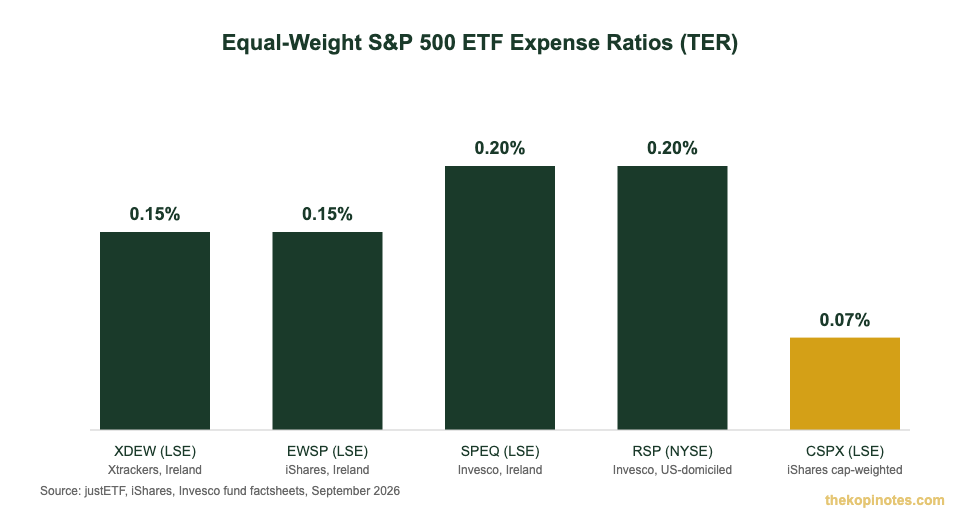
- You get this exposure via RSP (US, 0.20% TER) or LSE-listed XDEW and EWSP (Ireland-domiciled, 0.15% TER, lower withholding tax for SG investors).
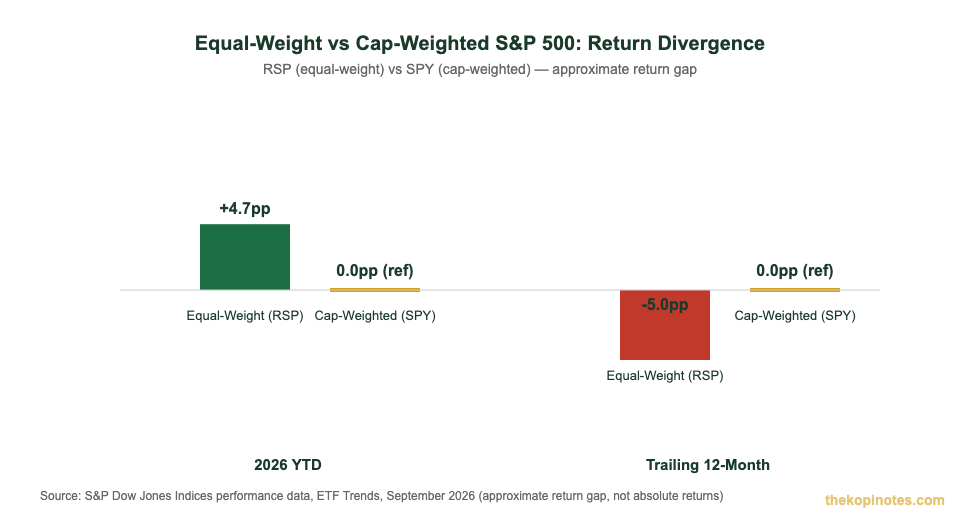
- Equal-weight outperformed in 2026 YTD as mega-cap concentration unwound, but it still lags cap-weighted S&P 500 on a trailing 12-month basis — this is a long-term diversification bet, not a guaranteed winner.
Table of Contents
Contents — Click to expand
- What Is an Equal-Weight S&P 500 ETF?
- RSP vs XDEW vs EWSP vs SPEQ at a Glance
- Why Equal-Weight Is Getting Attention in 2026
- Tax: LSE vs US-Listed Equal-Weight ETFs
- Equal-Weight vs Cap-Weighted: The Performance Trade-Off
- How to Buy Equal-Weight S&P 500 ETFs in Singapore
- Who Should Buy an Equal-Weight ETF?
- Frequently Asked Questions
What Is an Equal-Weight S&P 500 ETF?
The regular S&P 500 is market-cap weighted. That means the biggest companies — think Nvidia, Apple, Microsoft — get the biggest slice of your money. Some of these mega-cap names now sit above 25% of the index combined.
An equal-weight S&P 500 ETF fixes that. It tracks the S&P 500 Equal Weight Index (EWI), which resets every constituent to roughly the same 0.2% weight (1 divided by 500) at each quarterly rebalance in February, May, August and November. A small biotech company and a trillion-dollar tech giant start each quarter with the same-sized slice.
You are not buying a different set of 500 companies. You are buying the exact same S&P 500 universe, just re-sliced so no single name or sector can dominate your returns. This gives you a natural tilt toward mid-cap and value stocks, since mega-caps get scaled down and smaller constituents get scaled up.
RSP vs XDEW vs EWSP vs SPEQ at a Glance
| ETF | Exchange | Domicile | TER | AUM | Structure |
|---|---|---|---|---|---|
| RSP | NYSE Arca | USA | 0.20% | ~USD 100 billion (Aug 2026) | Distributing |
| XDEW | LSE | Ireland | 0.15% | ~EUR 11.5 billion | Accumulating |
| EWSP | LSE | Ireland | 0.15% | ~EUR 4.3 billion | Accumulating |
| SPEQ | LSE | Ireland | 0.20% | ~USD 1.74 billion | Accumulating |
Source: justETF, iShares, Invesco fund factsheets, September 2026
Why Equal-Weight Is Getting Attention in 2026
For most of 2023 to 2025, cap-weighted S&P 500 funds crushed equal-weight alternatives. A handful of AI-driven mega-caps did the heavy lifting, and any fund that underweighted them fell behind.
That flipped in 2026. As at September 2026, RSP has outpaced SPY by roughly 5 percentage points year-to-date, as mega-cap tech names cooled off and gains broadened across sectors. However, S&P Dow Jones Indices data through March 2026 still showed the equal-weight index trailing the cap-weighted version by about 5% on a trailing 12-month basis. In other words, equal-weight is not a guaranteed winner — it does best when market gains are broad-based, and worst when a small group of mega-caps runs away with the market.
For a Singapore investor, the practical question is concentration risk. If your CSPX or VWRA holding already gives you 25%-plus exposure to 10 mega-cap names, an equal-weight sleeve is one way to dial that down without leaving the S&P 500 altogether.
Tax: LSE vs US-Listed Equal-Weight ETFs
This is the part that matters most if you are investing from Singapore. RSP is a US-domiciled ETF. Dividends paid to non-US holders face 30% US withholding tax (WHT). Worse, RSP counts as a US-situs asset, which exposes your estate to US estate tax if your total US assets exceed USD 60,000 at death — a threshold that catches more investors than people expect.
XDEW, EWSP and SPEQ are all domiciled in Ireland. Under the Ireland-US tax treaty, Irish-domiciled UCITS funds face only 15% WHT on US-sourced dividends. Ireland-domiciled ETFs also fall outside the scope of US estate tax, because the fund itself — not you — holds the underlying US shares.
| ETF Type | Domicile | US Dividend WHT | US Estate Tax Risk |
|---|---|---|---|
| XDEW / EWSP / SPEQ (LSE) | Ireland | 15% | None |
| RSP (NYSE Arca) | USA | 30% | Yes (above USD 60k) |
Source: IRS, Ireland-US tax treaty provisions, September 2026
Here is what that looks like in practice. The S&P 500 Equal Weight Index yields roughly 1.5% in dividends, slightly higher than the cap-weighted index because of its value tilt toward dividend-paying mid-caps. On a SGD 50,000 XDEW holding, that is about SGD 750 in annual gross dividends. At 15% WHT, you lose SGD 112.50 a year. Hold the same amount in RSP at 30% WHT, and you lose SGD 225 a year — double the drag, on top of a slightly higher 0.20% TER and the estate tax exposure RSP carries that XDEW does not.
Also note: XDEW and EWSP are accumulating, so dividends are reinvested inside the fund automatically and there is no dividend tax event in Singapore either way. RSP and SPEQ’s distributing share classes pay cash dividends, which you would need to manually reinvest.
Equal-Weight vs Cap-Weighted: The Performance Trade-Off
Equal-weight is not a free lunch. You are trading concentration risk for a different risk: a stronger tilt toward mid-caps and value stocks, and a fund that structurally underweights the mega-cap winners when they are the ones driving the market.
Here’s the honest picture as at September 2026: RSP beat SPY by around 5 percentage points year-to-date, as tech concentration unwound and market gains broadened. But looking back over the trailing 12 months, the equal-weight index was still down roughly 5% versus the cap-weighted version, according to S&P Dow Jones Indices data through March 2026. Whichever period you pick tells a different story — which is exactly why this should be a long-term structural bet on diversification, not a short-term trade based on last quarter’s numbers.
How to Buy Equal-Weight S&P 500 ETFs in Singapore
You buy XDEW, EWSP or SPEQ the same way you would buy VWRA or IWDA — through a broker that gives you LSE access.
Interactive Brokers (IBKR): fund your account, search the ticker (XDEW, EWSP or SPEQ), select the London Stock Exchange as the listing venue, and place your order in GBP or USD depending on the share class. IBKR is the most cost-effective option for larger, buy-and-hold portfolios thanks to its low commission structure.
Saxo Markets: similar process — search the ticker, confirm you are selecting the LSE-listed UCITS version (not the US-listed RSP), and place your order. Saxo’s platform fee applies on top of commission.
Syfe Brokerage: if you prefer a simpler mobile-first interface with no separate custody fees, Syfe Brokerage supports LSE-listed ETFs and is a reasonable starting point for beginners building a first equal-weight position. See the Syfe referral code and sign-up bonus for current promotions.
FSMOne: also offers LSE access and is worth comparing on FX spread and custody fees before you commit — check the FSMOne referral code page for current terms.
Whichever broker you use, double-check you are buying the Ireland-domiciled UCITS ticker on the LSE, not the US-listed RSP on NYSE Arca — the ticker symbols are different but it is an easy mix-up if you are searching by name.
Who Should Buy an Equal-Weight ETF?
An equal-weight S&P 500 ETF makes sense if:
You already hold a large-cap growth-heavy portfolio (CSPX, VOO, or individual mega-cap tech stocks) and want to reduce concentration risk without abandoning US equities. You believe market leadership will broaden beyond the current handful of AI-driven mega-caps. You are investing for the long term and can tolerate multi-year stretches of underperformance versus the standard S&P 500.
Consider sticking with a standard cap-weighted S&P 500 ETF if:
You want the simplest, lowest-cost core holding — CSPX still carries a lower 0.07% TER than any equal-weight alternative. You are not concerned about mega-cap concentration, or you already diversify through a separate Singapore REIT ETF or global small-cap sleeve. You want to keep your portfolio to the fewest possible moving parts.
Equal-weight ETFs are not eligible for CPF Ordinary Account investment (LSE-listed ETFs generally are not CPFIS-approved), but they are SRS-compatible through brokers that support SRS funding for overseas ETFs. If you are building a broader retirement plan around this, the Singapore retirement calculator and our CPF investment strategy guide are useful next reads. For a wider view of the mega-cap concentration problem across your holdings, see our guide to factor investing ETFs, which covers value, quality and low-volatility tilts alongside equal-weight.
Frequently Asked Questions
What is an equal-weight S&P 500 ETF and why do Singapore investors buy it?
An equal-weight S&P 500 ETF tracks the S&P 500 Equal Weight Index, which gives all 500 constituent companies roughly the same 0.2% weight instead of letting mega-cap names dominate. Singapore investors buy the LSE-listed versions like XDEW or EWSP to reduce concentration risk while keeping the lower 15% US dividend withholding tax and no US estate tax exposure that Ireland-domiciled UCITS ETFs offer.
Is RSP the same as XDEW or EWSP?
They all track the same S&P 500 Equal Weight Index, but RSP is US-domiciled and listed on NYSE Arca, while XDEW and EWSP are Ireland-domiciled UCITS ETFs listed on the London Stock Exchange. For Singapore investors, RSP carries 30% US dividend withholding tax and US estate tax exposure above USD 60,000, while XDEW and EWSP carry only 15% withholding tax and no estate tax exposure.
Can I buy equal-weight S&P 500 ETFs using my CPF or SRS funds?
LSE-listed equal-weight ETFs like XDEW, EWSP and SPEQ are generally not CPFIS-approved for CPF Ordinary Account investment. They are SRS-compatible if you use a broker that supports SRS funding for overseas-listed ETFs — check with your specific broker before committing SRS funds.
Which broker is best for buying XDEW or EWSP in Singapore?
Interactive Brokers tends to be most cost-effective for larger, buy-and-hold portfolios due to its low commission structure. Syfe Brokerage and FSMOne are simpler alternatives for beginners, though it is worth comparing FX spreads and custody fees across all three before deciding.
Does equal-weight always outperform the standard S&P 500?
No. Equal-weight tends to outperform when market gains are broad-based across many stocks and sectors, and underperform when a small group of mega-caps drives most of the market’s returns. As at September 2026, equal-weight had outpaced the cap-weighted S&P 500 year-to-date, but was still behind on a trailing 12-month basis. Treat it as a long-term diversification decision, not a short-term timing call.
What are the risks of an equal-weight S&P 500 ETF?
Equal-weight ETFs carry a structural tilt toward mid-cap and value stocks and away from mega-cap growth, which means they can lag the standard S&P 500 for extended periods when a handful of large companies drive most gains. They also rebalance quarterly, which creates modestly higher internal turnover than a pure cap-weighted index fund, though this is already reflected in the TER you pay.
Ready to Diversify Beyond Mega-Cap Concentration?
Open a brokerage account and add an equal-weight sleeve to your portfolio. Use our referral links for exclusive sign-up bonuses.
This article was researched with the help of AI. While we strive to keep all information accurate and up to date, there may be errors. If you notice any discrepancies, please contact us.