Medisave Limit 2026: Pre-Existing Condition Exclusion in Your ISP — What You Can Still Claim
Your ISP can exclude a condition. MediShield Life cannot. Here is exactly what that difference costs you at the hospital counter in 2026.
An Integrated Shield Plan can exclude a pre-existing condition from its private insurance component, but it cannot remove your MediShield Life coverage for that same condition. If you are admitted for an excluded condition, MediShield Life still pays its share of the bill based on your ward class, and you can use Medisave to settle the deductible and co-payment up to the Additional Withdrawal Limit. This guide explains exactly what each layer pays, what you owe out of pocket, and whether buying an ISP still makes sense if you carry an exclusion.
Not financial advice. All figures are for educational reference only. Data verified as at 5 November 2026.
In This Guide
- The Two-Layer Structure: Why MediShield Life Is Different from Your ISP
- What a Pre-Existing Condition Exclusion Actually Means
- Full Medical Underwriting vs Moratorium Underwriting
- What MediShield Life Still Pays for Your Excluded Condition
- Using Medisave When Your ISP Has an Exclusion
- The April 2026 Rider Rules and How They Interact with Exclusions
- Real Hospital Bill Example: Excluded Condition, Private Ward
- Should You Buy ISP If You Have a Pre-Existing Condition?
- Frequently Asked Questions
The Two-Layer Structure: Why MediShield Life Is Different from Your ISP
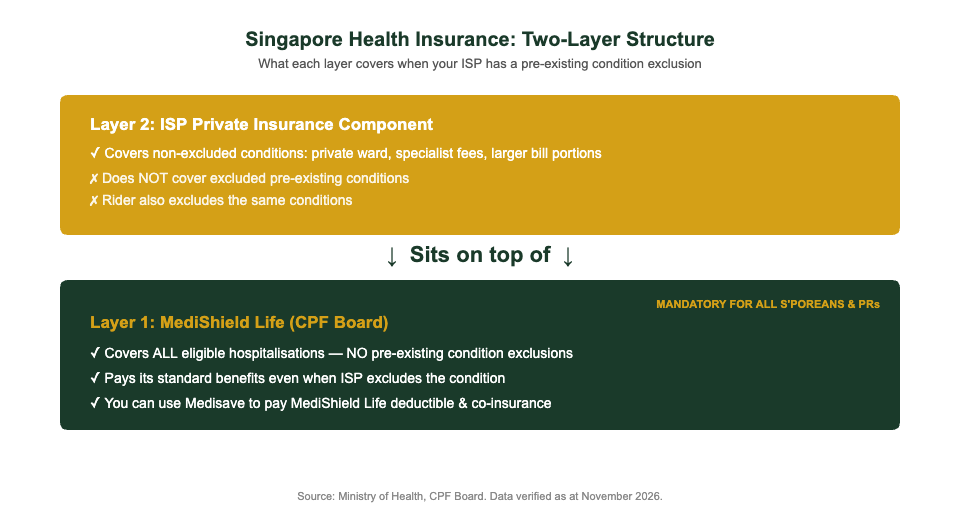
To understand what an ISP exclusion actually costs you, you first need to understand how Singapore’s health insurance stack is built. It has two distinct layers, and they operate under entirely different rules when it comes to pre-existing conditions.
Layer 1 — MediShield Life is administered by the CPF Board on behalf of MOH. Every Singapore Citizen and Permanent Resident is covered. By law, MediShield Life carries no exclusions for pre-existing conditions. It does not matter when you were diagnosed, how severe your condition is, or what your medical history looks like — MediShield Life pays its standard benefits for any eligible hospitalisation. This is a core design principle of the scheme, and it has not changed since MediShield Life replaced MediShield in November 2015.
Layer 2 — The Integrated Shield Plan private insurance component is sold by one of six licensed insurers (AIA, Great Eastern, Income, Prudential, Singlife, HSBC Life). This private layer tops up MediShield Life by paying for higher ward classes, private hospitals, and larger bill portions. Unlike MediShield Life, the IP component is commercial insurance and operates under standard underwriting rules. Insurers can exclude specific pre-existing conditions from this layer, and they routinely do.
The critical point: an ISP exclusion affects only the private IP component. MediShield Life remains in full force regardless of whatever exclusions appear in your ISP policy.
| Layer | Covers Your Excluded Condition? | Basis of Coverage |
|---|---|---|
| MediShield Life | ✓ Yes — always | Mandatory; no exclusions allowed by law |
| ISP private IP component | ✗ No — condition excluded | Commercial insurance; insurer sets exclusions at underwriting |
| IP rider (if any) | ✗ No — excluded condition | Rider follows IP component; exclusions carry through |
Source: Ministry of Health, CPF Board. Data verified as at November 2026.
What a Pre-Existing Condition Exclusion Actually Means
When an insurer adds a pre-existing condition exclusion to your ISP, it means the IP private component will not pay any benefits for hospitalisations caused by or related to that condition. The exclusion typically appears as a named condition endorsement on your policy schedule — for example, “Exclusion: Hypertension and its complications.”
Several practical consequences follow:
- The exclusion applies to both the base IP and the rider. If your plan includes an IP rider (the top-up that covers deductibles and co-payments), that rider also does not pay for the excluded condition.
- Related complications are usually excluded too. If your policy excludes hypertension, a stroke or heart attack linked to that hypertension is also typically excluded from the IP component.
- The exclusion is permanent under Full Medical Underwriting, unless you successfully apply to have it reviewed after a specified symptom-free period (which varies by insurer).
- Under Moratorium Underwriting, the exclusion is time-limited. See the section below on FMU vs MU.
- Claiming for an unrelated condition is unaffected. If you are admitted for a broken leg and your exclusion covers your thyroid condition, the ISP pays the broken leg claim in full (subject to normal deductible and co-payment rules).
Being on an IP with an exclusion does not reduce your MediShield Life benefits in any way. The two layers are assessed independently for each claim.
Full Medical Underwriting vs Moratorium Underwriting
How an exclusion ends up in your policy depends on the type of underwriting used when you applied for your ISP. There are two main approaches in Singapore.
Full Medical Underwriting (FMU)
Under FMU, you complete a full medical declaration when applying for your ISP. The insurer reviews your health history and either accepts you at standard rates, adds exclusions for specific conditions, adds a loading (higher premium), or declines your application. FMU gives you clarity upfront: your policy schedule will list exactly which conditions are excluded. The exclusion is typically permanent unless you apply for a review after meeting the insurer’s symptom-free criteria.
Most ISP plans currently sold in Singapore use FMU. Because you declare everything at the start, there is less dispute at claim time about whether a condition was pre-existing — the insurer already knew about it and priced accordingly.
Moratorium Underwriting (MU)
Under MU, you do not need to declare pre-existing conditions when applying. Instead, any condition for which you had symptoms, sought treatment, or were advised to seek treatment in the years before joining is automatically excluded for a moratorium period — typically 10 years from your policy start date. After that period, if you have been symptom-free and treatment-free for the full duration, the condition becomes covered. If you experienced a recurrence during the moratorium, the clock resets.
MU plans are less common now, with most major ISP insurers moving to FMU. However, many older policyholders remain on MU plans. If you hold a moratorium plan and are approaching the 10-year mark for a previously excluded condition, it is worth checking your insurer’s process for reviewing cover.
For a detailed breakdown of how the moratorium look-back rule works, see TKN’s guide on Integrated Shield Plans in Singapore.
What MediShield Life Still Pays for Your Excluded Condition
When you are hospitalised for a pre-existing condition that your ISP excludes, MediShield Life pays its standard claim amount based on the ward type you are admitted to. The claim is calculated using MediShield Life’s fee schedules, which set the maximum claimable amount for each type of treatment and ward class.
For hospitalisation in a subsidised ward (Class B2 or C in a public hospital), MediShield Life’s reimbursement usually covers a substantial portion of the bill after the deductible and co-insurance. For Class B1, Class A, and private hospital wards, MediShield Life reimburses at a fixed rate based on what equivalent subsidised care would cost — not the full private rate. This means the gap between what MediShield Life pays and what you actually owe is much larger in higher-ward-class admissions.
The key numbers for 2026:
- MediShield Life annual deductible: $1,500 for B2 and C ward class; higher for B1, A, and private (the full schedule is on the MOH website).
- MediShield Life co-insurance: 10% of the claimable amount after the deductible.
- MediShield Life payout is then: claimable amount minus deductible minus co-insurance.
Because your ISP and rider do not cover the excluded condition, there is no IP top-up. You pay the deductible and co-insurance yourself — either from Medisave (up to the AWL) or in cash. The portion of your bill that exceeds MediShield Life’s fee schedule is paid entirely out of pocket.
This is the essential reason why choosing your ward class matters enormously when you have an ISP exclusion. Staying in a subsidised B2 or C ward significantly reduces the bill gap compared with a Class A or private room, because MediShield Life pays proportionally more of the subsidised bill.
Using Medisave When Your ISP Has an Exclusion
Medisave can be used to pay for two types of costs even when your ISP excludes the condition you are claiming for:
- ISP premiums — You pay your ISP premiums from Medisave regardless of your exclusions. The MediShield Life component of your premium is fully deductible from Medisave. The private IP component is deductible from Medisave up to the Additional Withdrawal Limit (AWL) for your age group.
- Hospital bills for the excluded condition — Medisave can be used to pay the deductible and co-insurance for hospital admissions, including admissions for excluded conditions, subject to the prevailing Medisave hospitalisation withdrawal limits.
The AWL for IP premiums is set by the CPF Board and varies by age. These are the current limits:
| Age Next Birthday | Medisave AWL for IP Premium (per year) |
|---|---|
| 1 to 40 | $300 |
| 41 to 70 | $600 |
| 71 and above | $900 |
Source: CPF Board, as at March 2025. Last confirmed unchanged for 2026.
What this means in practice: if you are 45 years old and your ISP premium exceeds the AWL, the portion above $600 must be paid in cash. This is true whether or not you have a pre-existing condition exclusion — the AWL limit applies to all IP policyholders.
Having an exclusion does not change your AWL entitlement, but it does mean you get less value from your ISP premium spend if most of your likely admissions fall under the excluded condition.
For more detail on how Medisave limits interact with ISP premiums, see the guide on Medisave Limit 2026.
The April 2026 Rider Rules and How They Interact with Exclusions
From 1 April 2026, MOH introduced new requirements for IP riders. The key changes relevant to policyholders with pre-existing condition exclusions are:
- Minimum IP deductible: New riders sold from 1 April 2026 can no longer cover the minimum IP deductible. The minimum deductibles (which you must bear yourself) are $3,500 for Class A and private; $2,500 for B1; $2,000 for B2; and $1,500 for Class C ward.
- Minimum 5% co-payment: This requirement was already in place and remains unchanged. At least 5% of each eligible claim must be borne by the policyholder.
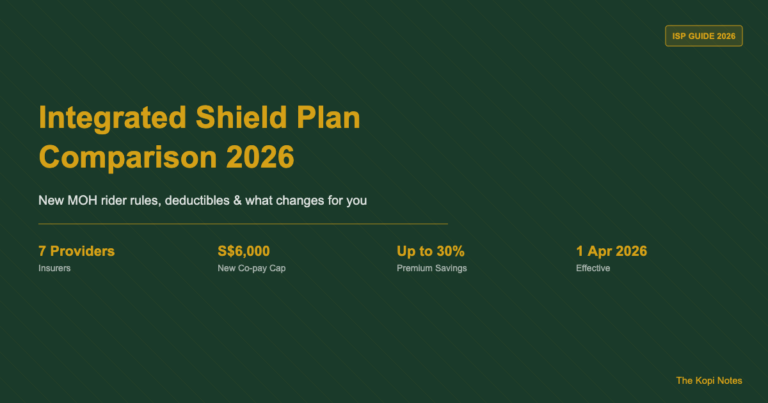
- Co-payment annual cap: Raised from $3,000 to $6,000 per policy year for panel or pre-authorised claims. This is the maximum total co-payment (excluding the minimum deductible) you pay per year under a compliant new rider.
For policyholders with an excluded condition, these changes have an indirect effect. When you are admitted for an excluded condition, your IP rider does not pay at all — the new 5%/$6,000 cap structure does not apply because the rider is not on the hook for excluded claims. You are essentially paying the full deductible and co-insurance under MediShield Life rules, plus any excess over MediShield Life’s fee schedule.
However, for non-excluded conditions — conditions your ISP does cover — the new rider rules apply as normal. If you hold a compliant new rider, you benefit from the $6,000 annual co-payment cap on those covered claims.
The deductible and co-payment amounts can be paid from Medisave, subject to prevailing withdrawal limits, according to MOH guidelines.
For a full breakdown of the April 2026 rider changes, see the ISP Rider Medisave 2026 Guide.
Real Hospital Bill Example: Excluded Condition, Private Ward
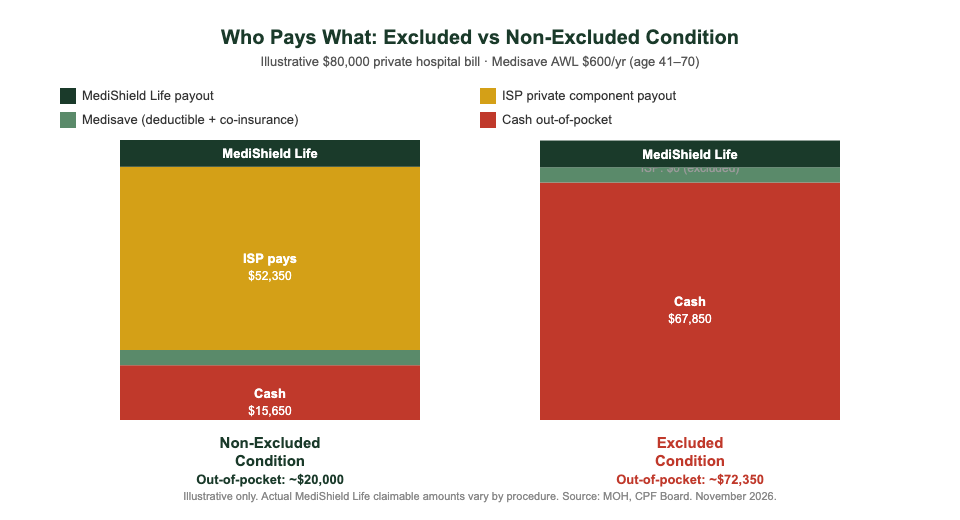
To make this concrete, consider a 50-year-old policyholder with an ISP (Class A/Private ward plan) who has a hypertension exclusion added under Full Medical Underwriting. She is admitted to a private hospital for a coronary artery bypass procedure related to her hypertension — an excluded condition. Her total bill is $80,000.
How her claim is settled:
- MediShield Life claimable amount: MediShield Life applies its surgical procedure fee and ward claimable amounts — in a private hospital, this is typically a fraction of the actual bill. For illustrative purposes, assume MediShield Life’s maximum claimable amount for this procedure is $12,000.
- MediShield Life deductible: She pays the first $3,500 (the deductible for a private hospital equivalent under MediShield Life). This can come from her Medisave.
- MediShield Life co-insurance: 10% of the remaining claimable amount ($12,000 − $3,500 = $8,500), so 10% × $8,500 = $850. This can also be paid from Medisave.
- MediShield Life payout: $8,500 − $850 = $7,650.
- ISP private component: Pays nothing — hypertension is excluded.
- IP rider: Pays nothing — exclusion carries through to rider.
- Amount left unpaid by insurance: $80,000 − $7,650 = $72,350. Of this, $4,350 (deductible + co-insurance) can be drawn from Medisave; approximately $67,850 must be paid in cash.
This example illustrates the stark financial gap created when a high-cost admission involves an excluded condition in a private hospital. For comparison, if the same procedure were done in a subsidised B2 or C ward, MediShield Life’s fee schedule would cover a larger share of the actual bill, and the total gap would be significantly smaller.
Note: MediShield Life’s actual claimable amounts vary by procedure and are set out in the prevailing Schedule of Claimable Charges. The figures above are illustrative only.
Should You Buy ISP If You Have a Pre-Existing Condition?
Having a pre-existing condition exclusion does not necessarily mean an ISP is worthless. The right answer depends on the nature of the exclusion and your broader health risk profile.
When an ISP Still Makes Sense Despite an Exclusion
- The excluded condition is narrow or low-risk. If your exclusion covers a minor past injury (such as a knee ligament issue from years ago), the ISP still covers everything else — cancer, infections, cardiac events unrelated to your exclusion, and so on. For broad health coverage on non-excluded conditions, the ISP remains valuable.
- You are under moratorium underwriting and approaching the 10-year mark. If the excluded condition has been symptom-free for close to 10 years, coverage may be restored. It is worth asking your insurer about the review process.
- The ISP provides private ward access for all non-excluded conditions. Even with one exclusion, your plan still allows private room admission, panel specialist access, and faster elective treatment for other conditions — benefits that MediShield Life alone cannot give you.
When the ISP Value Diminishes Significantly
- The excluded condition is your primary health risk. If your exclusion covers diabetes and you are at significant risk of diabetes-related complications, you may find that your most likely hospitalisations are not covered by the ISP at all.
- ISP premiums are expensive at your age and the coverage gap is large. For older policyholders with high premiums and an exclusion covering their most probable admission reason, the premium cost may outweigh the benefit.
- You are comfortable with public hospital subsidised care. If you are willing to be admitted to a Class B2 or C ward for the excluded condition, MediShield Life alone — without the ISP top-up — covers a substantial share of the bill in subsidised wards. Some policyholders in this situation downgrade their ISP to a lower ward class or drop their rider while keeping the base plan.
Whatever you decide, do not cancel your ISP without understanding the guaranteed renewability rules. ISP plans are guaranteed renewable — your insurer cannot cancel your policy because you become sick. If you cancel voluntarily, you may not be able to reinstate at the same terms later, particularly if your health has changed further.
Looking for a comparison of ISP options? Syfe referral code and sign-up bonus and our Singapore retirement calculator can also help you model the long-term cost of different health coverage choices.
Frequently Asked Questions
If my ISP excludes my condition, does MediShield Life still pay?
Can I use Medisave to pay for a hospitalisation if my ISP does not cover it?
Does my ISP rider cover the excluded condition if I meet the new 2026 co-payment cap?
If I downgrade from a private ward ISP to a Class B1 ISP, does that change my exclusion?
When can I apply to have my exclusion reviewed or removed?
What happens to my ISP exclusion if I switch insurers?
Get Free Insurance Advice
Speak with a licensed insurance advisor. No obligation, no cost.
By submitting this form, you agree to our Privacy Policy.
This article was researched with the help of AI. While we strive to keep all information accurate and up to date, there may be errors. If you notice any discrepancies, please contact us.