Integrated Shield Plan Singapore 2026: Complete Guide + April Rider Changes
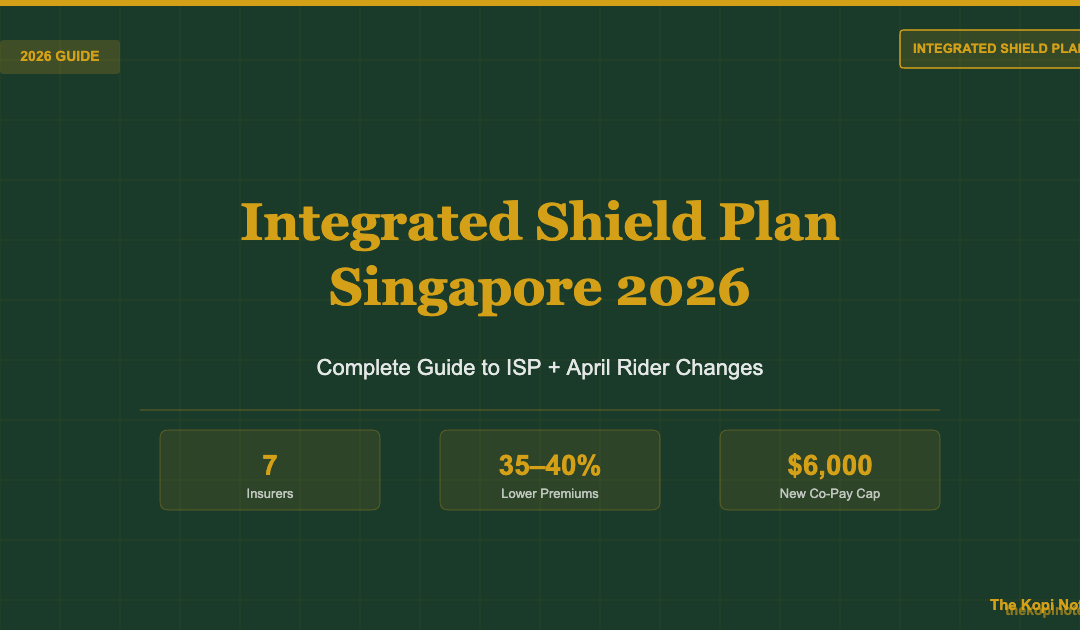
An Integrated Shield Plan (ISP) is a private health insurance plan sold by seven MOH-approved insurers. It sits on top of your MediShield Life base layer to give you higher ward class coverage — from Class B1 in public hospitals all the way up to private hospital rooms. From 1 April 2026, all new ISP riders must meet stricter MOH requirements: they can no longer cover your deductible, and your annual co-payment cap has doubled from $3,000 to $6,000. In return, new rider premiums are roughly 35–40% cheaper.
Not financial advice. All figures are for educational reference only. Data verified as at August 2026.
- An ISP upgrades your MediShield Life to cover higher ward classes or private hospitals — 7 insurers offer them.
- From April 2026, new riders can no longer pay your deductible, and the co-pay cap doubled to $6,000/year — but premiums dropped 35–40%.
- You can use MediSave for your base ISP premium, but not the rider — that comes out of cash.
What Is an Integrated Shield Plan?
Think of your healthcare coverage as a sandwich. The bread at the bottom is MediShield Life — the national scheme every Singapore citizen and PR has automatically. It covers Class B2 and C ward bills in public hospitals. That’s decent, but it leaves gaps for anyone who wants a higher ward class or private hospital option.
An Integrated Shield Plan fills that gap. It’s a private insurance policy that integrates with MediShield Life to give you one combined plan. Your ISP premium pays for both the MediShield Life component (administered by CPF Board) and the additional private insurance component (sold by a private insurer).
The result? You get continuous, seamless coverage — without managing two separate policies.
What does an ISP cover?
At a minimum, every ISP covers Class B1 wards in public hospitals — a step up from MediShield Life’s B2/C default. Higher-tier plans cover Class A wards or private hospitals altogether.
| Plan Tier | Ward Coverage | Hospital Type |
|---|---|---|
| MediShield Life (base) | Class B2 / C | Public hospital only |
| ISP Standard | Class B1 | Public hospital |
| ISP Enhanced | Class A | Public or private |
| ISP Premium | Private ward / room | Private hospital |
Source: MOH Integrated Shield Plan framework, August 2026
How ISP Premiums and Claims Work
Your ISP premium has two parts. The MediShield Life component goes to CPF Board — this is the same for everyone and you can pay it from MediSave. The additional private insurance component goes to your chosen insurer. You can also use MediSave to help pay this portion, up to an annual withdrawal limit.
On top of the base ISP, you can add an optional rider. A rider reduces the deductible and co-insurance you pay when you claim. Before April 2026, some riders covered almost everything. That has now changed.
What is the deductible?
The deductible is the first chunk of your bill you pay before insurance kicks in. It ranges from $1,500 to $3,500 depending on which ward class you choose. Under the new 2026 rules, no new rider can cover this for you — you pay it out of pocket first.
What is co-insurance?
Co-insurance is the percentage of the remaining bill you pay after the deductible. Typically 10%. A rider can reduce this — but from 2026, new riders must have a minimum annual co-payment cap of $6,000 (previously $3,000). That means in a serious hospitalisation, you could be responsible for up to $6,000 beyond the deductible.
2026 Rider Changes: What You Need to Know
MOH announced the new ISP rider requirements in November 2025. They took effect on 1 April 2026. If you already have a legacy rider, it is not immediately affected — but new riders sold from that date must follow the new rules.
Here is what changed in plain English:
- No deductible coverage. New riders cannot pay your minimum deductible. You pay this first, every year, before your insurance claim begins.
- Higher co-payment cap. The annual co-payment cap doubled from a minimum of $3,000 to at least $6,000. This is the most you will pay in co-insurance per year.
- Lower rider premiums. Because you now share more risk, new private hospital rider premiums are on average 35–40% lower than legacy riders with maximum coverage.
MOH’s goal is to reduce over-consumption of private healthcare and keep the system sustainable. When patients have more skin in the game, they tend to make more cost-conscious choices.
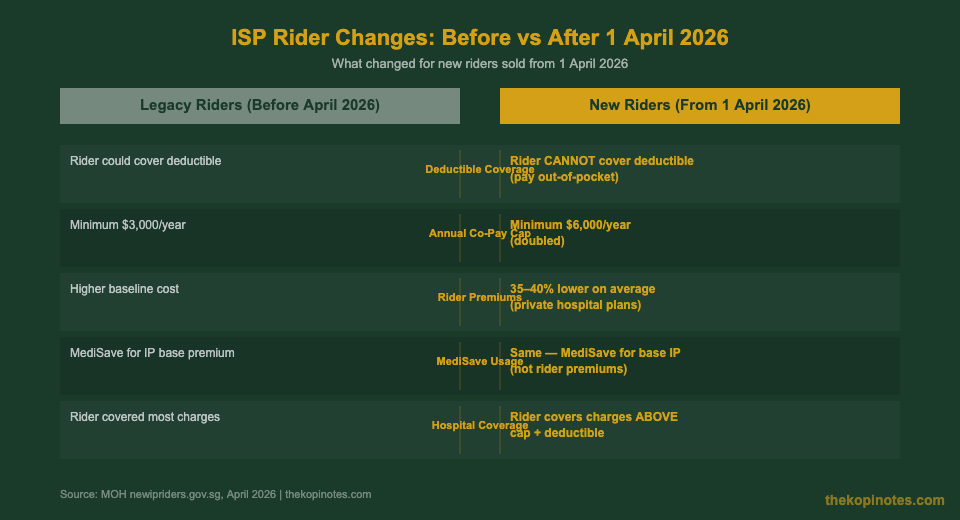
Source: MOH newipriders.gov.sg, April 2026
What if you have a legacy rider?
If you bought your rider before 1 April 2026, you are on a legacy plan. You can keep it. Your terms do not change overnight. However, if you switch to a new rider or buy a new policy, the 2026 rules apply immediately.
MOH has encouraged policyholders to review and right-size their coverage. Many Singaporeans will find the new riders — with their lower premiums and increased out-of-pocket exposure — actually suit their needs better, especially if they are healthy and rarely hospitalised.
One way to prepare for the higher co-payment cap: use a retirement planning calculator to set aside a healthcare buffer in your long-term financial plan.
All 7 ISP Insurers in Singapore (2026)
As of 2026, MOH has approved seven private insurers to offer Integrated Shield Plans. Each insurer offers a range of plan tiers. Here is an overview of all seven and their top-tier private hospital plans:
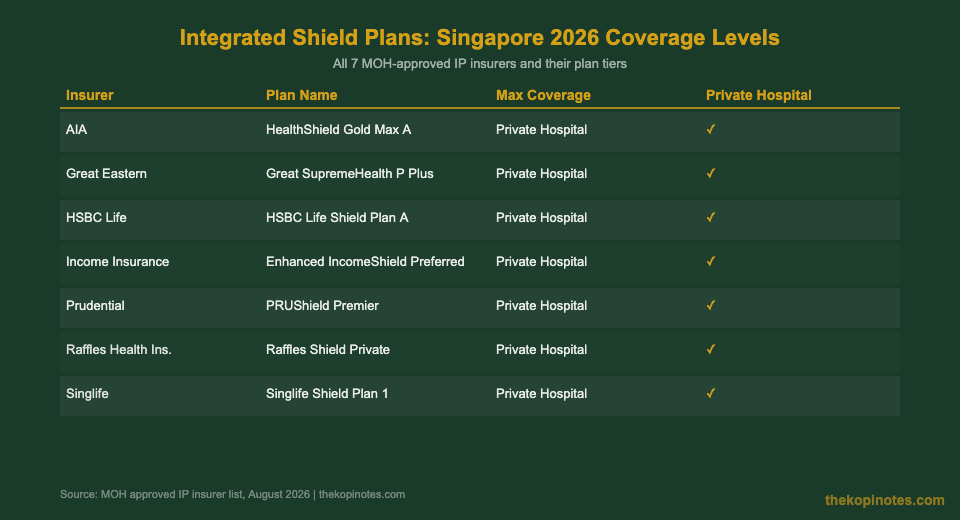
Source: MOH approved IP insurer list, August 2026
| Insurer | Plan Name (Highest Tier) | Max Coverage |
|---|---|---|
| AIA | HealthShield Gold Max A | Private Hospital |
| Great Eastern | Great SupremeHealth P Plus | Private Hospital |
| HSBC Life | HSBC Life Shield Plan A | Private Hospital |
| Income Insurance | Enhanced IncomeShield Preferred | Private Hospital |
| Prudential | PRUShield Premier | Private Hospital |
| Raffles Health Insurance | Raffles Shield Private | Private Hospital |
| Singlife | Singlife Shield Plan 1 | Private Hospital |
Source: MOH approved IP insurer list, August 2026. Always check the latest premiums by age on the official MOH ISP comparison page.
All seven insurers have launched new rider products that comply with the April 2026 MOH requirements. For personalised investment planning alongside your ISP, platforms like Syfe and Endowus can help you grow a cash reserve for future healthcare costs.
Using MediSave for Your ISP
MediSave helps make ISP premiums more affordable. You can use MediSave to pay the base ISP premium — both the MediShield Life component and the additional private insurer component — up to the annual MediSave withdrawal limit for insurance.
However, you cannot use MediSave to pay for your rider premium. Rider premiums must be paid in cash. This is an important distinction many people miss.
MediSave withdrawal limits for ISP (2026)
| Age Next Birthday | MediSave Withdrawal Limit (per year) |
|---|---|
| 1 – 20 | $300 |
| 21 – 30 | $600 |
| 31 – 40 | $900 |
| 41 – 50 | $1,200 |
| 51 – 60 | $1,800 |
| 61 – 65 | $2,160 |
| 66 and above | $2,600 |
Source: CPF Board MediSave withdrawal limits, 2026. Verify at the official CPF Board website as limits are updated periodically.
If your ISP premium exceeds the withdrawal limit, you pay the difference in cash. For most people in their 20s–40s on a standard B1 or Class A plan, MediSave covers a significant chunk of the annual premium.
Want to understand how MediSave fits into your broader CPF picture? Our guide on CPF investment strategy covers the full breakdown of how your Ordinary, Special, and MediSave accounts work together.
How to Choose the Right Integrated Shield Plan
Choosing an ISP comes down to three questions: which ward class do you want, do you need a rider, and which insurer’s panel suits your preferred doctors?
Step 1: Decide on ward class
This is the most important decision. Ask yourself honestly: if you were hospitalised tomorrow, which ward class would you be comfortable in? If a B1 ward in a public hospital is fine, you do not need a private hospital plan. Private hospital plans cost significantly more — both in premiums and in the gap bills that riders may not fully cover.
Step 2: Consider whether you need a rider
Under the new 2026 rules, a rider still reduces your co-insurance — but you will always pay the deductible ($1,500–$3,500) and up to $6,000 in annual co-payments. For someone who is healthy and rarely hospitalised, paying the rider premium every year may not be cost-effective. Run the numbers honestly.
Step 3: Check the insurer’s panel
Each insurer has a list of panel specialists and hospitals. If you have preferred doctors or hospitals, check that they are on the panel before committing. Using a non-panel doctor means higher out-of-pocket costs.
Step 4: Think long-term on premiums
ISP premiums increase sharply with age. A plan that is affordable at 30 may be expensive at 55. Factor in long-term premium sustainability when choosing your insurer and plan tier. Use our Singapore retirement calculator to stress-test your healthcare budget at different life stages.
Tip: Do not over-insure
MOH’s S+3Ms framework means even without a rider, Singaporeans will not go without appropriate care. If you are on a tight budget, a base ISP without a rider is still dramatically better protection than MediShield Life alone.
Frequently Asked Questions
What is the difference between MediShield Life and an Integrated Shield Plan?
How many insurers offer Integrated Shield Plans in Singapore?
What changed about ISP riders in April 2026?
Can I still use my old ISP rider after April 2026?
Can I use MediSave to pay for my ISP?
Do I need an ISP if I am happy with public hospitals?
What is the ISP deductible amount in 2026?
Get Free Insurance Advice
Speak with a licensed insurance advisor. No obligation, no cost.
By submitting this form, you agree to our Privacy Policy.
This article was researched with the help of AI. While we strive to keep all information accurate and up to date, there may be errors. If you notice any discrepancies, please contact us.