Great Eastern Shield Plan Singapore: GREAT SupremeHealth Complete Guide 2026
Your complete guide to GREAT SupremeHealth — Singapore’s integrated shield plan from Great Eastern. Plans, premiums, riders, and who it actually suits.
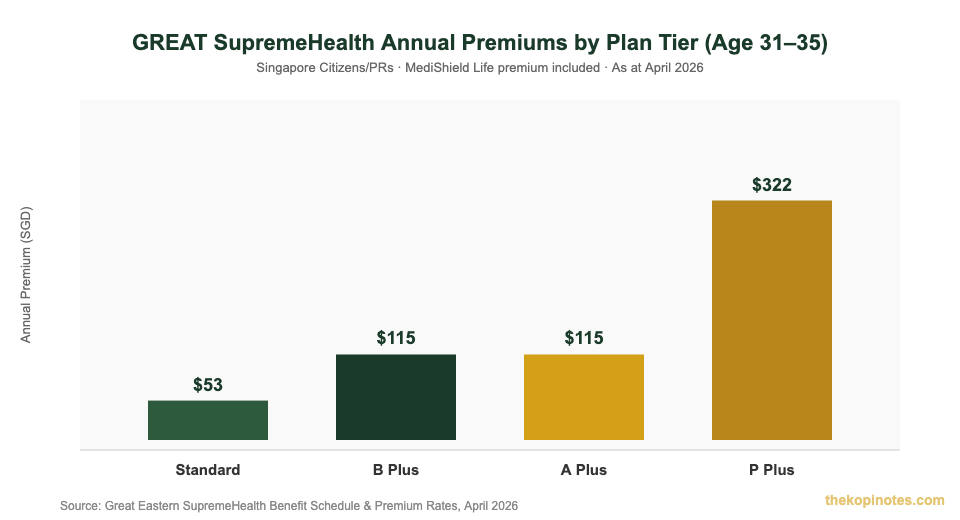
Great Eastern’s shield plan is called GREAT SupremeHealth — a MediSave-approved Integrated Shield Plan (ISP) that stacks on top of MediShield Life to cover higher ward classes and private hospitals. It comes in four tiers: Standard, B Plus, A Plus, and P Plus. For a 35-year-old, premiums range from about $53 to $322 per year. Great Eastern is known for competitive pricing in the 25–45 age group and claims-based pricing, which rewards healthy policyholders with lower premiums.
Not financial advice. All figures are for educational reference only. Data as at April 2026 unless noted.
- GREAT SupremeHealth has 4 tiers — Standard, B Plus, A Plus, P Plus — covering B1 ward through private hospitals.
- Premiums are competitive for younger, healthier Singaporeans but claims-based pricing means they rise after you claim.
- The GREAT TotalCare 2 rider reduces out-of-pocket costs but no longer covers your deductible after April 2026.
Table of Contents
Contents — Click to expand
- What Is the Great Eastern Shield Plan?
- GREAT SupremeHealth Plan Tiers at a Glance
- Premiums: How Much Does It Cost?
- GREAT TotalCare 2 Rider — What It Covers
- April 2026 MOH Rider Changes: What Changed for You
- Great Eastern vs Other Shield Plans
- Who Should Buy GREAT SupremeHealth?
- Frequently Asked Questions
What Is the Great Eastern Shield Plan?
GREAT SupremeHealth is Great Eastern’s Integrated Shield Plan (ISP) — Singapore’s government-approved category of private health insurance that wraps around MediShield Life. Think of MediShield Life as the government’s basic layer, sized for subsidised B2/C wards. GREAT SupremeHealth is the additional layer that kicks in when you want higher coverage — Class B1, Class A, or a private hospital stay.
Great Eastern Life has been in Singapore since 1908. It is one of seven government-approved ISP providers, alongside AIA, Prudential, Singlife, NTUC Income, Raffles Health Insurance, and AXA. This matters because only approved ISPs can be paid for using your MediSave funds.
GREAT SupremeHealth is made up of two components: the MediShield Life portion (administered by CPF Board) and an additional private insurance layer provided by Great Eastern. When you buy GREAT SupremeHealth, your single premium covers both — and your CPF Board handles the MediShield Life part automatically.
You can also add the GREAT TotalCare 2 supplementary plan — a rider that reduces your co-insurance and deductible. This is a cash-only plan and is not payable by MediSave.
GREAT SupremeHealth Plan Tiers at a Glance
GREAT SupremeHealth comes in four tiers. The tier you pick determines which hospital wards you’re covered for and your annual benefit limit. Here’s a clear breakdown:
| Plan Tier | Hospital Coverage | Annual Limit | Who It Suits |
|---|---|---|---|
| Standard | Restructured Hospital, Class B1 & below | $200,000 | Budget-conscious; want step up from MediShield Life |
| B Plus | Restructured Hospital, Class B1 & below | $500,000 | B1 ward coverage with higher limits |
| A Plus | Restructured Hospital, Class A ward & below | $1,000,000 | Single room in restructured hospital; most popular tier |
| P Plus | Private Hospitals & Restructured Hospitals | $1,500,000 | Full private hospital access; choice of any doctor |
Source: Great Eastern SupremeHealth Benefit Schedule & Premium Rates, April 2026
A Plus is typically the most popular tier — it gives you a single room in a restructured hospital (think SGH, NUH, TTSH), which means better privacy and service. P Plus goes further, covering private hospitals like Mount Elizabeth, Gleneagles, and Farrer Park Hospital.
There is also a newer P Prime plan, designed for those who want private hospital access through a panel of Great Eastern’s Partnering Medical Institutions (PMIs) — these include Raffles Hospital, Farrer Park Hospital, Thomson Medical Centre, and Mount Alvernia. Premiums for P Prime are lower than P Plus, but you are restricted to these PMIs for the reduced co-payment benefit to apply.
Premiums: How Much Does It Cost?
Great Eastern uses claims-based pricing. This means your premium is partly determined by your personal claims history — if you claim frequently, your premiums rise more than someone who hasn’t claimed. This is different from AIA and Prudential, which use community-rated pricing where everyone in the same age band pays the same.
Claims-based pricing works in your favour when you are young, healthy, and rarely hospitalised. It can work against you as you age and your claim frequency increases.
Here are approximate annual premiums for a Singapore Citizen aged 31–35, inclusive of the MediShield Life component:
| Plan Tier | Age 26–30 | Age 31–35 | Age 41–45 | Age 56–60 |
|---|---|---|---|---|
| Standard | ~$45 | ~$53 | ~$130 | ~$650 |
| B Plus | ~$100 | ~$115 | ~$250 | ~$1,200 |
| A Plus | ~$100 | ~$115 | ~$280 | ~$1,450 |
| P Plus | ~$270 | ~$322 | ~$650 | ~$2,807 |
Source: Great Eastern SupremeHealth Benefit Schedule & Premium Rates, April 2026. Figures are approximate and may vary by gender and health history.
All GREAT SupremeHealth premiums can be paid using MediSave, up to the Additional Withdrawal Limit (AWL) based on your age. For most working adults, MediSave covers the full GREAT SupremeHealth premium — meaning you pay zero cash for the base plan. If you’re thinking about your CPF investment strategy, it’s worth noting that ISP premiums come from your MediSave account, not your OA or SA.
GREAT TotalCare 2 Rider — What It Covers
GREAT SupremeHealth on its own still requires you to pay a deductible (the first portion of each hospital bill) and co-insurance (10% of the remaining bill). These out-of-pocket costs can add up. That’s where the GREAT TotalCare 2 rider comes in.
GREAT TotalCare 2 covers part of your co-insurance and applies a Co-payment Cap of $6,000 per policy year. This means your total out-of-pocket co-payments cannot exceed $6,000 in any year — regardless of how large your bill grows. However, this cap excludes the deductible (see next section).
GREAT TotalCare 2 also includes additional benefits not in the base plan:
- Outpatient cancer drug treatment not on the Cancer Drug List (CDL)
- Emergency accidental outpatient treatment
- Post-stroke outpatient care support
- Additional outpatient cancer support
There are four versions of GREAT TotalCare 2, matched to your GREAT SupremeHealth tier:
| GREAT SupremeHealth Plan | Recommended Rider | Annual Rider Benefit Cap |
|---|---|---|
| P Plus | GREAT TotalCare 2 (P) | Up to $400,000 |
| P Prime | GREAT TotalCare 2 (Prime) | Up to $400,000 |
| A Plus | GREAT TotalCare 2 (A) | Up to $400,000 |
| B Plus / Standard | GREAT TotalCare 2 (B) | Up to $400,000 |
Source: Great Eastern Life, April 2026. Rider premium is payable in cash only — not MediSave.
April 2026 MOH Rider Changes: What Changed for You
From 1 April 2026, MOH introduced new requirements for all IP supplementary plans (riders) in Singapore. These affect GREAT TotalCare 2 significantly. Here’s what changed:
1. Riders no longer cover your deductible. Before April 2026, some riders covered your deductible in full. Now, you must pay the deductible yourself — no rider in Singapore can cover it anymore. The deductible amounts are:
- Private hospital or Class A ward: $3,500
- Class B1 ward: $2,500
- Class B2/C ward: $2,000
- Day surgery (non-subsidised): $2,500
2. Co-payment Cap raised from $3,000 to $6,000. Your rider now caps total co-payments at $6,000 per year (excluding the deductible), up from the previous $3,000 cap. So your maximum out-of-pocket is now your deductible plus up to $6,000 in co-insurance — meaning potentially $9,500 in a bad year for a private hospital stay.
This is a significant change for anyone who currently has ISP coverage and expected their rider to minimise all hospital bills. If you’re planning your retirement savings, factor in a higher healthcare reserve — roughly $10,000 per hospitalisation event in a private hospital as a planning figure.
The good news: the new GREAT TotalCare 2 plans introduced on 1 April 2026 are fully compliant with these MOH rules. If you bought a rider before April 2026, Great Eastern will have transitioned you to the new structure.
Great Eastern vs Other Shield Plans
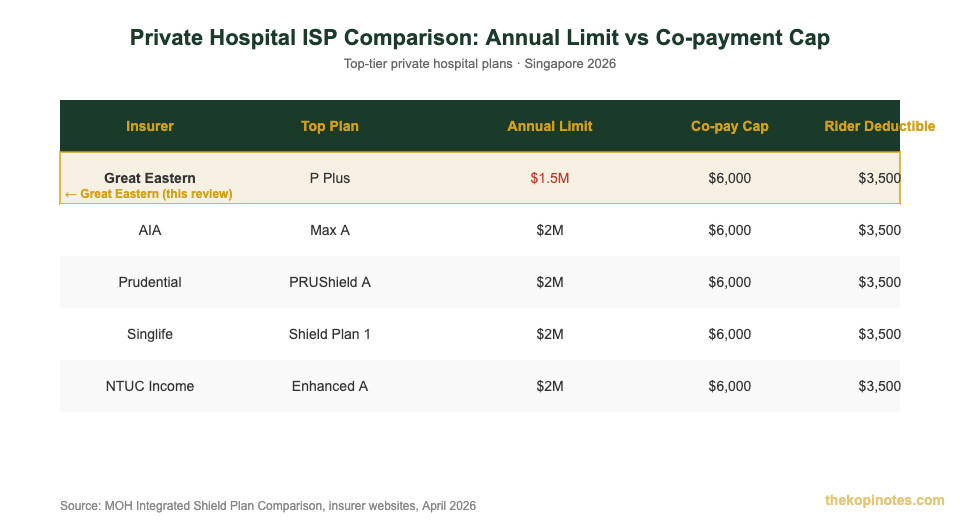
How does GREAT SupremeHealth stack up against the other six ISPs in Singapore? Here’s a side-by-side for the top private hospital tiers, which is where the real differences emerge:
| Insurer | Top Plan | Annual Limit | Co-pay Cap | Pricing Model |
|---|---|---|---|---|
| Great Eastern | P Plus | $1.5M | $6,000 | Claims-based |
| AIA | HealthShield Gold Max A | $2M | $6,000 | Community-rated |
| Prudential | PRUShield Premier | $2M | $6,000 | Community-rated |
| Singlife | Shield Plan 1 | $2M | $6,000 | Community-rated |
| NTUC Income | Enhanced IncomeShield | $2M | $6,000 | Community-rated |
Source: MOH Integrated Shield Plan Comparison, insurer product pages, April 2026. Co-payment caps exclude deductibles.
The main areas where Great Eastern differs from competitors:
Annual limit: Great Eastern’s P Plus caps at $1.5M annually, while most other top-tier plans offer $2M. In practice, $1.5M is enough for virtually any hospitalisation — but it’s worth noting if peace of mind is your priority.
Pre-hospitalisation coverage: GREAT SupremeHealth B Plus covers 120 days pre-hospitalisation. Some competitors offer up to 180 days. If you need extended specialist consultations before admission, this may matter.
Post-hospitalisation coverage: Great Eastern covers 365 days post-hospitalisation — one of the best in the market. This is especially relevant for recovery treatments after surgery.
Great Medical Care Concierge: Exclusive to GREAT SupremeHealth policyholders, this 24/7 service provides on-site desks at Partnering Medical Institutions, referrals to 800+ private panel specialists, and pre-authorisation assistance. This is a genuine differentiator — competitor plans do not offer this level of concierge service.
For a deeper look at how all Singapore ISPs compare, including premium tables by age band, read the full ISP comparison guide.
Who Should Buy GREAT SupremeHealth?
GREAT SupremeHealth is not the right plan for everyone. Here’s a practical guide to help you decide:
Great Eastern SupremeHealth is a strong fit if you:
- Are between 20 and 45 years old and in good health — claims-based pricing keeps your premium low when you’re rarely hospitalised
- Want A Plus coverage (single room in restructured hospital) at a competitive price — Great Eastern’s A Plus is among the most affordable in this tier
- Value the Great Medical Care Concierge service for referrals and pre-authorisation help
- Already have other products with Great Eastern and prefer a single insurer relationship
- Are new to the workforce and want private hospital coverage at an entry price (P Prime is designed for this)
You might prefer a different ISP if you:
- Have pre-existing conditions that make you more likely to claim — community-rated pricing (AIA, Prudential, Singlife) means your premiums don’t spike after individual claims
- Need a $2M annual limit for maximum peace of mind
- Want more than 120 days pre-hospitalisation coverage
- Have family members who are also comparing — AIA and Prudential have broader panel doctor networks
For parents setting up coverage for young children, Great Eastern has a specific For Parents with Young Children plan variant worth exploring. For foreigners residing in Singapore, there’s a dedicated Non-Singaporeans variant. Neither is covered by MediShield Life, but the GREAT SupremeHealth structure still applies.
Whatever plan you choose, pairing it with a retirement strategy matters. Your Singapore retirement calculator can help you estimate how much of your CPF and savings you’ll need to keep liquid for healthcare costs in your 60s and 70s when ISP premiums rise steeply.
If you’re also considering robo-advisors to grow your savings alongside your shield plan, compare platforms through this Singlife integrated shield plan review and the AIA integrated shield plan review to see how the full picture compares.
Frequently Asked Questions
What is the Great Eastern shield plan called?
Great Eastern’s Integrated Shield Plan is called GREAT SupremeHealth. It is a MediSave-approved plan that stacks on top of MediShield Life to provide additional hospitalisation coverage. It comes in four main tiers — Standard, B Plus, A Plus, and P Plus — covering B1 ward through private hospital access. There is also a P Prime variant for those who prefer a panel-based private hospital model at lower premiums.
Can I use MediSave to pay for GREAT SupremeHealth?
Yes. GREAT SupremeHealth is MediSave-approved, so you can use your CPF MediSave to pay the premiums, up to the Additional Withdrawal Limit (AWL) set by MOH. For most working adults under 40, MediSave covers the full base premium. However, the GREAT TotalCare 2 rider is not MediSave-approved — that premium must be paid in cash.
Does GREAT SupremeHealth cover pre-existing conditions?
No. Like all Integrated Shield Plans in Singapore, GREAT SupremeHealth does not cover pre-existing conditions known at the time of application. MediShield Life — the compulsory government layer — does cover pre-existing conditions for Singapore Citizens and PRs. So you retain that baseline coverage. The additional GREAT SupremeHealth layer excludes conditions declared or discovered before your policy started.
What is the difference between GREAT SupremeHealth P Plus and P Prime?
Both P Plus and P Prime cover private hospitals, but they work differently. P Plus gives you access to all private hospitals in Singapore with no restriction on which institution you use. P Prime is a panel-based plan — you access private hospitals through Great Eastern’s Partnering Medical Institutions (PMIs), which include Raffles Hospital, Farrer Park Hospital, Thomson Medical Centre, and Mount Alvernia Hospital. P Prime premiums are lower, but you sacrifice freedom of hospital choice. If you go to a non-PMI private hospital under P Prime, a pro-ration factor applies and you pay more out of pocket.
What changed with the GREAT TotalCare 2 rider in April 2026?
From 1 April 2026, MOH required all IP riders to stop covering the policyholder’s deductible. Under GREAT TotalCare 2, you now pay the deductible yourself — $3,500 for private hospital or Class A ward stays, $2,500 for B1 ward. The co-payment cap was also raised from $3,000 to $6,000 per year (excluding the deductible). This means your maximum out-of-pocket in a private hospital is your deductible ($3,500) plus up to $6,000 in co-insurance — a combined maximum of $9,500 in a very bad hospitalisation year.
Is Great Eastern's GREAT SupremeHealth cheaper than AIA HealthShield?
For younger, healthier Singaporeans (ages 25–45 who rarely claim), GREAT SupremeHealth is generally competitive with or slightly cheaper than AIA HealthShield Gold Max at the A Plus tier. The key difference is pricing model: Great Eastern uses claims-based pricing (your premium rises if you claim), while AIA uses community-rated pricing (your premium stays the same regardless of your individual claims). Over a lifetime, community-rated pricing can be more predictable for those who anticipate more frequent hospitalisation as they age.
What is the maximum entry age for GREAT SupremeHealth?
The maximum entry age for GREAT SupremeHealth P Plus, P Prime, A Plus, and B Plus is age 75 years (next birthday). Once you are a policyholder, coverage continues for life as long as you pay premiums. This is an important feature — unlike some private medical plans that terminate at a set age, GREAT SupremeHealth provides lifelong coverage, which matters most when you’re older and healthcare costs are highest.
Plan Your Healthcare Coverage — and Your Finances
A good shield plan is just one piece of your financial picture. Use our tools and guides to build a complete strategy.
Get Free Insurance Advice
Speak with a licensed insurance advisor. No obligation, no cost.
By submitting this form, you agree to our Privacy Policy.
This article was researched with the help of AI. While we strive to keep all information accurate and up to date, there may be errors. If you notice any discrepancies, please contact us.