CapitaLand Ascendas REIT Share Price 2026: Inside the S$1.8B Acquisition Spree (CLAR)
A deep dive into CLAR’s 1H2026 results, its global acquisition pipeline, and why the payout barely moved.
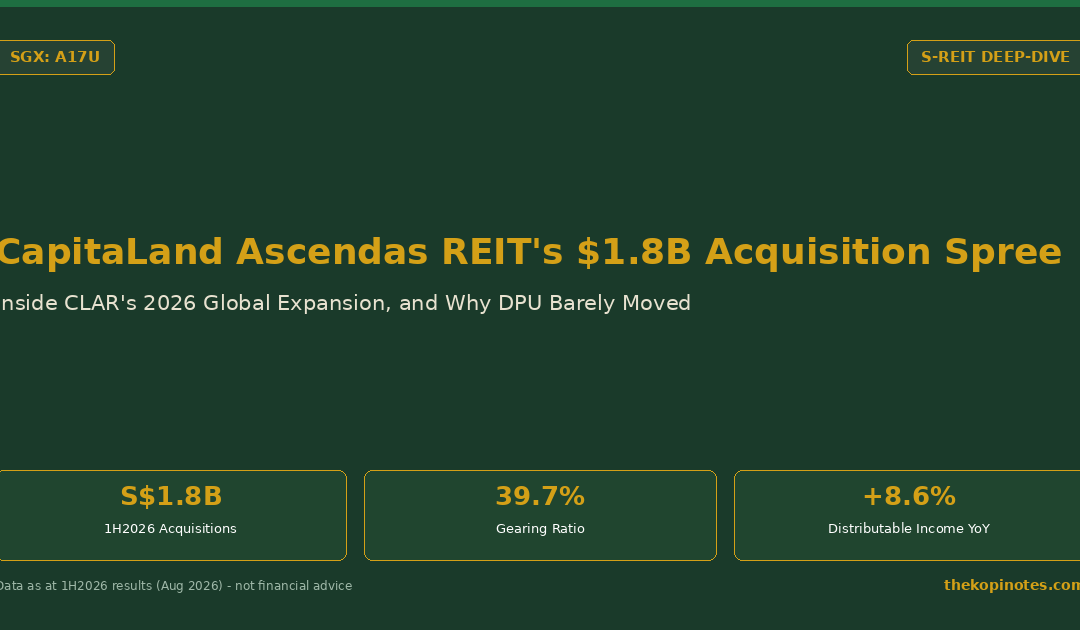
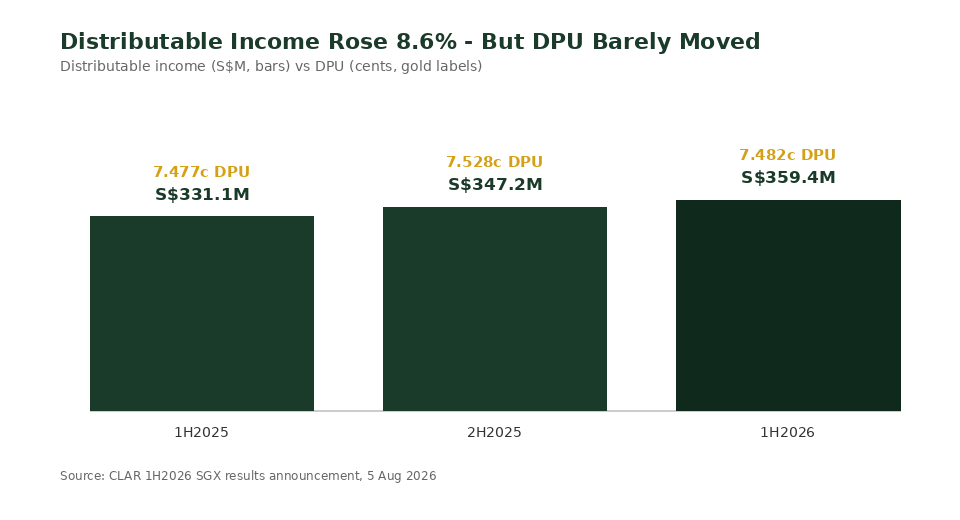
CapitaLand Ascendas REIT (SGX: A17U) spent roughly S$1.8 billion on new properties in the first half of 2026, spanning a Japan data centre, Spanish logistics parks, and Singapore assets. Distributable income rose 8.6% year-on-year to S$359.4 million. Yet DPU barely moved, up just 0.1% to 7.482 cents, because CLAR issued 8.5% more units to pay for the deals. Here’s what that trade-off means for your dividend.
Not financial advice. All figures are for educational reference only. Data as at CLAR’s 1H2026 results announcement, 5 August 2026, unless otherwise stated.
- CLAR completed or announced about S$1.8 billion of acquisitions in 1H2026, led by a 49% stake in an Osaka data centre and six logistics assets in Spain.
- Distributable income grew 8.6%, but a larger unit base (up 8.5% from equity fundraising) meant DPU per unit was almost flat.
- Gearing actually fell to 39.7%, so CLAR has room to keep buying without stressing its balance sheet.
CLAR’s 1H2026 Results Snapshot
CapitaLand Ascendas REIT (CLAR) is Singapore’s largest listed industrial and business space REIT, with a S$20.1 billion portfolio spanning Singapore, Australia, the US, the UK, Europe and now Japan. Its 5 August 2026 results showed steady top-line growth, but the story underneath the headline numbers is more nuanced.
Gross revenue rose 6.7% year-on-year to S$805.5 million. Net property income climbed 6.2% to S$556.1 million. Distributable income, the pool of cash actually paid out to unitholders, grew a healthy 8.6% to S$359.4 million. That’s the fastest income growth CLAR has posted in several quarters.
| Metric | 1H2026 | YoY Change |
|---|---|---|
| Gross Revenue | S$805.5 million | +6.7% |
| Net Property Income | S$556.1 million | +6.2% |
| Distributable Income | S$359.4 million | +8.6% |
| DPU | 7.482 cents | +0.1% |
| Portfolio AUM | S$20.1 billion | – |
| Occupancy | 89.1% | -1 to -2 ppt QoQ* |
| Aggregate Leverage (Gearing) | 39.7% | – |
*Occupancy dip is mainly due to newly completed properties still ramping up leasing. Excluding these, occupancy stays above 90%. Source: CLAR 1H2026 SGX results announcement, 5 August 2026.
At around S$2.51 a unit (11 August 2026), CLAR trades on a trailing dividend yield of roughly 6.0%, according to StockAnalysis.com. That’s within the typical 5-6.5% range for large-cap industrial S-REITs, and it sits close to the middle of CLAR’s own 52-week range of S$2.42 to S$2.92.
Where the S$1.8 Billion Went
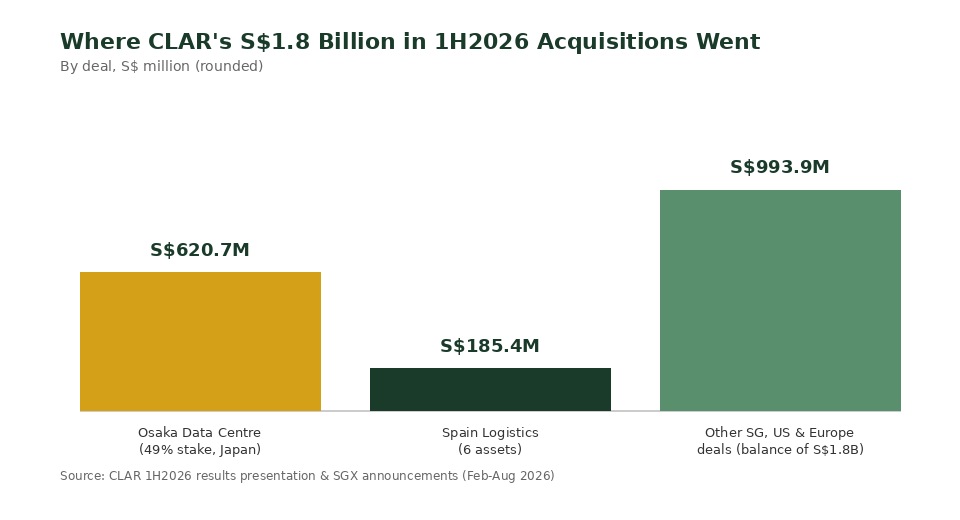
The headline figure from CLAR’s 1H2026 update is the roughly S$1.8 billion of DPU-accretive acquisitions completed or announced during the half, spread across the US, Europe, Singapore and Japan. Two deals stand out because they mark genuinely new territory for the REIT.
The first is a 49% stake in a Tier III hyperscale data centre in Greater Osaka, Japan, for about S$620.7 million. This is CLAR’s first data centre investment in Japan. The asset is fully occupied by a single blue-chip hyperscale tenant with a weighted average lease to expiry (WALE) of 14.2 years, which locks in income visibility for well over a decade. The remaining 51% stake is held by a fund managed by Mitsui & Co Realty Management.
The second is a S$185.4 million acquisition of six Grade A logistics properties in Spain, two in Madrid and four in Barcelona. The portfolio is fully occupied with a 9.1-year WALE, and it deepens CLAR’s existing European logistics footprint beyond its original UK base.
| Deal | Location | Value | Asset Type | Lease Profile |
|---|---|---|---|---|
| Osaka Data Centre 1 (49% stake) | Japan | S$620.7 million | Tier III hyperscale data centre | 14.2-yr WALE, 100% occupied |
| Spain Logistics Portfolio (6 assets) | Madrid & Barcelona | S$185.4 million | Grade A logistics | 9.1-yr WALE, fully occupied |
| Other SG, US & Europe deals | Multiple markets | ~S$993.9 million (balance) | Logistics, industrial & business space | NPI yields 4.3-7.4% pre-transaction costs |
Source: CapitaLand newsroom, March 2026 and February 2026 press releases; CLAR 1H2026 results presentation.
Taken together, these deals push CLAR further into two structural growth themes: data centres riding AI-driven demand, and logistics riding e-commerce. Neither of these was a major part of CLAR’s portfolio a few years ago. If you already hold CLAR’s full 2026 share price and valuation guide bookmarked, this acquisition wave is the missing context behind the numbers in that piece.
Why DPU Barely Moved Despite 8.6% Income Growth
Here’s the part many headlines miss. CLAR didn’t pay for these deals entirely with debt. It raised S$900 million through two rounds of equity fundraising across 1H2025 and 1H2026, which expanded its unit base by 8.5% year-on-year.
Do the maths and the picture becomes clear. Distributable income grew 8.6%. The unit base grew 8.5%. Divide one by the other and you get almost exactly the reported DPU growth of 0.1%. In plain English: CLAR grew the pie, but it also cut the pie into more slices. Each unitholder’s slice stayed roughly the same size.
This isn’t unique to CLAR. It’s a common trade-off for REITs funding growth through equity instead of debt. The advantage is a stronger balance sheet. The disadvantage, for existing unitholders, is that near-term DPU growth gets diluted even as the underlying business gets bigger and more diversified. For the full payout history and how this compares to prior years, see CLAR’s full DPU history and payout schedule.
Balance Sheet: Gearing Falls to 39.7%
The upside of funding growth with equity rather than pure debt shows up on the balance sheet. CLAR’s aggregate leverage (gearing) fell to 39.7%, comfortably below the Monetary Authority of Singapore’s 50% regulatory limit for S-REITs. Its interest coverage ratio stands at a healthy 3.5 times, and about 70% of its debt is on fixed rates, which limits the sting from any near-term rate volatility.
If you want to see how CLAR’s gearing stacks up against the regulatory ceiling and other S-REITs, TKN’s S-REIT gearing ratio calculator lets you plug in a REIT’s total debt and asset value to check its own headroom.
CLAR also isn’t just buying. It’s proposed divesting the Kim Chuan Telecommunications Complex in Singapore for S$200.4 million, roughly double the original purchase price and a 32% premium over the latest independent valuation. That’s a textbook example of “capital recycling”, selling a mature, lower-yielding asset to fund higher-growth deals like the Osaka data centre, without needing to raise even more units.
Around S$230 million has already gone into completed redevelopment and asset enhancement projects, including 27 International Business Park in Singapore and the Summerville Logistics Center in the US. Another five projects, worth more than S$500 million in committed capital, are still underway.
What’s Next for CLAR
Management has flagged two Singapore property acquisitions expected to complete in August 2026, on top of the deals already announced. Combined with newer developments coming online, these should keep contributing to income growth into 2H2026.
Rental reversions, the change in rent when a lease is renewed, averaged a strong 8.5% across the portfolio in 1H2026, and CLAR’s management has guided for continued positive momentum. Portfolio occupancy sits at 89.1%, but management notes this is being weighed down by newly completed properties still in their leasing ramp-up phase. Strip those out and occupancy is above 90%.
The tenant base itself is a quiet strength: over 1,800 tenants across more than 20 industries, with no single property contributing more than 5% of gross revenue. That diversification limits the damage any single tenant default or sector downturn can do to the overall payout.
Is CLAR a Buy After This Acquisition Spree?
If you already hold CLAR, the 1H2026 results support holding. Distributable income is growing, gearing has room, and the acquisition pipeline is diversifying the portfolio into higher-growth sectors like data centres and logistics without over-leveraging the trust.
If you’re deciding whether to start a position, the trade-off is straightforward. You’re buying a larger, more diversified, better-capitalised REIT than a year ago, at a yield of roughly 6.0%. But near-term DPU growth is likely to stay muted while CLAR keeps digesting new units from fundraising and integrating newly acquired assets. Analyst sentiment is broadly constructive, with a consensus price target of around S$3.08, though individual house views range from neutral to buy depending on how much weight is placed on near-term DPU dilution versus long-term diversification.
Before allocating, it’s worth checking how CLAR fits alongside other options in your portfolio. TKN’s best S-REITs in Singapore 2026 roundup compares CLAR against peers on yield, gearing and growth outlook, and the Singapore retirement calculator can help you see how a ~6% yielder like CLAR fits into a broader passive income plan.
Disclaimer: this article is for educational purposes only and does not constitute financial advice. CLAR’s unit price, DPU and gearing figures change over time; always verify against CLAR’s latest SGX filings before making an investment decision.
Frequently Asked Questions
What is CapitaLand Ascendas REIT (CLAR) and what does it own?
CapitaLand Ascendas REIT (SGX: A17U) is Singapore’s largest listed industrial and business space REIT, with a S$20.1 billion portfolio of over 230 properties across Singapore, Australia, the US, the UK, Europe and Japan. Its holdings span business parks, high-specification industrial buildings, logistics assets and, since 2026, data centres.
Why did CapitaLand Ascendas REIT's DPU stay flat despite S$1.8 billion in acquisitions?
CLAR funded part of its acquisitions with S$900 million in equity fundraising, which expanded its unit base by 8.5% year-on-year. Distributable income grew 8.6% in 1H2026, but spreading that larger income pool across 8.5% more units left DPU almost unchanged, up just 0.1% to 7.482 cents.
Is CapitaLand Ascendas REIT's dividend safe in 2026?
CLAR’s payout looks well-supported for now. Distributable income is growing, occupancy excluding newly completed properties is above 90%, rental reversions are positive at 8.5%, and gearing at 39.7% is well within MAS’s 50% limit. No single property makes up more than 5% of gross revenue, which limits concentration risk.
What is CLAR's gearing ratio and is it too high?
CLAR’s aggregate leverage was 39.7% as at June 2026, down from prior periods after its equity fundraising. This is comfortably below the Monetary Authority of Singapore’s 50% regulatory ceiling for S-REITs, and its interest coverage ratio of 3.5 times shows debt is well serviced by income.
Can I buy CapitaLand Ascendas REIT with my CPF or SRS?
CLAR is not on the CPF Investment Scheme (CPFIS) list of approved instruments for CPF Ordinary Account funds, so you cannot buy it directly with CPF-OA. It can be bought using SRS funds through most SRS-linked brokerage accounts, and of course with cash through any SGX broker.
Is CapitaLand Ascendas REIT a buy after its 1H2026 results?
At around S$2.51 with a trailing yield near 6.0%, CLAR offers exposure to a larger, more diversified portfolio than a year ago, with a healthier balance sheet. The trade-off is that near-term DPU growth may stay muted while CLAR digests its enlarged unit base. Whether that’s a buy depends on your income needs versus your appetite for near-term dilution.
Build Your Own S-REIT Income Portfolio
Compare CLAR against other S-REITs, then open a brokerage account to start investing.
This article was researched with the help of AI. While we strive to keep all information accurate and up to date, there may be errors. If you notice any discrepancies, please contact us.