CapitaLand Ascendas REIT Share Price: Complete 2026 Investor Guide (CLAR)
CapitaLand Ascendas REIT (SGX: CLAR) is Singapore’s largest and oldest industrial REIT, with a portfolio of over 230 properties across Singapore, Australia, the US, and the UK. As at July 2026, CLAR’s share price trades around S$2.55–S$2.70, offering a forward dividend yield of approximately 5.5% per annum. Singapore investors favour CLAR for its blue-chip sponsor (CapitaLand Group), diversified industrial exposure including data centres, and its consistent track record of paying DPU every quarter.
Not financial advice. All figures are for educational reference only. Data as at July 2026 unless noted.
- CLAR is SGX-listed (ticker: CLAR) and trades around S$2.55–S$2.70 as at July 2026, with a ~5.5% dividend yield
- It is Singapore’s largest industrial REIT with 230+ properties including data centres, logistics facilities, and business parks across 4 countries
- You can buy CLAR through any SGX broker — IBKR, moomoo, Syfe, or FSMOne are popular low-cost choices for Singapore investors
Table of Contents
Table of Contents — Click to Expand
- What Is CapitaLand Ascendas REIT (CLAR)?
- CLAR Share Price — Current Level and Historical Range
- CLAR Distribution Per Unit (DPU) History
- CLAR Portfolio: What Does It Own?
- CLAR vs Peer S-REITs: Yield Comparison
- How to Buy CLAR Shares in Singapore
- Key Risks to Watch in 2026
- CLAR 2026 Outlook
- Frequently Asked Questions
What Is CapitaLand Ascendas REIT (CLAR)?
CapitaLand Ascendas REIT — known by its SGX ticker CLAR — launched in November 2002, making it Singapore’s first and largest industrial real estate investment trust. It was originally called Ascendas REIT before being rebranded following the CapitaLand Group merger in 2019.
The REIT is managed by CapitaLand Ascendas REIT Management Limited, a wholly-owned subsidiary of CapitaLand Group — one of Asia’s largest real estate developers and investors. That blue-chip sponsor backing means CLAR benefits from a deep acquisition pipeline and strong balance sheet support.
As at mid-2026, CLAR owns and manages over 230 properties with a total assets under management (AUM) of approximately S$18–19 billion. Its portfolio spans four geographies: Singapore, Australia, the United Kingdom, and the United States.
| Key Fact | Detail |
|---|---|
| SGX Ticker | CLAR |
| Listed Since | November 2002 |
| Sponsor | CapitaLand Group |
| Asset Class | Industrial, Logistics, Data Centres, Business Parks |
| No. of Properties | 230+ across 4 countries |
| AUM (approx.) | ~S$18–19 billion (2026) |
| Distribution Frequency | Quarterly |
| Index Inclusion | STI, FTSE ST REIT Index, iEdge S-REIT Leaders Index |
Source: CapitaLand Ascendas REIT investor relations, SGX filings, July 2026
One thing that sets CLAR apart from smaller S-REITs is its inclusion in the Straits Times Index (STI) — Singapore’s benchmark index. That means every unit trust or ETF that tracks the STI automatically holds CLAR, providing a steady institutional demand floor for its units.
CLAR Distribution Per Unit (DPU) History
Distribution Per Unit — or DPU — is how much cash you receive per CLAR unit you own, paid quarterly. For a Singapore investor focused on passive income, this is the number that matters most.
CLAR has maintained a relatively stable DPU track record, though it has dipped slightly in recent years as higher interest rates increased its borrowing costs:
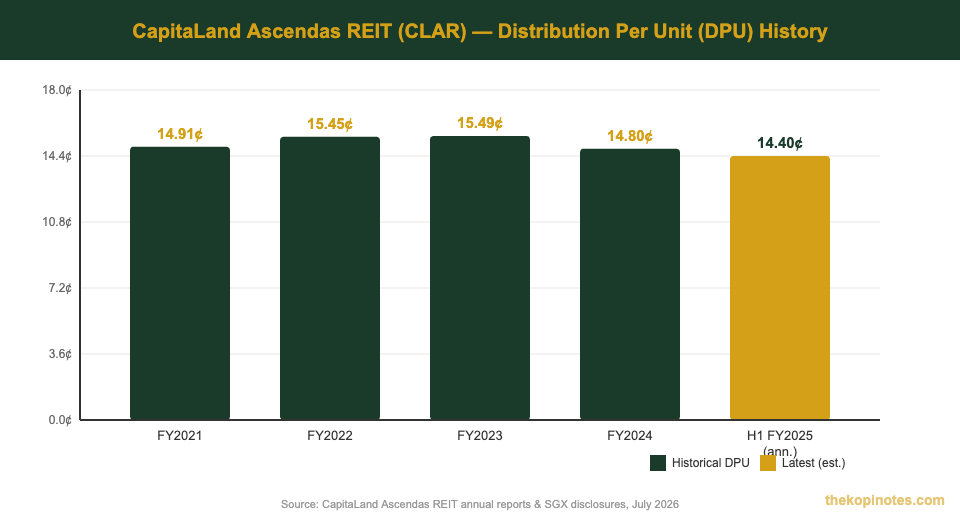
| Financial Year | Total DPU (SGD cents) | Yield at S$2.60 price |
|---|---|---|
| FY2021 | 14.91¢ | 5.73% |
| FY2022 | 15.45¢ | 5.94% |
| FY2023 | 15.49¢ | 5.96% |
| FY2024 | 14.80¢ | 5.69% |
| FY2025 H1 (annualised est.) | ~14.40¢ | ~5.54% |
Source: CapitaLand Ascendas REIT SGX announcements and annual reports. Annualised FY2025 estimate based on H1 2025 results. Not a forward guarantee.
A few things to note about CLAR’s DPU. First, CLAR pays quarterly — not semi-annually like many other S-REITs. That means you receive cash four times a year. For retirees or those building a passive income Singapore strategy, that regular cadence is genuinely useful.
Second, the slight DPU decline from FY2022–FY2023 peaks to FY2024–FY2025 is mainly due to higher financing costs. CLAR, like all leveraged REITs, carries debt to fund acquisitions. When interest rates rose sharply from 2022 onward, its interest expense went up, trimming the distributable income available to unitholders.
The good news? With global central banks signalling rate cuts or pauses in 2025–2026, CLAR’s financing costs should stabilise or fall — providing a potential DPU recovery tailwind.
CLAR Portfolio: What Does It Own?
Unlike retail or office REITs, CLAR focuses on industrial and business space. Its portfolio is deliberately diversified — not just by geography, but by property type. Here’s how it breaks down:
| Property Type | % of Portfolio (AUM) | Geography |
|---|---|---|
| Logistics & Distribution Centres | ~28% | SG, AU, UK, US |
| Data Centres | ~20% | SG, AU, UK, US |
| Business Space & Science Parks | ~24% | SG, AU |
| Industrial Facilities (Light Industrial) | ~20% | SG |
| Suburban Offices | ~8% | AU, US |
Source: CapitaLand Ascendas REIT portfolio breakdown, 2025 Annual Report. Percentages are approximate.
The data centre weighting is a major differentiator for CLAR. As AI, cloud computing, and digital infrastructure demand surges globally, data centres have become one of the most sought-after real estate asset classes. CLAR was early to this theme, and today its data centre assets span Singapore, the UK, and the US.
Occupancy across the portfolio has remained high — consistently above 90% — driven by long-term leases with tech firms, logistics operators, and government tenants. Its Weighted Average Lease Expiry (WALE) is typically around 3.5 to 4 years, which provides reasonable earnings visibility.
For more context on how industrial REITs stack up in Singapore’s market, see our passive income Singapore guide, which covers the full spectrum of yield-generating S-REITs.
CLAR vs Peer S-REITs: Yield Comparison
How does CLAR stack up against other popular S-REITs? Here’s a head-to-head comparison on the metric most Singapore income investors care about — dividend yield:
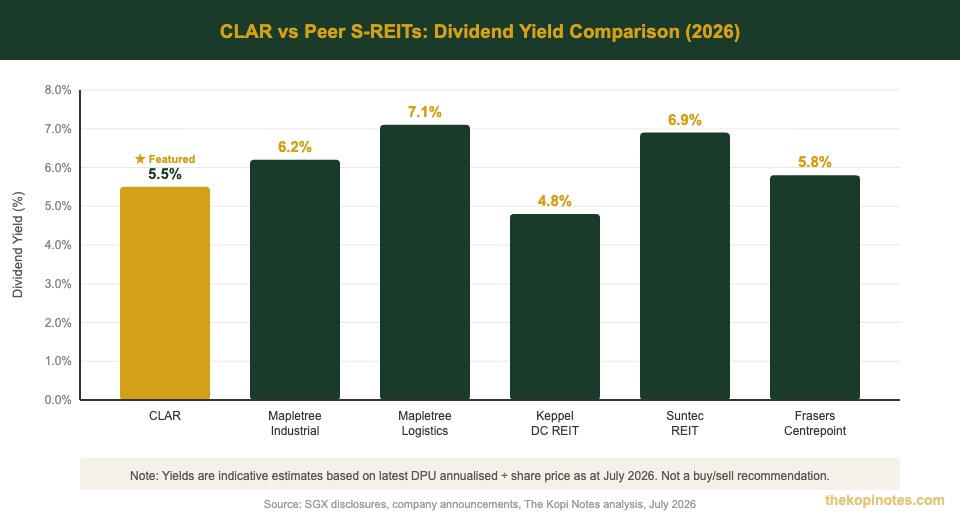
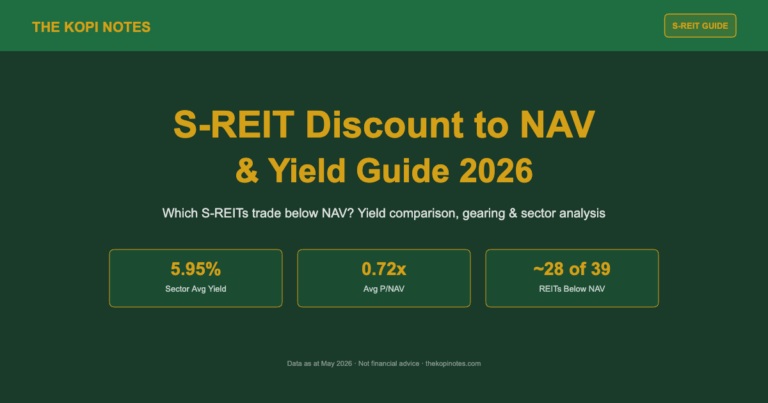
CLAR’s ~5.5% yield is on the lower end versus peers like Mapletree Logistics Trust (~7.1%) and Suntec REIT (~6.9%). But yield alone doesn’t tell the full story.
Here’s why some investors still prefer CLAR despite the lower yield:
- Blue-chip sponsor: CapitaLand Group provides a strong acquisition pipeline and financial backstop that smaller REIT sponsors can’t match
- STI index inclusion: CLAR is in the Straits Times Index, giving it passive institutional buying flows that support the unit price
- Data centre exposure: Its growing data centre weighting positions it well for the AI and cloud demand wave
- Geographic diversification: Exposure to Australia, UK, and US reduces Singapore-specific concentration risk
- Consistent DPU track record: Over 20 years of distributions with no cuts during COVID — a rare achievement
That said, if you are purely chasing the highest yield, Mapletree Logistics Trust or Suntec REIT may look more attractive on paper — though each carries its own risk profile. Our full best S-REITs in Singapore 2026 guide breaks down the trade-offs in detail.
For retirement-focused investors, using a platform like Syfe referral code and sign-up bonus lets you access curated REIT portfolios including CLAR through their REIT+ strategy, removing the need to pick individual REITs yourself.
How to Buy CLAR Shares in Singapore
Buying CLAR is straightforward since it’s SGX-listed. You’ll need a brokerage account that supports SGX stock trading. Here are the most popular platforms among Singapore investors:
| Broker | Commission (SGX stocks) | Min. Commission | Best For |
|---|---|---|---|
| IBKR (Interactive Brokers) | 0.05% (Tiered) | S$2.50 | Active traders, large portfolios |
| moomoo | 0.03% (promo) | S$0.99 | Cost-conscious investors |
| Syfe Trade | 0.06% | S$1.49 | Beginners, clean interface |
| FSMOne | 0.08% | S$10 | Multi-asset investors (ETFs + REITs) |
| DBS Vickers / OCBC / UOB | 0.18–0.28% | S$25 | Those who prefer bank-backed brokers |
Source: Broker websites, The Kopi Notes research, July 2026. Commissions subject to change — check broker’s current fee schedule.
For most Singapore retail investors buying CLAR in lots of S$2,000–S$5,000 at a time, moomoo or Syfe Trade offer the lowest effective transaction cost. IBKR is excellent if you’re also buying overseas ETFs like CSPX or VWRA on the same platform — you consolidate your portfolio and pay very low commissions.
Step-by-step to buy CLAR:
- Open a SGX brokerage account (e.g. moomoo or Syfe) — takes 10–15 minutes online
- Fund your account with SGD (most platforms accept bank transfer or PayNow)
- Search for ticker CLAR on the SGX stock screen
- Enter the number of units (CLAR trades in lots of 100) and place a limit or market order
- Wait for settlement (T+2 business days) — your CDP account will reflect the shares
If you’d rather not pick individual REITs, check the Syfe referral code and sign-up bonus to access Syfe REIT+ — a managed portfolio of top S-REITs including CLAR, rebalanced automatically. Use Endowus referral code if you prefer to invest through CPF OA or SRS funds into REIT-focused unit trusts.
Prefer to research ETFs instead of individual REITs? Our Singapore REIT ETF guide covers the Lion-Phillip S-REIT ETF and NikkoAM-STT REIT, both of which hold CLAR as a top position.
Key Risks to Watch in 2026
CLAR is widely regarded as a quality, defensive S-REIT — but no investment is risk-free. Here are the key risks you should understand before buying:
1. Interest Rate Risk
This is the biggest near-term risk for all S-REITs, including CLAR. As of mid-2026, approximately 75–80% of CLAR’s debt is on fixed rates, which limits the immediate impact of rate moves. But when fixed-rate hedges expire and are rolled at higher rates, financing costs can tick up — squeezing DPU. Monitor CLAR’s quarterly results for average cost of debt disclosures.
2. Currency Risk
CLAR earns income in AUD, GBP, and USD from its overseas portfolio. When these currencies weaken against the SGD, distributable income in SGD terms falls. CLAR hedges a portion of its foreign income, but residual currency risk remains. A strong SGD in 2025–2026 has been a mild headwind.
3. Asset Concentration in Data Centres
Data centres are a growth asset — but they also carry higher capital expenditure requirements and longer development timelines. If AI spending slows sharply or hyperscaler demand weakens, data centre valuations could be pressured. CLAR’s ~20% data centre exposure means this sector now materially influences its NAV.
4. Gearing Level
CLAR’s aggregate leverage ratio (gearing) has been creeping toward the 37–39% range — still below MAS’s 50% regulatory limit but higher than its historical 30–35% comfort zone. Higher gearing limits CLAR’s capacity for acquisitions without equity fundraising. Any equity rights issue or private placement would dilute existing unitholders.
For a broader view of S-REIT risks in the current macro environment, our Singapore retirement calculator can help you model how different yield scenarios affect your long-term income needs.
CLAR 2026 Outlook
Here’s where things stand for CLAR heading into H2 2026:
Positive catalysts: The global AI buildout is driving unprecedented demand for data centre capacity — and CLAR is positioned directly in that thematic. Its 2024–2025 data centre development pipeline across Singapore and the UK is delivering new assets that will boost rental income going forward. Meanwhile, Singapore’s industrial land scarcity keeps occupancy high and rental reversions positive for logistics and light industrial assets.
Rate environment: The US Federal Reserve has signalled a cautious easing path. If rates decline through H2 2026 and into 2027, CLAR’s debt refinancing costs should ease, providing a DPU recovery tailwind. Analysts tracking CLAR have been raising target prices on this basis — consensus estimates cluster around S$2.80–S$3.00.
Watch points: Track CLAR’s half-year results (typically August), any new acquisition announcements, and quarterly DPU declarations. The Singapore Savings Bonds guide can help you benchmark whether CLAR’s current yield adequately compensates for the additional equity risk vs risk-free SG government debt.
In summary — CLAR is not the highest-yielding S-REIT on the market. But for investors who want a large, liquid, diversified industrial REIT backed by Singapore’s top property sponsor, it remains one of the most reliable anchors in a S-REIT portfolio.
Frequently Asked Questions
What is the current CLAR share price?
What is CLAR's dividend yield in 2026?
Is CapitaLand Ascendas REIT a good buy in 2026?
How do I buy CapitaLand Ascendas REIT in Singapore?
Does CLAR pay dividends monthly or quarterly?
What is CLAR's NAV per unit?
What is CLAR's gearing ratio?
This article was researched with the help of AI. While we strive to keep all information accurate and up to date, there may be errors. If you notice any discrepancies, please contact us.