XUS vs CSPX vs SPYL: Should You Switch to the New S&P 500 ETF on SGX? (2026)
Xtrackers’ XUS lets you buy the S&P 500 in SGD on SGX. Cheaper on paper, but is it worth leaving CSPX?
XUS is the Xtrackers S&P 500 UCITS ETF, listed on SGX since 13 October 2026 and traded in SGD. Like CSPX and SPYL, it is Ireland-domiciled and accumulating, so it gets the same 15% US dividend withholding tax and avoids US estate tax. XUS and SPYL charge 0.03% a year against CSPX’s 0.07%. For most existing CSPX holders, switching is not worth the selling costs; XUS makes most sense for new SGD money, SRS funds and small monthly buys on SGX.
Not financial advice. All figures are for educational reference only. Data as at the dates shown in each table (September to November 2026). The Kopi Notes may earn referral fees from some brokers mentioned.
What Is XUS? The New S&P 500 ETF on SGX
XUS is the SGX trading line of the Xtrackers S&P 500 UCITS ETF (4C), run by DWS. It is a cross-listing of an existing Irish fund that already trades in Europe, including on the London Stock Exchange. On SGX it trades in Singapore dollars, during Singapore market hours, in lots of one share.
It holds the actual S&P 500 shares (physical replication) and reinvests dividends instead of paying them out. At listing, one unit was indicatively about S$20, so even a S$100 monthly buy is practical.
XUS is one of four Xtrackers ETFs that came to SGX together. Our guide to the four new Ireland-domiciled ETFs on SGX covers XND, XWR and EUS as well.
XUS vs CSPX vs SPYL at a Glance
| XUS | CSPX | SPYL | |
|---|---|---|---|
| Full name | Xtrackers S&P 500 UCITS ETF 4C | iShares Core S&P 500 UCITS ETF | SPDR S&P 500 UCITS ETF (Acc) |
| Exchange / currency | SGX / SGD | LSE / USD | LSE / USD |
| Total expense ratio | 0.03% | 0.07% | 0.03% |
| Fund size | About US$4.1bn (Aug 2026) | US$157.6bn (Sep 2026) | US$44.9bn (Nov 2026) |
| Domicile | Ireland | Ireland | Ireland |
| Dividends | Accumulating | Accumulating | Accumulating |
| US dividend withholding tax | 15% (fund level) | 15% (fund level) | 15% (fund level) |
| US estate tax exposure | No | No | No |
| Approx. unit price | About S$20 | About US$829 (Sep 2026) | Much lower than CSPX |
| SRS | Stated as SRS-eligible; confirm with your SRS operator | Not via the usual SRS route | Not via the usual SRS route |
Source: iShares CSPX factsheet (30 Sep 2026); State Street SPYL page (4 Nov 2026); XUS details from DWS and SGX listing materials as reported September 2026
The three funds track the same index, sit in the same tax structure and reinvest dividends. The real differences are the fee, the exchange and currency you trade in, and how big and liquid each fund is.
The Fee Gap in Dollars
A 0.04 percentage point fee gap sounds tiny. Here is what it means in money, before any growth:
| Amount invested | CSPX at 0.07% / year | XUS or SPYL at 0.03% / year | Yearly difference |
|---|---|---|---|
| S$10,000 | S$7 | S$3 | S$4 |
| S$50,000 | S$35 | S$15 | S$20 |
| S$100,000 | S$70 | S$30 | S$40 |
| S$500,000 | S$350 | S$150 | S$200 |
Source: The Kopi Notes calculation: amount × TER. Excludes trading costs and tracking difference.
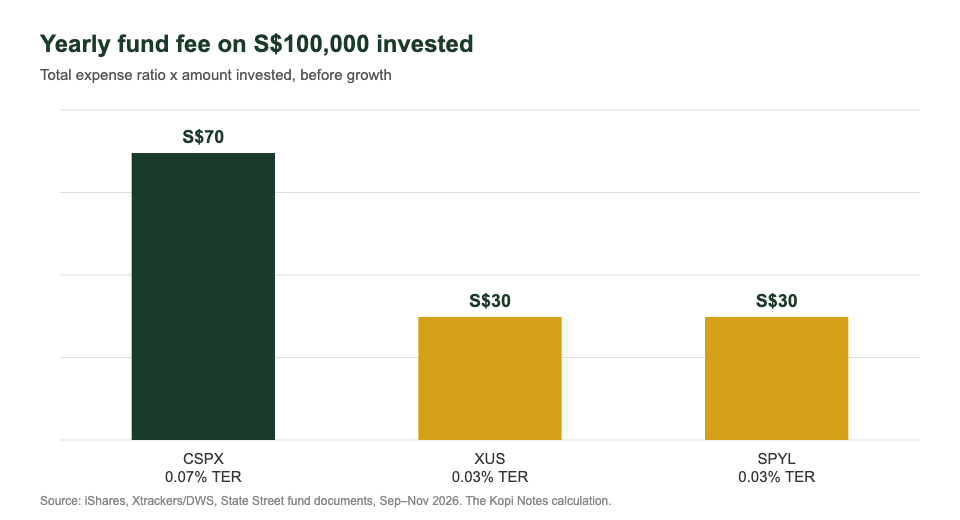
Fees are only part of the cost. What you actually earn relative to the index is the tracking difference, which also depends on securities lending income and how efficiently the fund handles dividends. CSPX’s factsheet shows the share class returned 15.47% over the year to 30 September 2026 against 15.34% for the S&P 500 benchmark, so it has been beating its benchmark despite the higher fee.
XUS on SGX has too short a record to judge its tracking yet. Our tracking difference guide explains why the fee alone does not decide the winner.
Does Trading in SGD Remove Currency Risk?
No. XUS is priced in SGD, but it still owns US shares priced in US dollars. If the US dollar falls against the Singapore dollar, XUS falls with it, exactly as CSPX would once you convert back to SGD.
What SGD trading does remove is the conversion step at your broker. With CSPX or SPYL you convert SGD to USD first, and the broker’s FX spread can cost more than a year’s fee difference on a large deposit. With XUS you pay in SGD, and the currency conversion happens inside the fund’s price.
Fund Size and Liquidity
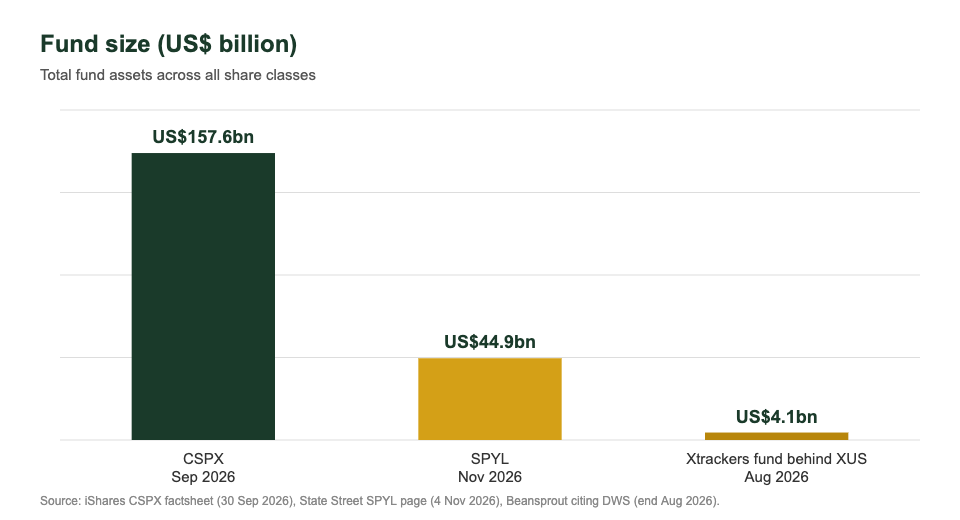
CSPX is one of the largest ETFs in the world at about US$158 billion, and it trades heavily on the London Stock Exchange with tight spreads. SPYL is younger (launched in October 2023) but already about US$45 billion. The Xtrackers fund behind XUS was about US$4 billion before the SGX listing.
For a long-term investor, fund size matters less than the bid-ask spread on the line you trade. XUS’s SGX line relies on a designated market maker, and a new SGX listing can show wider spreads than a big LSE line, especially near the open and close. Check the live spread before you trade and use limit orders.
Should You Switch From CSPX? The Maths
Switching means selling CSPX and buying XUS or SPYL. Singapore has no capital gains tax, so the cost is mainly trading fees, spreads, FX and a few days out of the market. Here is a simple payback test.
| Your CSPX holding | Yearly fee saved (0.04%) | If switching costs 0.2% in total | Years to break even |
|---|---|---|---|
| S$20,000 | S$8 | S$40 | 5 years |
| S$50,000 | S$20 | S$100 | 5 years |
| S$100,000 | S$40 | S$200 | 5 years |
| S$100,000, switching costs only 0.1% | S$40 | S$100 | 2.5 years |
Source: The Kopi Notes calculation. 0.2% is an illustrative round-trip cost (two commissions, two spreads, FX); your actual cost depends on your broker.
Break-even is measured in years, and that assumes XUS tracks the index as well as CSPX does. If XUS’s tracking difference turns out even 0.04% worse, the saving disappears entirely.
There is also a behavioural cost. Selling an investment you have held for years invites second-guessing about timing. For most people, the sensible move is to keep existing CSPX units and decide where new money goes.
Three things to check before buying XUS
- The live bid-ask spread. On a new SGX line, a spread of a few cents on a S$20 unit can cost more than a year of fee savings. Use limit orders, and avoid the first and last minutes of the trading day.
- Your broker’s SGX minimum fee. A S$0.99 minimum on a S$100 monthly buy is about 1% of the order. Fewer, larger buys keep that down.
- SRS support. Being SRS-eligible on paper does not guarantee every SRS operator or broker has enabled it. Ask before you transfer SRS cash.
Which One Fits Which Investor
| You are… | Consider | Why |
|---|---|---|
| Investing SRS money in the S&P 500 | XUS | SGX-listed and stated as SRS-eligible; CSPX and SPYL are not available via the usual SRS route |
| Doing small monthly buys (S$100–S$500) in SGD | XUS | About S$20 a unit, no FX conversion, SGX commissions |
| Already holding CSPX and adding a little each month | Keep CSPX, or start XUS/SPYL for new money | Avoids selling; any of the three is a sound core holding |
| Investing large lump sums through IBKR or a broker with cheap USD conversion | SPYL or CSPX | Deep LSE liquidity; SPYL has the 0.03% fee |
| Wanting the longest record and biggest fund | CSPX | Since 2010, about US$158bn |
Source: The Kopi Notes, November 2026
None of the three is a bad choice. They own the same 500 companies under the same tax treatment. Our CSPX vs SPYL vs VUAA comparison goes deeper on the LSE options, and CSPX withholding tax explained covers why Irish domicile matters.
How to Buy XUS, CSPX and SPYL in Singapore
XUS trades on SGX, so most local and app brokers can buy it like any SGX stock. As an example, Longbridge charges 0.03% (minimum S$0.99) as a platform fee on SGX trades, plus SGX clearing and trading fees; see our Longbridge fees guide for worked examples. For SRS, check that your SRS operator and broker support XUS before ordering.
CSPX and SPYL trade on the LSE in USD, so you need a broker with London access, such as IBKR or moomoo. Read our moomoo ETF fee guide for LSE costs, or compare robo options in our Syfe referral code and sign-up bonus page.
Whichever you choose, a regular plan matters more than the ticker. Use our Singapore retirement calculator to see what a monthly S&P 500 habit adds up to.
Disclaimer: This article is for educational purposes and is not a recommendation to buy or sell any security. ETF prices and fees change; check the latest factsheets before investing.
Frequently Asked Questions
What is XUS on SGX?
XUS is the SGX-listed, SGD-traded line of the Xtrackers S&P 500 UCITS ETF (4C), an Ireland-domiciled, accumulating fund with a 0.03% total expense ratio. It began trading on SGX on 13 October 2026.
Is XUS better than CSPX?
XUS is cheaper (0.03% vs 0.07%) and trades in SGD on SGX, but CSPX is far larger, more liquid and has a 15-year record. For new SGD or SRS money XUS is attractive; for existing CSPX holders switching rarely pays.
Should I sell CSPX to buy XUS?
Usually not. The fee saving is 0.04% a year, about S$40 on S$100,000. If switching costs around 0.2% in trading fees, spreads and FX, it takes about five years to break even.
Do XUS, CSPX and SPYL have the same withholding tax?
Yes. All three are Ireland-domiciled, so US dividends are taxed at 15% inside the fund, and none of them exposes Singapore investors to US estate tax.
Can I buy XUS with SRS?
XUS has been described as SRS-eligible at listing. Confirm with your SRS operator and broker that they support it before you place an order.
Does buying XUS in SGD protect me from USD falls?
No. XUS owns US shares, so its SGD price moves with the US dollar. It only saves you the broker currency conversion step.
XUS vs SPYL: which is cheaper?
Both charge 0.03% a year. SPYL trades on the LSE in USD and is much larger; XUS trades on SGX in SGD. Your broker’s fees and FX costs decide which is cheaper for you.
This article was researched with the help of AI. While we strive to keep all information accurate and up to date, there may be errors. If you notice any discrepancies, please contact us.