VWRA Expense Ratio 2026: Why TER Dropped to 0.14% (And What It Actually Costs You)
A Singapore investor’s guide to VWRA’s true total cost of ownership — verified against the fund’s current factsheet data, with a worked SGD calculation.
VWRA’s total expense ratio (TER) is 0.14% per year, confirmed against the fund’s current factsheet data as at end-August 2026 — lower than the 0.19%–0.22% figures many older guides still quote. On a SGD 50,000 holding, that works out to roughly SGD 70 a year in fund-level fees. For Singapore investors, the bigger cost usually isn’t the TER — it’s the brokerage commission and FX conversion spread charged when you actually buy VWRA on the London Stock Exchange.
Not financial advice. All figures are for educational reference only. Data verified as at October 2026 against fund factsheet data (31 August 2026 snapshot) and official broker pricing pages, unless otherwise stated.
Table of Contents
Contents — Click to expand
- What Is a TER (And Why It’s Not Your Only Cost)
- VWRA’s Expense Ratio Today: 0.14%, Verified
- VWRA vs CSPX vs IWDA: TER Compared
- Total Cost of Ownership: TER + Buying Costs
- Worked Example: What VWRA Actually Costs on SGD 50,000 and SGD 100,000
- Who Should Actually Care About VWRA’s TER?
- Frequently Asked Questions
What Is a TER (And Why It’s Not Your Only Cost)
The total expense ratio (TER) is the annual fee a fund charges to cover management, administration, custody and index-licensing costs. It is deducted continuously from the fund’s net asset value (NAV), so you never see a separate bill — the cost is already baked into the price you see on your brokerage screen. For an investor holding VWRA’s underlying 3,759 holdings across 61 countries, the TER is what you pay for Vanguard to replicate the FTSE All-World Index, handle corporate actions, and keep the fund UCITS-compliant.
But TER is only one slice of what Singapore investors actually pay. The other two are the brokerage commission charged when you buy or sell, and the foreign exchange (FX) spread charged when you convert SGD into USD to fund the trade. A fund with a low TER but an expensive broker can still cost you more overall than a slightly pricier fund bought cheaply — which is why this guide walks through all three components, not just the headline percentage.
VWRA’s Expense Ratio Today: 0.14%, Verified
As at the 31 August 2026 factsheet snapshot, the Vanguard FTSE All-World UCITS ETF (USD) Accumulating — ticker VWRA on the London Stock Exchange, ISIN IE00BK5BQT80 — carries a TER of 0.14% per annum. This is lower than the 0.19%–0.22% range still cited in a number of older ETF guides, including some of our own earlier coverage, reflecting a fee reduction Vanguard has rolled out across its FTSE All-World range. If you last checked VWRA’s cost a year or two ago, it is worth updating your assumptions.
| Metric | Detail |
|---|---|
| Full Name | Vanguard FTSE All-World UCITS ETF (USD) Accumulating |
| Ticker (LSE) | VWRA |
| ISIN | IE00BK5BQT80 |
| Index Tracked | FTSE All-World Index |
| Domicile | Ireland |
| Structure | Accumulating |
| TER | 0.14% p.a. |
| Fund Size (AUM) | EUR 55.4 billion |
| Number of Holdings | 3,759 |
| Inception Date | 23 July 2019 |
Source: justETF fund profile (data provider: Trackinsight/FactSet), snapshot as at 31 August 2026.
VWRA vs CSPX vs IWDA: TER Compared
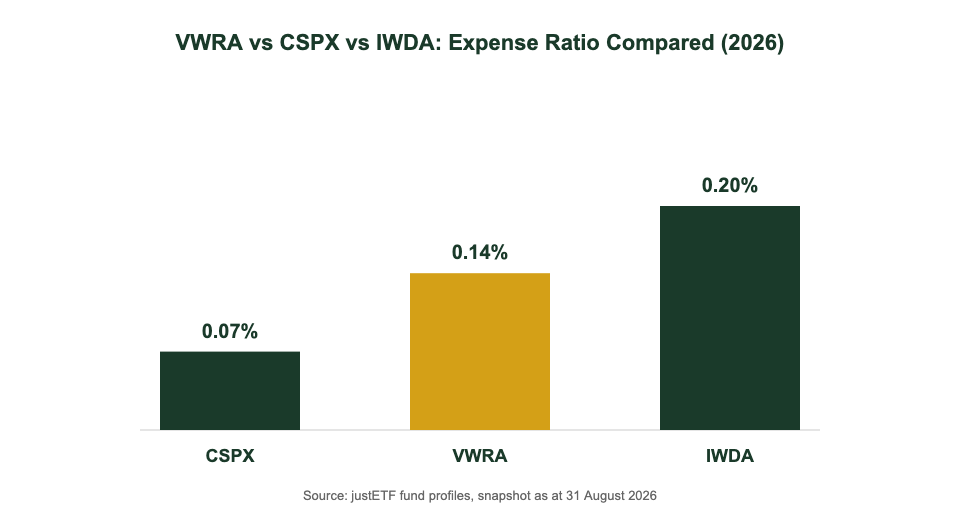
TER alone doesn’t tell the whole story, because each ETF tracks a different index with a different number of holdings. CSPX tracks the S&P 500 (US large-caps only), IWDA tracks the MSCI World (developed markets only), and VWRA tracks the FTSE All-World (developed and emerging markets combined). A lower TER on a narrower index isn’t automatically “cheaper” in the sense that matters — diversification has its own value.
| ETF | TER | Index | Holdings | AUM | US Weight |
|---|---|---|---|---|---|
| VWRA | 0.14% | FTSE All-World | 3,759 | EUR 55.4bn | 59.8% |
| CSPX | 0.07% | S&P 500 | 503 | EUR 141.4bn | 97.5% |
| IWDA | 0.20% | MSCI World | 1,252 | EUR 133.5bn | 70.3% |
Source: justETF fund profiles, snapshot as at 31 August 2026. All three ETFs are Ireland-domiciled, UCITS-compliant, and accumulating.
The practical read: CSPX is cheaper on TER but is a pure US bet with no emerging-market exposure. VWRA costs 7 basis points more than CSPX but adds roughly 3,250 additional holdings across 60-plus countries, including the emerging markets CSPX and IWDA both exclude entirely. Whether that 0.07-percentage-point gap is “worth it” depends on how much single-country concentration risk you’re willing to carry — a question this guide answers with real numbers in the worked example below. For a closer look at how the two funds track their indices day to day, see our guide on CSPX and VWRA tracking difference, and our dedicated comparison of VWRA vs IWDA if developed-only diversification is what you’re weighing instead.
Total Cost of Ownership: TER + Buying Costs
TER is charged by the fund, every year, regardless of which broker you use. Buying and FX costs are charged by your broker, every time you trade. For a long-term buy-and-hold investor making occasional purchases, TER dominates over a multi-year horizon. For someone dollar-cost-averaging monthly, the per-trade commission and FX spread can add up to more than the TER itself.
Syfe publishes its London Stock Exchange (LSE) brokerage pricing openly, which makes it a useful reference point for what a VWRA trade actually costs beyond the TER:
| Syfe Tier | Commission (% of trade value) | Minimum per Order (USD) |
|---|---|---|
| Blue | 0.04% | 1.99 |
| Black | 0.03% | 1.99 |
| Gold | 0.02% | 1.79 |
| Platinum | 0.02% | 1.59 |
| Diamond | 0.02% | 0.99 |
Source: Syfe Help Centre, “What is the LSE pricing on Syfe?”, accessed October 2026. On top of commission, LSE-listed ETF trades carry external exchange fees (trade value × 0.000045, minimum GBP 0.10 per order) and a flat clearing fee of GBP 0.06 per order — charged by the exchange, not Syfe.
Interactive Brokers (IBKR) and Saxo Markets both offer LSE access with their own tiered commission schedules and FX conversion pricing that vary by account tier and change periodically — rather than quote figures that may already be stale by the time you read this, check each broker’s current published rate card before trading, since even a 0.1 percentage-point FX spread difference matters more on frequent, smaller trades than it does on a single lump-sum purchase. As a structural rule of thumb: brokers that price FX conversion closer to the interbank rate (rather than bundling it into a wider “all-in” spread) tend to work out cheaper for investors converting SGD to USD on every trade.
Worked Example: What VWRA Actually Costs on SGD 50,000 and SGD 100,000
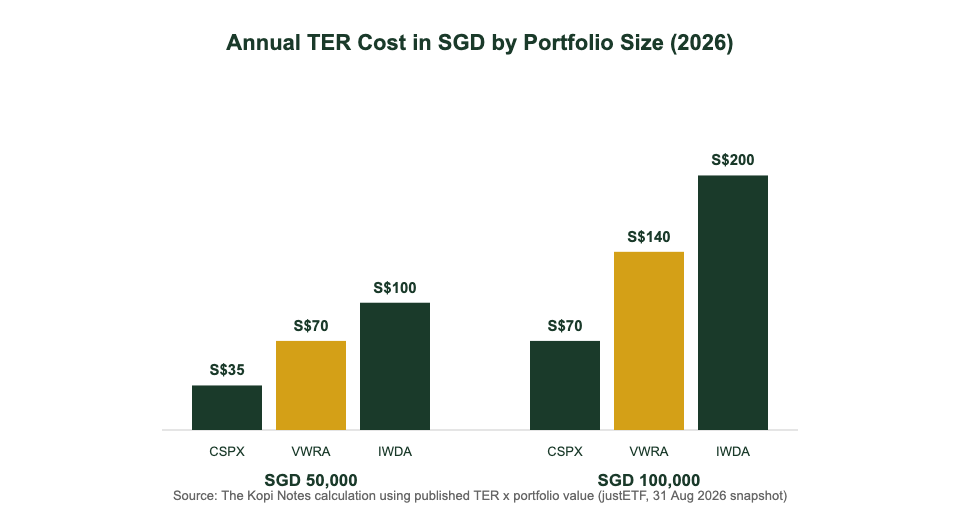
Here is the TER cost alone, before any brokerage commission or FX spread, for a Singapore investor holding VWRA at two portfolio sizes:
| Portfolio Size | VWRA TER Cost/Year (0.14%) | CSPX TER Cost/Year (0.07%) | IWDA TER Cost/Year (0.20%) |
|---|---|---|---|
| SGD 50,000 | SGD 70 | SGD 35 | SGD 100 |
| SGD 100,000 | SGD 140 | SGD 70 | SGD 200 |
Source: calculated by The Kopi Notes using published TER figures (justETF, 31 August 2026 snapshot) × stated portfolio value. For illustration only; actual fund-level costs are deducted continuously from NAV and are not billed separately.
On a SGD 50,000 holding, the gap between VWRA and CSPX works out to SGD 35 a year — roughly the cost of two hawker meals — in exchange for exposure to around 3,250 additional stocks and every developed and emerging market CSPX excludes. On the same SGD 50,000, VWRA is actually SGD 30 a year cheaper than IWDA while covering more markets, since IWDA’s MSCI World index leaves out emerging markets entirely despite its higher TER. Compounded over a 20-year holding period on a static SGD 50,000 base, that SGD 35 annual gap versus CSPX totals roughly SGD 700 in cumulative fund fees — a small, quantifiable price for diversification, not a reason on its own to avoid VWRA.
Who Should Actually Care About VWRA’s TER?
If you are a buy-and-hold investor making one or two lump-sum purchases a year and planning to hold for a decade or more, the TER is your dominant cost — it compounds quietly in the background regardless of how cheaply you execute each trade. A 0.06-percentage-point difference between brokers’ FX spreads matters far less to you than the 0.06-percentage-point difference between VWRA’s and CSPX’s TER.
If you are dollar-cost-averaging monthly with smaller trade sizes, the brokerage commission and FX spread on each purchase can easily exceed a year’s worth of TER on a small position — in that case, minimising per-trade cost (commission tier, minimum order fee, FX pricing) matters more than shaving a few basis points off the fund’s TER. Either way, VWRA’s ETF structure means it is not CPF-investable, though it remains accessible through SRS-linked brokerage accounts at providers that support LSE trading — worth checking against your own CPF investment strategy and retirement timeline before committing new capital, which you can model using our Singapore retirement calculator.
Frequently Asked Questions
What is VWRA's expense ratio in 2026?
VWRA’s total expense ratio (TER) is 0.14% per year as at the 31 August 2026 fund factsheet snapshot. This is lower than the 0.19%–0.22% figures sometimes still quoted in older guides, following a fee reduction across Vanguard’s FTSE All-World ETF range. Always check the current factsheet, since TERs can change.
Is VWRA's TER higher or lower than CSPX?
VWRA’s TER (0.14%) is higher than CSPX’s TER (0.07%) by 0.07 percentage points. On a SGD 50,000 portfolio, that is a difference of about SGD 35 a year. In exchange, VWRA holds roughly 3,759 stocks across 61 countries versus CSPX’s 503 US-only holdings.
Does the TER get billed to me separately?
No. The TER is deducted continuously from the fund’s net asset value by the fund manager, not billed to your brokerage account. It is already reflected in VWRA’s share price and historical performance figures — you will not see a separate line-item charge.
What other costs apply when buying VWRA in Singapore?
Beyond the TER, you will pay your broker’s commission on each trade, an FX conversion spread when converting SGD to USD, and — for LSE-listed ETFs — external exchange and clearing fees charged by the London Stock Exchange itself (typically a fraction of a percent plus a small flat fee per order). These vary by broker and account tier, so compare current rate cards before trading.
Can I buy VWRA using CPF or SRS funds?
VWRA is not on the CPF Investment Scheme (CPFIS) approved list, so you cannot use CPF Ordinary Account funds to buy it directly. It can be accessible through SRS-linked brokerage accounts at providers that support London Stock Exchange trading — check with your specific broker, since SRS fund access varies by platform.
Is a lower TER always better?
Not necessarily. A lower TER on a narrower index (like CSPX tracking only the S&P 500) means less diversification, not just a lower cost. VWRA’s slightly higher TER buys exposure to thousands more stocks and every major emerging market, which many investors consider worth the extra few basis points.
Ready to Start Investing in VWRA?
Compare your broker’s LSE pricing before you trade — the TER is only part of what you’ll actually pay.
This article was researched with the help of AI. While we strive to keep all information accurate and up to date, there may be errors. If you notice any discrepancies, please contact us.