CSPX vs SPYL vs VUAA: Which S&P 500 ETF Should Singapore Investors Buy? (2026)
A complete cost and tax comparison for Singapore investors — TER, withholding tax, AUM, and real SGD impact at every portfolio size.
For Singapore investors buying an S&P 500 UCITS ETF on the London Stock Exchange, SPYL (SPDR, TER 0.03%) has the lowest management fee, while CSPX (iShares, TER 0.07%) and VUAA (Vanguard, TER 0.07%) offer larger AUM and longer track records. All three are Ireland-domiciled, accumulating ETFs — meaning you pay 15% withholding tax (not 30%) and face zero US estate tax risk. For most Singapore investors, SPYL saves the most in annual fees, but CSPX’s massive liquidity and brand recognition make it the default choice for larger portfolios.
Not financial advice. All figures are for educational reference only. Data as at April 2026 unless noted.
Table of Contents
Contents — Click to expand
- Quick Answer: CSPX vs SPYL vs VUAA
- Key Differences at a Glance
- Tax & WHT Comparison for Singapore Investors
- Total Cost Drag: TER + Withholding Tax
- Real SGD Cost Impact by Portfolio Size
- Historical Performance Comparison
- Liquidity and AUM
- Who Should Pick Which ETF?
- How to Buy These ETFs in Singapore
- Frequently Asked Questions
Quick Answer: CSPX vs SPYL vs VUAA
All three ETFs track the S&P 500, are Ireland-domiciled UCITS funds listed on the London Stock Exchange (LSE), and are structured as accumulating (dividends reinvested, not paid out). This means the tax comparison that matters most to Singapore investors — US estate tax and withholding tax (WHT) — is identical across all three. The real differentiator is the Total Expense Ratio (TER) and the maturity of the fund.
Bottom line by investor type:
- Cost-conscious investors: SPYL wins on TER at 0.03% p.a. — the lowest of the three
- Established track record: CSPX (launched 2010) and VUAA (launched 2019) have longer histories than SPYL (launched October 2023)
- Largest fund by AUM: VUAA (~USD 80B) and CSPX (~USD 80B+) dwarf SPYL (~USD 13.5B) — though SPYL is growing fast
- Default pick for most SG investors: CSPX remains the most widely discussed and broker-supported on Singapore forums and platforms
Key Differences at a Glance
Here is a full side-by-side comparison of all three ETFs on the metrics that matter to a Singapore investor buying on the LSE:
| Feature | CSPX | SPYL | VUAA |
|---|---|---|---|
| Full Name | iShares Core S&P 500 UCITS ETF (Acc) | SPDR S&P 500 UCITS ETF (Acc) | Vanguard S&P 500 UCITS ETF (Acc) |
| Issuer | BlackRock / iShares | State Street SPDR | Vanguard |
| LSE Ticker | CSPX | SPYL | VUAA |
| Index Tracked | S&P 500 | S&P 500 | S&P 500 |
| Domicile | Ireland | Ireland | Ireland |
| Structure | Accumulating | Accumulating | Accumulating |
| TER (p.a.) | 0.07% | 0.03% ✓ Lowest | 0.07% |
| AUM (approx.) | ~USD 80B+ | ~USD 13.5B | ~USD 80B |
| Launch Date | May 2010 | Oct 2023 | Mar 2019 |
| Currency | USD | USD | USD |
| US WHT Rate | 15% | 15% | 15% |
| US Estate Tax Risk | None | None | None |
Source: iShares, State Street SPDR, Vanguard fund factsheets, April 2026
Tax & WHT Comparison for Singapore Investors
The most important tax consideration for Singapore investors buying US equity ETFs is the structure of the fund, not the ticker. Because CSPX, SPYL, and VUAA are all Ireland-domiciled UCITS ETFs, they benefit from the Ireland–US tax treaty, which caps the withholding tax (WHT) on US dividends paid into the fund at 15% — half the 30% rate applied to US-domiciled ETFs like VOO or SPY.
Additionally, because all three ETFs are accumulating, dividends are reinvested inside the fund and never distributed to you. This means Singapore investors pay no further WHT at the investor level — you simply benefit from the fund’s 15% gross WHT, which is far more efficient than the 30% hit on a US-domiciled equivalent.
The other critical risk — US estate tax — also applies equally (or rather, does not apply) to all three. US estate tax applies to the US-situs assets of non-US persons, and affects holdings in US-domiciled ETFs above USD 60,000. Ireland-domiciled ETFs like CSPX, SPYL, and VUAA are not considered US-situs assets, so Singapore investors have zero estate tax exposure regardless of portfolio size.
| Factor | CSPX / SPYL / VUAA (Ireland) | VOO / SPY (USA) |
|---|---|---|
| Fund Domicile | Ireland (UCITS) | United States |
| US Dividend WHT (at fund level) | 15% | 30% |
| WHT on investor distributions | None (accumulating) | 30% (for SG investors) |
| US Estate Tax Risk | None | Yes (above USD 60k) |
| Singapore CGT / Dividend Tax | None | None |
Source: Ireland–US Double Tax Treaty; IRS Publication 515; MAS guidelines, April 2026
For a Singapore investor building a retirement portfolio, this tax equivalence across CSPX, SPYL, and VUAA means the decision comes down almost entirely to cost and fund maturity — which we cover next.
Total Cost Drag: TER + Withholding Tax
While the WHT rate is the same for all three ETFs, the TER creates a real difference in annual returns. Here is how the numbers break down:
- CSPX TER: 0.07% p.a.
- SPYL TER: 0.03% p.a. — 0.04% lower than CSPX/VUAA
- VUAA TER: 0.07% p.a.
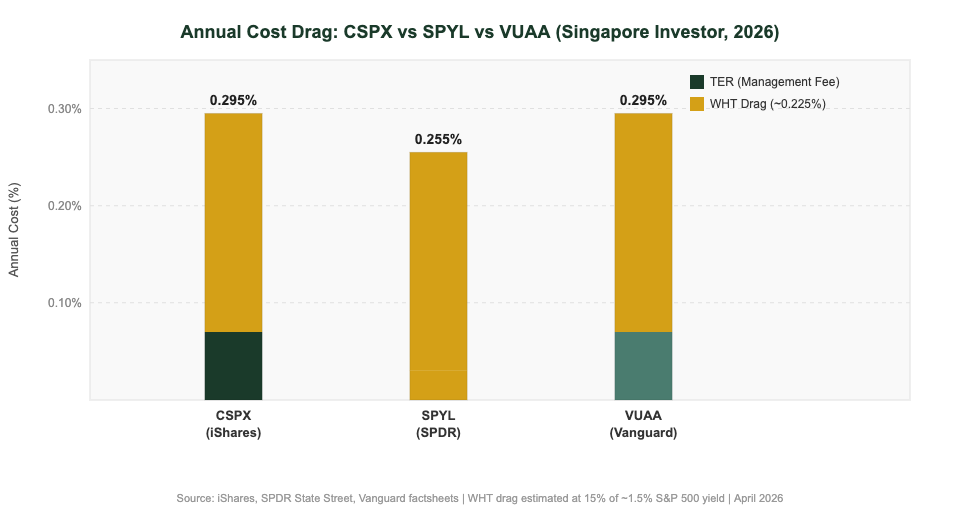
The WHT drag is identical across all three. The S&P 500 yields approximately 1.3–1.5% in dividends annually (as at April 2026). At a 15% WHT rate, this creates an estimated annual drag of 0.195%–0.225% for all three funds equally — so it does not differentiate them.
Original calculation — total annual cost drag comparison:
- CSPX: 0.07% (TER) + ~0.21% (WHT drag) = ~0.28% total
- SPYL: 0.03% (TER) + ~0.21% (WHT drag) = ~0.24% total
- VUAA: 0.07% (TER) + ~0.21% (WHT drag) = ~0.28% total
SPYL’s total cost drag is approximately 0.04% lower than CSPX and VUAA — a meaningful difference that compounds significantly over a long investment horizon. Over 20 years on a SGD 200,000 portfolio, that 0.04% TER saving translates to roughly SGD 2,400–3,500 more in your pocket (assuming 8% gross annual returns), due to compounding.
For investors building passive income in Singapore, these cost savings add up — even if they seem small on a per-year basis. As your portfolio grows, so does the dollar impact of that TER difference. You can use the Singapore retirement calculator to model the long-term compounding impact of different expense ratios on your portfolio.
Real SGD Cost Impact by Portfolio Size
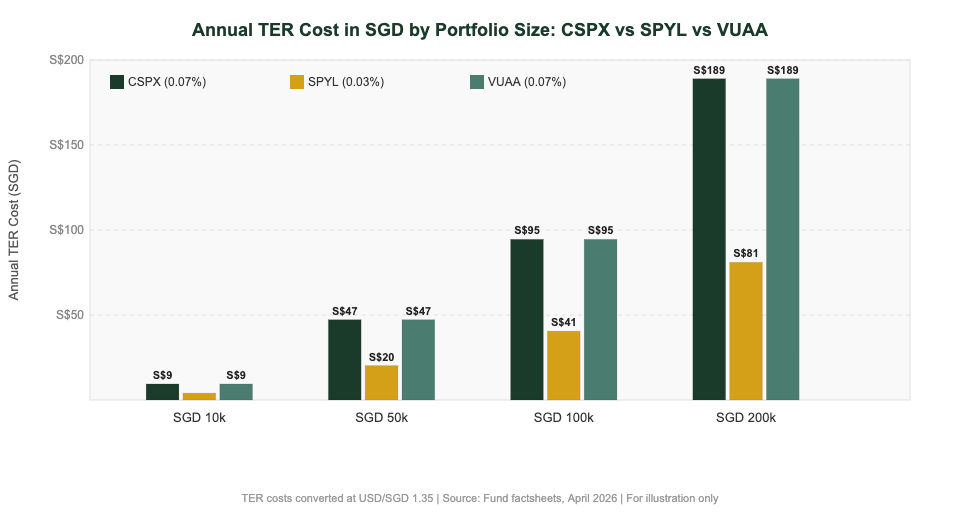
Here is the annual TER cost in Singapore dollars for each ETF at common portfolio sizes (converted at USD/SGD 1.35, April 2026):
| Portfolio Size | CSPX (0.07%) | SPYL (0.03%) | VUAA (0.07%) | SPYL Saving vs CSPX |
|---|---|---|---|---|
| SGD 10,000 | S$9.45 | S$4.05 | S$9.45 | S$5.40/yr |
| SGD 50,000 | S$47.25 | S$20.25 | S$47.25 | S$27.00/yr |
| SGD 100,000 | S$94.50 | S$40.50 | S$94.50 | S$54.00/yr |
| SGD 200,000 | S$189.00 | S$81.00 | S$189.00 | S$108.00/yr |
TER costs converted at USD/SGD 1.35 | Source: Fund factsheets, April 2026 | For illustration only — actual costs depend on NAV and FX rate at time of investment
At SGD 100,000, SPYL saves you approximately S$54 per year versus CSPX or VUAA. Over 20 years (with reinvestment), that saving compounds meaningfully. For investors also tracking passive income in Singapore, every basis point of cost saved is a basis point that stays invested and working for you.
Historical Performance Comparison
Because all three ETFs track the same index — the S&P 500 — their performance is nearly identical over matching time periods. The only material difference comes from TER drag, which causes CSPX and VUAA to trail SPYL by approximately 0.04% per year in net return.
SPYL launched in October 2023, so direct multi-year comparison data is limited. However, using the S&P 500 as the common benchmark:
- S&P 500 (gross): ~23% in 2023, ~25% in 2024 (USD terms)
- CSPX net return (after 0.07% TER + WHT): Closely tracks the index net of costs
- SPYL net return (after 0.03% TER + WHT): Expected to outperform CSPX by ~0.04% per year over long periods
- VUAA net return (after 0.07% TER + WHT): Virtually identical to CSPX performance
For Singapore investors, the performance question is largely settled: same index, same domicile, same WHT — the only variable is TER, and SPYL wins on that metric.
Note: All three ETFs carry market risk. The S&P 500 is a large-cap US equity index and can experience significant drawdowns. As an example, the index fell approximately 19% in 2022. Past performance is not an indicator of future returns. Singapore investors interested in diversifying beyond US equities may also consider the Singapore REIT ETF guide for local exposure.
Liquidity and AUM
Fund size matters for two reasons: it affects the bid-ask spread (and therefore your transaction cost each time you buy or sell), and it signals the fund’s likelihood of continuing to operate over the long term. Larger funds are more liquid and have lower closure risk.
- CSPX: ~USD 80B+ AUM — one of the largest UCITS ETFs in the world. Extremely liquid on the LSE, tight spreads
- VUAA: ~USD 80B AUM — similarly large, excellent liquidity
- SPYL: ~USD 13.5B AUM (as at March 2026) — smaller but growing rapidly since its October 2023 launch. Liquidity is adequate for most retail investors but spreads may be slightly wider than CSPX/VUAA during off-peak trading hours
For Singapore investors making large regular investments (e.g. SGD 5,000–10,000 per month), CSPX and VUAA’s deeper liquidity pool is an advantage. For smaller regular investors (SGD 500–2,000 per month), SPYL’s liquidity is more than sufficient and the lower TER wins.
Who Should Pick Which ETF?
SPYL is ideal if you:
- Want the lowest possible expense ratio on an S&P 500 UCITS ETF
- Are a long-term buy-and-hold investor who won’t be actively trading
- Are comfortable with a newer fund (launched 2023) backed by a major institution (State Street)
- Are investing smaller amounts where CSPX/VUAA’s liquidity advantage is irrelevant
CSPX is ideal if you:
- Want the longest track record (launched 2010) and maximum liquidity on the LSE
- Are making very large trades where the tightest possible bid-ask spread matters
- Prefer the BlackRock/iShares brand and ecosystem for fund reporting
- Are already invested in CSPX and want to avoid the administrative hassle of switching
VUAA is ideal if you:
- Prefer Vanguard’s investor-owned structure and philosophy
- Want similar liquidity to CSPX but prefer Vanguard as the fund manager
- Are using a platform that has better support for Vanguard products specifically
From a CPF investment strategy perspective, note that none of these three ETFs — CSPX, SPYL, or VUAA — are eligible for CPF-OA investment, as they are not listed on the SGX. They are, however, generally compatible with SRS (Supplementary Retirement Scheme) accounts if purchased through an SRS-eligible broker.
How to Buy These ETFs in Singapore (Step-by-Step)
All three ETFs trade on the London Stock Exchange in USD. You’ll need a brokerage account that provides LSE access. The most cost-effective options for Singapore investors are:
1. Interactive Brokers (IBKR)
Best for: Large portfolios (SGD 50,000+). Commission from USD 0 (IBKR Lite) or USD 1.70 per trade (IBKR Pro). No platform fee. Lowest FX conversion cost among major brokers. Search for CSPX, SPYL, or VUAA on the LSE exchange.
2. Saxo Markets Singapore
Best for: Mid-size portfolios. Commission from USD 3 per LSE trade. Clean interface, direct LSE access. Well-established in Singapore.
3. Syfe Brokerage
Best for: Beginners and small regular investors. Simple interface, fractional investing available on some securities. Use the Syfe referral code for sign-up bonuses when you open a new account.
4. FSMOne
Best for: Investors who want a Singapore-based platform with LSE access. Use the FSMOne referral code for fee rebates. RSP (Regular Savings Plan) available for some ETFs.
Step-by-step process (same for all three ETFs):
- Open and fund your brokerage account in SGD or USD
- Convert SGD to USD (or GBP if your broker prices LSE stocks in GBP)
- Search for the ticker: CSPX, SPYL, or VUAA — select the LSE exchange
- Place a limit order at or near the ask price to control your entry cost
- Confirm the trade — settlement is T+2 for LSE securities
- Reinvestment is automatic (accumulating structure — no action needed)
If you are also exploring dividend-paying alternatives for retirement income, the best S-REITs in Singapore 2026 article covers high-yield options that complement an S&P 500 ETF allocation.
Disclaimer: This article is for educational purposes only and does not constitute financial advice. All data is sourced from publicly available fund factsheets and is accurate as at April 2026. Past performance is not indicative of future results. Please consult a licensed financial adviser before making investment decisions.
Frequently Asked Questions
What is the main difference between CSPX, SPYL, and VUAA?
All three ETFs track the S&P 500 index and are Ireland-domiciled UCITS accumulating funds listed on the London Stock Exchange — so the tax treatment is identical for Singapore investors. The key differences are the expense ratio (SPYL 0.03% vs CSPX/VUAA 0.07%), fund size (CSPX and VUAA are larger at ~USD 80B each vs SPYL at ~USD 13.5B), and track record (CSPX launched in 2010, VUAA in 2019, SPYL in October 2023).
Is SPYL better than CSPX for Singapore investors?
SPYL has a lower TER (0.03% vs 0.07%), which means it costs less to hold annually. On a SGD 100,000 portfolio, SPYL saves approximately S$54 per year versus CSPX. However, CSPX has a longer track record (14+ years vs 2+ years), larger AUM, and deeper liquidity on the LSE. For long-term buy-and-hold investors, SPYL is the cost-efficient choice; for investors making very large trades or who value the longest possible track record, CSPX remains a strong option.
Do CSPX, SPYL, and VUAA all have the same withholding tax rate?
Yes. All three ETFs are Ireland-domiciled, so they benefit from the Ireland–US tax treaty, which caps the withholding tax on US dividends received by the fund at 15% — compared to 30% for US-domiciled funds like VOO or SPY. Because all three are accumulating ETFs, there is no further withholding tax at the investor level. Singapore investors also pay no capital gains tax or dividend tax under Singapore law.
Can I buy CSPX, SPYL, or VUAA with my CPF or SRS funds?
None of these three ETFs are eligible for CPF-OA investment, as the CPF Investment Scheme (CPFIS) only covers funds and ETFs listed on the SGX. However, CSPX, SPYL, and VUAA may be purchased through SRS (Supplementary Retirement Scheme) accounts if bought via an SRS-eligible broker such as IBKR, Saxo, or certain Singapore-licensed brokerages. Check with your broker to confirm SRS eligibility before transacting.
Which broker is best for buying SPYL in Singapore?
Interactive Brokers (IBKR) is generally the most cost-effective for buying SPYL, CSPX, or VUAA on the LSE, particularly for larger portfolios. IBKR offers very low commissions and tight FX conversion spreads. For beginners, Syfe Brokerage offers a simpler user experience. FSMOne is a good mid-tier option for Singapore-based investors who prefer a local platform. All three brokers provide LSE access where SPYL, CSPX, and VUAA are listed.
Is it worth switching from CSPX to SPYL to save on fees?
For most Singapore investors, switching from CSPX to SPYL is not worth the transaction cost if you already hold a significant CSPX position. The annual TER saving of 0.04% means you would need to hold SPYL for several years to recoup the brokerage commission on selling CSPX and buying SPYL. The better strategy is to direct new investments into SPYL going forward, while holding your existing CSPX position. There is no Singapore capital gains tax on the sale, but you should factor in the bid-ask spread and broker commission on both legs of the switch.
What is the minimum investment for SPYL, CSPX, or VUAA?
The minimum investment is one share, which as at April 2026 is approximately USD 550–620 for CSPX, USD 540–600 for SPYL, and USD 98–110 for VUAA (prices vary with the S&P 500 index level). VUAA trades at a lower per-share price because it has not been split-adjusted like CSPX. In SGD terms (at 1.35 rate), that is roughly S$740–850 for CSPX and SPYL, and S$130–150 for VUAA per share. Some brokers also offer fractional shares, reducing the effective minimum further.
Ready to Start Buying S&P 500 ETFs?
Open a brokerage account and buy CSPX, SPYL, or VUAA on the LSE today. Use our referral links for exclusive sign-up bonuses.
This article was researched with the help of AI. While we strive to keep all information accurate and up to date, there may be errors. If you notice any discrepancies, please contact us.