Best Investment Plans in Singapore 2026: 6 Types Compared for Every Budget
Singapore has no capital gains tax, strong regulatory oversight, and world-class investment platforms — yet many residents delay investing for years, paralysed by one question: which investment plan should I start with? This guide compares six types of investment plans in Singapore for 2026, breaking down fees, minimum amounts, CPF/SRS eligibility, and who each plan is best suited for.
Not financial advice. All figures are for educational reference only. Data as at November 2026 unless noted.
Why Most Singaporeans Delay Investing (And How to Stop)
You’ve probably heard it before: “the best investment plan is the one you actually stick to.” Yet most guides present a list of platforms and leave you to figure out which is right for your situation.
The challenge is that Singapore genuinely offers more types of investment plans than most other countries — from bank-backed Regular Savings Plans (RSPs) to CPF-eligible digital advisors to international brokers with zero commissions. Without a clear framework for comparing them, it’s easy to default to doing nothing.
This guide cuts through the complexity. We’ll compare six distinct types of investment plans, their true cost at S$300–S$500/month, and the specific situations where each makes sense.
One thing worth noting upfront: Singapore’s zero capital gains tax means all your investment returns are yours to keep. The only drag on your wealth is the fees you pay. That makes choosing a low-cost plan especially important here.
The 6 Types of Investment Plans in Singapore
1. Bank-Backed Regular Savings Plans (RSPs)
RSPs from local banks let you invest a fixed monthly amount into ETFs or blue-chip stocks automatically. No separate brokerage account required — it links directly to your existing bank account.
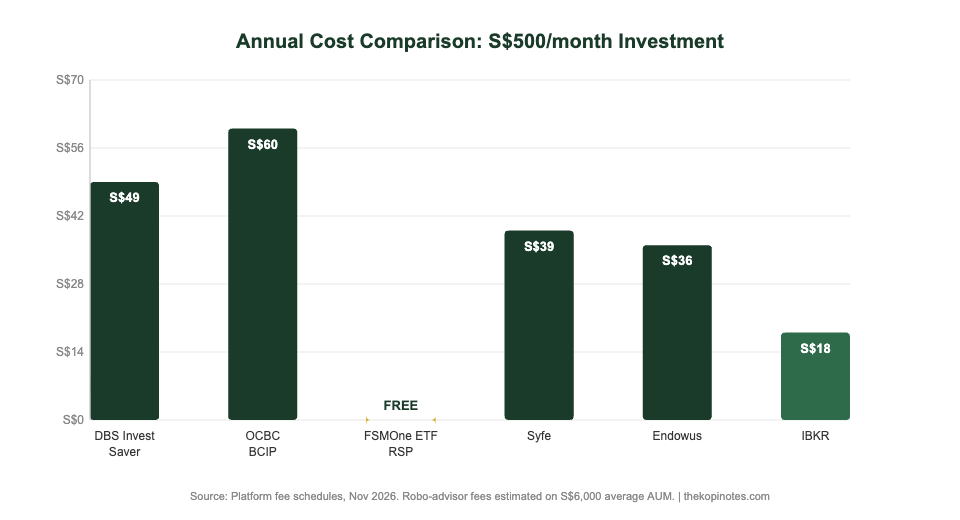
DBS Invest Saver is the most widely used: minimum S$100/month, with a 0.82% sales charge per transaction for the ETF option (Nikko AM STI ETF, ABF Singapore Bond Index Fund). At S$500/month, you pay about S$4.10 in fees each transaction — roughly S$49/year, or 0.82% annualised on your contributions.
OCBC Blue Chip Investment Plan (BCIP) charges 0.3% per counter per month (minimum S$5 per counter), with a minimum of S$100/month per stock or ETF. It gives you access to 25 SGX-listed blue chips and the SPDR STI ETF — useful if you want to gradually build a blue-chip stock portfolio alongside an index ETF.
Bank RSPs are ideal for true beginners who value simplicity and an integrated banking experience. The main trade-off: narrow fund selection and fees that become relatively expensive at higher investment amounts.
2. Platform-Based RSPs (FSMOne, Phillip Capital)
Third-party investment platforms offer a much wider universe of funds at lower costs than bank RSPs.
FSMOne (formerly Fundsupermart, run by iFAST) allows RSPs from just S$50/month. For selected ETFs, the upfront charge is 0% — making it one of the cheapest ways to do monthly ETF investing in Singapore. The platform covers 1,000+ funds, ETFs, and Singapore government bonds. If you want global ETF exposure (US, Europe, emerging markets) at low cost, FSMOne is worth considering. Use our FSMOne referral code to get started. Our referral code is P0544985.
Phillip Capital (POEMS) also offers an RSP (Share Builders Plan) with similar access to SGX stocks and ETFs, minimum S$100/month.
Platform RSPs suit investors who want broader fund choice and are comfortable opening a separate investment account from their bank.
3. Robo-Advisors
Robo-advisors handle everything: portfolio construction, automatic rebalancing, and global diversification. You fund your account monthly and let the algorithm manage the rest.
Syfe charges an annual management fee of 0.65% (balances under S$20,000), 0.50% (S$20k–S$100k), and 0.35% (above S$100k). There’s no minimum investment requirement — you can start with as little as S$1. Portfolios include Core Equity100 (100% global equities via iShares ETFs), Income+ (bonds + REITs), and a customisable option. Use our Syfe referral code SRPRFFFCD for a bonus when signing up.
StashAway charges 0.8% (under S$10k) down to 0.2% (above S$1M) p.a., with no minimum. Its Economic Regime-based Asset Allocation (ERAA) model adjusts portfolio weights based on macro conditions.
Robo-advisors are ideal for investors who want a truly hands-off approach and are comfortable with ongoing annual fees rather than upfront transaction charges.
4. CPF & SRS Investing via Endowus
This is where Singapore’s investment landscape becomes genuinely unique. The CPF Investment Scheme (CPFIS) lets you invest your CPF Ordinary Account (OA) balance — which earns 2.5% p.a. in the OA — into higher-return funds. The Supplementary Retirement Scheme (SRS) lets Singaporeans and PRs contribute up to S$15,300/year for a tax deduction, then invest those funds.
Endowus charges an annual management fee of 0.25%–0.60% p.a. (tiered by total AUM), with a S$1,000 minimum initial investment. Its key differentiator: it’s the only major digital advisor in Singapore that accepts CPF-OA, CPF-SA, and SRS funds alongside cash. If you have idle CPF-OA earning just 2.5% p.a., Endowus lets you put it into globally diversified funds targeting 4%–7% p.a. returns. Use our Endowus referral code 2V343 to get started.
Endowus is the best choice for investors who want to unlock the return potential of their CPF-OA balance or who are building a tax-efficient SRS portfolio for retirement.
5. Self-Directed ETF Investing via Online Brokers
For investors comfortable picking their own ETFs, a broker account offers maximum control and potentially the lowest long-term cost.
Interactive Brokers (IBKR) charges no commission for US-listed stocks and ETFs under IBKR Lite, and around USD 0.0035/share (min USD 0.35) under IBKR Pro. For SGX trades, commissions start at approximately S$1.50–2.50 per order. There’s no minimum deposit as of 2026, making IBKR accessible to investors at any stage. See our IBKR Singapore review for a detailed walkthrough. Our referral code is jianxiong368.
moomoo Singapore offers commission-free trading for the first year. See our moomoo Singapore review for the full breakdown on fees and features.
Self-directed investing via brokers suits investors who want to build a low-cost ETF portfolio (e.g. CSPX, VWRA, or the Nikko AM STI ETF) without ongoing advisory fees. The trade-off is that you bear full responsibility for portfolio decisions and rebalancing.
6. Insurance-Based Savings Plans (Endowment Plans)
Endowment plans from insurers such as Manulife, AIA, and Prudential offer a structured savings-with-investment wrapper, commonly marketed as “investment plans” in Singapore.
Typical returns: 2%–3.5% p.a. guaranteed plus non-guaranteed bonuses of 1%–2%. Lock-up periods range from 5 to 20 years, and early surrender typically results in a capital loss in the first few years.
Endowment plans can play a role in a diversified financial plan — particularly for specific goals with a defined time horizon (e.g. a 15-year education fund). However, as a primary investment vehicle for wealth building, they are generally inferior to diversified ETF portfolios due to lower returns, higher costs embedded in the structure, and illiquidity.
What Makes Singapore Investment Plans Unique
Singapore’s investment environment has three structural advantages not found in most other countries:
No capital gains tax. Every dollar your investments earn — whether from price appreciation, dividends, or ETF distributions — is entirely tax-free. This means you keep 100% of your compounded returns, unlike in countries where investors pay 15%–30% CGT on gains.
CPF and SRS as investable assets. Most Singaporeans and PRs have significant sums sitting in their CPF accounts. CPFIS allows you to invest CPF-OA funds (beyond the first S$20,000, which earns the guaranteed 2.5% p.a.) into approved funds. The SRS scheme offers a tax deduction on contributions, then tax-deferred growth — with only 50% of withdrawals taxable at retirement. Used well, SRS is one of the most effective tax-planning tools available to Singapore residents.
Regulatory stability and investor protection. All platforms mentioned in this guide are regulated by the Monetary Authority of Singapore (MAS). Customer assets are held in segregated accounts, reducing — but not eliminating — platform risk.
Use our Singapore retirement calculator to estimate how much your monthly investment plan needs to generate to reach your retirement target.
Side-by-Side Comparison: Fees, Minimums & Best For
The table below compares all six investment plan types on the metrics that matter most: cost, accessibility, and use case. All fee figures are verified as at Q4 2026.
| Plan Type | Example | Min/Month | Fees | CPF/SRS | Best For |
|---|---|---|---|---|---|
| Bank RSP | DBS Invest Saver | S$100 | 0.82% / trade | No | Total beginners |
| Bank RSP | OCBC BCIP | S$100 | 0.3% (min S$5) | No | Blue-chip builders |
| Platform RSP | FSMOne RSP | S$50 | 0%–0.5% upfront | No | Fund diversifiers |
| Robo-Advisor | Syfe | No min | 0.35–0.65%/yr | No | Hands-off investors |
| CPF/SRS Advisor | Endowus | S$1,000 initial | 0.25–0.60%/yr | Yes | CPF/SRS maximisers |
| DIY Broker | IBKR | No min | USD 0–1/trade | No | Self-directed ETF investors |
| Endowment Plan | Various insurers | S$100–S$300 | Embedded (~2–3%) | Some | Goal-based savers |
Source: Platform fee schedules and official websites, November 2026. Robo-advisor fees exclude underlying fund expense ratios.
The chart below visualises the annual cost difference at a S$500/month contribution, illustrating how fee structures compound over time.
Which Investment Plan in Singapore Is Right for You?
The right plan depends on three things: how much you’re investing monthly, how hands-on you want to be, and whether you have CPF-OA or SRS funds to deploy.
Start with S$100–S$300/month and want simplicity? DBS Invest Saver or OCBC BCIP are the easiest entry points — no separate account needed, and the auto-debit is linked to your existing bank account. At this contribution level, the 0.82% fee is small in absolute dollar terms (< S$2.50/month).
Want broader fund choice or lower fees? FSMOne RSP at S$50/month minimum gives you access to 1,000+ funds — including international ETFs at 0% upfront. This is the most cost-efficient RSP option for investors comfortable opening a separate account. Read our full regular savings plan Singapore guide for a deeper comparison of all RSP platforms.
Fully hands-off, investing S$500+/month? Syfe or StashAway offer automated, globally diversified portfolios. The annual fee of 0.5%–0.65% is reasonable for the level of automation and diversification you get. If you’re new to investing and don’t want to pick your own ETFs, these are the best default choice for most Singaporeans.
Have idle CPF-OA funds or want to maximise SRS? Endowus is the only major digital advisor offering CPF-OA, CPF-SA, and SRS investing. If your CPF-OA is sitting at 2.5%, investing it via Endowus in a diversified global fund could meaningfully improve your long-term retirement balance. Use the Endowus referral code 2V343 to get started.
Comfortable doing your own research and picking ETFs? IBKR with a DIY ETF strategy (e.g. monthly VWRA or CSPX purchases) will likely produce the lowest total cost over a 10–20 year horizon. The trade-off: you need to decide which ETFs to buy, manage any rebalancing, and be disciplined enough to invest consistently through market downturns.
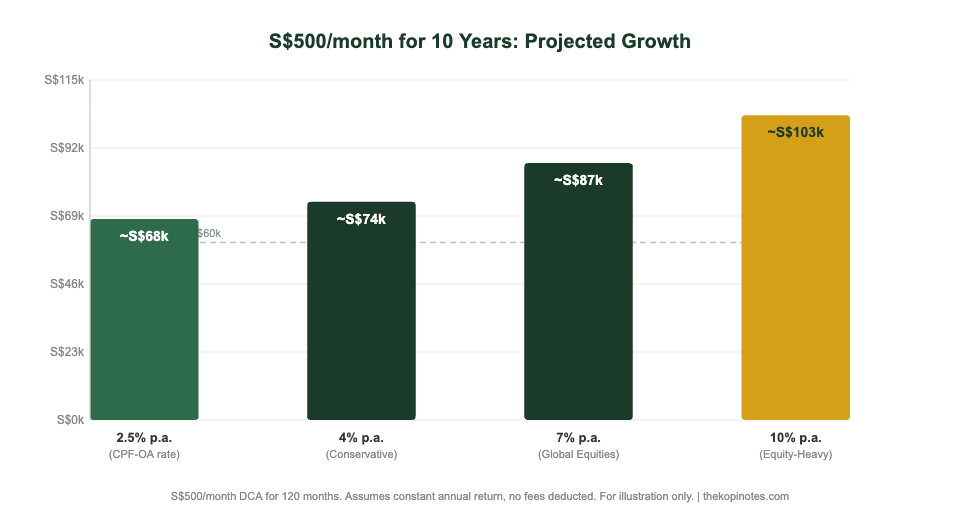
The chart below shows projected wealth from investing S$500/month for 10 years at different expected annual returns — illustrating how your plan choice (and its fees) can affect the outcome.
The Bottom Line: A Simple 3-Step Framework
- Step 1: If you have CPF-OA funds above S$20,000 sitting idle — prioritise Endowus first. The tax-advantaged structure makes this the highest-return lever for most investors.
- Step 2: For monthly cash contributions, choose based on involvement: Bank RSP (zero involvement) → Robo-advisor (low) → Platform RSP (medium) → Self-directed broker (high).
- Step 3: Review fees annually. As your portfolio grows, the absolute dollar cost of annual-fee-based plans (like robo-advisors) rises. At S$200k+, switching to a low-commission broker for new contributions often makes sense.
Frequently Asked Questions
What is the best investment plan in Singapore for beginners?
How much should I invest monthly in Singapore?
Can I use CPF to invest in a regular savings plan?
What is the difference between an RSP and a robo-advisor?
Is it safe to invest through Syfe, Endowus, or FSMOne?
When should I switch from a bank RSP to a robo-advisor or broker?
This article was researched with the help of AI. While we strive to keep all information accurate and up to date, there may be errors. If you notice any discrepancies, please contact us.