How to Invest in Singapore: Portfolio Rebalancing — When, Why & How (2026)
The step-by-step guide for Singapore investors — covering CPF, SRS & cash accounts
Portfolio rebalancing means selling what has grown and buying what has lagged — to restore your original target allocation. For Singapore investors, this is one of the most overlooked steps in long-term wealth-building. Done right, rebalancing keeps your risk level where you want it and may improve long-term returns. This guide covers when to rebalance, how to do it across CPF, SRS and cash accounts, and which platforms make it easiest in 2026.
Not financial advice. All figures are for educational reference only. Data verified as at 18 September 2026 unless noted.
- Your portfolio drifts over time as equities outpace bonds, or vice versa — without any action from you
- Rebalance when any asset class drifts more than 5–10% from your target, or at least once a year
- Singapore has no capital gains tax, so rebalancing is cheaper here than in most countries
What Is Portfolio Rebalancing?
Rebalancing is the process of returning your portfolio to its original target allocation after market movements cause it to drift.
Here’s a simple example. You start with a 70% equities / 30% bonds portfolio. After a strong year for stocks, equities grow to 80% of your portfolio while bonds shrink to 20%. You’re now taking on more risk than you originally planned. Rebalancing means selling some equities and buying more bonds to get back to 70/30.
This is NOT market timing. You’re not predicting which direction markets will move. You’re simply enforcing the risk level you chose — and in the process, systematically selling high and buying low.
Why does this matter? Because left unchecked, a portfolio that started at 70% equities might drift to 85% equities after a multi-year bull market. At that point, you’re taking on significantly more risk than you signed up for. A market correction would hit you much harder than your original plan intended.
Rebalancing is especially important for long-term investors in Singapore who invest across CPF OA, SRS, and cash brokerage accounts. Each bucket has different investment options and different growth rates — making drift even more likely over time.
Why Your Portfolio Drifts Over Time
Markets never move in straight lines. Different asset classes grow at different rates. Over months and years, this causes your original allocation to shift — sometimes dramatically — without you doing anything at all.
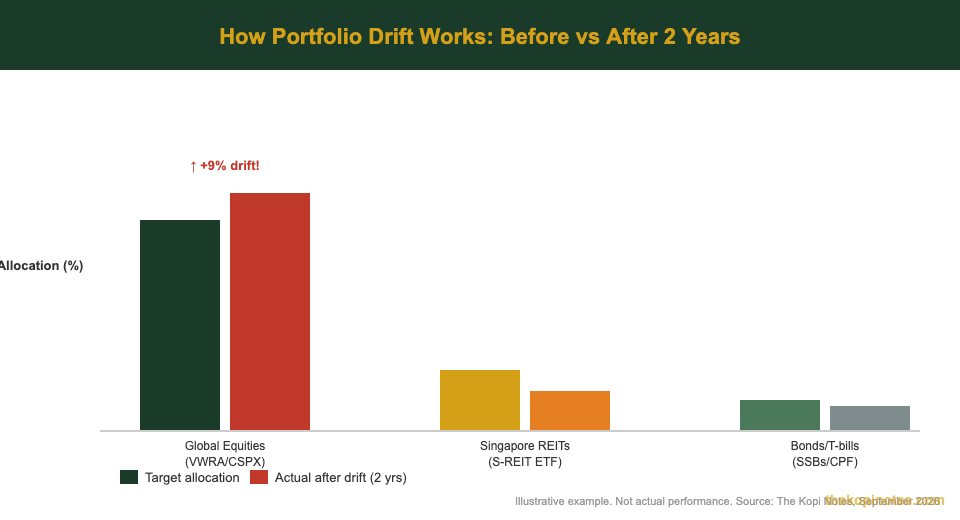
Consider a Singapore investor who starts with S$100,000 split across global equities (70%), Singapore REITs (20%), and bonds/T-bills (10%). After two years of varied market performance:
| Asset Class | Target % | Starting Value | 2-Year Return | Ending Value | Actual % |
|---|---|---|---|---|---|
| Global Equities (VWRA/CSPX) | 70% | S$70,000 | +38% | S$96,600 | 79% |
| S-REIT ETF | 20% | S$20,000 | -10% | S$18,000 | 15% |
| Singapore T-bills / Bonds | 10% | S$10,000 | +8% | S$10,800 | 9% |
Source: Illustrative example only. Not actual performance data. The Kopi Notes, September 2026.
The result: a portfolio that started at 70/20/10 has drifted to 79/15/9 — a 9-percentage-point overshoot in equities. Without rebalancing, you are now taking on significantly more equity risk than you originally planned. If markets correct, you’ll feel the pain more sharply than your risk profile intended.
When Should You Rebalance?
There are two main approaches. You can use either one, or combine them.
1. Calendar Rebalancing (Annual)
Check your portfolio on a fixed schedule — typically once a year — and rebalance if any asset class has drifted from its target. January and December are the most popular times for Singapore investors, since they align with year-end planning and SRS top-ups.
2. Threshold Rebalancing (5% or 10% Band)
Rebalance only when an asset class drifts beyond a set threshold from its target. A 5% band means you rebalance if equities hit 75% when your target is 70%. A 10% band means you only act when equities hit 80%.
Research generally suggests threshold-based rebalancing slightly outperforms calendar-based, because you act when drift is meaningful rather than on an arbitrary date. However, threshold rebalancing requires more active monitoring.
For most Singaporeans, annual calendar rebalancing is the simplest and most practical approach.
| Method | How It Works | Best For | Downside |
|---|---|---|---|
| Annual (calendar) | Check once a year; rebalance if any asset drifted | Busy investors, beginners | May miss mid-year drift |
| 5% threshold | Rebalance when any asset drifts >5% from target | Moderately active investors | Needs regular monitoring |
| 10% threshold | Rebalance only when drift exceeds 10% | Very passive investors | Risk can build significantly before triggering |
| Opportunistic | Only use new deposits to buy under-weight assets | DCA investors, avoids selling costs | Very slow to correct large drifts |
Source: The Kopi Notes, September 2026.
A practical rule: check once a year, and rebalance if any asset class is more than 5 percentage points off target. This gives you a disciplined system without over-trading.
How to Rebalance Your Portfolio in Singapore (By Platform)
The method depends on which platform you use. Here’s how rebalancing works on Singapore’s most popular investment platforms in 2026.
Endowus (Cash / CPF / SRS)
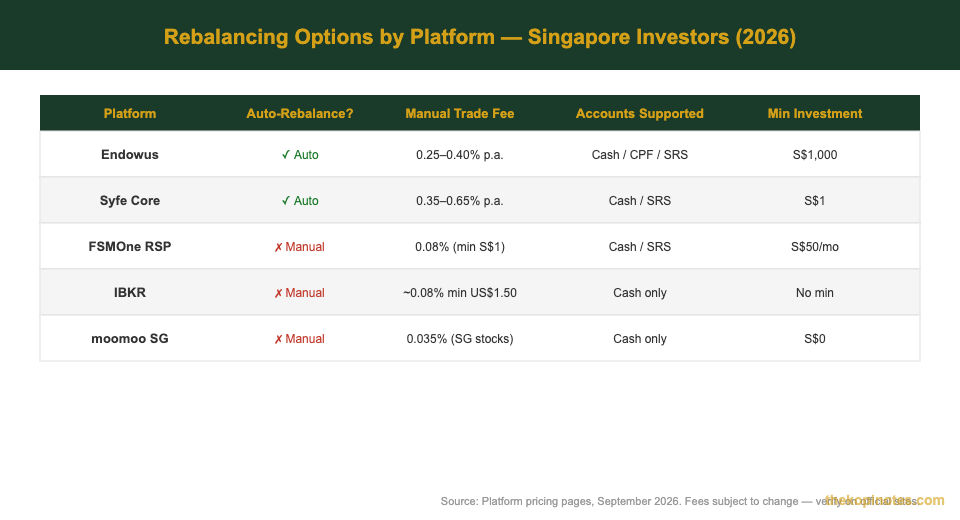
If you use Endowus’s managed portfolios (Core, Satellite, or ESG), rebalancing is fully automatic. Endowus rebalances your portfolio within the set bands without any action from you. If you use Fund Smart for DIY fund investing, you’ll need to manually adjust allocations: log in → Portfolio → Adjust holdings.
Endowus charges a flat 0.25%–0.40% p.a. management fee depending on account type. Explore your options via the Endowus referral code to claim a welcome bonus when you sign up.
Syfe Core & Select (Cash / SRS)
Syfe’s Core portfolios auto-rebalance. If you hold individual ETFs in Syfe Brokerage, rebalancing is manual — sell over-weight positions and buy under-weight ones. Syfe charges 0.25%–0.65% p.a. depending on your portfolio size (five tiers from 0.65% for small balances down to 0.25% for larger ones, as at 1 January 2026). Use the Syfe referral code and sign-up bonus (code: SRPRFFFCD) to get a fee waiver on your first months.
IBKR (Cash Only)
IBKR is fully self-directed. Calculate the drift, determine how many units to sell/buy, and execute the trades. IBKR charges approximately 0.08% per trade with a minimum of US$1.50 — making it cost-effective for larger rebalancing trades above S$2,000. Sign up via referral code jianxiong368 to earn IBKR stock rewards.
FSMOne (Cash / SRS)
FSMOne offers RSPs and manual trading. For rebalancing, you’ll adjust your RSP split online or place sell/buy orders manually. FSMOne charges 0.08% per transaction (minimum S$1). The FSMOne referral code is P0544985.
Rebalancing Across CPF, SRS & Cash Accounts
One of the trickiest parts of rebalancing in Singapore is that your investments are spread across different “buckets” — each with its own rules, tax treatment, and restrictions.
CPF OA via CPFIS
Your CPF OA earns a guaranteed 2.5% per year (as confirmed by the CPF Board, rate guaranteed through 31 December 2026). Factor this into your overall portfolio as a “bond-equivalent” allocation — your CPF OA is essentially your safest, lowest-risk holding.
If you invest CPF funds via CPFIS-OA, note the rules: you must keep at least S$20,000 in CPF OA before investing, and stocks are capped at 35% of your investible savings while gold is capped at 10%. These limits affect how much you can rebalance within CPFIS. Read our CPF investment strategy guide for a deeper breakdown.
SRS (Supplementary Retirement Scheme)
SRS funds can be invested in ETFs, unit trusts, and insurance products. Rebalancing within SRS is straightforward — log into your SRS broker (Endowus, Syfe, DBS Vickers, etc.) and adjust allocations. There’s no minimum balance restriction like CPFIS-OA.
One powerful SRS rebalancing tip: if you make annual SRS top-ups (up to S$15,300 per year for citizens/PRs as at 2026), direct the new funds into your most under-weight asset class before rebalancing. This reduces how much you need to sell.
Cash Brokerage Accounts
The most flexible. No restrictions on amounts or timing. You can rebalance at any point.
The big advantage for Singapore investors: there is no capital gains tax in Singapore. When you sell equities that have grown in your cash brokerage account, you don’t pay tax on those gains — only the brokerage commission. This makes rebalancing far cheaper here than in countries like the US or UK where capital gains tax can erode the benefit.
How to Think About All Three Buckets Together
When calculating your overall allocation, include all three buckets:
- CPF OA (uninvested): Count as bonds/fixed income at 2.5% guaranteed
- CPF OA via CPFIS: Count per what you’ve invested in (equities, gold, unit trusts)
- SRS: Count per investments held
- Cash brokerage: Count per investments held
Add it all up. Then compare against your target. This is your true overall allocation — and what you should be rebalancing toward. If your CPF OA balance is large, it already provides significant “bond-equivalent” exposure, which may mean you need less bonds in your SRS or cash accounts to hit your target.
Check our Singapore retirement calculator to model how your overall portfolio allocation affects your retirement date.
Step-by-Step Rebalancing Checklist for Singapore Investors
Follow these five steps every time you rebalance. Do this once a year (e.g. December, alongside your SRS top-up).
Step 1 — Record your current allocation
Log into all accounts (CPF portal, SRS broker, cash brokerage). Note the current market value of each asset class. Include uninvested CPF OA as “bonds”. Add it all up.
Step 2 — Calculate your actual allocation (%)
Divide each asset class value by the total portfolio value. Compare to your target allocation. Note any that have drifted more than 5%.
Step 3 — Redirect new deposits first
If you’re making an SRS top-up or regular cash contribution, direct that new money to your most under-weight asset class. This reduces how much you need to sell.
Step 4 — Sell over-weight, buy under-weight
For any remaining drift after new deposits, sell a portion of your over-weight assets and buy your under-weight ones. Start with the largest drifts.
Step 5 — Record the date and review in 12 months
Update your tracker spreadsheet (or your brokerage app’s notes). Set a calendar reminder for next year.
Pro tip: if you use a managed robo-advisor like Endowus Core or Syfe Core, steps 3–4 are handled automatically. Your only job is to confirm your target allocation remains appropriate for your life stage and risk tolerance.
Common Rebalancing Mistakes to Avoid
Even experienced investors get these wrong. Here’s what to watch out for.
Mistake 1: Rebalancing Too Often
Monthly rebalancing racks up transaction costs without meaningful benefit. Annual or threshold-based rebalancing is all you need. Over-trading erodes returns — especially on platforms with per-trade commissions.
Mistake 2: Forgetting CPF and SRS
Many investors think of only their cash brokerage when rebalancing. Your true portfolio includes CPF OA, CPF SA (via investments), SRS, and cash. If you only rebalance your brokerage account, you may still be significantly over-exposed to equities overall once you account for your CPFIS holdings.
Mistake 3: Confusing Rebalancing with Panic Selling
Rebalancing means selling what has gone UP to buy what has gone DOWN — the opposite of panic selling. If markets drop 20% and you sell equities to “rebalance,” that is panic selling, not rebalancing. Rebalancing only makes sense relative to your target allocation.
Mistake 4: Aiming for Perfect Precision
You don’t need to be exactly 70.00% equities. Being within 5% of your target is fine. Over-precision leads to more transactions and higher costs than the precision is worth. Think of rebalancing as a yearly health check, not a daily calibration.
Mistake 5: Ignoring Currency and Geographic Drift
If you hold both global ETFs (in USD) and Singapore assets (in SGD), exchange rate movements also shift your effective allocation. VWRA priced in USD at 1.35 SGD/USD vs 1.45 SGD/USD is a 7% shift in your SGD portfolio value. Check this annually alongside your asset class drift.
Looking for more detail on how to structure your overall Singapore investment strategy? Our Syfe Singapore review 2026 covers how auto-rebalancing works in practice, and our guide on passive income in Singapore shows how S-REITs can anchor the income portion of a balanced portfolio.
Frequently Asked Questions
How often should I rebalance my portfolio in Singapore?
Do I pay capital gains tax when I rebalance in Singapore?
Can I rebalance my CPF investments?
Is it better to rebalance by selling or by redirecting new deposits?
Which Singapore platform makes rebalancing easiest?
What's a good target allocation for a Singapore investor?
Should I include my CPF SA in my rebalancing calculations?
Ready to Build a Rebalancing System That Sticks?
The best rebalancing strategy is the one you’ll actually follow. If you want hands-off automation, Endowus Core and Syfe Core do the work for you. If you prefer full control, IBKR gives you the lowest-cost platform for manual rebalancing in Singapore.
Start with a clear target allocation, pick a rebalancing trigger (annual or 5% threshold), and review once a year. That’s it. No complex formulas required.
- Open an Endowus account (referral code 2V343) for CPF/SRS investing with auto-rebalancing → Endowus referral code
- Start with Syfe Core for a low-minimum, auto-rebalanced cash portfolio → Syfe referral code and sign-up bonus
- Use FSMOne for low-fee RSP investing → FSMOne referral code (P0544985)
Not financial advice. Always verify figures on official platform websites before making investment decisions. Data as at 18 September 2026.
This article was researched with the help of AI. While we strive to keep all information accurate and up to date, there may be errors. If you notice any discrepancies, please contact us.