INVESTING GUIDE · SINGAPORE 2026
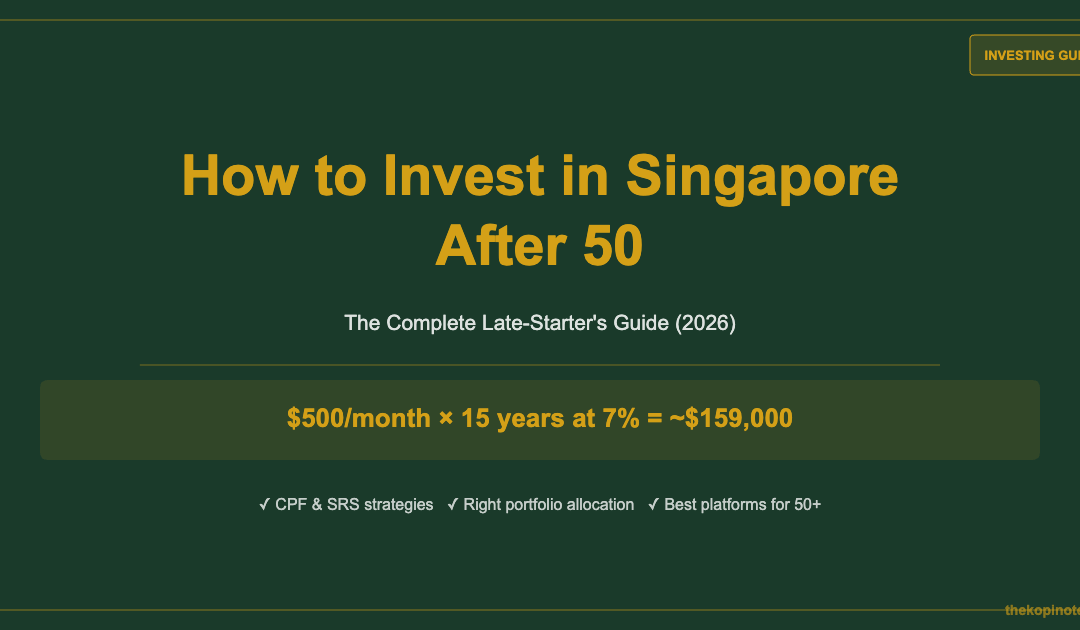
How to Invest in Singapore After 50: The Complete Late-Starter’s Guide (2026)
Your roadmap to building real wealth in your 50s, 60s and beyond — using CPF, SRS, ETFs and Singapore’s best investment tools.
Investing in Singapore after 50 is not only possible — it is one of the most powerful financial moves you can make. You likely have more savings, a clearer picture of your expenses, and powerful tax-advantaged tools like CPF and SRS working in your favour. Whether you are starting from zero or optimising an existing portfolio, this guide walks you through exactly what to do, step by step, using Singapore-specific strategies for 2026.
Not financial advice. All figures are for educational reference only. Data verified as at 12 September 2026.
- Starting at 50 gives you 15–20 years of compounding — more than enough to build meaningful wealth
- Maximise your SRS contributions first: you get a tax deduction now, and your money grows tax-deferred until age 63
- Use a simple global ETF (like VWRA on the London Stock Exchange) as your core holding, and shift gradually toward CPF and bonds as you age
In This Guide
- Is It Too Late to Start Investing After 50?
- How Much Time — and Money — You Actually Have
- Your CPF Strategy After 50
- The SRS Advantage: Tax Savings + Growth
- Building Your Portfolio: The Glide Path
- Best Investment Platforms in Singapore
- 3 Mistakes Late Starters Make (And How to Avoid Them)
- Frequently Asked Questions
Is It Too Late to Start Investing After 50?
No. And here is why that question itself is worth pushing back on.
The fear of being a “late starter” is deeply human. But in practice, a 50-year-old Singapore resident can expect to live well into their 80s — meaning you have 30 or more years ahead of you. Even if you only have 15 years to your target retirement age of 65, that is 180 months of dollar-cost averaging and compounding.
In fact, investing after 50 comes with real advantages that younger investors do not have:
- Higher income, lower expenses. Your mortgage may be nearly paid off. Your children may be more independent. That means more monthly cash flow to invest.
- Clarity. You know roughly what your retirement lifestyle costs. A 25-year-old is guessing. You are planning.
- Access to better instruments. CPF top-ups and SRS contributions give you tax deductions that benefit higher earners disproportionately — and after 50, you are likely in a higher income bracket than at 25.
The key mindset shift: stop comparing yourself to someone who started at 25. Focus on what is possible from here. And the numbers may surprise you.
How Much Time — and Money — You Actually Have
Let us put some numbers to it. If you invest $500 a month starting at age 50, here is what a 7% annualised return (the long-run average for a globally diversified equity portfolio) looks like over different time horizons.
| Time Horizon | Your Age at End | Total Invested | Portfolio Value (7% p.a.) | Wealth Created |
|---|---|---|---|---|
| 10 years | 60 | $60,000 | ~$86,900 | +$26,900 |
| 15 years | 65 | $90,000 | ~$158,500 | +$68,500 |
| 20 years | 70 | $120,000 | ~$260,400 | +$140,400 |
Source: Future Value of Annuity formula. Assumes $500/month DCA, 7% p.a. annualised return (illustrative). Not a guarantee of returns.
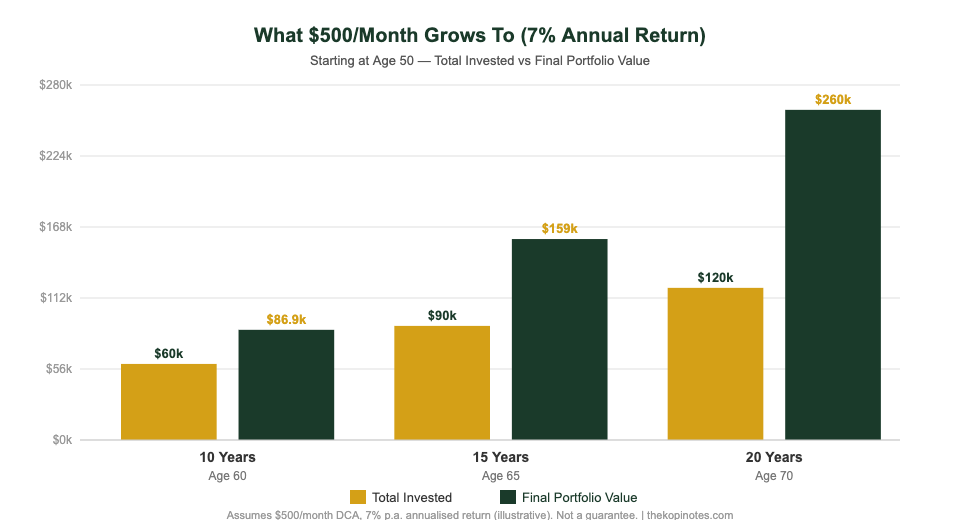
Notice that the 15-year investor earns nearly double what they put in. And this is before counting CPF contributions, SRS tax savings, and any employer CPF. Add those in, and the real picture is considerably better.
The lesson: time in the market beats timing the market. Every month you delay is a month of compounding you give up. If you have not started, start this week — even with $200.
To see your own personalised projection, use our Singapore retirement calculator — it factors in CPF payouts, SRS drawdowns, and inflation.
Your CPF Strategy After 50
CPF is one of the most under-utilised wealth-building tools for Singaporeans over 50. Here is why it deserves serious attention.
The CPF Retirement Sums (2026)
When you turn 55, your Ordinary Account (OA) and Special Account (SA) savings are swept into a Retirement Account (RA). The amount you keep determines your CPF LIFE monthly payout from age 65. Three tiers apply:
| Retirement Sum | Amount (2026) | Estimated Monthly Payout from 65 |
|---|---|---|
| Basic Retirement Sum (BRS) | $110,200 | ~$650–$750/month |
| Full Retirement Sum (FRS) | $220,400 | ~$1,300–$1,500/month |
| Enhanced Retirement Sum (ERS) | $440,800 | ~$2,400–$2,600/month |
Source: CPF Board, September 2026. Payouts are estimates under CPF LIFE Standard Plan at age 65.
CPF Interest Rates (2026)
Your CPF Ordinary Account earns 2.5% per year, guaranteed. Your Special Account and Retirement Account earn 4% — also guaranteed by the Singapore government. These rates beat the 6-month T-bill yield of 1.70% (September 2026) and equal the average SSB return of 2.25%, with the added bonus of full capital guarantee and no effort required on your part.
For a deeper look at how to maximise returns within CPF, read our guide on CPF investment strategy for Singapore.
The Retirement Account Top-Up
If your CPF RA is below the FRS at 55, you can top it up (or have a family member top it up for you) to earn 4% guaranteed. For someone in the 15% income tax bracket, an RA top-up also reduces your chargeable income — an added bonus on top of the guaranteed return.
Action step: Log into your CPF account and check your projected RA balance at 55. If it is below the FRS, consider regular top-ups from your paycheck or SRS funds now.
The SRS Advantage: Tax Savings + Growth
The Supplementary Retirement Scheme (SRS) is Singapore’s equivalent of a tax-advantaged retirement account — and it is significantly underused by people over 50.
Here is how it works: you contribute up to $15,300 per year (Singapore Citizens and PRs) to your SRS account. That full amount is deducted from your chargeable income in the same year. Your money then grows tax-free inside the account. When you withdraw after the statutory retirement age (currently 63, rising to 64 from 1 July 2026), only 50% of withdrawals are taxable — and you have 10 years to spread those withdrawals to minimise the tax hit further.
How Much You Save in Tax
The SRS deduction is worth more the higher your income. Here is what a $15,300 SRS contribution saves you per year, by tax bracket:
| Chargeable Income (Approx.) | Marginal Tax Rate | Annual Tax Saved |
|---|---|---|
| $80,000 – $120,000 | 7% | ~$1,071 |
| $120,000 – $160,000 | 11.5% | ~$1,760 |
| $160,000 – $200,000 | 15% | ~$2,295 |
Source: IRAS tax table 2026. Savings shown are estimates based on contribution of $15,300 at the stated marginal rate.
What to Invest Your SRS Money In
SRS funds do not earn interest by default — they sit in a cash account at your SRS bank (DBS, OCBC, or UOB). You need to actively invest the money. Good options include:
- UCITS ETFs on the LSE: VWRA (global equities, accumulating) or CSPX (S&P 500) via IBKR. Low fees, no US estate tax risk, no dividend withholding for accumulating funds.
- Singapore Savings Bonds (SSBs): Safe, flexible, government-backed. Current average yield: 2.25% (September 2026). Good for the bond portion of your SRS portfolio.
- Endowus Fund Smart: Access institutional-class funds at low cost via Endowus — one of the only platforms that can invest CPF OA and SRS funds at scale.
If you invest $15,300/year into SRS for 10 years at 7% per year, you accumulate approximately $211,000. That is before factoring in the tax deductions you collected along the way.
Building Your Portfolio: The Glide Path
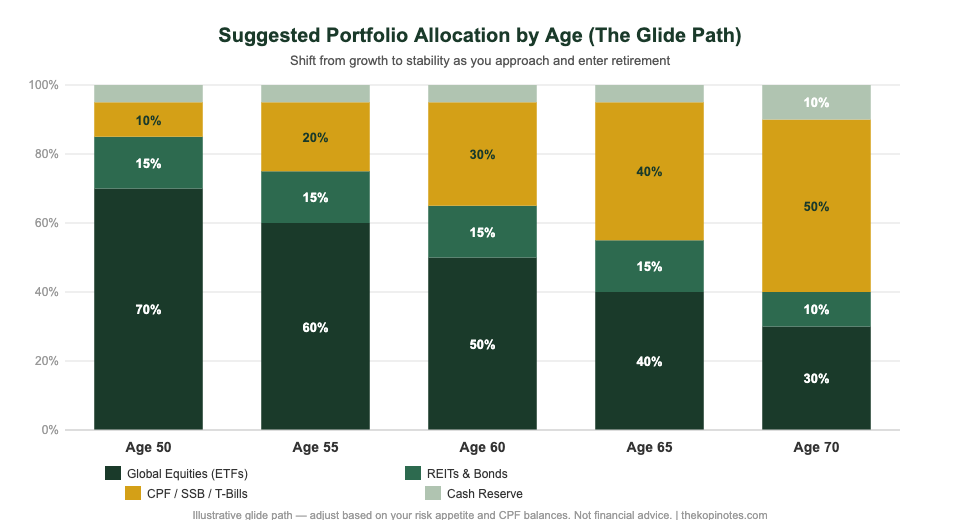
One of the biggest mistakes investors make after 50 is being either too aggressive (100% equities, ignoring sequence-of-returns risk) or too conservative (100% cash, losing to inflation). The answer is a glide path — a planned shift from growth to stability as you age.
Here is a simple, practical framework for Singapore investors:
Understanding the Glide Path
At 50, you still have 15 or more years ahead. A 70% equity allocation makes sense — global equities have delivered around 7% annually over long periods. As you approach 60 and then 65, you gradually shift into lower-volatility assets: CPF (4% guaranteed), SSBs, and T-bills.
The logic is simple: if the market drops 30% the year before you retire and you are 100% in equities, you have a serious problem. If you are 50% in CPF and SSBs, that same 30% drop only affects half your portfolio.
Your Core Equity Holding
For the equity portion, a single global ETF is all you need. VWRA (the Vanguard FTSE All-World UCITS ETF, accumulating) listed on the London Stock Exchange gives you exposure to 3,500+ companies across developed and emerging markets — at a total expense ratio of just 0.22% per year. No stock picking. No sector guessing. Just the world’s economy, in one fund.
You can generate passive income in Singapore by adding a dividend-distributing version (VWRD) as you near retirement, which pays quarterly dividends you can spend without selling units.
Best Investment Platforms for Singapore Investors After 50
You do not need complex tools. You need reliable, low-cost platforms that handle the basics well. Here are the three you actually need:
1. Interactive Brokers (IBKR) — For ETFs
IBKR is the gold standard for buying UCITS ETFs on the London Stock Exchange (LSE). Commissions are as low as USD 1 per trade, and the platform supports SRS accounts. Use referral code jianxiong368 when signing up. It has a learning curve — but once set up, it is the most cost-effective way to hold global ETFs for the long term.
2. Syfe or Endowus — For Managed / Semi-Managed Portfolios
If you prefer someone to handle the rebalancing and portfolio construction, Syfe and Endowus are both excellent choices for Singapore investors. Syfe’s Core Equity100 portfolio holds global ETFs at a low management fee. Endowus is unique in its ability to invest both your SRS and CPF OA funds — a significant advantage for late starters who want to put their CPF OA to work beyond the default 2.5%.
3. FSMOne — For SSBs and Bond Funds
For the bond and conservative portion of your portfolio, FSMOne (referral code P0544985) lets you buy Singapore Savings Bonds and a wide range of bond funds with low transaction costs. It is particularly useful for investors building a capital-preservation layer inside their SRS account.
| Platform | Best For | SRS Compatible | CPF OA Compatible |
|---|---|---|---|
| IBKR | UCITS ETFs (LSE) | Yes | No |
| Endowus | Managed funds, CPF & SRS | Yes | Yes |
| Syfe | Managed portfolios | Yes | No |
| FSMOne | SSBs, bond funds, REITs | Yes | No |
Source: Platform websites, September 2026. SRS/CPF compatibility subject to change — verify directly with platform before investing.
3 Mistakes Late Starters Make (And How to Avoid Them)
Mistake 1: Chasing High Returns to “Catch Up”
This is the most common and most dangerous mistake. People who feel behind often take on excessive risk — putting money into penny stocks, crypto, or leveraged products — hoping for a shortcut. In reality, the higher the potential return, the higher the chance of permanent capital loss at exactly the wrong time in your life. A 30% loss at age 55 is far more damaging than at 30, because you have fewer working years to recover.
The fix: stick to broadly diversified, low-cost ETFs. Accept that 7% annual returns are excellent. The tortoise wins.
Mistake 2: Ignoring Your SRS Deadline
Many Singaporeans in their 50s do not have an SRS account. Opening one takes ten minutes at DBS, OCBC, or UOB — but people keep putting it off. The problem? Every year you delay is a year of tax deductions you lose permanently.
Open your SRS account this week. You do not have to invest the money immediately. Just opening the account and making a small contribution before 31 December gives you the deduction for this year.
Mistake 3: Keeping Too Much in Cash
Cash feels safe. But at Singapore’s current inflation rate, your purchasing power erodes slowly but surely. A $100,000 cash pile that earns 2.5% in a bank account while inflation runs at 3% is losing ground every year.
The fix: keep 6–12 months of expenses in cash (your emergency fund), then put everything else to work — at minimum in CPF SA top-ups (4% guaranteed) or SSBs. Idle cash is a slow leak in your retirement plan.
Frequently Asked Questions
Is it really worth investing at 55 if I retire at 65?
How do I invest my SRS money in Singapore?
What is the best ETF for Singapore investors after 50?
Can I still contribute to CPF after 55?
What is the CPF retirement age in Singapore?
Start This Week, Not Next Year
The most important investment decision you can make today is not which fund to pick — it is simply starting. Open an SRS account. Make one CPF top-up. Set up a $300/month recurring purchase into a global ETF. Do any one of these things and you have done more than most Singaporeans in your age group.
The Kopi Notes does not provide personalised financial advice. All figures in this article are illustrative only. Past returns are not indicative of future performance. Please consult a licensed financial adviser before making investment decisions. Data verified as at 12 September 2026.
This article was researched with the help of AI. While we strive to keep all information accurate and up to date, there may be errors. If you notice any discrepancies, please contact us.