How to Invest in Singapore: Local Stocks vs Global ETFs — The 2026 Guide
The complete guide to choosing between Singapore stocks and global ETFs — with cost data, tax implications, and practical portfolio strategies for 2026.
Singapore investors face a classic choice: put money into local stocks like DBS or the STI ETF, or buy global ETFs like CSPX and IWDA for worldwide diversification. Both approaches work — but they have very different cost structures, dividend profiles, and tax implications. This guide explains when to go local, when to go global, and how to combine both in a portfolio that fits your goals.
Not financial advice. All figures are for educational reference only. Data verified as at August 2026 unless noted.
- Global ETFs (CSPX, IWDA) have outperformed the STI ETF significantly over the past decade — but local stocks offer higher dividend yields and SGD income.
- Ireland-domiciled ETFs on the LSE pay only 15% withholding tax on US dividends vs 30% for US-listed ETFs — a big cost advantage for Singapore investors.
- Most Singapore investors combine both: global ETFs for growth and the STI ETF (or blue chips) for income and home-currency stability.
Table of Contents
Contents — Click to expand
- What Is Local Investing in Singapore?
- What Are Global ETFs and Why Are They Popular?
- The Withholding Tax Advantage: Ireland-Domiciled ETFs Explained
- Cost Comparison: STI ETF vs CSPX vs IWDA
- Has the STI ETF Kept Up with Global Markets?
- The Case for Local: Why Some Investors Still Prefer Singapore Stocks
- How to Build Your Portfolio: Local, Global, or Both?
- Where to Buy Local Stocks and Global ETFs in Singapore
- Frequently Asked Questions
What Is Local Investing in Singapore?
When Singapore investors talk about “local investing”, they usually mean one of two things: buying individual Singapore-listed stocks on the SGX, or buying a Singapore index ETF that tracks the Straits Times Index (STI).
The most popular option is the SPDR STI ETF (SGX: ES3), managed by State Street Global Advisors. It tracks the 30 largest and most liquid companies on the SGX — names you already know: DBS Bank, OCBC, UOB, Singapore Telecommunications, CapitaLand Integrated Commercial Trust, and Jardine Matheson.
ES3 is easy to buy through any local broker — POEMS, MooMoo, DBS Vickers, or OCBC Securities. You can even set up a Regular Savings Plan (RSP) to invest a fixed monthly amount without paying per-trade commissions. This makes it popular with new investors who want a simple, low-cost start.
Key ES3 facts (as at August 2026):
| Metric | Detail |
|---|---|
| Full Name | SPDR Straits Times Index ETF |
| Ticker | ES3 (SGX) |
| Index Tracked | Straits Times Index (30 largest SGX stocks) |
| TER (Expense Ratio) | 0.30% per annum |
| Dividend Yield | ~3.3% (2026) |
| Structure | Distributing (pays dividends quarterly) |
| Currency | SGD |
Source: SSGA factsheet, August 2026.
What Are Global ETFs and Why Are They Popular?
Global ETFs give you ownership of hundreds — or thousands — of companies across the world in a single purchase. Two are especially popular with Singapore investors:
CSPX (iShares Core S&P 500 UCITS ETF) tracks the S&P 500 — the 500 largest US companies including Apple, Microsoft, Nvidia, and Amazon. IWDA (iShares Core MSCI World UCITS ETF) goes even wider: it tracks ~1,500 companies across 23 developed markets, though it is still roughly 70% weighted toward the US.
Both ETFs are listed on the London Stock Exchange (LSE) and domiciled in Ireland. That matters a lot for tax reasons — which we will explain in the next section.
You buy these through international brokers: Interactive Brokers (IBKR), Saxo Markets, or MooMoo Singapore’s global account. IBKR is the most cost-effective for larger portfolios; MooMoo suits beginners who want a simpler interface.
You can also access CSPX and IWDA through Endowus (using your CPF or SRS funds) or through Syfe‘s managed portfolios — both platforms handle the LSE trading on your behalf.
The Withholding Tax Advantage: Ireland-Domiciled ETFs Explained
This is the single most important reason Singapore investors buy CSPX and IWDA instead of US-listed equivalents like VOO or VT.
When a US company pays a dividend, the US government withholds tax before the money reaches foreign investors. The rate depends on where the ETF is domiciled:
- US-domiciled ETF (e.g. VOO, VT): 30% withholding tax on US dividends for Singapore investors — because Singapore has no tax treaty with the US for portfolio investments.
- Ireland-domiciled ETF (e.g. CSPX, IWDA): Only 15% withholding tax — because Ireland has a tax treaty with the US that halves the rate.
The saving is real money. On a SGD 100,000 portfolio in a global ETF paying 1.3% in US dividends, the difference between 30% WHT and 15% WHT is approximately SGD 195 per year — every year, in perpetuity.
There is also the US estate tax risk to consider. If you hold US-domiciled ETFs worth more than USD 60,000 (approximately SGD 80,000) and you pass away, the US government can levy estate tax of up to 40% on the excess. Ireland-domiciled ETFs have no such exposure — the assets sit outside US jurisdiction.
| ETF | Domicile | US Dividend WHT | US Estate Tax Risk |
|---|---|---|---|
| CSPX / IWDA (LSE) | Ireland | 15% | None |
| VOO / VT (NYSE) | USA | 30% | Yes (above USD 60k) |
| STI ETF ES3 (SGX) | Singapore | 0% | None |
Source: IRS Publication 515; Ireland-US tax treaty; MAS guidance, August 2026.
Singapore itself does not tax investment income at all — no capital gains tax, no dividend tax for individuals. So the only tax drag you face is the withholding at source (in the US, before the money reaches the ETF). Using an Ireland-domiciled ETF halves that drag.
Cost Comparison: STI ETF vs CSPX vs IWDA
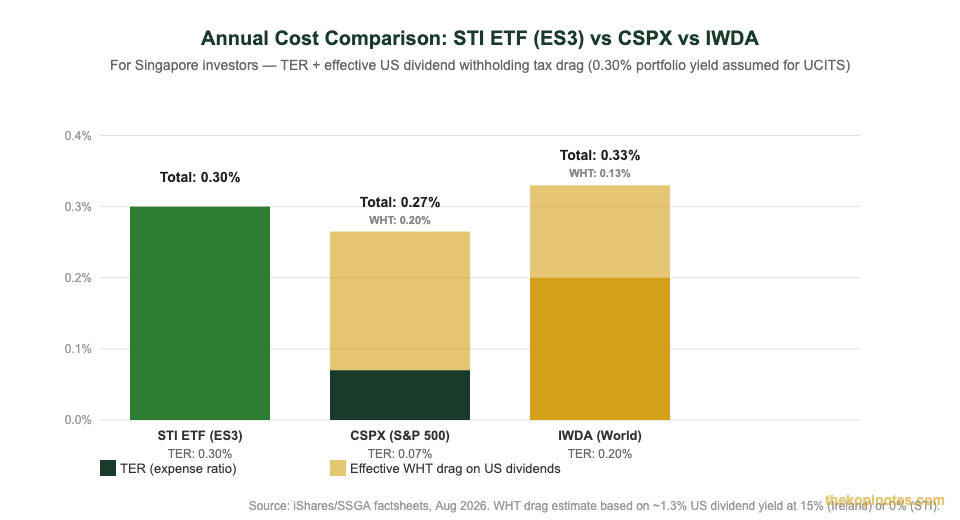
Costs are the one thing you can control in investing. Here is how the three most common options stack up:
| ETF | Ticker | TER | WHT Drag (est.) | Effective Annual Cost |
|---|---|---|---|---|
| SPDR STI ETF | ES3 | 0.30% | 0% | 0.30% |
| iShares Core S&P 500 | CSPX | 0.07% | ~0.20% | ~0.27% |
| iShares Core MSCI World | IWDA | 0.20% | ~0.13% | ~0.33% |
Source: iShares/SSGA factsheets, Aug 2026. WHT drag estimate based on ~1.3% US dividend yield for S&P 500 components at 15% Ireland treaty rate. IWDA has lower US-weighted dividend due to broader global mix.
On a pure cost basis, CSPX comes out slightly ahead of the STI ETF. IWDA is slightly more expensive — but it gives you exposure to thousands more companies across 23 markets.
Has the STI ETF Kept Up with Global Markets?
Here is where local investing has struggled. Over the past decade, the STI ETF significantly underperformed global indices — particularly the S&P 500, which was supercharged by the rise of US tech companies.
The STI is heavily weighted toward Singapore banks (DBS, OCBC, UOB together make up roughly 40% of the index), property developers, and Singtel. These are solid, dividend-paying businesses. But they are not high-growth companies, and they did not benefit from the AI and semiconductor boom the way Apple, Nvidia, and Microsoft did.
To give you a rough sense: a Singapore investor who put SGD 10,000 into the SPDR STI ETF (ES3) in 2014 would have seen a total return (price gain + reinvested dividends) of around 100–110% by 2024 — roughly doubling their money. The same SGD 10,000 in a global S&P 500 ETF like CSPX would have grown to approximately SGD 38,000–45,000 over the same period, driven primarily by US tech returns.
That is not a small gap. However, past performance does not predict future results. US markets could underperform in the next decade. Singapore banks and REITs may thrive if interest rates stay higher for longer. Diversification across both reduces your concentration risk in either direction.
You can use the Singapore retirement calculator to model different return scenarios with your actual numbers.
The Case for Local: Why Some Investors Still Prefer Singapore Stocks
Despite the underperformance, there are real reasons to hold Singapore stocks — especially as part of a balanced portfolio.
1. High dividend yield in SGD. The STI ETF pays roughly 3.3% per year in dividends (as at 2026), entirely in Singapore dollars. For retirees or anyone building passive income in Singapore, this is attractive. You receive cash quarterly without selling any units.
2. No currency risk. When you invest in CSPX or IWDA, you are holding USD-denominated assets. If the SGD strengthens against the USD, your portfolio loses value in local terms even if the ETF price stays flat. Local SGX stocks and the STI ETF carry no currency conversion risk.
3. CPF and SRS compatibility. Under the CPF Investment Scheme (CPFIS), you can invest your CPF Ordinary Account (OA) funds in selected unit trusts and ETFs — including some SGX-listed products. Check the CPF investment strategy guide for a full breakdown of what is allowed and whether it makes financial sense.
4. Familiarity and ease. You understand the companies in the STI. DBS is your bank. CapitaLand manages malls you shop at. This familiarity is not a logical investment reason — but it reduces the temptation to panic-sell during downturns, which is actually very valuable.
5. Singapore REITs. Many investors who say they “invest locally” are actually combining the STI ETF with Singapore REITs (S-REITs). S-REITs are required by law to distribute at least 90% of taxable income, which creates high, consistent dividend yields — often 5–7% annually. That changes the local vs global calculus significantly.
How to Build Your Portfolio: Local, Global, or Both?
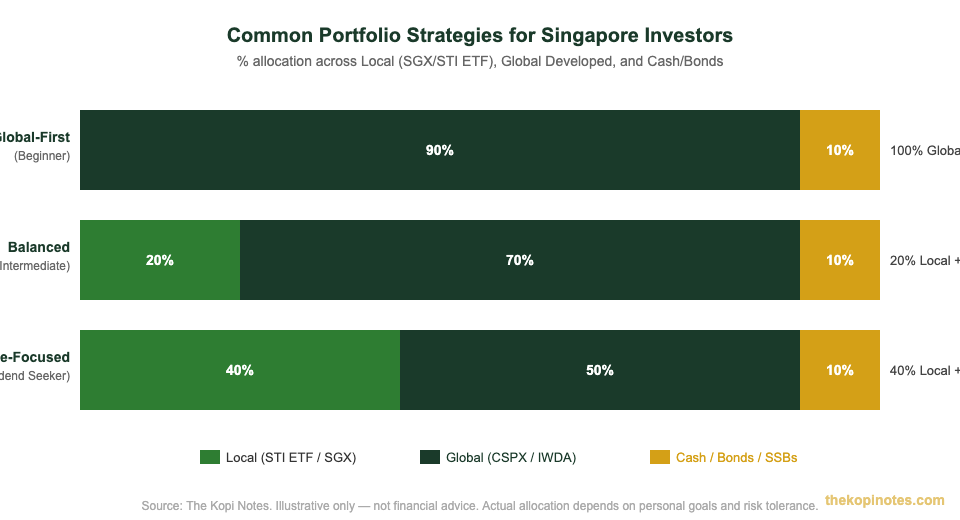
The honest answer: most experienced Singapore investors hold both. Here are three practical approaches, depending on your goals:
Strategy 1 — Global-First (Recommended for Most Beginners)
Put 90% of your investable savings into a single global ETF like IWDA or CSPX. Keep 10% in cash or Singapore Savings Bonds for stability. This gives you maximum diversification and simplicity. You do not need to pick stocks, rebalance sectors, or worry about which local company is doing well. Just buy and hold.
Strategy 2 — Balanced (Local + Global)
70% global ETF (CSPX or IWDA) + 20% STI ETF + 10% bonds or SSBs. This is appropriate if you want to moderate your currency risk and receive some SGD dividends. You benefit from global growth while keeping a meaningful stake in Singapore’s economy.
Strategy 3 — Income-Focused (For Dividend Investors)
50% global ETF + 40% local (STI ETF + selected S-REITs) + 10% cash. If your goal is generating regular SGD income — for example, if you are approaching retirement or want to cover monthly expenses from dividends — this mix can deliver 3–4%+ in annual dividend yield while still maintaining long-term growth.
Whichever strategy you choose, the most important thing is consistency: invest regularly via dollar-cost averaging rather than trying to time the market. A fixed monthly investment in CSPX or IWDA — even SGD 300–500 — beats waiting for the “right time” to invest a lump sum.
Where to Buy Local Stocks and Global ETFs in Singapore
You need different accounts for local SGX stocks versus LSE-listed global ETFs.
For SGX stocks and the STI ETF (ES3):
- FSMOne — low commissions on SGX trades, excellent Regular Savings Plan for ES3. Use our FSMOne referral code P0544985 when signing up.
- POEMS (Phillip Securities) — Singapore’s oldest online broker, widely used for SGX investing.
- MooMoo Singapore — competitive commissions, zero-commission promos for new users.
For global ETFs (CSPX, IWDA on LSE):
- Interactive Brokers (IBKR) — the lowest commissions for LSE trades. Commissions start from USD 0.35 per trade on the tiered plan — among the lowest available for LSE-listed ETFs. Use referral code jianxiong368 when opening your account.
- Syfe Brokerage — no minimum commission on certain markets, good for smaller monthly investments in global ETFs. Use Syfe referral code SRPRFFFCD for a welcome bonus.
- Endowus — if you want to use CPF or SRS funds for global fund exposure, Endowus is the cleanest option. Use Endowus referral code 2V343 to get a fee rebate on your first investment.
Note: you cannot buy LSE-listed ETFs like CSPX directly through CPF OA under CPFIS. To invest CPF OA funds in global ETF-like instruments, your best option is Endowus, which routes the money into approved funds with global equity exposure.
Not financial advice. All figures are for educational reference only. Data verified as at August 2026. Referral codes may carry sign-up bonuses that TKN may benefit from.
Frequently Asked Questions
Should I invest in local Singapore stocks or global ETFs?
Most Singapore investors benefit from a mix of both. Global ETFs like CSPX and IWDA provide diversification across thousands of companies and have historically delivered stronger long-term returns. Local Singapore stocks and the STI ETF offer higher dividend yields in SGD and no currency risk. A common starting point is 70–80% global ETF and 20–30% local for balance.
What is the cheapest ETF for Singapore investors — ES3, CSPX, or IWDA?
On total expense ratio alone, CSPX is cheapest at 0.07% per annum, followed by the STI ETF (ES3) at 0.30%, and IWDA at 0.20%. However, once you factor in withholding tax drag on US dividends, CSPX’s effective cost for Singapore investors is around 0.27% — similar to ES3. IWDA’s effective cost is roughly 0.33%. ES3 has no withholding tax drag since all holdings are Singapore-listed.
Why do Singapore investors use LSE-listed ETFs instead of US ETFs like VOO?
Ireland-domiciled ETFs listed on the London Stock Exchange (LSE), such as CSPX and IWDA, pay only 15% withholding tax on US dividends — compared to 30% for Singapore investors holding US-domiciled ETFs like VOO or VT. Additionally, US-domiciled ETFs expose you to US estate tax on holdings above USD 60,000. LSE-listed UCITS ETFs have no such risk.
Can I buy global ETFs using my CPF money?
Not directly. Under CPFIS, CPF OA funds can be invested in approved unit trusts and ETFs listed on the SGX — LSE-listed ETFs like CSPX and IWDA are not eligible. However, Endowus allows CPF OA and SRS investors to access globally diversified funds with similar exposure, at competitive fees. Use the Endowus referral code 2V343 when signing up.
Is the STI ETF a good long-term investment for 2026?
The STI ETF (ES3) is a decent income investment — it yields around 3.3% in dividends annually and is heavily weighted toward Singapore’s largest, most stable companies. However, as a growth investment it has significantly underperformed global markets over the past decade due to Singapore’s limited exposure to the tech sector. Most financial planners suggest the STI ETF is better as a supplementary income component than as a primary growth vehicle.
What is the minimum amount to start investing in global ETFs in Singapore?
Through IBKR, CSPX trades at around USD 830–840 per unit (as at August 2026), so you need at least that amount to buy one lot. Through Syfe or Endowus, you can start with as little as SGD 100–500 and get fractional exposure to globally diversified portfolios. Dollar-cost averaging with smaller monthly amounts through robo-advisors is a practical way to start if you cannot yet afford a full CSPX unit.
This article was researched with the help of AI. While we strive to keep all information accurate and up to date, there may be errors. If you notice any discrepancies, please contact us.