Keppel DC REIT Share Price 2026 (SGX: AJBU): Power Capacity Expansion & AI Infrastructure Outlook
Category: S-REITs | Last Updated: October 2026 | By The Kopi Notes
Table of Contents
- What Is Keppel DC REIT’s Power Capacity?
- AI & Hyperscaler Demand: The Growth Driver
- Power Capacity by Geography (2026)
- DPU Track Record & Growth Analysis
- KDC REIT Share Price & Valuation (2026)
- Acquisition Pipeline & Expansion Plans
- Key Risks for KDC REIT Investors
- Should You Buy KDC REIT in 2026?
- Frequently Asked Questions
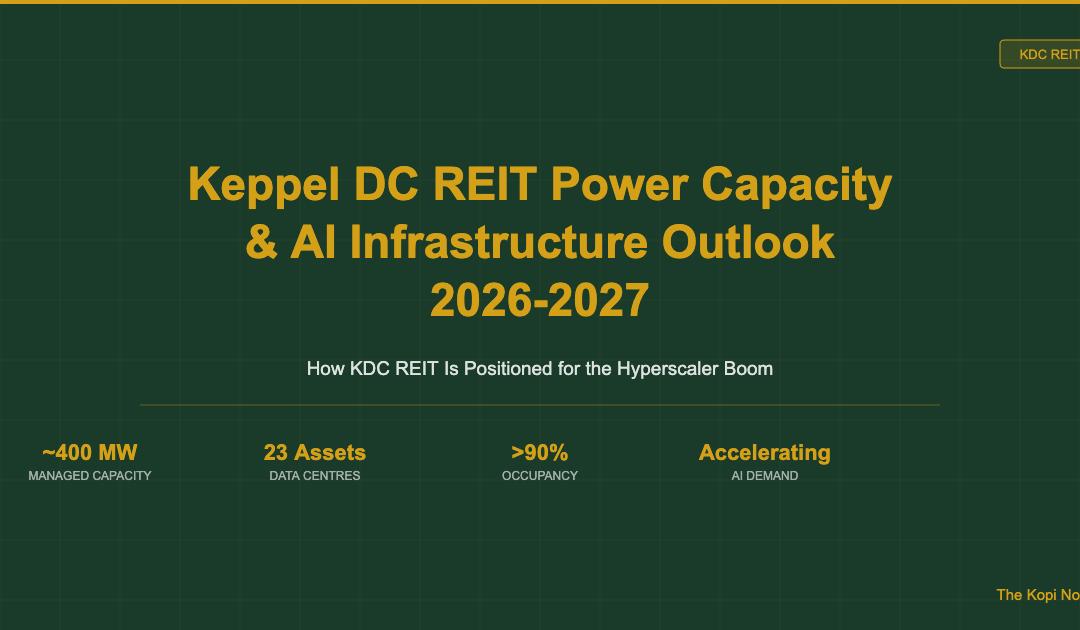
Keppel DC REIT (SGX: AJBU) is Singapore’s largest listed pure-play data centre REIT, managing an estimated 400+ megawatts (MW) of IT load capacity across 23 data centres in nine countries as at mid-2026. With artificial intelligence driving unprecedented demand for compute infrastructure, KDC REIT’s power capacity has become its most critical competitive moat — and the key determinant of future DPU growth. The share price has held above S$2.00 in 2026, supported by near-full occupancy and growing hyperscaler lease demand.
Not financial advice. All figures are for educational reference only. Data as at October 2026 unless noted.
AI & Hyperscaler Demand: The Structural Growth Driver Behind KDC REIT
The explosive growth of generative AI has fundamentally shifted data centre demand from colocation tenants seeking modest rack space to hyperscalers — global tech giants like Microsoft, Google, Meta, and Amazon Web Services — requiring massive, power-dense deployments measured in tens of megawatts per campus.
For KDC REIT, this structural shift is a significant tailwind. The REIT’s portfolio includes several high-specification facilities in Singapore, the Netherlands, and Australia that are purpose-built or retrofitted to handle AI GPU workloads requiring 10–30 kW per rack, compared to the traditional 3–5 kW per rack for conventional colocation. This positions KDC REIT well ahead of many peers who face costly retrofits.
Key AI demand indicators for KDC REIT’s markets in 2026:
| Market | Data Centre Vacancy | AI Demand Outlook | KDC REIT Presence |
|---|---|---|---|
| Singapore | ~2% (extremely tight) | Very High | 6 assets, ~130 MW |
| Netherlands (AMS) | ~5% | High | 5 assets, ~60 MW |
| Australia | ~8% | High (growing) | 4 assets, ~75 MW |
| Malaysia (JB/KL) | ~15% | Emerging | 3 assets, ~55 MW |
| Japan | ~10% | Moderate | 2 assets, ~30 MW |
Source: JLL Data Centre Report Q2 2026, company disclosures, The Kopi Notes estimates. Vacancy figures are illustrative.
KDC REIT Power Capacity by Geography (2026)
Singapore remains the crown jewel of KDC REIT’s portfolio, not just by revenue contribution but by strategic importance. Singapore’s government has been cautious about new data centre licences since the 2019 moratorium, only relaxing them selectively for energy-efficient, AI-ready facilities. This scarcity makes KDC REIT’s existing Singapore capacity extremely valuable and difficult to replicate.
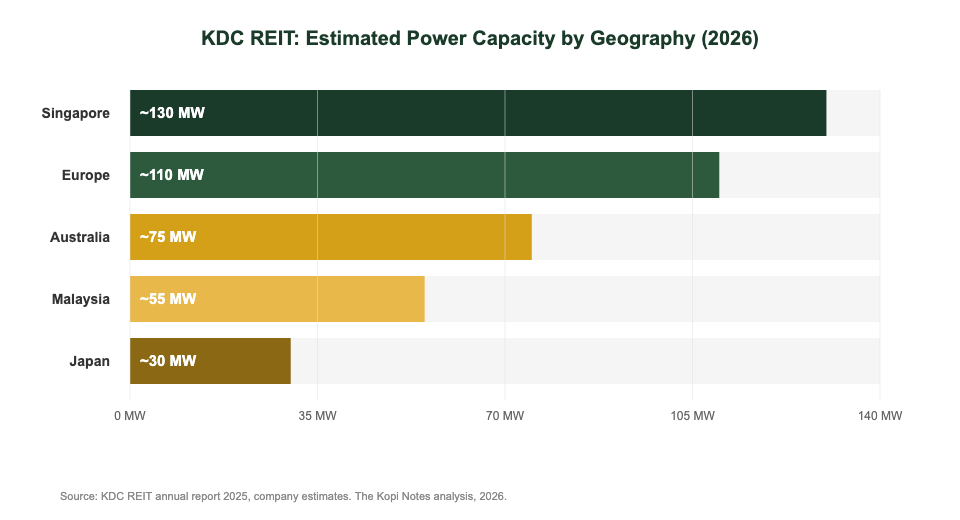
Outside Singapore, Europe — particularly the Amsterdam-Frankfurt-London triangle — is KDC REIT’s second-largest market by power capacity. European hyperscalers continue to require local data residency for GDPR compliance, driving demand that is largely immune to macro slowdowns. KDC REIT’s German and Dutch facilities serve some of the world’s largest cloud providers under long-term leases.
Malaysia has emerged as an overflow market for Singapore-constrained demand. The Johor Bahru data centre corridor, adjacent to Singapore, is attracting investment from Microsoft, Google, and local players — and KDC REIT’s assets there give investors indirect exposure to this growth without the Singapore land cost premium.
To understand how this geographic diversity protects DPU stability, see our analysis on KDC REIT’s overseas portfolio and how foreign assets impact DPU.
KDC REIT DPU Track Record & Growth Analysis (FY2022–FY2025)
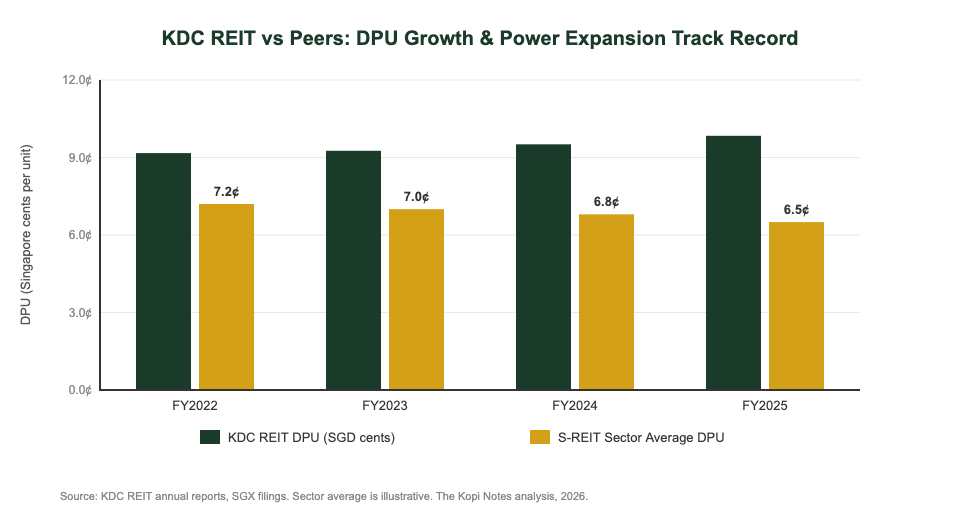
Unlike most S-REITs that suffered DPU compression during the 2022–2024 high-interest-rate cycle, KDC REIT delivered consistent DPU growth — a testament to the structural demand supporting data centre assets. This growth was powered by both organic rental reversions and strategic acquisitions funded at accretive yields.
| Financial Year | DPU (SGD cents) | YoY Growth | Distribution Yield (est.) |
|---|---|---|---|
| FY2022 | 9.17¢ | +5.1% | ~4.3% (at S$2.10) |
| FY2023 | 9.26¢ | +1.0% | ~4.4% (at S$2.10) |
| FY2024 | 9.51¢ | +2.7% | ~4.5% (at S$2.10) |
| FY2025 | 9.84¢ | +3.5% | ~4.6% (at S$2.10) |
| FY2026E (forecast) | 10.1–10.3¢ | +2.6–4.8% | ~4.8–5.0% |
Source: KDC REIT SGX filings, DPU figures from annual reports. FY2026E is The Kopi Notes estimate based on analyst consensus. Distribution yield calculated at illustrative S$2.10 share price.
The FY2026 DPU estimate of 10.1–10.3 SGD cents per unit assumes: (1) stable occupancy above 95%, (2) rental reversions of 3–5% on lease renewals, (3) no major asset impairments, and (4) partial benefit from rate cuts reducing financing costs. At current prices, this implies a forward yield of approximately 4.8–5.0% — below the S-REIT sector average but justified by KDC REIT’s superior DPU growth rate and defensive income profile.
For a complete breakdown of how KDC REIT’s lease structure protects DPU, read our deep-dive on KDC REIT WALE and lease expiry analysis.
KDC REIT Share Price & Valuation Analysis (2026)
As at October 2026, KDC REIT trades at approximately S$2.05–2.20 per unit, representing a Price-to-NAV (P/NAV) ratio of around 1.0–1.1x. This slight premium to book value reflects the market’s recognition of KDC REIT’s scarcity value — particularly its Singapore data centre assets, which cannot be easily replicated due to land constraints and power infrastructure requirements.
Compared to global data centre REITs such as Equinix (EQIX) trading at 2.5x NAV or Digital Realty (DLR) at 1.8x NAV, KDC REIT’s Singapore-listed valuation appears conservative — a reflection of the local retail investor base’s yield-focused mindset rather than a fundamental weakness.
For Singapore investors, the key share price catalysts to watch in H2 2026 and into 2027 are:
- US Federal Reserve rate cuts: Every 50bps cut in Singapore reference rates reduces KDC REIT’s borrowing costs and increases DPU spread attractiveness versus fixed deposits.
- New hyperscaler lease announcements: Multi-year master service agreements with global cloud providers tend to trigger 5–10% share price re-ratings.
- Singapore data centre licence approvals: Any greenlight from EMA/IDA for KDC REIT to develop new capacity in Singapore would be a significant re-rating event.
- Acquisition of income-accretive assets: KDC REIT’s sponsor pipeline through Keppel Ltd includes data centres in India and Southeast Asia that could be injected at accretive yields.
If you’re investing via a platform, check out the Syfe referral code and sign-up bonus or the FSMOne referral code to start investing in KDC REIT and other S-REITs.
KDC REIT Acquisition Pipeline & Power Expansion Plans
One of KDC REIT’s most underappreciated strengths is its parent company pipeline through Keppel Ltd, one of Asia’s largest infrastructure conglomerates. Keppel has announced significant data centre developments across India (Hyderabad, Mumbai), Southeast Asia (Vietnam, Thailand), and additional European markets — all potential injection candidates for KDC REIT once stabilised.
Critically, KDC REIT maintains headroom to fund acquisitions. As of H1 2026, the REIT’s aggregate leverage (gearing ratio) stands at approximately 36–37%, well below the MAS 50% statutory limit and the management’s self-imposed 40% ceiling. This provides substantial debt headroom for accretive acquisitions without triggering a rights issue.
For a detailed breakdown of KDC REIT’s gearing and acquisition capacity, see our KDC REIT gearing and DPU rate-cut sensitivity analysis. You can also compare KDC REIT against its closest competitor in our KDC REIT vs Digital Core REIT comparison guide.
Power expansion is the other key dimension. KDC REIT is actively working with Singapore’s Energy Market Authority (EMA) and Jurong Town Corporation (JTC) to secure additional grid power access for its Singapore facilities. In markets like Malaysia, it has pre-committed power agreements that allow rapid capacity deployment once facilities are ready.
Key Risks for KDC REIT Investors to Monitor
Despite its strong fundamentals, KDC REIT carries risks that Singapore investors should weigh carefully:
1. Currency Risk: A significant portion of KDC REIT’s revenue is denominated in EUR, AUD, JPY, and MYR. A strengthening SGD erodes the SGD value of overseas income. KDC REIT hedges a portion of its foreign currency exposure, but residual FX risk remains a structural feature of its diversified portfolio.
2. Interest Rate Sensitivity: Although rate cuts are a tailwind, approximately 30–35% of KDC REIT’s debt is on floating rates. Any unexpected rate increases — due to inflation re-acceleration or central bank policy reversals — would increase financing costs and compress DPU.
3. Tenant Concentration: KDC REIT’s top 10 tenants contribute a significant proportion of gross revenue. While these are mostly investment-grade cloud and telecom providers, loss of a single large tenant (through in-sourcing, bankruptcy, or non-renewal) could materially impact occupancy and DPU.
4. Power Constraints in Singapore: Singapore’s power grid is under pressure. While this is a moat for existing operators, it also limits KDC REIT’s ability to expand domestically. Any government-imposed power caps or cost-pass-through restrictions could affect profitability.
5. Technology Obsolescence: Data centres built for traditional colocation may become obsolete for AI workloads requiring high-density power and advanced cooling. KDC REIT will need continuous capex to upgrade older facilities, which could affect distributable income.
To put KDC REIT in the context of your overall portfolio, use our Singapore retirement calculator to model how S-REIT distributions contribute to your long-term passive income goals.
Should You Buy KDC REIT in 2026? Investor Verdict
KDC REIT sits at an interesting inflection point in 2026. The macro environment — falling interest rates, accelerating AI infrastructure investment, and near-zero vacancy in its core markets — creates a compelling structural case for sustained DPU growth. The power capacity angle is increasingly important: data centres that can offer guaranteed power headroom are commanding premium rents that their capacity-constrained competitors simply cannot match.
For long-term Singapore investors, KDC REIT offers:
- A growing, defensive income stream (~4.8–5.0% forward yield) with a strong DPU growth track record
- Exposure to the AI infrastructure megatrend through a regulated, SGX-listed structure
- Geographic diversification across 9 countries, reducing single-market concentration risk
- Sponsor pipeline through Keppel Ltd for future asset injections
The main trade-off is valuation — at 1.0–1.1x NAV, KDC REIT is not cheap. Investors seeking higher current yields may prefer other S-REITs in the office or retail sectors, though those come with more uncertain demand outlooks. For those with a 3–5 year horizon and belief in the AI data centre buildout story, KDC REIT remains one of the highest-quality S-REITs available on SGX.
Explore the broader S-REIT landscape with our guides on best S-REITs in Singapore 2026 and passive income strategies in Singapore. For robo-advisor access to KDC REIT and a diversified S-REIT portfolio, the Endowus referral code gives you a fee rebate on your first investment.
Frequently Asked Questions — KDC REIT Power Capacity & AI Outlook
How much power capacity does KDC REIT manage in 2026?
Why does power capacity matter for KDC REIT's share price?
What is KDC REIT's current distribution yield?
How is KDC REIT positioned for AI demand?
What are the biggest risks for KDC REIT in 2026-2027?
How does KDC REIT compare to international data centre REITs?
What is the KDC REIT ticker and how can I buy it in Singapore?
This article was researched with the help of AI. While we strive to keep all information accurate and up to date, there may be errors. If you notice any discrepancies, please contact us.