Singapore Robo Advisor Guide 2026: Which Platform Should You Use?
Compare Syfe, StashAway, Endowus and more — fees, features, SRS/CPF compatibility, and which suits your goals.
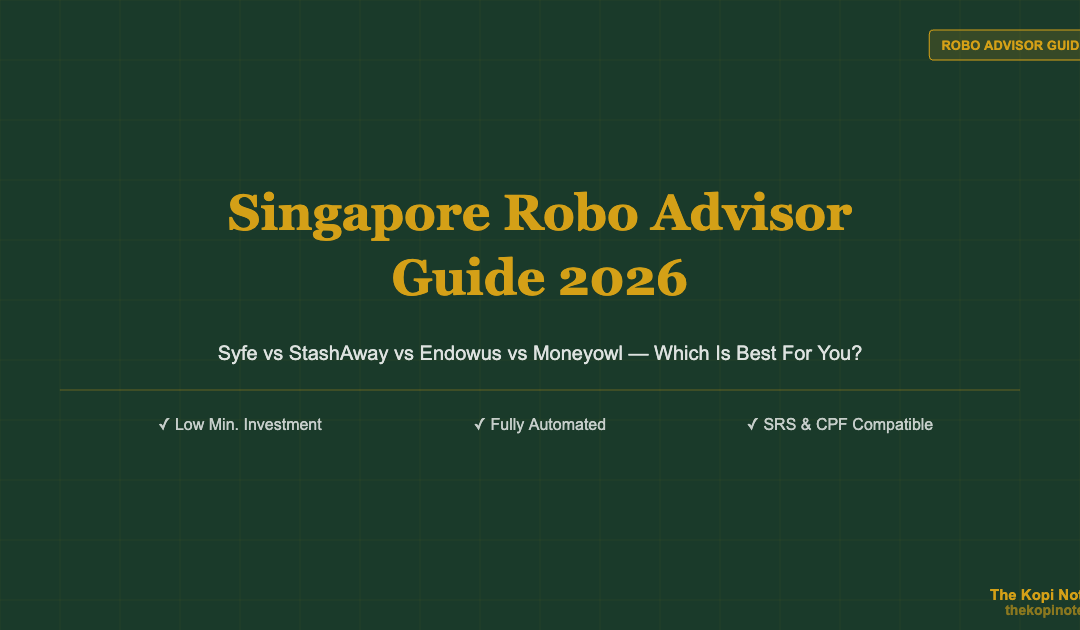
A Singapore robo advisor is a digital investment platform that automatically builds and rebalances a diversified portfolio for you — no financial advisor needed. The top platforms in 2026 are Syfe, StashAway, Endowus, and MoneyOwl. Fees range from 0.20% to 0.80% per year, minimums start from just S$1, and most are compatible with your SRS account. This guide breaks down exactly which robo advisor fits your situation.
Not financial advice. All figures are for educational reference only. Data as at June 2026 unless noted.
- Syfe and StashAway are best for beginners — S$1 minimum, simple onboarding, no financial knowledge needed
- Endowus is the top pick if you want to invest CPF OA or SRS funds into low-cost global funds
- All robo advisors charge lower fees than traditional unit trusts — but you still need to pick the right risk portfolio
Table of Contents
Contents — Click to expand
What Is a Robo Advisor?
A robo advisor is an automated investment platform. You answer a short questionnaire about your risk tolerance, investment goals, and time horizon. The platform then selects a diversified portfolio — usually made up of low-cost Exchange Traded Funds (ETFs) — and manages it on your behalf.
The term “robo” is a bit misleading. There’s no physical robot. What you’re getting is an algorithm-driven portfolio that automatically rebalances when markets move and reinvests any dividends. You never need to pick stocks, time the market, or manually adjust your allocation.
In Singapore, robo advisors are licensed by the Monetary Authority of Singapore (MAS) as Capital Markets Services (CMS) licensees. This means they’re regulated, your money is held in custody (not co-mingled with the platform’s funds), and you have legal recourse if anything goes wrong.
For everyday Singaporeans who want to invest but don’t have the time or confidence to build their own portfolio, a robo advisor is often the most practical starting point.
How Robo Advisors Work
The mechanics are simpler than most people expect. Here’s what happens when you sign up:
- Risk profiling — You answer 5–10 questions about your income, savings, investment horizon, and comfort with market swings. The platform maps you to a risk level (e.g., Conservative, Balanced, Aggressive).
- Portfolio construction — The algorithm assigns you a mix of assets. Most Singapore robo advisors use ETFs tracking global equities, bonds, and sometimes REITs or gold. The exact ETFs depend on the platform.
- Automatic rebalancing — When one asset class grows faster than others (say, equities rise while bonds lag), the portfolio drifts from its target allocation. The robo advisor automatically sells a little of what’s overweight and buys what’s underweight — keeping your risk level consistent without you lifting a finger.
- Dividend reinvestment — Any dividends paid by the ETFs are reinvested automatically, compounding your returns over time.
The result: a diversified, low-cost, self-managing portfolio. For a Singapore investor putting in S$300–S$500 a month, this is far more efficient than trying to replicate the same strategy manually through a brokerage.
Robo Advisors in Singapore: The Regulatory Picture
All robo advisors operating in Singapore must be licensed by the Monetary Authority of Singapore (MAS) under the Securities and Futures Act. This provides several protections you don’t get with unregulated platforms:
- Custody segregation — Your invested funds are held separately from the platform’s own assets. If the platform goes under, your money isn’t used to pay creditors.
- Mandatory suitability assessments — Platforms must assess whether a product is appropriate for you before recommending it. This is why you always complete a risk questionnaire.
- Annual audit requirements — MAS-licensed platforms are subject to regular audits and must maintain adequate capital reserves.
The current licensed robo advisors in Singapore include Syfe (Syfe Pte Ltd), StashAway (StashAway Singapore Pte Ltd), Endowus (Endowus Financial Advisers Pte Ltd), and MoneyOwl (MoneyOwl Pte Ltd). Kristal.AI is licensed for accredited investors, with some products available to retail investors.
One important nuance: Endowus holds a Financial Adviser licence, not just a CMS licence. This means it can advise on CPF and SRS funds — something the other platforms cannot fully replicate.
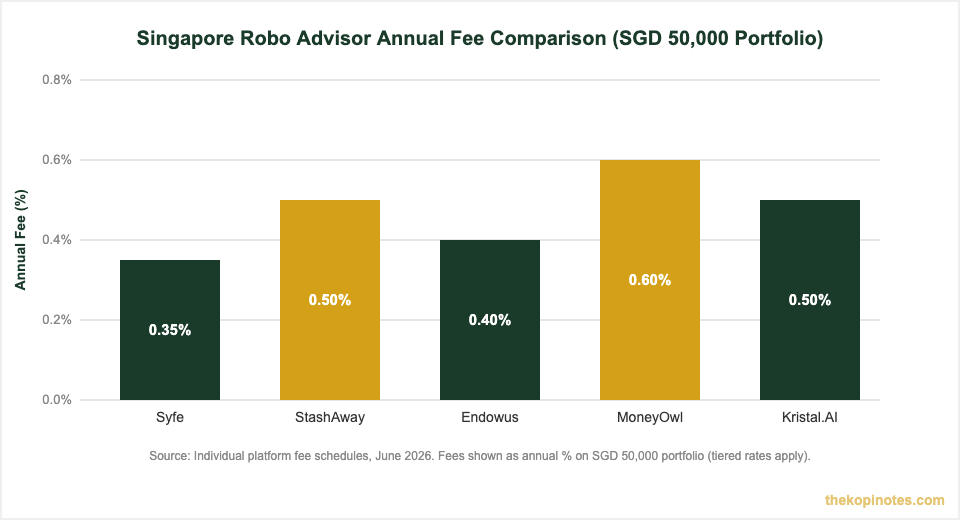
Comparing the Top Singapore Robo Advisors (2026)
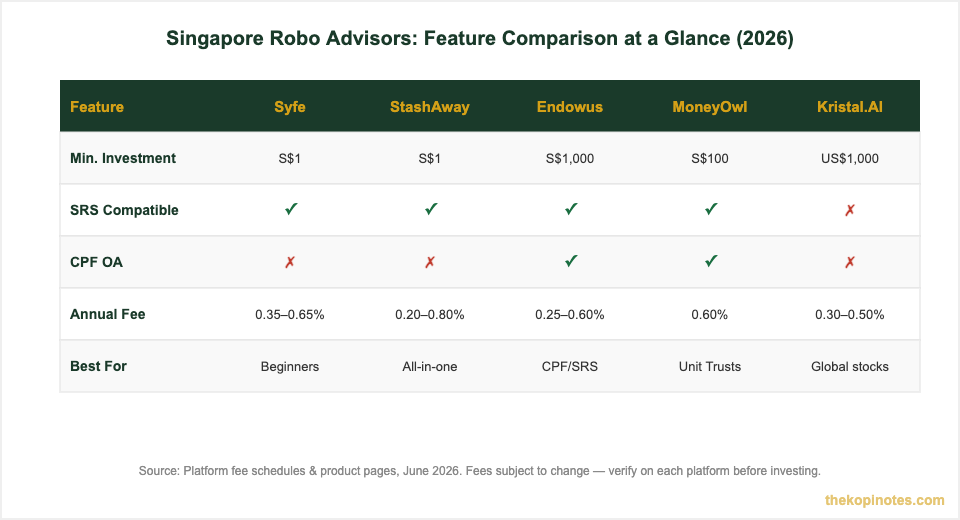
Here’s a side-by-side look at the four main platforms Singapore investors use. Each has a different sweet spot — understanding the difference is the key to picking the right one for your situation.
| Platform | Min. Investment | Annual Fee | SRS | CPF OA | Best For |
|---|---|---|---|---|---|
| Syfe | S$1 | 0.35–0.65% | ✓ | ✗ | Beginners, REIT portfolios |
| StashAway | S$1 | 0.20–0.80% | ✓ | ✗ | Goal-based investing, cash management |
| Endowus | S$1,000 | 0.25–0.60% | ✓ | ✓ | CPF OA investing, fund-based portfolios |
| MoneyOwl | S$100 | 0.60% | ✓ | ✓ | Unit trust investors, comprehensive planning |
| Kristal.AI | US$1,000 | 0.30–0.50% | ✗ | ✗ | Global stock portfolios, US market access |
Source: Individual platform fee schedules and product pages, June 2026. Fees are approximate — exact rates depend on portfolio size and products selected.
Syfe
Syfe launched in 2019 and has become one of the most popular robo advisors in Singapore, with over S$1 billion in assets under management. Its standout feature is the REIT+ portfolio — a diversified Singapore REIT allocation that’s unique among local robo advisors and popular among income-focused investors.
For beginners, Syfe’s Core portfolios (Global Equity, Balanced, Defensive) use iShares and Vanguard ETFs and are easy to understand. Annual fees range from 0.35% (for portfolios above S$100,000) to 0.65% (below S$20,000). You can also use your Syfe referral code to get a fee waiver for the first few months.
Syfe also offers a Cash+ product (a cash management account yielding around 3.5%+ p.a.) and a Syfe Trade brokerage for direct stock trading. This makes it a one-stop shop for many investors.
StashAway
StashAway is the pioneer — it was the first robo advisor to launch in Singapore in 2017. It uses a proprietary Economic Regime-based Asset Allocation (ERAA) framework, which adjusts your portfolio based on macroeconomic conditions (inflation, GDP growth). This is more active than Syfe’s straightforward passive ETF approach.
StashAway’s fees are tiered: 0.80% for portfolios under S$25,000, scaling down to 0.20% for portfolios above S$1 million. For a typical investor with S$20,000–S$50,000, you’ll pay around 0.50–0.80% per year — making it slightly pricier than Syfe at that range.
StashAway Simple (cash management) and StashAway Simple Plus are useful for parking emergency funds while earning competitive returns. The platform is well-suited for investors who want a more dynamic allocation rather than a pure buy-and-hold approach.
Endowus
Endowus is the only robo advisor in Singapore licensed as a full Financial Adviser — and this distinction matters enormously. It means Endowus can advise on and invest your CPF Ordinary Account (OA) and CPF Special Account (SA) funds, not just cash and SRS.
For a Singapore investor with S$50,000+ in CPF OA earning 2.5% p.a., the ability to invest that into a global equity portfolio targeting 6–8% long-term returns is significant. No other robo advisor offers this. You can explore this further through our Endowus referral code for a fee rebate on your first investment.
Endowus also stands out for its fund selection — it offers institutional share classes of funds from Dimensional, PIMCO, and Vanguard, with trailer fee rebates (fees kickbacks from fund managers returned to you). The S$1,000 minimum is higher than Syfe and StashAway, but for serious investors with larger portfolios, Endowus often delivers better net returns after fees.
MoneyOwl
MoneyOwl is a social enterprise backed by NTUC Enterprise. It offers a unique combination of robo investing and human financial planning. Every MoneyOwl client gets access to a salaried financial advisor (not commission-based), which is unusual in Singapore’s financial industry.
MoneyOwl invests in Dimensional Fund Advisors (DFA) funds — factor-based funds that target small-cap and value premiums. This is a more academically grounded approach than index-tracking ETFs, though it comes with a slightly higher expense ratio on the underlying funds. CPF-OA investing is available through MoneyOwl.
Fees Breakdown: What You Actually Pay
When you invest through a robo advisor, you pay two layers of fees: the platform’s management fee and the underlying fund’s expense ratio (TER — Total Expense Ratio). Here’s how they stack up for a S$50,000 portfolio:
| Platform | Platform Fee | Underlying Fund TER | Total Cost (est.) | Annual Cost on S$50k |
|---|---|---|---|---|
| Syfe Core (Equity) | 0.50% | 0.10–0.20% | ~0.65% | ~S$325 |
| StashAway (General) | 0.60% | 0.10–0.20% | ~0.75% | ~S$375 |
| Endowus (Advised) | 0.40% | 0.20–0.30% | ~0.65% | ~S$325 |
| Traditional Unit Trust | 0.50% + sales charge | 1.00–1.50% | ~1.75% | ~S$875 |
| DIY ETF via IBKR | S$0/year | 0.07–0.22% | ~0.15% | ~S$75 |
Source: Platform fee schedules and ETF factsheets, June 2026. Figures are estimates for illustration — actual fees depend on portfolio mix and size.
The takeaway: robo advisors cost roughly S$300–S$400 per year on a S$50,000 portfolio. That’s significantly less than a traditional financial advisor or unit trust platform. However, if you’re comfortable picking your own ETFs through a platform like Interactive Brokers, you can reduce costs to under S$100 per year — though you’ll need to handle rebalancing yourself. For most beginners, the convenience of a robo advisor is worth the extra S$200–S$300 per year, especially early on when you’re still learning.
To understand how your investment strategy fits into your broader CPF investment strategy, it’s worth reading our full guide before allocating a large sum through any platform.
SRS and CPF Compatibility
For Singapore investors, your SRS (Supplementary Retirement Scheme) account and CPF funds are powerful — but not all robo advisors can access them.
SRS compatibility is available across most platforms: Syfe, StashAway, Endowus, and MoneyOwl all allow you to invest your SRS balance. SRS contributions reduce your taxable income (up to S$15,300 per year for Singapore citizens and PRs), making it one of the best tax-planning tools available. Using a robo advisor to invest your SRS savings — rather than leaving them in the SRS account earning 0.05% — is a straightforward win.
CPF OA investing is only available through Endowus and MoneyOwl. Your CPF OA currently earns a guaranteed 2.5% p.a. Before investing it, consider carefully: you’ll be giving up a guaranteed return for a market-based one. That said, for investors with a long horizon (10+ years), a globally diversified equity portfolio has historically outperformed 2.5% significantly. Our Singapore retirement calculator can help you model this decision.
Also note: ETFs listed on the London Stock Exchange (LSE) — like CSPX and VWRA — are not CPF-investable. If you want to invest your CPF in equities, Endowus or MoneyOwl (through their approved fund list) is your route. You can also consider a regular savings plan Singapore approach for disciplined monthly investing.
Which Robo Advisor Should You Choose?
Here’s a simple decision framework based on your situation:
| Your Situation | Best Pick | Why |
|---|---|---|
| First-time investor, small amount | Syfe | S$1 minimum, simple interface, good ETF selection |
| Want to invest CPF OA | Endowus | Only fully licensed FA that can invest CPF OA & SA |
| Want goal-based investing (house, retirement) | StashAway | Best goal-setting tools and multi-portfolio management |
| Want human advisor + robo investing | MoneyOwl | Salaried (non-commission) advisors included |
| SRS investing + low fees | Endowus | Trailer fee rebates reduce net cost; wide fund selection |
| Want REIT exposure via robo | Syfe REIT+ | Only platform with a dedicated Singapore REIT portfolio |
| Confident DIY investor, lower fees | None — use IBKR | Buy CSPX or VWRA directly; ~0.07–0.15% TER only |
Source: The Kopi Notes analysis based on platform features and fee schedules, June 2026.
The most important thing is to start. The cost of inaction — leaving your savings in a bank account earning 0.05–0.10% — is far higher than the 0.5% robo advisor fee. If you’re comparing robo advisors to direct ETF investing, you can also read about passive income Singapore strategies that combine multiple approaches.
One more consideration: you don’t have to pick just one platform. Many Singapore investors use Syfe or StashAway for their cash savings, and Endowus specifically for their CPF OA and SRS. The platforms aren’t mutually exclusive.
Not financial advice. The figures above are for educational reference only and may change. Always verify directly with the platform before investing. Data as at June 2026.
Frequently Asked Questions
What is the best robo advisor in Singapore in 2026?
The best robo advisor depends on your goals. For beginners with cash savings, Syfe offers the simplest onboarding and a low S$1 minimum. For CPF OA investing, Endowus is the only fully licensed option. For goal-based investing with a dynamic allocation strategy, StashAway is a strong choice. If you want human financial planning bundled with robo investing, MoneyOwl is unique in offering salaried (non-commission) advisors. Most investors are best served by Syfe or Endowus — or both.
Is a robo advisor safe in Singapore?
Yes — all robo advisors operating in Singapore must be licensed by the Monetary Authority of Singapore (MAS). Your funds are held in a segregated custodian account, separate from the platform’s own assets. This means if the robo advisor platform shuts down, your investments are protected. The underlying ETFs and funds are also held in your name, not the platform’s. That said, your investments are still subject to market risk — the value can go up or down with markets.
Can I invest my CPF savings with a robo advisor?
Only Endowus and MoneyOwl are licensed to invest CPF Ordinary Account (OA) and Special Account (SA) funds. Syfe and StashAway only accept cash and SRS funds. CPF OA earns a guaranteed 2.5% p.a., so investing it through a robo advisor means accepting market risk in exchange for potentially higher long-term returns. This is generally suitable for investors with a 10+ year horizon who have adequate emergency savings and are comfortable with short-term portfolio volatility.
How much does a robo advisor cost in Singapore?
Singapore robo advisors charge annual management fees of 0.20%–0.80% depending on portfolio size and platform. On top of this, the underlying ETFs or funds have their own expense ratios (TER) of 0.07%–0.30%. Total annual cost for a typical S$50,000 portfolio is around 0.50%–0.80%, or roughly S$250–S$400 per year. This is significantly less than traditional unit trust platforms (which typically cost 1.5%–2.5% per year including sales charges) but higher than buying ETFs directly via a brokerage.
Can I use my SRS account with a robo advisor?
Yes. Syfe, StashAway, Endowus, and MoneyOwl all support SRS investing. Using your SRS account with a robo advisor is one of the most tax-efficient investing strategies available to Singapore residents. SRS contributions (up to S$15,300 per year for citizens and PRs) reduce your assessable income, and the funds can grow tax-deferred until withdrawal at retirement. Investing your SRS balance in a robo advisor — rather than leaving it earning 0.05% in the SRS bank account — is almost always the better financial move.
What is the minimum investment for Singapore robo advisors?
Syfe and StashAway both require just S$1 to get started, making them accessible to any investor. Endowus requires a minimum of S$1,000 for cash investing (lower minimums may apply for SRS and CPF). MoneyOwl requires S$100. Kristal.AI has a higher minimum of US$1,000. All platforms support regular monthly top-ups (as low as S$50–S$100 per month), making it easy to build up your portfolio incrementally through dollar-cost averaging.
Is it better to use a robo advisor or buy ETFs directly?
It depends on your confidence and time commitment. Buying ETFs directly through a broker like Interactive Brokers costs less in fees (roughly 0.07%–0.22% p.a. vs 0.50%–0.80% for a robo advisor) but requires you to choose your own ETFs, rebalance manually, and reinvest dividends yourself. For investors who want a fully hands-off experience, the extra 0.3%–0.5% per year a robo advisor charges is worth the simplicity. For investors comfortable with a buy-and-hold ETF strategy, direct investing through a broker is the more cost-efficient route.
Ready to Start Investing with a Robo Advisor?
Open an account today using our referral links for exclusive sign-up bonuses and fee rebates.
This article was researched with the help of AI. While we strive to keep all information accurate and up to date, there may be errors. If you notice any discrepancies, please contact us.