Regular Savings Plan Singapore 2026: Complete Guide (RSP Explained)
A beginner-friendly guide to regular savings plans in Singapore — how they work, which platforms offer them, and whether one suits your financial goals.
A regular savings plan (RSP) in Singapore is a service that automatically invests a fixed amount — typically S$50 to S$3,000 per month — into stocks, ETFs, or unit trusts on your behalf. Instead of timing the market, you invest the same dollar amount every month. When prices fall, you buy more units; when prices rise, you buy fewer. This is dollar-cost averaging (DCA), and it’s one of the most reliable ways for beginners to start investing in Singapore.
Not financial advice. All figures are for educational reference only. Data as at June 2026 unless noted.
- An RSP automatically invests a fixed monthly amount into stocks or ETFs — no timing the market required.
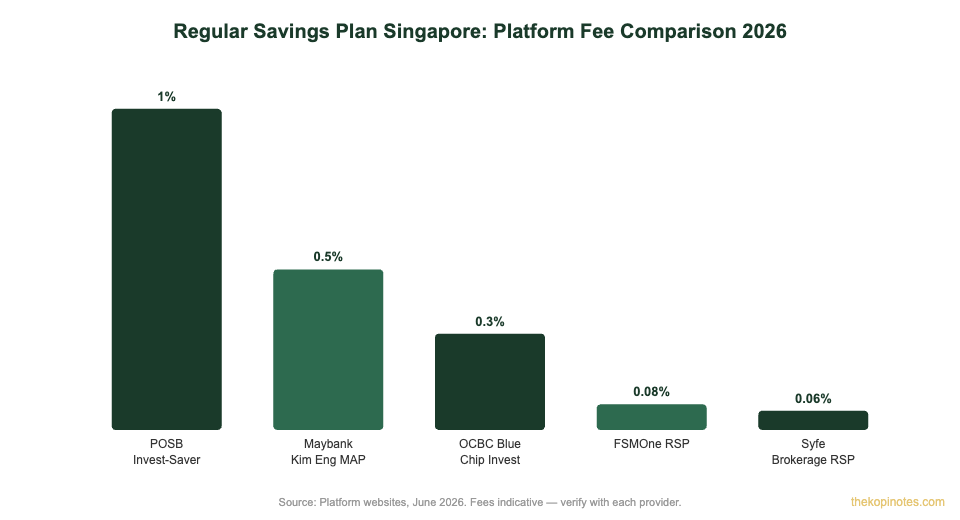
- FSMOne and Syfe Brokerage offer the lowest fees (0.06–0.08% per transaction); POSB Invest-Saver charges 1% but requires no brokerage account setup.
- RSPs are best for disciplined long-term investors who want to build wealth steadily without monitoring the market daily.
Table of Contents
What Is a Regular Savings Plan?
A regular savings plan (RSP) is a systematic investment programme offered by banks and online brokerages. You set a fixed monthly contribution — say S$200 — and the platform automatically buys units of your chosen stock, ETF, or fund on a fixed date each month.
The concept isn’t new. DBS, OCBC, and Maybank have offered RSP-style products for decades under names like “Blue Chip Investment Plan” and “Monthly Investment Plan”. What’s changed in recent years is that lower-cost digital platforms like FSMOne and Syfe Brokerage have introduced RSPs with dramatically lower fees — making the strategy genuinely viable for small monthly amounts.
There are no penalties for stopping an RSP, and most platforms let you adjust your monthly contribution or switch instruments at any time. Think of it as a standing order that builds your investment portfolio automatically.
How RSPs Work in Singapore
Here’s what happens each month when you have an RSP set up:
On your chosen deduction date (usually the 18th of the month), your bank or platform deducts the agreed amount from your account. The platform then purchases fractional or whole units of your chosen instrument at the prevailing market price. Your portfolio balance updates to reflect the new units added.
Most Singapore RSPs let you invest in:
- Local stocks — blue chips like DBS, OCBC, Singtel, and CapitaLand
- ETFs — including the Nikko AM Singapore STI ETF, Lion-Phillip S-REIT ETF, and ABF Singapore Bond Index Fund
- Unit trusts / funds — available on FSMOne and most bank-linked RSPs
Instruments available vary by platform. POSB Invest-Saver focuses on SGX-listed ETFs and blue-chip stocks. FSMOne offers access to thousands of unit trusts globally, plus SGX equities. Syfe Brokerage RSP lets you invest in SGX-listed stocks and ETFs with very low fees.
Best RSP Platforms in Singapore 2026
Here’s how the major RSP platforms in Singapore compare as at June 2026:
| Platform | Min Monthly | Fee per Transaction | Instruments | Best For |
|---|---|---|---|---|
| POSB Invest-Saver | S$100 | 1.0% | SGX ETFs, blue chips | DBS/POSB account holders — zero setup hassle |
| OCBC Blue Chip Investment Plan | S$100 | 0.30% | SGX blue chips, ETFs | OCBC customers wanting bank-integrated investing |
| Maybank Kim Eng MAP | S$100 | 0.50% | SGX stocks, ETFs | Maybank account holders |
| FSMOne RSP | S$50 | 0.08% (min S$1) | SGX stocks/ETFs, 1,000+ unit trusts | Lowest fees, widest fund universe |
| Syfe Brokerage RSP | S$50 | 0.06% | SGX stocks and ETFs | Cost-conscious investors wanting a clean mobile experience |
Source: Platform websites, June 2026. Fees may change — always verify before signing up.
If you already bank with DBS, POSB Invest-Saver is the path of least resistance — no new account to open. But at 1% per transaction, you’re paying S$10 per S$1,000 invested every month. Over a 10-year period, that fee drag is significant. For cost-conscious investors, the FSMOne referral code or Syfe referral code and sign-up bonus platforms offer a far better deal.
RSP Fees and Costs Compared
Fees matter enormously in a long-term RSP. Let’s look at a concrete example. Suppose you invest S$500 per month for 10 years — a total of S$60,000 contributed. How much do the different platform fees cost you in absolute terms?
| Platform | Fee Rate | Monthly Fee (S$500 contribution) | Total Fees Over 10 Years |
|---|---|---|---|
| POSB Invest-Saver | 1.00% | S$5.00 | S$600 |
| Maybank Kim Eng MAP | 0.50% | S$2.50 | S$300 |
| OCBC Blue Chip | 0.30% | S$1.50 | S$180 |
| FSMOne RSP | 0.08% (min S$1) | S$1.00 | S$120 |
| Syfe Brokerage RSP | 0.06% | S$0.30 | S$36 |
Calculated on S$500/month × 120 months. Syfe and FSMOne may have minimum fee floors — verify current fee schedules with each provider.
The difference between POSB Invest-Saver and Syfe Brokerage RSP over 10 years is S$564. That’s nearly six months of contributions lost to fees. For a 20-year RSP, the gap widens further. You can read more about choosing the right brokerage in our moomoo Singapore review.
Why Dollar-Cost Averaging Works
The biggest psychological challenge in investing isn’t picking the right stocks — it’s sticking to a plan when markets fall. An RSP forces discipline. You invest the same amount every month regardless of whether the market is up or down.
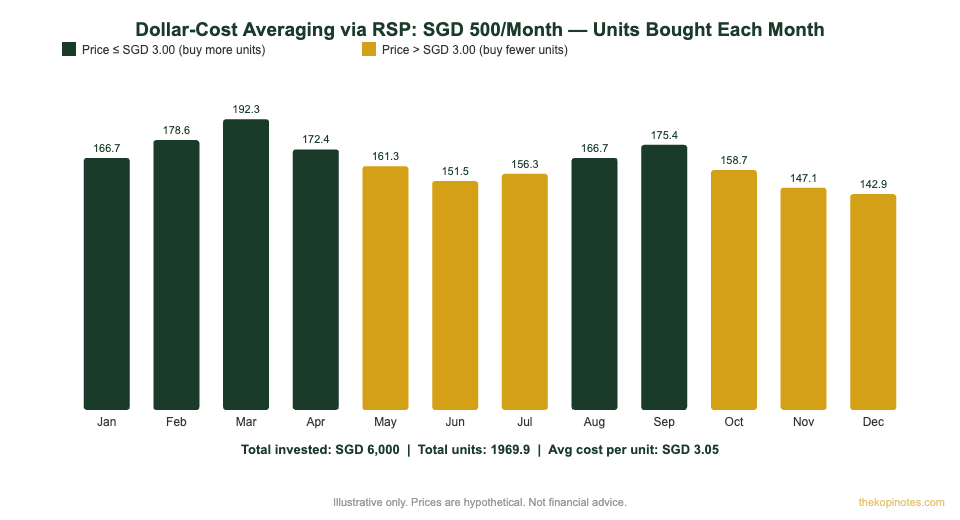
When prices are low, your fixed monthly contribution buys more units. When prices are high, it buys fewer. Over a market cycle, this averaging effect means your blended cost per unit tends to be lower than the average market price over that period.
In the DCA chart below, when the price falls to S$2.60 in March, the S$500 buys 192.3 units. When the price rises to S$3.50 in December, it buys only 142.9 units. The investor ends up with a blended average cost of approximately S$3.08 per unit — even though the average market price over the same period was higher. You benefit from buying more automatically when prices dip.
This benefit compounds over years. Singapore investors using an RSP to accumulate ETF units over a 10–20 year horizon tend to do well precisely because they are not tempted to time market pullbacks or sell during crashes. The RSP removes emotion from the equation.
RSP vs Lump Sum Investing
If you have a large sum to invest, you might wonder: is it better to invest it all at once (lump sum), or spread it out via an RSP? The honest answer is that lump-sum investing outperforms DCA about two-thirds of the time historically — because markets generally trend upward, so earlier entry is better on average.
However, most people don’t have S$30,000 sitting idle waiting to be invested. They earn a salary and save monthly. For this more common scenario, an RSP is the natural and correct approach. RSPs also outperform lump sum during periods of high volatility or at market peaks. If you invested a lump sum at the top of the market in late 2021 just before the 2022 correction, your DCA counterpart with a monthly RSP would have fared significantly better during that period.
For most Singaporean workers — who save from their monthly pay cheque — an RSP is simply the most practical investing vehicle available. It pairs well with a Singapore retirement calculator to project how your RSP contributions compound over time.
Can You Use CPF or SRS for an RSP?
Your Ordinary Account (OA) and Special Account (SA) monies under CPF can be used to invest in selected products under the CPF Investment Scheme (CPFIS). However, CPFIS does not support automatic monthly RSP deductions in the traditional sense. You can invest CPF OA funds manually into eligible stocks, unit trusts, and ETFs — but it isn’t an automated monthly arrangement.
SRS (Supplementary Retirement Scheme) funds are more flexible. You can top up your SRS account and use those funds to invest through eligible brokers, including FSMOne. Some brokers allow systematic investments from your SRS account, though mechanics vary by operator. Check with your SRS operator — DBS, OCBC, or UOB — for specifics.
Our CPF investment strategy Singapore guide covers how to integrate both CPF and SRS into your long-term investment plan. If you want a zero-risk complement to your RSP for your cash savings, the Singapore Savings Bonds guide is worth reading too.
Who Should Use an RSP?
An RSP is well-suited for you if you’re a beginner investor who wants to start without needing to time the market, you have a monthly surplus of S$50–S$1,000 you want to put to work, and you have a long time horizon of at least 5 years. RSPs are also ideal if you want a hands-off, automated investment system that doesn’t require daily monitoring, and if you’ve already built a 3–6 month emergency fund and are ready to invest the surplus.
An RSP may not be right for you if you have a large lump sum to invest (lump sum is likely more efficient), if you want exposure to international ETFs on the London Stock Exchange like VWRA or CSPX (most RSPs are limited to SGX-listed products), or if you have a very short investment horizon of under 3 years.
For investors who want international diversification alongside an RSP, combining a local RSP (e.g. Nikko AM STI ETF via FSMOne) with a separately managed position in a global ETF is a common strategy. Our passive income Singapore guide explores how to structure this hybrid approach. You can also compare syfe vs endowus 2026 to decide which robo-advisor to pair with your RSP. And for income-generating assets, check out our Singapore REIT ETF guide.
Not financial advice. All figures are for educational reference only. Consult a licensed financial adviser before making investment decisions. Data as at June 2026.
Frequently Asked Questions
What is a regular savings plan in Singapore?
A regular savings plan (RSP) in Singapore is a systematic investment programme that automatically deducts a fixed monthly amount from your bank account and uses it to purchase units of a chosen stock, ETF, or unit trust. Platforms like POSB Invest-Saver, FSMOne RSP, and Syfe Brokerage RSP offer this service. The key benefit is dollar-cost averaging — you buy more units when prices are low and fewer when prices are high, reducing your average cost per unit over time.
What is the minimum investment for an RSP in Singapore?
Most RSP platforms in Singapore allow you to start from as little as S$50 per month. FSMOne RSP and Syfe Brokerage RSP both accept S$50/month minimums. POSB Invest-Saver and OCBC Blue Chip Investment Plan require a minimum of S$100/month. There is generally no upper limit, though some platforms cap individual contributions at S$3,000 per instrument per month.
Which RSP platform has the lowest fees in Singapore?
As at June 2026, Syfe Brokerage RSP charges 0.06% per transaction — the lowest among major platforms. FSMOne RSP is a close second at 0.08% (minimum S$1). Bank-linked RSPs like POSB Invest-Saver (1.0%) and Maybank MAP (0.5%) charge considerably more. For long-term investors making S$500 monthly contributions, choosing FSMOne or Syfe over a bank RSP can save hundreds of dollars in fees over a decade.
Can I use CPF to invest via an RSP in Singapore?
CPF funds (OA and SA) can be used to invest under the CPF Investment Scheme (CPFIS), but CPFIS does not offer a formal automatic monthly RSP deduction. You would need to manually instruct each CPFIS investment. SRS funds are more flexible — you can top up your SRS account and invest from it through eligible platforms like FSMOne. Check with your SRS operator (DBS, OCBC, or UOB) for available options and setup steps.
Is an RSP better than a robo-advisor in Singapore?
RSPs and robo-advisors serve similar goals but differ in structure. An RSP through FSMOne or Syfe Brokerage gives you direct ownership of individual stocks or ETFs. A robo-advisor like Endowus or Syfe Core invests in a managed portfolio and charges a platform fee on top of underlying fund fees. RSPs are lower-cost if you’re comfortable choosing your own instrument. Robo-advisors are better if you want professional portfolio allocation and automatic rebalancing without making investment decisions yourself.
What happens if I miss a monthly RSP payment?
If your bank account has insufficient funds on the deduction date, most platforms will simply skip that month’s contribution without penalty. Some platforms may retry once later in the month. There are no account suspension or penalty fees for a missed month — your RSP continues from the next cycle. That said, consistency is the whole point of an RSP. If you’re regularly missing payments, consider lowering your monthly contribution to an amount you can reliably afford.
What stocks and ETFs can I buy via an RSP in Singapore?
Available instruments depend on the platform. Bank RSPs typically offer a shortlist of SGX blue chips (DBS, OCBC, SingTel, etc.) and SGX-listed ETFs like the Nikko AM Singapore STI ETF. FSMOne RSP has the widest selection — SGX stocks and ETFs plus over 1,000 unit trusts globally. Syfe Brokerage RSP focuses on SGX-listed stocks and ETFs. If you want exposure to global ETFs on the London Stock Exchange (like VWRA or CSPX), you’ll need a separate brokerage account with IBKR or Saxo Markets, as these aren’t available via Singapore RSP platforms.
Ready to Start Investing With an RSP?
Open a low-cost brokerage account and set up your first RSP today. Use our referral links for exclusive sign-up bonuses.
This article was researched with the help of AI. While we strive to keep all information accurate and up to date, there may be errors. If you notice any discrepancies, please contact us.