Endowus Fee Explained: The Full 2026 Breakdown
Every access fee tier, the GST you actually pay, real SGD worked examples, and how Endowus stacks up against Syfe and StashAway.
The Endowus fee is an all-in access fee of 0.15% to 0.60% a year, before 9% GST, depending on your account type and portfolio size. On a S$50,000 Flagship portfolio, that works out to roughly S$327 a year. You also pay a separate fund-level fee (0.05%-1%) that’s already built into each fund’s price, not billed to you directly.
Not financial advice. All figures are for educational reference only. Data verified as at 16 August 2026 against Endowus, Syfe and StashAway official pricing pages.
- Endowus charges 0.15%-0.60% a year depending on account type (Cash, CPF, SRS) and how much you invest — plus 9% GST on top.
- Bigger balances get cheaper tiers. Below S$200,000 in a Flagship, Income or ESG portfolio, you’re on the top rate of 0.60%.
- Syfe (0.65% entry tier) and StashAway (0.80% entry tier) both charge more than Endowus at the entry level in 2026.
Table of Contents
Contents — Click to expand
- What Is the Endowus Fee?
- Endowus Fee Tiers by Account Type
- GST and Your Real All-In Cost
- Fund-Level Fees (TER) — The Cost Endowus Doesn’t Bill You For
- How and When the Fee Is Charged
- Endowus vs Syfe vs StashAway Fee Comparison
- How to Lower Your Endowus Fee
- Who Should Pay Attention to This Fee?
- Frequently Asked Questions
What Is the Endowus Fee?
The Endowus Fee is the single, all-in charge you pay for using the Endowus platform. It’s not a “management fee” in the traditional sense — it covers investment advice, portfolio monitoring, automatic rebalancing, platform access, brokerage execution, and client support. There’s no separate sales charge and no transaction fee on top.
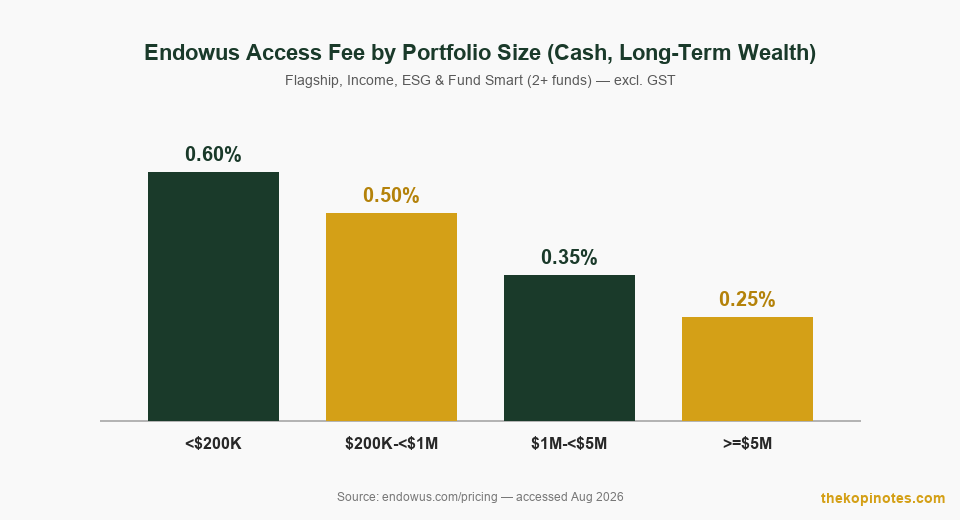
Endowus calls this an “access fee,” and it ranges from 0.15% to 0.60% a year depending on two things: which account you’re investing through (Cash, CPF, SRS, or Cash Smart) and how much you have invested. The more you invest, the lower your rate — Endowus uses a tiered structure, similar to how a phone bill gets cheaper per gigabyte the bigger your data plan is.
Here’s the part that trips people up: the headline rate you see on Endowus’s pricing page is before GST. You need to add 9% on top to get your real, all-in cost. We’ll walk through that in the next section.
Endowus Fee Tiers by Account Type
Endowus prices each account type separately — your Cash, CPF, and SRS balances don’t combine for tiering purposes, except within Cash itself, where your total Cash assets under advice (across advised portfolios and Fund Smart) determine your rate.
| Account / Portfolio Type | Tier | Annual Fee (excl. GST) |
|---|---|---|
| Cash — Flagship, Income, ESG, Fund Smart (2+ funds) | Below S$200,000 | 0.60% |
| S$200,000 – <S$1,000,000 | 0.50% | |
| S$1,000,000 – <S$5,000,000 | 0.35% | |
| S$5,000,000 and above | 0.25% | |
| Cash Smart / short-term cash (Cash) | Flat rate | 0.15% |
| CPF OA/SA & SRS — multi-fund (Flagship, Income, ESG, Fund Smart 2+ funds) | Flat rate | 0.40% |
| CPF OA/SA & SRS — single fund (Fund Smart, 1 fund) | Flat rate | 0.30% |
| Cash Smart / money market funds (SRS) | Flat rate | 0.15% |
Source: Endowus Pricing (endowus.com/pricing), accessed 16 August 2026.
A quick note on wording: Endowus uses “Cash” to mean money you invest from your bank account, separate from CPF or SRS savings. If you’re investing across multiple goals — say a Flagship portfolio and a few Fund Smart positions — they combine under Cash for tiering. Your CPF investment strategy is priced on its own, flat 0.40% or 0.30% rate, and doesn’t get cheaper just because your Cash balance grows.
GST and Your Real All-In Cost
Since 1 April 2023, the Endowus Fee has been subject to 9% GST. That means the percentage you see quoted — 0.60%, 0.40%, 0.15% and so on — isn’t your final cost. You need to add GST on top to know what actually leaves your account.
Here’s a real example. If you invest S$10,000 in a multi-fund Flagship portfolio at the top 0.60% tier, you’d pay S$60 a year in Endowus Fee, plus S$5.40 in GST — S$65.40 in total, or about S$5.45 a month.
Scale that up and the tiering matters more. A S$50,000 Flagship portfolio (still under the S$200,000 threshold) costs S$300 a year in fee plus S$27 GST, for S$327 total — about S$27.25 a month. Once your Cash balance crosses S$200,000, the rate drops to 0.50%, so a S$250,000 portfolio costs S$1,250 in fee plus S$112.50 GST, or S$1,362.50 a year.
| Portfolio Value | Tier | Fee (excl. GST) | All-In Cost (incl. 9% GST) |
|---|---|---|---|
| S$10,000 | 0.60% | S$60/yr | S$65.40/yr |
| S$50,000 | 0.60% | S$300/yr | S$327/yr |
| S$250,000 | 0.50% | S$1,250/yr | S$1,362.50/yr |
| S$1,500,000 | 0.35% | S$5,250/yr | S$5,722.50/yr |
Source: Endowus Pricing and Help Centre (help.endowus.com), accessed 16 August 2026. Assumes a single Flagship/Income/ESG portfolio, no other Cash holdings.
Fund-Level Fees (TER) — The Cost Endowus Doesn’t Bill You For
On top of the Endowus Fee, every fund you hold charges its own fund-level fee, known as the Total Expense Ratio (TER) — basically, what the fund manager (Dimensional, PIMCO, and similar firms) charges to run the fund. Endowus states this ranges from roughly 0.05% to 1% a year, depending on the fund.
You won’t see this as a separate deduction from your account. It’s already baked into the fund’s daily Net Asset Value (NAV), so performance figures you see are already net of this cost. For a Singapore investor, that’s actually a good thing — you don’t need to track two separate bills.
Endowus also negotiates access to institutional share classes, which typically charge lower TERs than the retail share classes you’d get buying the same fund directly. It also rebates 100% of any trailer fees (commissions fund managers pay distributors) back to you as cashback, which further lowers your effective fund-level cost.
Putting it together: for a S$50,000 Flagship portfolio, you might pay roughly S$327 a year in Endowus Fee (with GST) plus, say, S$100–150 a year in fund-level fees if your blended TER sits around 0.20%–0.30% — a rough illustration, since actual TER depends on which funds make up your specific portfolio. All-in, that’s an estimated 0.85%–0.95% a year, which is still well below the 1.5%–2% a year that Morningstar’s Global Investor Experience Study found is typical for traditional financial-advisor-sold funds in Singapore.
How and When the Fee Is Charged
Endowus calculates your fee daily, based on your average assets under advice, then bills it quarterly. You never get a surprise lump-sum invoice — it’s spread out and deducted automatically.
For Cash investments, Endowus first uses any available cash balance sitting in your UOB Kay Hian trust account. If that’s not enough to cover the bill, it redeems units from your investment holdings to make up the difference. For CPF and SRS accounts, the fee is deducted the same way — by redeeming a small amount from your holdings — since you can’t hold idle cash in those accounts the same way.
This “redeem to pay” mechanic means you don’t need to top up cash separately just to cover fees. It also means your invested amount ticks down slightly each quarter to cover the bill, which is worth remembering when you’re tracking your exact portfolio value.
Endowus vs Syfe vs StashAway Fee Comparison
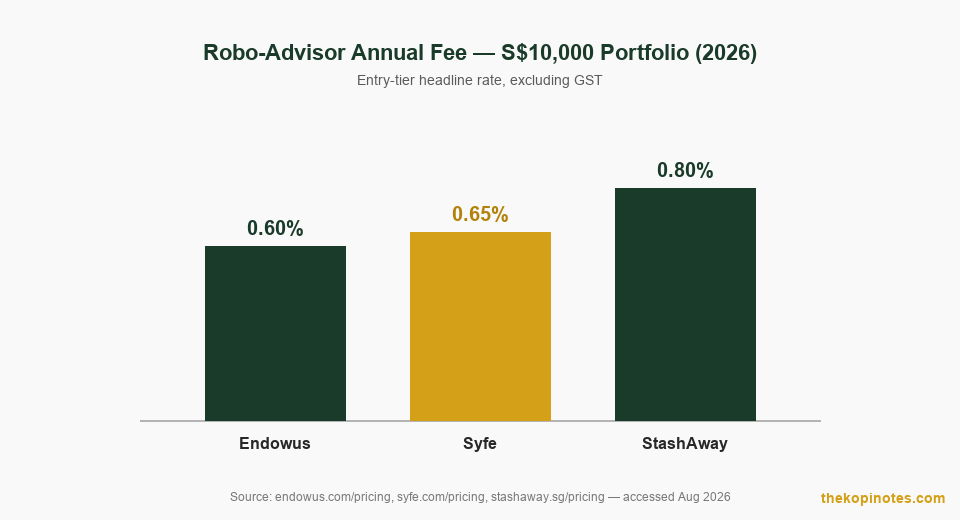
Endowus isn’t the only robo-advisor charging an all-in access fee in Singapore. Here’s how its 2026 pricing lines up against Syfe and StashAway, the two platforms Singaporeans compare it against most often.
| Platform | Entry-Tier Fee (excl. GST) | Cheapest Tier | Cash Management Fee | Fee Basis |
|---|---|---|---|---|
| Endowus | 0.60% (below S$200K) | 0.25% (S$5M+) | 0.15% (Cash Smart) | Total Cash AUA, combined across goals |
| Syfe | 0.65% (Blue, no min.) | 0.25% (Diamond, S$5M+) | 0.05%-0.15% (Cash+ Flexi SGD) | Total net worth or net invested, whichever is higher |
| StashAway | 0.80% (first S$25K) | 0.20% (above S$1M) | 0.15% (StashAway Simple) | Marginal — each additional slice priced separately |
Source: endowus.com/pricing, syfe.com/pricing (rates effective 1 January 2026), stashaway.sg/pricing — accessed 16 August 2026. All rates exclude GST unless stated. StashAway’s structure is marginal/bracketed, similar to income tax, so your blended rate falls between 0.20% and 0.80% depending on total invested.
The headline numbers tell part of the story. Endowus’s entry tier (0.60%) is cheaper than Syfe’s Blue tier (0.65%) and considerably cheaper than StashAway’s first bracket (0.80%). But StashAway’s structure is marginal, like income tax brackets — only the portion of your money above S$25,000 gets the lower 0.70% rate, and so on — so a large StashAway portfolio can end up with a lower blended rate than a small one. Syfe, meanwhile, upgrades your entire balance to a cheaper tier once you cross a threshold (S$50,000, S$250,000, S$1M, S$5M), which behaves more like Endowus’s own tiering.
For short-term cash parking, Syfe’s Cash+ Flexi (0.05%-0.15% depending on tier) and Endowus’s Cash Smart (flat 0.15%) are close, while StashAway Simple sits at 0.15% as well — all three are within a hair of each other for a plain cash management goal. Where Endowus tends to pull ahead is CPF and SRS investing, where its flat 0.40%/0.30% rate is simple to understand and doesn’t depend on how much cash you separately hold. If you’re weighing the two head-to-head for a full portfolio, our Syfe vs Endowus comparison breaks down performance and portfolio construction as well as fees.
How to Lower Your Endowus Fee
You don’t need S$5 million to pay less. A few practical moves can shift you into a cheaper tier or avoid paying the higher rate unnecessarily:
Consolidate your Cash goals. Because Endowus combines all your advised Cash portfolios and Fund Smart holdings for tiering, spreading money across many small separate goals doesn’t help — and won’t hurt either, since they’re pooled anyway. What matters is your total Cash AUA crossing the S$200,000 and S$1,000,000 thresholds.
Consider a single-fund Fund Smart position instead of a multi-fund advised portfolio if you’re comfortable picking your own funds. Fund Smart with one fund is priced at the lower of 0.30% or your applicable tier rate — often cheaper than the 0.60%-0.50% advised rate, though you give up automatic rebalancing and Endowus’s asset allocation advice.
For money you’ll need within a year, use Cash Smart rather than a general investing portfolio. At a flat 0.15%, it’s a quarter of the entry-tier rate, and it’s built for short holding periods anyway — Endowus explicitly says general investing portfolios are for money you can leave for 3+ years.
Finally, if you’re investing CPF or SRS money, remember the CPF/SRS rate (0.40% or 0.30%) is flat and doesn’t improve with a larger balance. There’s no fee benefit to combining CPF investing with a large Cash portfolio — they’re priced independently.
Who Should Pay Attention to This Fee?
The Endowus Fee matters most if you’re comparing platforms, sizing up whether a robo-advisor is worth it versus DIY investing, or trying to forecast your long-term net returns after costs.
It’s worth paying close attention if you’re sitting on a Cash balance close to a tier threshold (S$200,000 or S$1,000,000) — a modest top-up can tip you into a cheaper rate. It also matters if you’re deciding between an advised multi-fund portfolio and a single-fund Fund Smart position, since the fee gap (up to 0.30 percentage points) compounds meaningfully over 10-20 years.
It matters less if you’re parking money short-term in Cash Smart, where all three major platforms charge broadly similar low rates, or if you’re a beginner with under S$10,000 just getting started — the absolute dollar difference between 0.60% and 0.65% is small at that scale, and platform fit (app experience, portfolio options, CPF/SRS support) probably matters more than shaving a few basis points. If you’re brand new to the platform, our Endowus Singapore beginner guide covers account setup and portfolio choices in more depth. You can also use our Singapore retirement calculator to see how a fee difference of even 0.1-0.2 percentage points compounds over a multi-decade investing horizon.
Not financial advice. Fee rates, tiers and GST treatment are accurate as at 16 August 2026 based on each platform’s official pricing page, but are subject to change — always check the provider’s current pricing page before investing.
Frequently Asked Questions
What is the Endowus fee and how much does it cost?
The Endowus fee is an all-in access fee covering advice, rebalancing, platform access and support. It ranges from 0.15% to 0.60% a year before GST, depending on your account type (Cash, CPF, SRS or Cash Smart) and how much you’ve invested. Larger balances qualify for lower rates.
Is the Endowus fee charged before or after GST?
The quoted rate (e.g. 0.60%) is before GST. Endowus has charged 9% GST on top of the Endowus Fee since 1 April 2023. So a 0.60% headline rate works out to roughly 0.654% all-in — on S$10,000, that’s S$65.40 a year instead of S$60.
Do I still pay fund-level fees on top of the Endowus fee?
Yes. Every fund carries its own Total Expense Ratio (TER), typically 0.05%-1% a year, charged by the fund manager. You don’t see this as a separate deduction — it’s already reflected in the fund’s daily price (NAV), so performance figures you see are net of this cost.
Is Endowus cheaper than Syfe or StashAway?
At the entry level in 2026, Endowus (0.60%) is cheaper than Syfe’s Blue tier (0.65%) and StashAway’s first bracket (0.80%). At the top end, Endowus’s 0.25% (S$5M+) and Syfe’s 0.25% (Diamond, S$5M+) are roughly matched, while StashAway’s lowest marginal rate is 0.20% above S$1M. The cheapest platform for you depends on your balance and which tier structure benefits you.
Can I lower my Endowus fee without adding more money?
Yes, in a few ways: switch a multi-fund advised portfolio to a single-fund Fund Smart position (priced at the lower of 0.30% or your tier rate), move short-term cash into Cash Smart (flat 0.15%), or consolidate scattered Cash goals so your balance crosses a tier threshold sooner.
How and when does Endowus deduct the fee from my account?
Endowus calculates the fee daily based on your average assets under advice and bills it quarterly. For Cash accounts, it first uses any cash sitting in your UOB Kay Hian trust account, then redeems investment units if needed. CPF and SRS fees are deducted by redeeming units directly, since those accounts can’t hold idle cash the same way.
Ready to Start Investing With Endowus?
Open an account and see your exact fee tier before you commit. Use our referral links for sign-up perks.
This article was researched with the help of AI. While we strive to keep all information accurate and up to date, there may be errors. If you notice any discrepancies, please contact us.