What Is the Best Investment in Singapore?
2026 Complete Guide — Compare Every Option
The best investment in Singapore depends on your goals and timeline. For capital safety, CPF SA earns a guaranteed 4% p.a. and Singapore Savings Bonds average 2.11% over 10 years. For long-term growth, global ETFs like VWRA have historically delivered around 9-10% p.a. For passive income, S-REITs yield approximately 5.9% as of mid-2026. No single option wins for everyone — this guide helps you find yours.
Not financial advice. All figures are for educational reference only. Data verified as at 8 July 2026.
- CPF SA gives a guaranteed 4% p.a. — max it out before looking elsewhere
- For safe flexible cash parking, SSBs (2.11% 10Y avg) beat most bank deposits
- For 10+ year wealth building, low-cost global ETFs are hard to beat
How to Choose the Best Investment for You
Before comparing products, answer three questions honestly. Get these right and the best choice becomes clear.
1. What Is Your Time Horizon?
The biggest factor in choosing an investment is how long you can leave your money untouched. The longer your horizon, the more risk you can afford — and the more return you can capture.
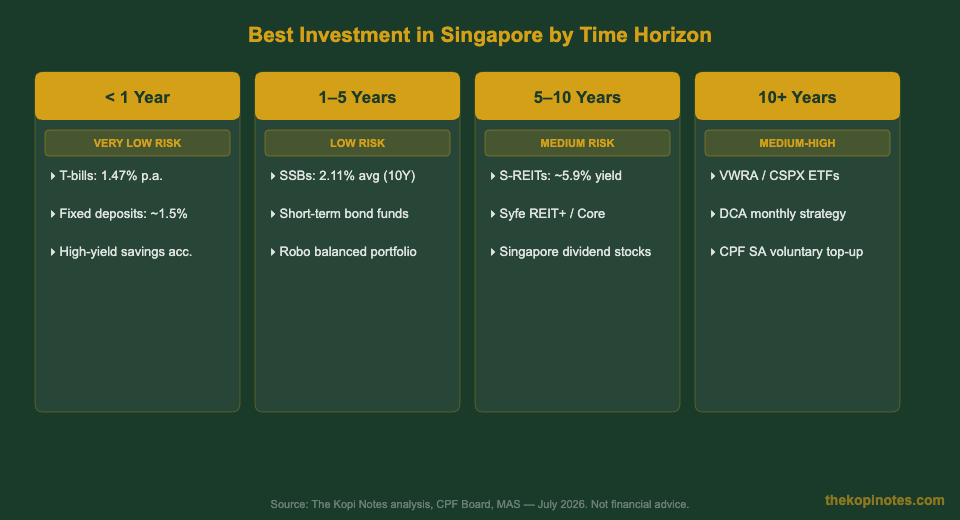
- Under 1 year — stick to capital-safe instruments: T-bills, fixed deposits, and SSBs.
- 1 to 5 years — add short-term bond funds or a balanced robo-advisor portfolio. Avoid heavy equity exposure.
- 5 years and above — equity risk makes sense. Global ETFs, REITs, and dividend stocks all fit here.
- Retirement horizon (20-30+ years) — maximise CPF voluntary top-ups first, then add global ETFs via DCA.
Why does time horizon matter so much? Equity markets can fall 30-50% in a bad year. Over 20 years, those dips recover and compound. Over 12 months, they can ruin your plan.
2. How Much Risk Can You Stomach?
Risk is not just about losing money in theory. It is about how you will actually behave when your portfolio drops 20% and the news says the world is ending. Be honest with yourself.
A simple test: if seeing your savings fall by $10,000 would stop you sleeping, keep the bulk in safe instruments. Build up equity exposure gradually — maybe $300-$500 a month — rather than going all-in at once.
3. What Are You Investing For?
- Emergency fund — not for investing. Keep 3-6 months of expenses in a high-yield savings account or SSBs.
- House downpayment in 5 years — SSBs or short-term bond funds. Capital preservation is the priority.
- Retirement in 20+ years — global ETFs with CPF voluntary top-ups and SRS contributions.
- Monthly passive income now — S-REITs and Singapore dividend stocks.
With those three questions answered, here is how each investment option stacks up in 2026.
Safest Investments in Singapore 2026
These options prioritise capital preservation. You will not generate outsized returns, but you will not lose your principal either.
CPF — The Best Risk-Free Return in Singapore
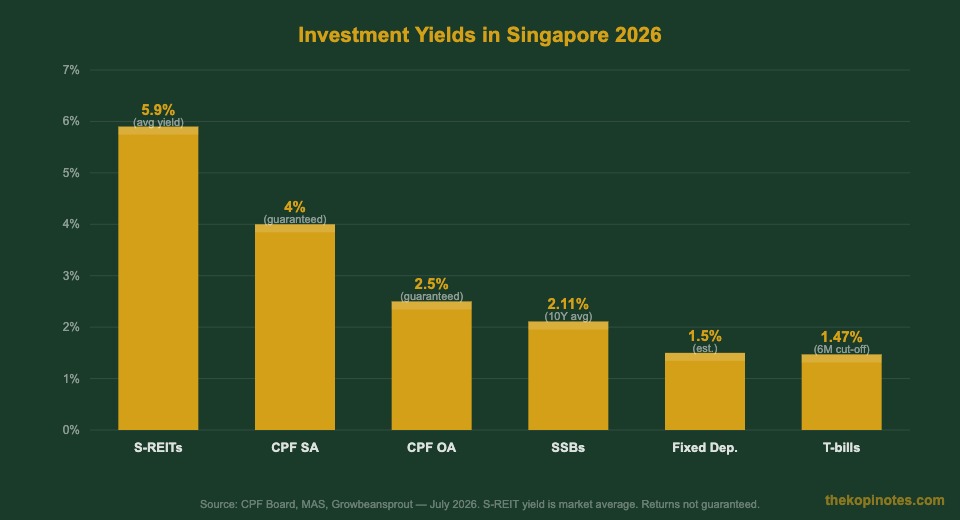
For Singapore citizens and Permanent Residents, CPF is the highest-returning risk-free investment available. Your Ordinary Account (OA) earns 2.5% p.a. and your Special Account (SA) earns 4% p.a. — both guaranteed by the Singapore Government with zero default risk.
The government extended the 4% floor rate on Special, MediSave, and Retirement Account balances until 31 December 2026. This guarantee is confirmed for the remainder of 2026 at minimum.
Floor rate extended to 31 December 2026 — Source: CPF Board
You can top up your SA via the Retirement Sum Topping-Up Scheme (RSTU) up to the prevailing Full Retirement Sum. Top-ups earn income tax relief of up to $8,000 per year for self-contributions, and another $8,000 when you top up a family member’s CPF. See our CPF investment strategy guide for the full step-by-step breakdown.
Singapore Savings Bonds (SSBs)
SSBs are issued by the Singapore Government and combine full capital safety with exceptional flexibility. The June 2026 tranche offers a 10-year average return of 2.11% p.a., with first-year interest around 1.46% stepping up over time as you hold longer.
The key advantage: you can redeem SSBs at the end of any month with no penalty whatsoever. This makes them ideal for parking money you might need within a few years, but want to earn more than a standard savings account. Minimum $500 per application. Maximum $200,000 per person across all SSB tranches. See our Singapore Savings Bonds guide for how the step-up interest mechanism works.
Treasury Bills (T-bills)
T-bills are short-dated Singapore Government securities issued in 6-month and 1-year tenors. The 6-month T-bill cut-off yield was 1.47% p.a. at the 18 June 2026 auction — down sharply from 3%+ at the start of 2026 as global interest rates declined. T-bills work best for investors who know exactly when they need the money back. Read the full Singapore T-bills 2026 guide for how to apply via CPF OA or cash.
Fixed Deposits
Most major Singapore banks are offering fixed deposit rates of around 1.3-1.5% p.a. for 6-12 month tenors as of mid-2026. SSBs and T-bills typically offer comparable or better rates with the same capital safety, so fixed deposits have become less competitive relative to 2023-2024. They remain useful for investors who prefer the simplicity of a bank relationship.
| Investment | Return (2026) | Min. Amount | Liquidity |
|---|---|---|---|
| CPF OA | 2.5% p.a. | Via payroll / voluntary | Restricted (retirement) |
| CPF SA | 4% p.a. | Via voluntary top-up | Restricted (retirement) |
| Singapore Savings Bonds | 2.11% avg (10Y) | $500 | Monthly, no penalty |
| T-bills (6M) | 1.47% p.a. | $1,000 | At maturity (6 months) |
| Fixed Deposit | 1.3-1.5% p.a. | $500-$10,000 (varies) | At maturity (penalty if early) |
Source: CPF Board, MAS — July 2026. CPF rates reviewed quarterly.
Best Investments for Long-Term Growth
If you have a 10-year or longer horizon and want to build real wealth, capital-safe instruments alone will not get you there. You need equity exposure. Here is where to look.
Global Index ETFs (VWRA, CSPX)
For most Singapore investors, low-cost globally diversified ETFs represent the best combination of accessibility and long-term expected return. Products like VWRA (Vanguard FTSE All-World, LSE-listed, accumulating) and CSPX (iShares Core S&P 500, LSE-listed) automatically track hundreds of the world’s largest companies.
The MSCI World Index has delivered roughly 9-10% p.a. in USD terms over rolling 20-year periods historically — though past returns are no guarantee of future results. Crucially, LSE-listed UCITS ETFs are safe from US estate tax for Singapore investors, unlike US-domiciled funds such as VOO or SPY. This matters if your portfolio ever exceeds USD 60,000 in US assets.
You can buy VWRA and CSPX via Syfe (managed ETF portfolios, no trading knowledge needed) or via Interactive Brokers (IBKR, use referral code jianxiong368) for direct market access with the lowest commissions.
Dollar Cost Averaging — The Strategy That Actually Works
The most effective strategy for most retail investors is simple: invest a fixed amount every month regardless of market conditions. This is dollar cost averaging (DCA).
If you put $500 into VWRA every month, you automatically buy more units when the price is low and fewer when it is high. Over 20 years, consistent DCA into a low-cost index ETF has historically outperformed most actively managed funds — without the stress of trying to time the market. You do not need to watch charts or read financial news. You just need to stick to the plan.
Singapore Stocks and the STI
The Straits Times Index (STI) covers Singapore’s 30 largest listed companies — DBS, OCBC, UOB, Singtel, CapitaLand, and others. You can invest in the STI via the Nikko AM STI ETF (ES3) or the SPDR STI ETF, both listed on SGX.
Singapore stocks skew more dividend-focused than growth-oriented compared to global markets. The STI makes a reasonable complement to a global ETF portfolio but not a full substitute for international diversification.
Best Investments for Passive Income in Singapore
If your goal is regular cash income rather than capital growth, Singapore offers some of the best income investment options in Asia.
Singapore REITs (S-REITs)
S-REITs are listed property trusts required by law to distribute at least 90% of their taxable income as dividends. The average S-REIT yield is approximately 5.9% p.a. as of June 2026 — far above bank deposits, SSBs, or government bonds.
Popular S-REITs include CapitaLand Integrated Commercial Trust (CICT), Mapletree Pan Asia Commercial Trust (MPACT), Parkway Life REIT (healthcare), and Frasers Centrepoint Trust (retail). Each covers a different sub-sector, giving you diversification across asset classes.
If you prefer not to pick individual REITs, the Syfe REIT+ portfolio tracks the iEdge S-REIT Index automatically. Use Syfe referral code SRPRFFFCD when signing up for a fee waiver. Read our Singapore REIT ETF guide for a comparison of REIT index products. For a broader passive income strategy, see our passive income Singapore 2026 guide.
Dividend Stocks
Singapore’s three major banks — DBS, OCBC, and UOB — have maintained consistent dividend payouts across economic cycles and are among Asia’s best-capitalised financial institutions. Beyond banks, SGX-listed blue chips such as Singtel and CapitaLand also pay regular dividends.
Singapore dividend stocks typically yield between 3-6% p.a., with dividends paid semi-annually or quarterly depending on the company. Unlike REITs, they are not required to distribute a fixed percentage of income, so dividends can vary with earnings.
| Investment | Typical Yield (2026) | Risk Level | Best For |
|---|---|---|---|
| S-REITs | ~5.9% p.a. | Medium | Quarterly income |
| Singapore blue-chip stocks | 3-6% p.a. | Medium | Growth and income |
| Global ETFs (VWRA/CSPX) | Low (accumulating) | Medium-High | Long-term capital growth |
| Singapore Savings Bonds | 2.11% avg (10Y) | Very Low | Safe income, capital protection |
Source: Growbeansprout, MAS — July 2026. Yields are estimates and not guaranteed.
Best Investing Platforms in Singapore
Choosing the right platform matters as much as choosing the right investment. Here is how the main options compare.
Interactive Brokers (IBKR)
IBKR is the preferred platform for investors buying LSE-listed ETFs directly. Trade commissions start at USD 1.70 per transaction, with access to 150+ markets globally. IBKR also pays interest on idle cash balances above a threshold. It suits experienced investors comfortable with a professional interface and those with larger sums (SGD 10,000+). Referral code: jianxiong368.
Syfe
Syfe is Singapore’s most widely used robo-advisor. Their Core portfolios invest automatically in globally diversified ETFs — no trading knowledge required. Annual management fees run 0.35-0.65% depending on portfolio size, with no per-trade commission. The REIT+ portfolio tracks the iEdge S-REIT Index for income-focused investors. Use Syfe referral code SRPRFFFCD for a fee waiver. See the latest offers on our Syfe referral code and sign-up bonus page.
Endowus
Endowus is the only Singapore platform that lets you invest CPF OA and SRS funds in globally diversified, low-cost fund portfolios alongside cash — making it essential for anyone wanting to put CPF OA to work beyond the default 2.5%. Use Endowus referral code 2V343 for $20 in access fee credits.
FSMOne
FSMOne offers access to unit trusts, ETFs, bonds, and SGX stocks under one platform — useful for investors who want a wide range of actively managed funds alongside index products. Use FSMOne referral code P0544985 for sign-up benefits.
Summary: Best Investment in Singapore by Goal
Use this table as a quick reference. Match your goal to the right instrument, then explore the linked guides for detailed steps.
| Your Goal | Best Option | Expected Return |
|---|---|---|
| Guaranteed safe return (citizens/PRs) | CPF SA voluntary top-up | 4% p.a. (guaranteed) |
| Flexible cash parking (up to 10 years) | Singapore Savings Bonds | 2.11% avg (10Y) |
| Short-term 6-month locked return | T-bills | 1.47% p.a. |
| Passive income now | S-REITs / Syfe REIT+ | ~5.9% avg dividend yield |
| Long-term wealth (10+ years) | Global ETFs (VWRA / CSPX) | ~9-10% historical p.a. (USD) |
| Hands-off investing | Robo-advisor (Syfe / Endowus) | Depends on portfolio |
| CPF OA or SRS investing | Endowus | Varies by portfolio |
Source: CPF Board, MAS, Growbeansprout — July 2026. Historical returns are not indicative of future results. Not financial advice.
The bottom line: there is no single best investment in Singapore. The right answer depends on your goals, timeline, and risk appetite. Maximise CPF SA first. Park medium-term cash in SSBs. Build long-term wealth with global ETFs via monthly DCA. Add REITs if you want passive income alongside growth. Use a robo-advisor if you want to keep things simple.
Frequently Asked Questions
What is the safest investment in Singapore?
What investment gives the highest return in Singapore?
Can foreigners invest in Singapore?
What is the minimum amount to start investing in Singapore?
Is CPF a good investment in Singapore?
What is the best investment for beginners in Singapore?
Should I invest in REITs or ETFs in Singapore?
This article was researched with the help of AI. While we strive to keep all information accurate and up to date, there may be errors. If you notice any discrepancies, please contact us.